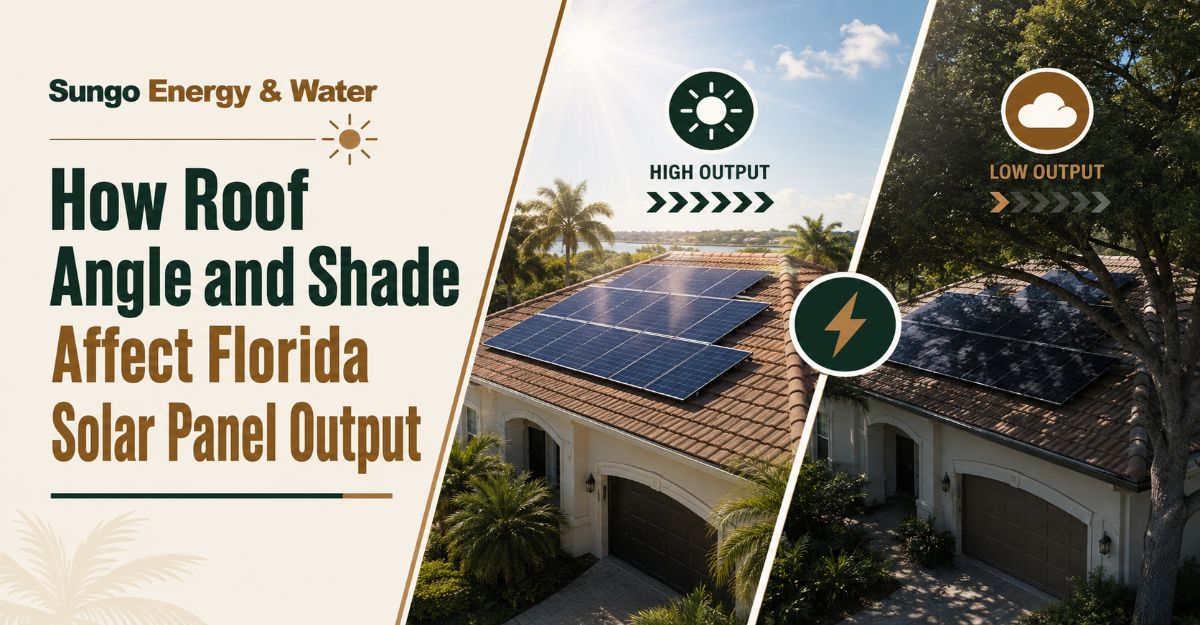
Roof angle and shade are the two primary environmental factors governing solar photovoltaic (PV) efficiency in Florida, directly determining a system’s return on investment. The angle dictates the geometric alignment required to maximize direct sunlight capture, while shade acts as a physical obstruction that chokes electrical current flow. Mastering both ensures maximum kilowatt-hour (kWh) generation.
Key Facts / At a Glance:
- Florida’s optimal year-round tilt angle ranges from 25° in South Florida to 28° in North Florida.
- True South (180°) is the optimal compass azimuth for maximum total annual energy production.
- Due to string wiring, shading just 10% of a solar array can slash total system output by 50% if unmitigated.
- Florida building codes require a minimum 10° tilt on flat roofs to ensure heavy rains can wash away pollen and debris naturally.
- Florida Statute 163.04 prohibits Homeowners Associations from blocking solar installations or enforcing modifications that reduce efficiency by more than 10%.
What Are the Optimal Solar Panel Angles for Florida?
Roof angle consists of two distinct measurements that filter the incoming energy from the sun: tilt (the vertical slope) and azimuth (the compass direction). Because Florida sits at a relatively low latitude—between roughly 24.5° N in Key West and 31° N in Pensacola—the geometric rules for maximum irradiance are highly specific to the region.
Tilt Angle Requirements
The Cosine Law of Irradiance dictates that solar panels capture the most energy when the sun’s rays strike the glass perpendicularly (at a 90° angle). If a roof tilts at a poor angle, a fixed percentage of potential energy bounces off the glass, creating an instant efficiency loss known as cosine error.
To minimize this error year-round in Florida, the ideal panel tilt should roughly match the local latitude. This puts the optimal tilt between 25° and 28°. Flat roofs (0°) suffer a 10% to 12% baseline efficiency penalty and require mechanical racking systems to achieve an appropriate angle.
Azimuth (Compass Direction) Strategies
A roof facing 180° True South will yield the highest total annual kWh output in the northern hemisphere. However, 270° West-facing arrays offer a highly strategic alternative for Florida homeowners. While a West-facing roof generates 10% to 15% less total annual energy than a South-facing one, it shifts peak production to the 2:00 PM – 6:00 PM window. This directly neutralizes the massive air conditioning loads of a Florida afternoon and maximizes ROI for homeowners subjected to Time-of-Use (TOU) utility rates.
How Does Shade Actually Reduce Solar Output?
Shade does not just dim a solar panel; it physically restricts the movement of electricity. Solar panels generate power via the photovoltaic effect, where silicon cells absorb unblocked photons to free electrons, creating Direct Current (DC). When a shadow falls on a cell, it stops generating power and instead becomes a resistor, burning up the power generated by unshaded cells as heat.
The Series String Bottleneck
Solar cells are wired together in series inside a module, and the modules are linked in series strings across the roof. Think of a series string like a water hose. Blocking light to a single cell is exactly like stepping on that hose. It restricts the current (Amperage) flow through the entire string. Without modern mitigation hardware, a shadow from a single chimney covering one panel can drag the production of 10 neighboring panels down to near zero.
Shade Management Technologies Compared
To mitigate shading from Florida’s dense tree canopies or low-hanging winter clouds, modern systems utilize different inverter topologies to bypass obstructions.
| Inverter Technology | Mechanism | Cost Premium | Best Suited For | Winner / Verdict |
| Standard String Inverter | Links panels in a single series loop. Shade on one affects all. | Baseline Cost | Entirely unshaded, wide-open roofs facing South. | Loser for shaded properties; strictly for perfect roofs. |
| Microinverters | A small inverter mounts under every individual panel, isolating output. | $2,000 – $4,000 | Heavily wooded lots; roofs with multiple angles and dormers. | Winner for complex shade; zero impact on neighboring panels. |
| DC Power Optimizers | Pairs module-level trackers with a central string inverter to bypass shade. | $1,500 – $2,500 | Suburban roofs with intermittent, predictable shade (e.g., a single chimney). | Winner for value; balances shade mitigation with lower costs. |
How Much Does Florida Weather Alter Standard Guidelines?
Standard national solar advice frequently fails in Florida due to aggressive local environmental factors. From extreme humidity to tropical cyclones, system design must adapt to survive.
The Pollen Shield Effect
A common mistake in commercial and flat-roof residential projects is installing panels completely flat (0°) to avoid the $1,500 to $3,500 cost of tilt racking. In early spring, Florida’s massive oak pollen drops combine with heavy morning dew to bake a thick, yellow crust onto flat glass. This “pollen shield” can throttle output by over 20%. A minimum 10° shedding angle is mandatory in Florida to allow heavy afternoon thunderstorms to naturally squeegee the panels clean.
Hurricane Wind Loads vs. Angle Optimization
While 25° to 28° is optimal for energy production, high-tilt racking systems act like sails during a Category 4 hurricane. Florida building codes enforce strict wind-load engineering constraints. In coastal High Velocity Hurricane Zones (HVHZ) like Miami-Dade, engineers frequently cap panel tilt at 10° to 15° on flat roofs. The slight loss in solar efficiency is a required trade-off to ensure the array does not generate catastrophic uplift forces during a 150 mph wind event.
What Are the Best System Configurations by Roof Type?
System architecture must match the physical reality of the property. Forcing the wrong hardware onto a complicated roof guarantees a poor financial return.
- The Suburban “Optimal” Roof: If you have an unshaded, South-facing gabled roof with a 20° to 30° pitch, keep it simple. Deploy standard monocrystalline panels using a cost-efficient string inverter paired with DC optimizers. This yields the lowest cost per watt and the fastest payback period.
- The Wooded / Shaded Property: If you have mature Live Oaks or Slash Pines casting rolling shadows, Microinverters (like the Enphase IQ8 series) are non-negotiable. You must also budget for tree canopy thinning every three years, as Florida pines can grow 2 to 3 feet annually, rapidly altering your shade profile.
- The Modern Flat-Roof: For concrete or membrane flat roofs typical of coastal architecture, mandate a 10° to 15° tilted ballasted racking system. This balances hurricane wind-load safety with essential drainage, preventing dirt pooling and cosine reflection losses.
How Do You Troubleshoot Low Solar Output?
A sudden or gradual drop in kWh production usually points directly to an angle, shade, or hardware failure.
- Check the System App for Single-Module Drops: If your monitoring app shows one panel producing 80% less than its neighbor at 3:00 PM, look at your roof. A structural element (a vent pipe or neighboring roof peak) is likely casting a hard shadow. If there is no shadow, a DC optimizer or microinverter has failed.
- Look for Gradual Systemic Declines: If output drops slowly across the entire array over 3 to 6 months, visual inspection is required. Pollen, construction dust, or salt-spray buildup is the likely culprit.
- Perform Safe Maintenance: Gently spray the panels with water from a ground-level hose early in the morning. Never spray cold water onto boiling hot solar glass in the middle of a midday Florida sun; the thermal shock can shatter the panels instantly.
- Audit the Winter Sun Path: If your system produces perfectly in June but crashes in December, you are victim to the seasonal sun path. The sun drops lower in the southern sky during winter, causing previously harmless trees to suddenly cast long, restrictive shadows across the array.
Frequently Asked Questions
Can my HOA stop me from installing panels on my street-facing roof?
No. Florida Statute 163.04 protects solar rights. While an HOA can request aesthetic modifications, they cannot legally forbid the installation or force you to move the panels to a shaded, less efficient roof plane if it reduces system output by more than 10%.
Is it worth cutting down trees to improve my solar angle?
Generally, yes, if the tree casts hard shadows on a South or West-facing roof during peak hours (10:00 AM to 3:00 PM). A detailed solar shade analysis (often bundled in site assessments for under $250) will quantify the exact financial loss caused by the tree, making the ROI of removal easy to calculate.
How does a 10% shade blockage affect a string inverter system?
Because standard string inverters wire panels in a continuous series loop, the entire string can only operate as fast as its weakest link. Shading just 10% of one panel drops the electrical current for the entire circuit, potentially slashing total system power output by 50% or more.
Do solar panels produce power on cloudy Florida days?
Yes, but at a reduced capacity. Panels generate electricity from ambient irradiance, not just direct sunlight. During a heavy, overcast Florida summer storm, output will drop by 60% to 80%, but it rarely stops completely unless the cloud cover is exceptionally dark.