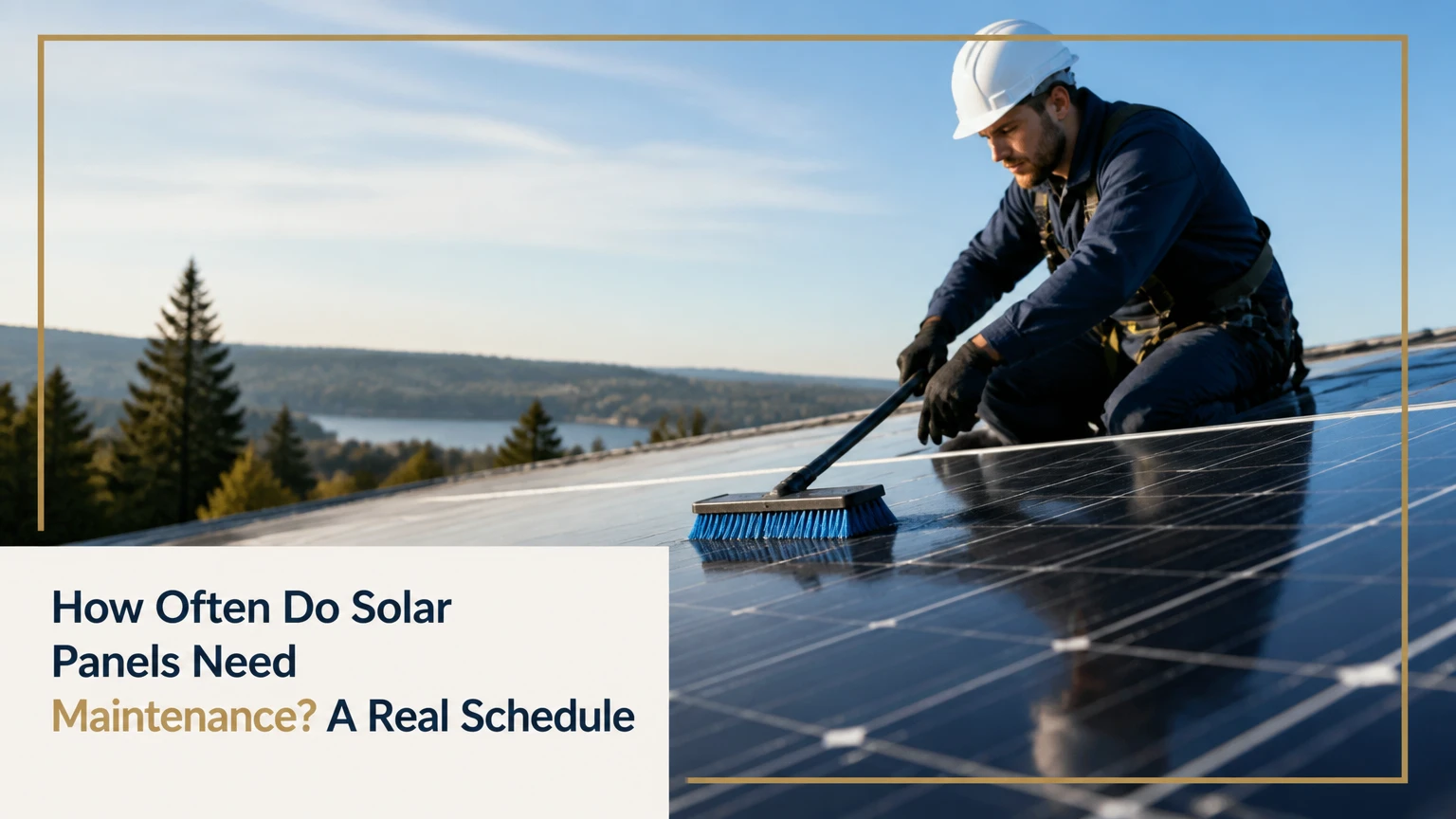
Solar panels typically need a professional inspection once per year, while cleaning is usually needed once or twice yearly only when local soiling reduces output. Most grid-connected systems require continuous monitoring, annual visual checks, and condition-based electrical service rather than frequent mechanical maintenance.
Key Facts at a Glance
- A residential photovoltaic system usually receives a professional inspection every 12 months.
- Panel cleaning commonly occurs once yearly, twice yearly in dusty or pollen-heavy locations, and less often where rainfall keeps modules clean.
- Digital monitoring should run continuously because sudden output loss can indicate an inverter, wiring, breaker, or communications fault.
- Solar panels have few moving parts, but inverters, connectors, wiring, roof penetrations, and mounting hardware still require inspection.
- Typical residential cleaning costs $150-$300 per visit, while a broader inspection commonly costs $250-$500.
- Homeowners should not open energized equipment, disconnect live conductors, walk on modules, or climb a roof without suitable fall protection.
How Often Do Solar Panels Need Maintenance?
Solar panels need maintenance at different intervals because cleaning, visual inspection, electrical testing, and inverter service address different risks. For a typical grid-connected home, review system performance monthly, inspect accessible equipment every few months, arrange professional service annually, and schedule deeper electrical diagnostics every two to three years or after a fault.
The correct frequency depends more on exposure than on the panel brand. A steep array in a rainy suburban area may remain productive with one annual inspection and occasional cleaning, while a shallow array near farmland, a gravel road, trees, or a coastline may need cleaning several times per year. Rain removes loose dust but often leaves mineral deposits, pollen films, and bird droppings.
Solar panel maintenance is therefore a condition-based program. The best trigger is a persistent production decline compared with the system’s historical output after accounting for irradiance, temperature, shading, and seasonal daylight.
Recommended maintenance schedule
| Maintenance task | Typical interval | Main purpose | Homeowner action |
|---|---|---|---|
| Monitoring-app review | Weekly to monthly | Detect abnormal production | Compare current output with prior weather-adjusted performance |
| Accessible visual check | Every 3-6 months | Find debris, pests, and visible damage | Inspect from ground level without touching wiring |
| Professional inspection | Every 12 months | Check structure and electrical safety | Hire a qualified solar or electrical contractor |
| Panel cleaning | Every 6-24 months | Remove output-blocking deposits | Clean only when soiling is measurable or visible |
| Thermal or string diagnostics | Every 2-3 years | Find hidden hotspots and weak circuits | Use a qualified technician |
| Inverter service | Annually, plus manufacturer interval | Check cooling, errors, and connections | Keep vents clear and record error codes |
| Roof and flashing inspection | Every 1-2 years | Detect leaks and seal failures | Coordinate with a roofing professional |
Why Do Solar Panels Need Maintenance?
Solar panels need maintenance because sunlight passes through the module glass, and dust, pollen, ash, leaves, and bird droppings can reduce the light reaching the photovoltaic cells. Electrical and structural components also age through heat cycles, ultraviolet exposure, moisture, vibration, rodents, and wind movement.
A solar array has no engine, belts, or lubricated bearings, so its maintenance burden is lower than that of a generator or combustion appliance. The inverter remains an active power-electronics device, however, and connectors, cable insulation, junction boxes, racking bolts, roof attachments, and monitoring hardware can fail independently of the modules.
The maintenance objective is not to make panels look clean. The objective is to preserve safe electrical operation and identify a loss of production before it becomes an expensive repair. The U.S. Department of Energy’s consumer guidance describes solar photovoltaic systems as generally low-maintenance, but low maintenance does not mean zero inspection.
What can deteriorate?
| Component | Common stressor | Observable symptom | Typical response |
|---|---|---|---|
| Module glass and cells | Hail, thermal cycling, impact | Cracks, hotspot, lower string output | Professional module testing |
| DC wiring | UV, rodents, abrasion | Ground-fault alarm or exposed conductor | Isolate and repair by qualified personnel |
| MC4-type connectors | Moisture, poor assembly, heat | Intermittent output or melted connector | Connector replacement and test |
| Inverter | Heat, dust, capacitor aging | Error code, fan noise, derating | Vent cleaning or service assessment |
| Racking | Wind, corrosion, loose fasteners | Movement, rust, misalignment | Torque and corrosion inspection |
| Roof penetrations | Seal aging, installation defects | Water stains or attic leakage | Roofing inspection and resealing |
How Often Should Panels Be Cleaned?
Solar panels should be cleaned when visible soiling causes a sustained production loss, not automatically every month. Once per year is a practical starting point for many homes, twice per year is more appropriate near farms, construction sites, deserts, wildfire zones, or heavy pollen, and some rainy locations may need cleaning only every 18-24 months.
The financial case for cleaning depends on the value of recovered electricity. If a 6-kilowatt system produces 7,500 kilowatt-hours annually, a 5% recoverable loss equals about 375 kilowatt-hours. At $0.20 per kilowatt-hour, that recovered energy is worth approximately $75 before considering export rates, incentives, or self-consumption. A $200 cleaning may not pay for itself in that scenario unless cleaning also protects access, appearance, or warranty documentation.
Energy Matters identifies dirt, bird droppings, tree sap, and environmental conditions as major factors in solar cleaning cost and frequency. Aurora Solar likewise recommends evaluating whether cleaning produces enough additional energy to justify the service.
Cleaning triggers by environment
| Site condition | Typical cleaning interval | Main contaminant | Practical trigger |
|---|---|---|---|
| Rainy suburban roof | 12-24 months | Pollen and bird droppings | Visible patches or 5%+ sustained loss |
| Dry urban area | 6-12 months | Road dust and soot | Dust film after several dry weeks |
| Agricultural property | 3-6 months | Soil, fertilizer, pollen | Seasonal field activity or output decline |
| Desert or gravel-road site | 1-3 months | Fine mineral dust | Frequent opaque coating and reduced yield |
| Coastal property | 6-12 months | Salt aerosol and dust | Hazy film, corrosion, salt residue |
| Snow-prone location | Condition-based | Snow and ice | Persistent snow layer or unsafe accumulation |
Does Rain Clean Solar Panels?
Rain removes loose dust from solar panels but does not reliably remove oily pollution, dried bird droppings, pollen, tree sap, or mineral deposits. A steep panel may receive useful natural rinsing, while a shallow roof can retain dirty runoff along its lower frame.
Rain also creates a misleading visual result. A module can look clean from the ground while a narrow strip of residue remains across the lower edge, where repeated water evaporation concentrates minerals. That strip may affect only a small area, but bird droppings can shade several cells and create localized heating.
Do not schedule cleaning solely because a calendar date has arrived. Compare production against the same season in prior years, inspect the array from the ground, and clean when the expected recovered value exceeds the service cost.
What Does a Professional Solar Inspection Include?
A professional solar inspection usually includes a visual module check, racking and roof-attachment review, inverter and disconnect inspection, monitoring verification, and electrical measurements appropriate to the system design. A more detailed service may add string testing, insulation resistance testing, thermal imaging, connector checks, and torque verification.
The technician should provide a written record containing inspection date, system size, inverter model, observed faults, production concerns, photographs, and recommended repairs. A generic statement that the system “looks fine” has limited value for warranty claims or future troubleshooting.
Thermal imaging is useful for finding hotspots, bypass-diode problems, loose connections, and uneven module performance, but an infrared image alone does not prove a failed panel. Wind, cloud cover, load conditions, irradiance, and camera calibration affect interpretation.
The International Energy Agency Photovoltaic Power Systems Programme has documented the value of operations and maintenance practices for detecting faults and preserving system performance, while field studies have associated thermal and electrical diagnostics with fault identification.
Inspection levels and timing
| Service level | Typical interval | Typical cost | Included checks |
|---|---|---|---|
| Visual service | 12 months | $150-$300 | Modules, cables, racking, inverter exterior |
| Clean and inspect | 12-24 months | $250-$500 | Visual inspection plus low-pressure cleaning |
| Electrical diagnostic | 24-36 months | $300-$700 | Voltage, current, insulation, grounding checks |
| Thermal survey | 24-36 months | $250-$800 | Infrared scan and fault report |
| Repair visit | As needed | $150-$1,000+ | Connector, wiring, breaker, or monitoring repair |
Prices are typical U.S. residential ranges, not guaranteed market rates. Roof height, array access, travel distance, local labor rates, system size, and battery equipment can change the invoice substantially.
How Long Do Solar Panels and Inverters Last?
Solar modules commonly carry performance warranties extending 25-30 years, but a warranty period is not the same as a guaranteed original output. Many manufacturers specify a first-year loss followed by annual degradation, often resulting in roughly 80-90% of rated starting output near the end of the warranty period.
The inverter generally has a shorter service life than the modules. String inverters often last about 10-15 years, while microinverters may have longer manufacturer warranty coverage but remain exposed to heat and rooftop conditions. Replacement cost depends on system size, labor, permitting, and whether the equipment remains available.
Maintenance cannot stop normal semiconductor aging. It can reduce avoidable losses caused by shading, failed cooling, loose connectors, corrosion, animal damage, and unnoticed inverter faults.
Component life and maintenance implications
| Component | Typical service life | Warranty pattern | Maintenance implication |
|---|---|---|---|
| Monocrystalline module | 25-35 years | 25-30-year performance warranty | Monitor degradation and physical damage |
| String inverter | 10-15 years | Commonly 5-12 years | Budget for mid-life replacement |
| Microinverter | 15-25 years typical | Often 10-25 years | Diagnose module-level faults |
| Aluminum racking | 25-40 years | Varies by manufacturer | Check corrosion and fasteners |
| Battery storage system | 8-15 years typical | Capacity and cycle limits | Inspect terminals, temperature, and alerts |
| Monitoring gateway | 5-15 years | Product-specific | Maintain connectivity and firmware |
Solar Panels Ireland describes routine inspection and cleaning as part of long-term photovoltaic system care, while lifespan guidance from Convert Solar distinguishes panel longevity from the shorter expected life of inverters.
DIY or Professional Maintenance: Which Is Safer?
DIY maintenance is reasonable for monitoring, ground-level observation, removing loose debris with a roof-safe tool, and recording visible changes. Professional service is the safer choice for roof access, electrical tests, inverter opening, damaged wiring, battery systems, thermal imaging, and any fault involving energized conductors.
Solar modules can generate voltage whenever light reaches them, even after a system appears switched off. Rapid shutdown and disconnect procedures reduce risk but do not turn every conductor into a harmless surface. Local electrical rules and the equipment manufacturer’s shutdown sequence control the work.
DIY and professional comparison
| Activity | DIY suitability | Typical risk | Professional advantage |
|---|---|---|---|
| Monitoring review | Suitable | Low | Trend analysis and alert configuration |
| Ground-level visual inspection | Suitable | Low | Documented condition report |
| Roof washing | Limited | Fall and glass damage | Fall protection and correct equipment |
| Inverter error recording | Suitable | Low if unopened | Fault-code interpretation |
| DC voltage testing | Not recommended | Shock and arc risk | Calibrated meters and isolation procedure |
| Thermal imaging | Limited | Misdiagnosis | Trained interpretation and report |
| Battery inspection | Limited | High-current short circuit | Electrical safety and terminal testing |
| Connector or cable repair | No | Fire and shock risk | Correct parts, crimping, and test results |
A practitioner rule is simple: homeowners can observe system behavior, but they should not diagnose energized electrical faults by trial and error. A monitoring screenshot, inverter code, and date-stamped production history give a technician useful evidence without exposing the homeowner to unnecessary risk.
What Are the Most Common Solar Maintenance Mistakes?
The most common maintenance mistakes are pressure washing, using abrasive or harsh chemicals, cleaning hot glass with cold water, walking on modules, and ignoring inverter ventilation. These actions can create scratches, thermal stress, broken seals, micro-cracks, or overheating that costs more than routine service.
Use clean water and a soft, non-abrasive brush or a professional water-fed system when the equipment manufacturer permits wet cleaning. Avoid household detergents unless the manufacturer specifically approves them, because residue can alter surface wetting and attract more dirt.
Aurora Solar advises against abrasive cleaning methods and recommends checking whether panels actually need cleaning before paying for service. A cleaning company should also carry appropriate liability insurance and explain how it protects roof surfaces and module warranties.
Mistakes and corrections
| Mistake | Likely consequence | Corrective action |
|---|---|---|
| Pressure washer on modules | Seal or glass damage | Stop immediately and arrange inspection |
| Steel wool or abrasive pad | Permanent surface scratches | Do not polish; assess output and warranty |
| Cold water on sun-heated glass | Thermal stress or cracking | Clean during cool, low-light conditions |
| Walking on panels | Micro-cracks and hotspot risk | Use designated roof access paths |
| Unapproved soap | Film and residue | Rinse thoroughly with suitable water |
| Covering inverter vents | Heat buildup and derating | Keep clearance per manufacturer instructions |
| Trimming trees without checking shade | Unnecessary work | Verify shade impact with monitoring data |
Why Is My Solar System Producing Less Power?
A solar system can produce less power because of weather, seasonal sun angle, new shade, soiling, inverter clipping, equipment failure, grid interruption, or a monitoring communications problem. A single low-production day is weak evidence; a persistent decline compared with similar irradiance and temperature conditions deserves investigation.
Start with the monitoring portal and identify whether the loss affects the whole array or one module, microinverter, or string. Whole-system loss points toward the grid, inverter, disconnect, communications, or weather. A single-module loss suggests shade, debris, module damage, or a module-level power electronics fault.
Do not reset breakers repeatedly when an inverter reports ground fault, insulation fault, arc fault, or repeated shutdown. Record the code and time, keep people away from exposed equipment, and contact the installer or a qualified electrician.
Symptom troubleshooting
| Symptom | Safe first check | Likely cause | Escalation point |
|---|---|---|---|
| Zero output in full sun | Check app and utility outage | Breaker, inverter, grid, or shutdown | Call service if unresolved |
| One low module | Review module-level data | Shade, bird dropping, microinverter | Technician diagnosis |
| Gradual seasonal decline | Compare weather-adjusted history | Soiling, shade, normal degradation | Clean or inspect |
| Ground-fault code | Record code, do not open equipment | Damaged insulation or moisture | Immediate professional service |
| Inverter overheating | Check external clearance | Dust, heat, fan failure | Service if derating repeats |
| Roof leak below array | Inspect attic from safe location | Flashing or penetration issue | Roofing and solar contractor |
Do Solar Panels Need Maintenance in Winter?
Winter maintenance is condition-based: remove persistent snow only when the roof and equipment can be accessed safely, and never scrape module glass with a hard tool. A normal light snowfall often slides off a sloped array or melts as the module warms, while heavy wet snow can add structural load and block production.
Snow removal is not automatically economical. If winter daylight is short and the array is inaccessible, hiring roof workers may cost more than the recovered energy. Snow guards, roof design, tilt, local snowfall, and battery storage change the decision.
Salt air creates a separate seasonal concern. Coastal systems need inspection for frame, racking, connector, and fastener corrosion, even when module surfaces appear clean.
Which Maintenance Schedule Fits Your System?
The appropriate schedule depends on location, roof access, system architecture, and the cost of lost production. Suburban grid-tied systems usually need the lightest program, while off-grid systems with batteries and remote locations need more frequent checks because a single failure can remove both generation and backup power.
Situation-specific schedules
| System situation | Monitoring | Cleaning | Professional service |
|---|---|---|---|
| Standard suburban grid-tied | Monthly | Every 12-24 months | Annual inspection |
| Tree-shaded roof | Monthly plus shade review | As needed | Annual inspection and shade assessment |
| Farm or gravel-road site | Weekly in dry season | Every 3-6 months | Annual electrical inspection |
| Coastal installation | Monthly alerts | Every 6-12 months | Annual corrosion inspection |
| Off-grid array with batteries | Weekly | Monthly to twice yearly | Quarterly battery and annual PV service |
| Commercial ground mount | Daily automated alerts | Contracted by soiling rate | Annual thermal and electrical survey |
For off-grid systems, inspect battery terminals, enclosure temperature, charge-controller alarms, ventilation, and state-of-charge history according to the battery manufacturer’s requirements. Lead-acid batteries require different inspection practices from lithium iron phosphate systems, so a generic quarterly terminal procedure does not apply to every installation.
Commercial operators should calculate a site-specific soiling ratio rather than copy a residential cleaning calendar. Aerial infrared surveys can cover large arrays efficiently, but ground confirmation remains necessary before replacing modules or connectors.
How Can You Reduce Maintenance Demand?
You can reduce solar maintenance by controlling shade, preventing animals from nesting beneath modules, maintaining clear inverter ventilation, preserving monitoring connectivity, and keeping warranty and installation records. Design choices such as adequate roof pitch, module-level monitoring, accessible equipment, and corrosion-resistant racking affect future service more than cleaning frequency alone.
Vegetation management often produces more durable value than repeated washing. A tree that shades the array every afternoon can reduce output throughout the year, whereas a one-time branch trim may remove the loss without recurring cleaning charges.
Critter guards can help where birds, squirrels, or rodents damage cable insulation, but guards must not trap animals or block drainage. A qualified installer should fit them without drilling into modules or compromising roof drainage.
Records worth keeping
- Original system design, module layout, and single-line diagram
- Inverter, optimizer, and battery model numbers
- Commissioning readings and warranty documents
- Monthly production totals and major weather events
- Inspection reports, photographs, invoices, and repair dates
- Error codes with timestamps and screenshots
- Roof work and tree-trimming records near the array
FAQ
Are solar panels maintenance-free?
Solar panels are low-maintenance, not maintenance-free. The modules may need little attention, but the inverter, wiring, mounting system, roof penetrations, monitoring equipment, and batteries can develop faults. A practical baseline is continuous digital monitoring, an annual professional inspection, and cleaning only when site conditions or production data justify it.
Can dirty solar panels damage the system?
Heavy dirt alone usually reduces light transmission before it causes physical damage, but bird droppings and uneven deposits can create localized hot areas on shaded cells. Dirt combined with moisture, salt, or damaged module surfaces can also accelerate corrosion. Persistent deposits should be removed using manufacturer-approved methods rather than abrasive tools.
How often should a solar inverter be checked?
A solar inverter should be reviewed through its monitoring portal monthly and inspected externally at least annually. Keep ventilation clear, record error codes, and check for repeated derating or unusual fan behavior. Internal electrical testing belongs to a qualified technician, especially when the inverter reports ground, arc, insulation, or isolation faults.
Is solar panel cleaning worth the cost?
Solar panel cleaning is worth the cost when recoverable production exceeds the cleaning price or when deposits create a persistent safety or warranty concern. For example, a 5% loss on a 7,500-kilowatt-hour system equals 375 kilowatt-hours annually. At $0.20 per kilowatt-hour, that is about $75, so a $200 cleaning may require greater soiling, higher electricity value, or non-financial benefits to make economic sense.
Do solar panels need maintenance after a storm?
Solar panels should receive a visual inspection after hail, high winds, lightning, flooding, or nearby wildfire. Look from the ground for cracked glass, shifted modules, hanging cables, new roof leaks, and inverter alarms. Do not touch damaged equipment. Arrange professional testing because micro-cracks, insulation faults, and loose racking may not be visible.
What happens if solar panels are never maintained?
Neglected solar panels may continue operating while producing less electricity, then develop faults that are harder to diagnose. Soiling, new shade, blocked inverter ventilation, rodent damage, loose connectors, corrosion, and roof leaks can accumulate unnoticed. Monitoring reduces the risk, but annual inspection remains useful because monitoring cannot detect every structural or safety defect.
The Bottom Line
Solar panels typically need a professional inspection once a year, cleaning once or twice a year only when local conditions justify it, and continuous performance monitoring throughout the year. Dusty, coastal, agricultural, snowy, shaded, and off-grid systems need more tailored schedules. For most homeowners, the most effective plan is monthly monitoring, a ground-level seasonal check, annual professional service, and condition-based cleaning.
How often do solar panels need maintenance? The practical answer is once yearly for inspection, as needed for cleaning, and immediately whenever production data, inverter alarms, storm damage, or roof leaks indicate a problem. That schedule protects output without paying for unnecessary visits.