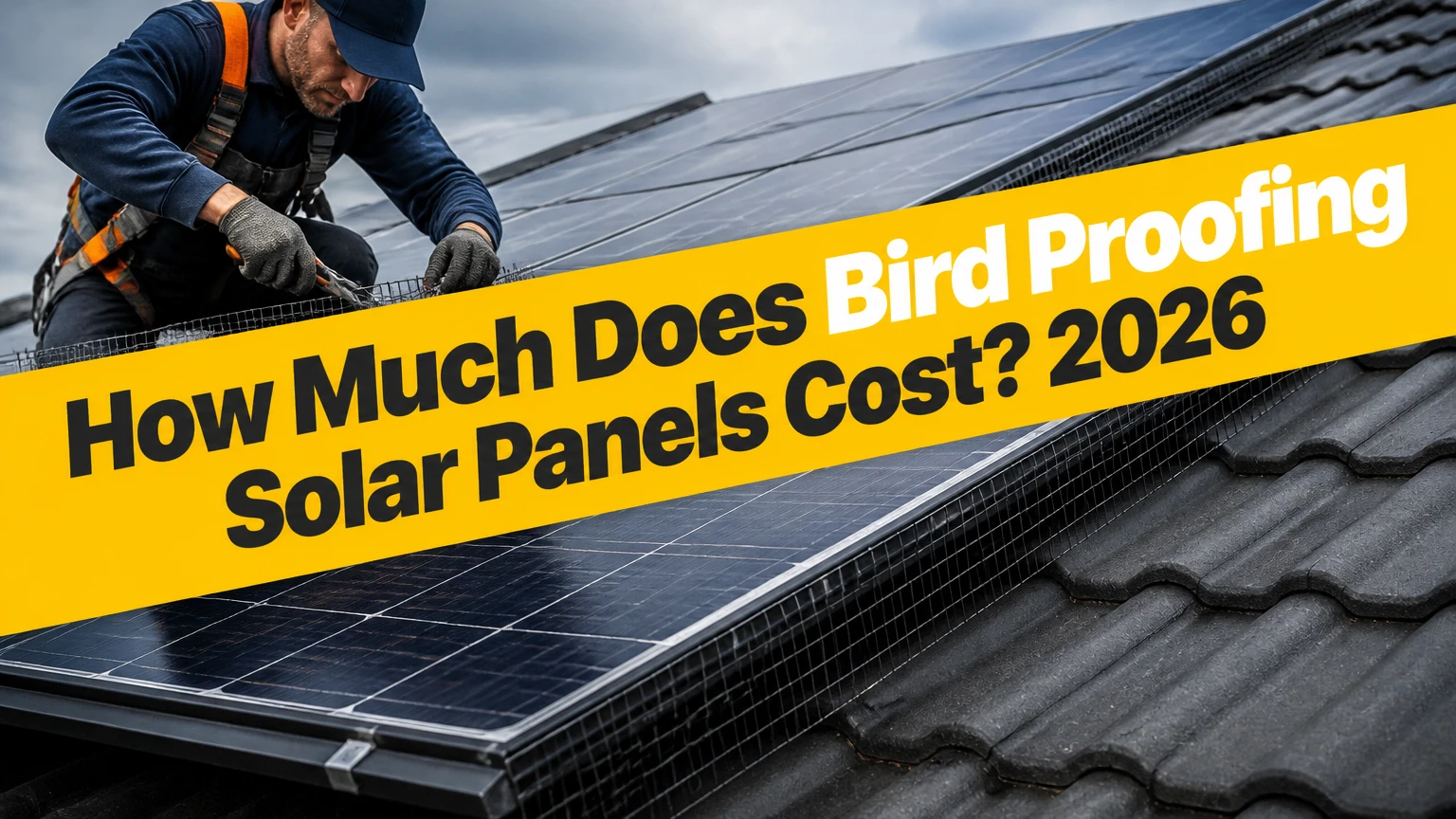
Bird proofing solar panels typically costs $600-$2,900 for professional installation in the United States, with small, uncomplicated arrays often near $600-$950 and large or difficult systems exceeding $1,900. A retrofit with active nests, sanitation, damaged wiring, steep roof access, or multiple arrays can add $150-$1,000 beyond the perimeter guard itself.
Key Facts at a Glance
- Professional solar panel bird proofing commonly costs $8-$13 per linear foot for PVC-coated galvanized mesh.
- A typical 12-16-panel system costs approximately $600-$950 when the roof is accessible and no remediation is needed.
- Nest removal, droppings cleanup, disinfecting, and wiring repairs are separate services in many quotes.
- Mechanical clips should attach to the panel frame or approved racking points without drilling into photovoltaic modules.
- A complete retrofit commonly takes 2-4 hours for prevention and 4-8 hours when nesting material or contamination requires removal.
- A perimeter guard excludes animals from the panel gap, but it does not repair roof entry points or guarantee protection from every pest.
How Much Does Bird Proofing Solar Panels Cost?
Solar panel bird proofing costs about $8-$20 per linear foot installed, or roughly $40-$150 in DIY materials for a basic mesh kit. Per-panel pricing usually falls between $40 and $150, but linear-foot pricing is more reliable because long, narrow arrays can have fewer panels and more exposed perimeter.
Installers price the work around the array’s outside edge, roof access, and labor time. A compact 20-panel rectangle may require less mesh than two separated arrays containing the same number of modules. Fixed minimum charges also matter: a contractor may charge for a half-day visit even when the measured perimeter is short.
Typical Installed Prices by System Size
| Solar system profile | Approximate panel count | Typical exposed perimeter | Professional price |
|---|---|---|---|
| Small residential array | 12-16 panels | 60-80 linear feet | $600-$950 |
| Medium residential array | 20-28 panels | 100-140 linear feet | $1,100-$1,700 |
| Large residential array | 30 or more panels | 160 or more linear feet | $1,900-$2,900+ |
| Split or irregular arrays | 16-32 panels | 120-200 linear feet | $1,400-$3,200+ |
These are typical US-dollar planning ranges, not regulated market prices. Labor rates, roof pitch, local wildlife rules, travel distance, and whether a solar contractor or pest-control company performs the work can move the quote substantially.
What Does Bird Proofing Cost per Panel?
Per-panel solar bird proofing usually costs $60-$100 for standard PVC mesh, although quotes from $40 to $150 per panel are common in different markets. Per-panel pricing is convenient for comparison, but it can hide the actual labor involved when arrays have several exposed sides, gaps between groups, or difficult roof obstructions.
A quote should state either the total linear footage or the complete perimeter being protected. Ask whether the price includes corners, cable penetrations, roof tiles, flashing, and removal for future panel servicing.
Why Do Birds Nest Under Solar Panels?
Birds nest beneath solar panels because the panel-to-roof gap provides shade, weather protection, stable warmth, and a restricted entrance that deters many predators. Pigeons, starlings, and some small rodents can use the sheltered cavity for nesting, roosting, and raising young.
Most photovoltaic arrays sit above the roof on rails or mounting hardware. The actual clearance varies with the roof system and mounting design, so the often-cited 3-6-inch gap is a typical range rather than a universal specification. The panels also create a dry edge over the roof, while the glass and frame can shield nesting material from wind.
Bird activity creates several cost pathways:
- Droppings can stain modules and roof surfaces.
- Twigs and feathers can obstruct drainage.
- Squirrels and rodents can chew insulation from photovoltaic cables.
- Nesting material can retain moisture against roofing materials.
- Repeated cleaning can cost more than one properly fitted exclusion guard.
A guard prevents re-entry. It does not remove the reason an active animal is already using the space, so eviction and legal wildlife handling must come first.
What Is Included in a Professional Installation?
A standard preventive installation includes measuring the perimeter, checking access, cutting mesh, attaching clips, sealing corners, and inspecting the finished barrier. Cleanup, animal removal, disinfecting, cable repairs, roof repairs, and panel removal are often additional line items.
Installation Stages and Typical Time
| Stage | Work performed | Typical duration | Usually included? |
|---|---|---|---|
| Roof and array inspection | Measure edges, identify access hazards, inspect visible cables | 20-45 minutes | Yes |
| Exclusion fitting | Cut mesh, form corners, install clips, tension lower edge | 1.5-3 hours | Yes |
| Nest and debris removal | Remove twigs, feathers, droppings, and carcasses | 30-150 minutes | Sometimes |
| Sanitation | Apply suitable disinfectant or biocide and rinse accessible surfaces | 30-120 minutes | Often extra |
| Wiring correction | Reclip, secure, or replace damaged cable protection | 20-90 minutes | Usually extra |
| Final inspection | Check openings, fasteners, drainage, and service access | 15-30 minutes | Yes |
Technicians should use fall protection appropriate to the roof and local regulations. Solar equipment introduces a separate electrical hazard because photovoltaic circuits can remain energized in daylight, even when the household supply is switched off.
Active nests require additional care. In the United States, federal, state, or local rules may protect certain migratory birds, eggs, or chicks under the Migratory Bird Treaty Act and related regulations. A contractor should identify the species and legal status before removing an occupied nest, rather than sealing animals inside.
Does Cleanup Increase the Price?
Cleanup can add $150-$600 for moderate debris and $500-$1,000 or more for severe contamination, carcass removal, sanitation, or wiring damage. The final amount depends on the volume of material, access under the modules, required protective equipment, and whether a separate wildlife or pest specialist is needed.
Common Add-On Charges
| Additional service | Typical price range | Typical time | Cost trigger |
|---|---|---|---|
| Light nest and debris removal | $100-$250 | 30-60 minutes | Small amount of dry material |
| Heavy nest extraction | $250-$600 | 1-3 hours | Packed material across several bays |
| Dropping cleanup and sanitation | $150-$500 | 1-2 hours | Hardened waste or contaminated roof |
| Basic cable securing | $100-$300 | 30-90 minutes | Loose or chewed cable insulation |
| Cable or connector repair | $250-$1,000+ | 1-4 hours | Damaged conductors or connectors |
| Return visit after fledging | $100-$300 | 30-90 minutes | Occupied nest cannot be removed immediately |
Sanitation is more than cosmetic cleaning. Dried bird droppings can become airborne during disturbance, and contractors may use respiratory protection and controlled cleaning methods. Histoplasmosis risk is associated with environments contaminated by bird or bat droppings, but a quote should not claim that a routine wash eliminates every pathogen or replaces professional health advice.
Which Solar Panel Guard Is Best?
PVC-coated galvanized mesh is the best general-purpose choice for most residential arrays because it balances airflow, flexibility, pest exclusion, and price. All-metal skirts suit homeowners prioritizing appearance or heavy-duty resistance, while spikes and full-array netting solve narrower problems.
Solar Protection Options Compared
| Protection type | Installed cost | Typical service life | Best target | Main limitation |
|---|---|---|---|---|
| PVC-coated galvanized mesh | $8-$13 per linear foot | 10-15 years | Pigeons, small birds, squirrels, rodents | Coating can deteriorate on low-grade products |
| Aluminum or steel skirt | $12-$20 per linear foot | 15-25 years | Large birds and high-impact exposure | Higher price and less flexible fitting |
| Clip-on bird spikes | $6-$10 per linear foot | 5-10 years | Pigeons and gulls landing on edges | Does not close the panel gap |
| HDPE bird netting | $7-$11 per linear foot | 3-10 years | Large or irregular multi-array areas | Can sag, tear, and collect leaves |
PVC-coated mesh normally uses a galvanized steel core with a corrosion-resistant coating. A half-inch grid is a common specification because it blocks many birds and small animals while preserving rain drainage and airflow. Mesh size must be selected for the smallest animal involved, not only for pigeons.
Solid skirts can improve appearance, but a contractor should not install an uninterrupted barrier that obstructs designed ventilation or drainage. The panel manufacturer’s installation instructions and racking requirements take priority over a generic product kit.
Can Bird Proofing Overheat Solar Panels?
Properly installed solar panel mesh should not significantly restrict airflow because the barrier blocks animal access at the perimeter while leaving the rear of the array open. Overheating becomes more plausible when installers use solid material incorrectly, compress the gap, block drainage paths, or trap leaf litter against the modules.
Solar output generally falls as module temperature rises, but a universal percentage loss cannot be assigned to every installation. Module temperature depends on wind, roof color, mounting clearance, irradiance, array layout, and the panel’s published temperature coefficient.
Check these installation details:
- Mesh sits against the outer frame, not across the module’s rear ventilation area.
- Drainage channels remain open at low points.
- Fasteners do not press against wiring or connectors.
- The lower edge follows roof contours without creating a debris shelf.
- The guard can be removed in sections for inverter, optimizer, or panel service.
An experienced installer should document the clip system and leave adequate access for future maintenance. The lowest material price is not the lowest ownership cost if technicians must dismantle the barrier during every service visit.
How Does the Mesh Attach Without Damaging Panels?
Solar critter mesh should attach with mechanical clips, hooks, or approved fasteners that grip the panel frame or racking without drilling into the module. Installers commonly place fasteners about 12-18 inches apart, then tension and shape the mesh around corners, tile profiles, brackets, and roof obstructions.
Never accept a method that penetrates the photovoltaic laminate, glass, backsheet, or an unapproved section of the frame. Drilling can create a path for water, weaken components, interfere with grounding, and complicate manufacturer warranty claims.
Attachment Quality Checklist
| Checkpoint | Acceptable specification | Warning sign |
|---|---|---|
| Fastener location | Approved frame lip or racking point | Screw through module or roof flashing |
| Clip spacing | Approximately 12-18 inches | Mesh spans over 24 inches unsupported |
| Mesh opening | Often about 1/2 inch for small pests | Large openings beside corners |
| Lower edge | Tensioned against roof contour | Loose skirt with a visible animal path |
| Cable clearance | Cables remain clipped and unpinched | Mesh rests on connectors or conductors |
| Service access | Sections can be removed and replaced | Entire array must be dismantled |
Solar manufacturers differ in frame shape and warranty language. A homeowner should request the product specification, attachment method, and warranty position in writing before installation.
Should You Install Solar Bird Proofing Yourself?
DIY solar bird proofing can cost $40-$150 for mesh, clips, cutters, and joining ties, but professional installation is usually safer on a two-story, steep, tiled, fragile, or electrically complex roof. Material cost is only one part of the project because fall protection, access equipment, nest handling, and correct frame attachment determine the result.
DIY may be reasonable when all of these conditions apply:
- The roof is single-story with a low, stable pitch.
- No active nest, eggs, chicks, or trapped animal is present.
- The homeowner has suitable fall-protection equipment and training.
- The kit includes corrosion-resistant clips rather than ordinary indoor cable ties.
- The array perimeter is accessible without stepping on modules.
- The installation will not alter grounding, wiring, flashing, or roof drainage.
Standard plastic zip ties often fail under prolonged ultraviolet exposure. Stainless-steel ties or manufacturer-approved UV-stabilized fasteners are more suitable for exterior solar work.
The honest limitation is significant: DIY mesh fitting does not replace electrical inspection or wildlife compliance. A homeowner who discovers chewed insulation, loose connectors, carcasses, or heavy contamination should stop and use qualified solar and wildlife professionals.
Is Bird Proofing Cheaper During Solar Installation?
Adding a perimeter guard during the original solar installation often costs $300-$500, while retrofitting later may cost $600-$2,900 because the contractor must arrange roof access, work around installed equipment, and possibly remove debris first. The saving comes mainly from shared labor and access equipment, not from a different mesh product.
New Installation Versus Retrofit
| Project situation | Typical price | Access requirement | Likely extra work |
|---|---|---|---|
| Guard added before panels are fitted | $300-$500 | Already available | Minimal |
| Preventive retrofit | $600-$1,700 | Ladder, roof access, fall protection | Perimeter fitting |
| Retrofit with active nesting | $900-$2,500 | Controlled wildlife access | Eviction, cleanup, sanitation |
| Complex multi-array retrofit | $1,900-$3,200+ | Scaffolding or lift may be needed | Multiple edges and return visits |
Request bird protection as a separate contract line. The line should identify mesh material, clip type, linear footage, corners, warranty, future removal terms, and whether cleanup is included.
What Makes One Quote Higher Than Another?
Roof access and remediation usually affect price more than panel wattage. A 10-kilowatt system on a simple single-story roof can cost less to protect than a 5-kilowatt system split across dormers, valleys, and two roof elevations.
The largest pricing variables are:
- Array geometry: Separate groups require more corners and termination points.
- Roof material: Fragile clay or concrete tile requires slower movement and careful edge shaping.
- Pitch and height: Steep roofs may need harnesses, scaffolding, lifts, or additional technicians.
- Travel and minimum charge: Rural or low-density service areas often carry mobilization costs.
- Wildlife condition: Active nests, carcasses, droppings, and chewed wires require specialized work.
- Guard material: Aluminum and steel skirts cost more than PVC-coated mesh.
- Future service design: Removable sections take more planning but reduce later maintenance expense.
A quote that is $200 higher may be better value if it includes sanitation and cable inspection. A cheap quote that merely attaches mesh over existing nests can create a larger repair bill.
What Mistakes Cause Solar Guards to Fail?
The most common failures involve sealing an occupied space, leaving corners open, using weak fasteners, and ignoring wiring or drainage. A guard is effective only when the entire accessible perimeter is closed and animals are removed before final fastening.
Failure Modes and Corrective Actions
| Failure | Likely cause | Diagnostic sign | Corrective action |
|---|---|---|---|
| Birds return under panels | Open corner or end termination | Feathers or droppings inside | Rework the full perimeter seal |
| Mesh rattles in wind | Excessive unsupported span | Squeaking or lifted sections | Add clips at 12-inch intervals |
| Rust appears early | Damaged coating or poor steel | Orange corrosion within 1-3 years | Replace affected mesh with coated or stainless material |
| Leaves collect at edge | Mesh forms a shelf | Wet debris after rainfall | Re-tension edge and clear debris |
| Rodents enter | Grid is too large | Small droppings or gnaw marks | Use smaller opening and seal service gaps |
| Cables are damaged | Guard rests on wiring | Pinched insulation or loose connectors | Isolate circuit and obtain solar inspection |
Do not patch a displaced section with household wire or adhesive alone. A durable repair uses compatible mesh, overlapping material, and corrosion-resistant joining hardware, followed by a check for the animal that caused the damage.
How Often Does a Solar Panel Bird Guard Need Maintenance?
A solar panel bird guard usually needs a visual inspection every 6-12 months, especially after high winds, storms, roof work, or pest activity. PVC-coated mesh can last 10-15 years in favorable conditions, but service life varies with ultraviolet exposure, salt air, corrosion, animal impact, and fastening quality.
Homeowners can inspect from ground level for:
- Sagging or lifted mesh.
- Missing clips or exposed corners.
- Leaf piles along the uphill edge.
- New droppings beneath the array.
- Gnawed cable insulation.
- Rust, flaking PVC, or sharp damaged wire.
Do not climb onto a roof or touch solar wiring merely to inspect a guard. A qualified contractor should handle elevated access and any suspected electrical damage. Annual solar panel cleaning is not automatically necessary, but debris trapped by a poorly shaped barrier should be addressed before it blocks drainage.
How Can You Compare a Bird-Proofing Quote?
Compare the scope, not only the total price. A reliable quote identifies the protected perimeter, material, fastener spacing, cleanup assumptions, access method, warranty, and exclusions.
Use this checklist before accepting an estimate:
- Does the quote specify linear feet or only panel count?
- Does the price include active nest assessment and debris removal?
- Will the contractor inspect photovoltaic cables and connectors?
- Which mesh opening, gauge, coating, and fastener material will be used?
- How will corners, tile contours, rails, and cable penetrations be sealed?
- Will the guard preserve ventilation, drainage, grounding, and service access?
- Is scaffolding, a lift, or a return visit excluded?
- Who handles protected species and occupied nests?
- What workmanship period applies to displaced or corroded mesh?
- Can the installer provide before-and-after photographs?
The strongest quote is specific enough for two contractors to price the same work. Vague phrases such as “pigeon proofing complete” conceal the exact tasks that drive cost.
FAQ
Will bird proofing stop squirrels from getting under solar panels?
A correctly sized metal mesh guard can exclude squirrels from the panel perimeter, but it cannot stop squirrels entering from roof edges, soffits, chimneys, or nearby trees. Squirrel damage to cables requires a wiring inspection, and the guard should not be fitted over an animal that remains beneath the array.
Does solar panel bird proofing affect the manufacturer warranty?
A non-invasive guard usually creates fewer warranty concerns than drilled or glued attachments, but warranty terms differ by panel and racking manufacturer. Ask for written confirmation that the proposed clips, mesh, grounding arrangement, and service method comply with the equipment installation instructions.
Can bird spikes replace mesh around solar panels?
Bird spikes can discourage pigeons from landing on exposed frame edges, but spikes do not close the cavity beneath an array and do not exclude squirrels or small birds. Spikes are suitable for a limited roosting problem, not as a substitute for perimeter mesh where nesting has already begun.
Do solar panels need to be removed for bird proofing?
Solar panels usually do not need removal for a standard perimeter guard because installers can fit mesh from the roof edge using frame clips. Removal may be necessary when debris is packed deeply underneath, cables are damaged, the array blocks access, or the mounting system cannot accept a safe attachment.
Is bird proofing worthwhile if no birds are nesting yet?
Preventive bird proofing can be worthwhile when pigeons regularly roost nearby, the array has a large accessible gap, or cleaning and droppings are already recurring expenses. Prevention is most cost-effective when added during initial solar installation, before later access and remediation charges apply.
How long does bird proofing last on solar panels?
A quality PVC-coated galvanized mesh guard commonly lasts 10-15 years, while powder-coated aluminum or steel systems may last 15-25 years in suitable conditions. Coastal salt, ultraviolet exposure, animal impact, roof movement, and damaged coatings can shorten those periods.
The Bottom Line
For most homes, how much does bird proofing solar panels cost has a practical answer: budget $600-$1,700 for a standard professional retrofit, or about $300-$500 when protection is added during new solar installation. Active nests, sanitation, damaged wiring, steep roofs, and multiple arrays can raise the total to $2,900 or more. Compare the complete scope, not the mesh price alone.