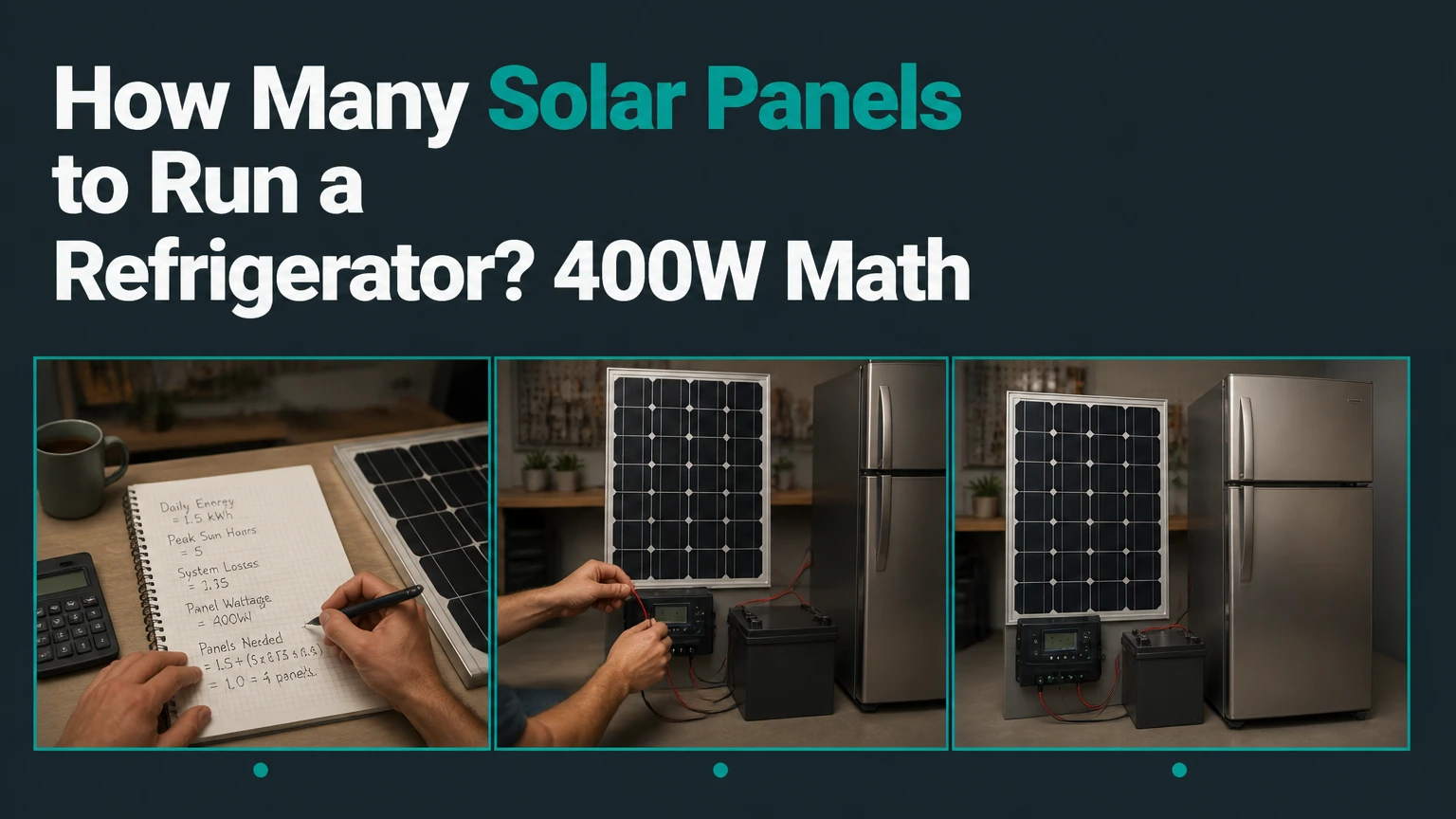
A standard household refrigerator usually needs 1-4 solar panels, but the exact number depends on its annual EnergyGuide consumption, panel wattage, local peak sun hours, and whether the system must operate overnight. For a typical refrigerator using 1.5 kWh per day, plan on about 600-800 watts of panels, usually two 400W panels, plus a battery and pure sine wave inverter for reliable 24-hour operation.
Key Facts at a Glance
- A refrigerator using 548 kWh per year consumes about 1,501 Wh per day before system losses.
- Two 400W solar panels provide an 800W array, a practical baseline for a 1.5 kWh-per-day refrigerator in a location averaging four peak sun hours.
- A refrigerator may draw only 100-250W while running, yet its compressor can briefly require 800-1,500W or more at startup.
- A battery is required for nighttime operation, because solar panels produce little or no useful energy after sunset.
- A 12V 200Ah LiFePO4 battery stores about 2,560 Wh nominally and typically provides around 2,000-2,300 Wh of usable energy.
- A pure sine wave inverter rated around 1,000-2,000W continuous output, with a suitable surge rating, is the safer refrigerator choice.
How Many Solar Panels to Run a Refrigerator?
Most refrigerators need two 400W panels for dependable daily operation, although one high-wattage panel can sometimes cover the average energy mathematically. A small, efficient refrigerator in a sunny location may operate on one 300-400W panel, while an older full-size refrigerator, shaded array, or winter installation may need three or four panels.
The panel count is an energy calculation, not a label attached to the appliance. A 200W panel and a 400W panel do not represent equivalent system capacity, and a refrigerator that uses 900 kWh annually has a materially different requirement from one using 350 kWh.
Use this basic formula:
Daily refrigerator energy = annual kWh ÷ 365 × 1,000
Required solar watts = daily Wh × loss factor ÷ peak sun hours
Panel count = required solar watts ÷ panel wattage
A practical loss factor is 1.20-1.35. The factor covers inverter conversion, battery charging, wiring, temperature, dust, and imperfect panel orientation. A design based on the best summer day will not reliably protect food during short winter days.
Refrigerator Energy Use by Type
Refrigerator energy consumption commonly ranges from approximately 0.6 to 2.5 kWh per day, with age, size, ambient temperature, ice-maker use, door openings, and efficiency determining the actual value. The EnergyGuide label provides the best starting point because it reports estimated annual electricity consumption for that model.
| Refrigerator type | Typical annual use | Daily average | 400W panels at 4 sun hours |
|---|---|---|---|
| Compact 3-5 cubic feet | 250-450 kWh | 0.7-1.2 kWh | 1-2 panels |
| ENERGY STAR full-size model | 350-600 kWh | 1.0-1.6 kWh | 2 panels |
| Older full-size refrigerator | 600-900 kWh | 1.6-2.5 kWh | 2-3 panels |
| Refrigerator-freezer combination | 500-1,000 kWh | 1.4-2.7 kWh | 2-4 panels |
| Commercial or large-capacity unit | 1,000-1,500 kWh | 2.7-4.1 kWh | 3-5 panels |
These are planning ranges rather than guarantees. The U.S. Department of Energy’s Energy Saver guidance identifies refrigerators and freezers as among the larger electricity-consuming appliances in a home, and ENERGY STAR says certified refrigerators use at least 10% less energy than models meeting the federal minimum standard.
How Do You Calculate the Solar Array Size?
Calculate the solar array from the refrigerator’s annual kWh, then adjust for local sunlight and conversion losses. For example, a refrigerator rated at 548 kWh per year uses 1.50 kWh per day, requiring roughly 469W of theoretical array capacity at four peak sun hours after applying a 25% loss factor.
The arithmetic is:
548 kWh ÷ 365 × 1,000 = 1,501 Wh per day
1,501 Wh × 1.25 = 1,876 Wh required generation
1,876 Wh ÷ 4 peak sun hours = 469W
469W ÷ 400W = 1.17 panels
The mathematical minimum rounds up to two panels. Two panels provide 800W of nameplate capacity, which gives additional production during warm temperatures, haze, suboptimal roof angles, and normal equipment losses.
How Do Peak Sun Hours Change the Answer?
Peak sun hours represent equivalent full-intensity sunlight, not the total number of daylight hours. A location receiving eight hours of weak morning and afternoon light may have only four peak sun hours for solar-sizing purposes.
| Average peak sun hours | Array for 1.5 kWh/day | 400W panel count | Planning interpretation |
|---|---|---|---|
| 2.5 hours | 750W | 2 panels | Cloudy or winter-sensitive location |
| 3.5 hours | 536W | 2 panels | Moderate solar resource |
| 4.0 hours | 469W | 2 panels | Baseline example |
| 5.0 hours | 375W | 1-2 panels | Strong sunlight with reserve needed |
| 6.0 hours | 313W | 1-2 panels | High production, but one panel has little margin |
Use the National Renewable Energy Laboratory’s PVWatts Calculator or equivalent local solar data for a serious design. Check the lowest useful seasonal production, not only the annual average. A two-panel system that works in July may produce too little in December.
Can One Solar Panel Run a Refrigerator?
One 400W solar panel can sometimes run an efficient refrigerator during sunny daytime hours, but one panel is rarely a robust 24-hour refrigerator system. The panel must first power the refrigerator, replace inverter and charging losses, and charge a battery for the hours when sunlight is unavailable.
A 400W panel rated at four peak sun hours produces a theoretical 1,600 Wh per day. After temperature, controller, wiring, and inverter losses, usable delivered energy may be closer to 1,200-1,400 Wh. That output may cover a compact refrigerator using 800-1,000 Wh daily, but it leaves little reserve for clouds or battery charging.
One panel is more plausible when all of these conditions apply:
- The refrigerator uses less than 1 kWh per day.
- The panel has unobstructed southern exposure in the Northern Hemisphere.
- The location has at least five strong peak sun hours.
- The battery is large enough for nighttime operation.
- The installation accepts reduced reliability during cloudy weather.
Two panels are the more defensible baseline for a standard full-size refrigerator. A third panel can be less expensive than buying an oversized battery if the main problem is slow daytime recovery.
What Battery Capacity Does a Refrigerator Need?
A refrigerator needs about 1.5-2.0 kWh of usable battery capacity for one day of backup when its daily consumption is near 1.5 kWh. Battery capacity must be specified as usable energy, because lead-acid batteries generally require a shallower discharge than LiFePO4 batteries.
The battery calculation is:
Usable battery Wh = refrigerator daily Wh × desired backup days
Nominal battery Wh = usable battery Wh ÷ allowable depth of discharge
For a 1.5 kWh refrigerator, one day requires approximately 1,500 Wh at the appliance. A 12V 200Ah lithium battery contains 2,400 Wh nominally. At an 85-90% practical depth of discharge, it provides roughly 2,040-2,160 Wh before inverter losses, which is normally sufficient for about one day.
| Battery configuration | Nominal storage | Typical usable storage | Approximate refrigerator backup |
|---|---|---|---|
| 12V 100Ah LiFePO4 | 1,280 Wh | 1,050-1,150 Wh | 14-18 hours |
| 12V 200Ah LiFePO4 | 2,560 Wh | 2,050-2,300 Wh | 24-32 hours |
| 12V 200Ah lead-acid | 2,400 Wh | 1,000-1,200 Wh | 12-17 hours |
| 24V 100Ah LiFePO4 | 2,560 Wh | 2,050-2,300 Wh | 24-32 hours |
| 24V 200Ah LiFePO4 | 5,120 Wh | 4,100-4,600 Wh | 2-3 days |
The table assumes a refrigerator averaging 1.5 kWh daily and an inverter operating near typical efficiency. Actual runtime changes when the compressor runs continuously, ambient temperatures rise, or additional loads share the battery.
A practitioner rule is to size the array for daily recovery and the battery for nighttime plus outage duration. Adding panels does not automatically create more nighttime runtime.
What Inverter Does a Refrigerator Need?
A refrigerator normally needs a pure sine wave inverter with at least 1,000W continuous output and approximately 2,000W or more of verified surge capacity. Large, old, or inefficient compressor refrigerators may justify a 2,000W continuous inverter, especially when other appliances share the system.
Running watts and starting watts are different measurements. The compressor motor can demand several times its normal operating power for a fraction of a second, and an inverter that handles the running load may still shut down during startup.
| Refrigerator load condition | Typical power range | Inverter implication |
|---|---|---|
| Electronics and standby | 2-10W | Low continuous draw |
| Compressor running | 80-250W | Normal operating load |
| Defrost heater active | 300-800W | Occasional higher demand |
| Compressor startup surge | 800-1,500W | Requires surge headroom |
| Older or stressed compressor surge | 1,500-2,500W | Verify measured startup current |
A pure sine wave output closely matches utility power and is the conservative choice for compressor motors, control boards, and variable-speed drives. Modified sine wave inverters may run some refrigerators, but buzzing, excess heat, failed startup, and reduced motor life make the apparent savings unattractive.
The inverter’s surge specification must state both the surge wattage and its duration. A vague “peak power” figure without a time rating is not enough for refrigerator sizing.
Which System Type Fits the Situation?
A dedicated off-grid system fits an RV, cabin, or remote property; a battery-backed hybrid system fits a house; and a solar generator fits temporary emergency use. The correct choice depends more on required autonomy, portability, code compliance, and expandability than on panel count alone.
| System type | Typical equipment | Typical cost | Best use | Main limitation |
|---|---|---|---|---|
| DIY off-grid | 600-1,000W panels, 2-5 kWh battery, MPPT controller, 2,000W inverter | $1,200-$2,500 | Cabin or RV | Wiring and protection require skill |
| Portable solar generator | 1,500-2,000Wh battery, 1,800-2,000W inverter, 400-600W panels | $900-$2,500 | Short outage backup | High cost per usable Wh |
| Hybrid home backup | Existing PV, hybrid inverter, 5-10 kWh battery | $4,000-$12,000 installed | Whole-home resilience | Permits and professional installation |
| Grid-tied solar only | PV array without battery | $2,500-$5,000 allocated equipment | Daytime bill reduction | Does not run during grid failure |
| Gas generator | 2,000-4,000W generator, fuel storage | $500-$2,000 | Multi-day outage | Fuel, noise, exhaust, maintenance |
A portable power station can run a refrigerator if its continuous output, surge capability, battery capacity, and recharge input all meet the load. A 2,000Wh station may run a 1.5 kWh-per-day refrigerator for roughly one day, not three days, after inverter losses and reserve limits.
Grid-tied solar panels alone generally shut down during a utility outage for anti-islanding protection. A battery-backed hybrid inverter or approved backup system is required to keep the refrigerator energized.
How Should You Build a Dedicated Refrigerator System?
Build a dedicated system around two 400W panels, a 12V or 24V LiFePO4 battery, an MPPT charge controller, and a pure sine wave inverter when the refrigerator uses about 1.5 kWh daily. A 24V battery architecture reduces current and cable size, while 12V components can be simpler for small RV installations.
Step 1: Read the EnergyGuide Label
Record the refrigerator’s annual kWh value rather than relying on the wattage printed on the compressor. Divide the annual figure by 365, then multiply by 1,000 to convert kWh per year into Wh per day.
You will know the input is adequate when the value reflects the entire appliance, including cycling. A plug-in energy monitor can validate the label over 3-7 days.
Step 2: Choose the Seasonal Solar Resource
Obtain the lowest practical average peak sun hours for the installation location. Multiply daily Wh by 1.25-1.35, then divide by that sunlight value.
You will know the estimate is conservative when it uses winter or shoulder-season production rather than an annual maximum. The common mistake is treating total daylight as peak sun hours.
Step 3: Round the Array Up
Select panel wattage and round the result upward to a whole panel. For a 469W requirement, one 400W panel is undersized in practice, while two 400W panels provide 800W and useful recovery margin.
You will know the array is adequate when a normal sunny day can replenish overnight battery use while operating the refrigerator. Add a third panel if shading or frequent cloudy weather is unavoidable.
Step 4: Size the Battery
Multiply daily consumption by the number of desired no-sun days. Divide by the battery’s usable depth of discharge, then allow for inverter losses.
A one-day reserve for a 1.5 kWh refrigerator commonly means a 12V 200Ah LiFePO4 battery. Two or three days generally require 4-6 kWh of usable storage.
Step 5: Install Protection and Ventilation
Use correctly rated fuses, disconnects, cable, grounding, and overcurrent protection. Keep batteries and inverters within their manufacturer’s temperature and ventilation limits, and never place a fuel generator in an enclosed space.
You will know the installation is ready when polarity, open-circuit voltage, charging voltage, and inverter output have been tested before connecting the refrigerator. Refrigerator startup is the final load test.
What Are the Main Design Mistakes?
The most common design mistakes are sizing from running watts alone, using average annual sunlight, ignoring battery depth of discharge, and connecting a refrigerator through undersized cables or an unsuitable inverter. Each error can produce a system that appears functional during testing but fails overnight or at compressor startup.
| Failure mode | Typical symptom | Likely cause | Corrective action |
|---|---|---|---|
| Inverter shuts down | Click or alarm at compressor start | Surge rating too low | Use verified 2,000W-plus surge capability |
| Battery empties overnight | Fridge loses power before sunrise | Insufficient usable Wh | Add battery capacity or reduce loads |
| Battery never fills | State of charge falls daily | Array too small or shaded | Add panels, remove shade, inspect controller |
| Hot cables or connectors | Warm insulation or voltage drop | Cable undersized or loose | Recalculate amperage and tighten connections |
| Compressor buzzes | Audible hum on inverter power | Modified sine wave output | Replace with pure sine wave inverter |
| Food warms in outages | Fridge is powered intermittently | Solar-only system lacks storage | Add battery backup or use a generator |
Do not solve every overnight failure by adding panels. If the refrigerator has enough daytime energy but fails at 2 a.m., the battery or inverter is the limiting component.
How Much Does Refrigerator Solar Backup Cost?
A small refrigerator backup system typically costs $900-$2,500 for a portable solar generator or $1,200-$2,500 for a component-based off-grid setup. A professionally installed residential hybrid system costs substantially more because the refrigerator receives only part of a larger battery, inverter, permitting, and labor package.
Typical equipment ranges are:
| Component | Entry range | Midrange example | Higher range |
|---|---|---|---|
| 400W solar panel | $150-$300 | $220 | $300-$500 |
| 12V 200Ah LiFePO4 battery | $450-$800 | $650 | $900-$1,300 |
| 40A MPPT controller | $120-$250 | $180 | $300-$500 |
| 2,000W pure sine inverter | $250-$500 | $350 | $600-$1,000 |
| Portable power station | $700-$1,300 | $1,200 | $1,800-$3,000 |
Equipment prices vary by certification, warranty, cell quality, shipping, and installation requirements. Electrical permits, mounting hardware, breakers, cables, and professional labor can add several hundred dollars to a dedicated installation.
A solar system used only to protect food during rare outages may cost more than a small generator. Solar becomes more attractive when the battery also supports lights, communications, medical equipment, or daily off-grid loads.
Would a DC Refrigerator Need Fewer Panels?
A native 12V or 24V DC refrigerator can need fewer panels than an AC refrigerator because it avoids inverter conversion losses and may use a high-efficiency compressor. A DC refrigerator does not eliminate the need for a battery, however, because it still must operate after sunset and through short weather interruptions.
A DC refrigerator is attractive in an RV, boat, or cabin where a battery system already exists. It is less convenient when replacing a standard household refrigerator, because household-size DC models are less common and may have higher purchase costs.
| Refrigerator choice | Typical daily use | Inverter required | Typical panel need at 4 sun hours |
|---|---|---|---|
| Older 18-22 cu. ft. AC refrigerator | 1.8-2.5 kWh | Yes | 2-3 400W panels |
| Efficient household AC refrigerator | 1.0-1.6 kWh | Yes | 2 400W panels |
| Compact AC refrigerator | 0.7-1.2 kWh | Yes | 1-2 400W panels |
| 12V compressor refrigerator | 0.5-1.0 kWh | No | 1-2 200-400W panels |
The best appliance choice depends on total ownership cost. Buying a new DC refrigerator solely to avoid an inverter may not recover its price difference unless the system operates off-grid for years.
How Do You Keep Food Safe During Solar Failures?
Keep the refrigerator at or below 40°F (4°C) and the freezer at 0°F (-18°C), consistent with U.S. Food and Drug Administration guidance. An unopened refrigerator generally keeps food cold for about four hours, while a full freezer can remain frozen for approximately 48 hours, or about 24 hours when half full.
Use a refrigerator thermometer rather than battery voltage as the food-safety test. Move perishable food to a functioning refrigerator, cooler, or generator-backed appliance when the temperature rises above the safe limit.
Solar backup is not a substitute for food-safety decisions. Repeated inverter cycling can create a misleading impression that the refrigerator is protected when its internal temperature is already unsafe.
What Changes in Hot, Cold, or Cloudy Weather?
Hot ambient temperatures increase compressor runtime, while heavy shade and winter conditions reduce solar production. A refrigerator in a hot garage can therefore require more daily energy at the same time that a winter array produces less energy.
Allow a 20-30% production margin beyond the calculated minimum when the refrigerator protects medication, the location has regular cloud cover, or the array cannot face the sun correctly. Keep condenser coils clean and leave the manufacturer’s specified clearance around the appliance.
A second counterintuitive rule matters: a larger inverter does not necessarily improve runtime. Inverter idle consumption can waste tens of watts continuously, so an oversized inverter may reduce battery autonomy even though it handles startup more easily.
FAQ
Can a 100W Solar Panel Run a Refrigerator?
A 100W solar panel generally cannot run a standard household refrigerator reliably. The panel may produce only 300-500 Wh per day under favorable conditions, while a full-size refrigerator commonly uses 1,000-2,500 Wh daily, before battery and inverter losses. A 100W panel is better suited to maintaining a battery or powering a compact DC cooler.
How Long Will a 2,000Wh Power Station Run a Refrigerator?
A 2,000Wh power station typically runs a refrigerator for about 24-36 hours when the appliance averages 1.0-1.5 kWh daily. Actual runtime falls when inverter losses, battery reserve limits, hot conditions, frequent door openings, and startup behavior increase consumption. Solar input can extend runtime if it exceeds the refrigerator’s daily energy use.
Can a Refrigerator Run Directly From Solar Panels?
A standard AC refrigerator should not connect directly to solar panels because panel voltage and power vary with sunlight. The normal architecture routes panel energy through an MPPT controller and battery, then through a pure sine wave inverter. A purpose-built DC refrigerator may connect to a regulated battery system, not an unregulated panel output.
Is a 2,000W Inverter Too Large for a Refrigerator?
A 2,000W inverter is not inherently too large for a refrigerator if its idle consumption is low and its surge specification is suitable. The refrigerator may use only 100-250W while running, but the larger inverter provides startup headroom. Select the smallest certified pure sine wave model that meets the measured surge requirement and any shared loads.
Do Solar Panels Run a Refrigerator at Night?
Solar panels do not provide dependable nighttime power because photovoltaic output falls to zero or near zero after sunset. A battery, utility connection, or generator must supply the refrigerator overnight. For a refrigerator using 1.5 kWh daily, plan roughly 1.5-2.0 kWh of usable battery capacity for one night, with additional reserve for cloudy weather.
Should You Use a Generator Instead of Solar Backup?
Use a generator when the outage may last several days and low upfront cost matters more than noise, fuel, and maintenance. Use solar and a battery when silent operation, automatic backup, indoor convenience, and recurring daily use matter more. A hybrid approach can protect the refrigerator through short outages while reserving a generator for prolonged storms.
The Bottom Line
The answer to how many solar panels to run a refrigerator is usually two 400W panels for a standard refrigerator using about 1.5 kWh per day in a four-peak-sun-hour location. Confirm the EnergyGuide annual kWh, apply a 1.20-1.35 system-loss factor, size the array for the weakest useful season, and add a battery plus pure sine wave inverter for overnight operation. One panel can work for a compact, efficient refrigerator in excellent sunlight, while older units or cloudy locations may require three or more.