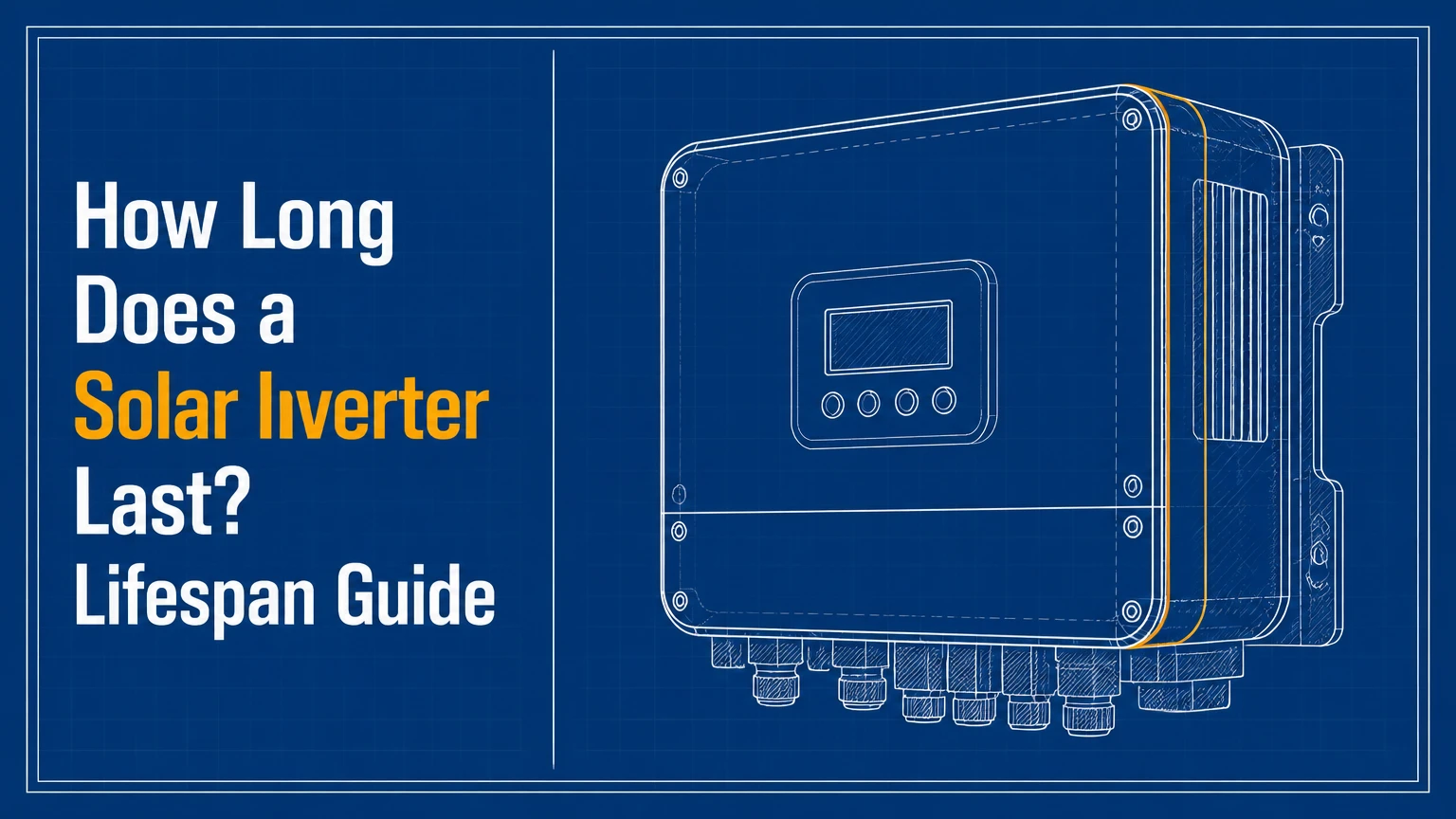
A solar inverter typically lasts 10-15 years in a residential string or hybrid system, while a quality microinverter commonly lasts 20-25 years. Solar panels generally produce for 25-30 years, so most systems with a central inverter need one replacement during their operating life, although cool placement, correct sizing, and preventive maintenance can extend service.
Key Facts at a Glance
A residential string inverter commonly lasts 10-15 years; some well-cooled units operate for 15-20 years.
A microinverter commonly lasts 20-25 years, but replacing one requires roof access and electrical work.
A hybrid battery inverter usually lasts 10-15 years because battery cycling adds thermal and electrical stress.
Solar panels usually outlast central inverters by 10-15 years.
Typical installed replacement cost is about $1,500-$3,500 for a string inverter and $250-$600 for one microinverter.
An inverter under warranty may still create labor, shipping, diagnostic, or compatibility costs.
What Determines How Long a Solar Inverter Lasts?
Solar inverter lifespan is determined mainly by internal temperature, electrical loading, moisture exposure, power quality, and component quality. The same model can fail after eight years in a hot, poorly ventilated location or operate beyond 15 years in a shaded, correctly sized installation.
The inverter works harder than most passive solar components because it converts power continuously, switches semiconductor devices at high frequency, regulates voltage, communicates with the grid, and dissipates heat. Electrolytic capacitors, cooling fans, relays, surge-protection components, and solder joints are common wear points.
The National Renewable Energy Laboratory identifies inverters as a major balance-of-system reliability concern because they contain more active electronics than modules and must operate through changing temperatures and loads. The U.S. Department of Energy has also described the inverter as “the brains of the system,” a useful shorthand for why its failure can stop or limit energy production even when the panels remain healthy.
A practical lifespan range by inverter type
| Inverter type | Typical service life | Typical warranty | Likely replacement timing |
|---|---|---|---|
| String inverter | 10-15 years | 5-12 years | Year 10-15 |
| Microinverter | 20-25 years | 20-25 years | Year 20-25 or later |
| Hybrid battery inverter | 10-15 years | 5-12 years | Year 10-15 |
| Off-grid inverter | 5-10 years | 2-5 years | Year 5-10 |
| Optimizer plus string inverter | 10-15 years for inverter | 10-25 years by component | Central inverter first |
These are planning ranges, not guaranteed expiration dates. Warranty terms, climate, operating profile, installation quality, and manufacturer support can produce materially different outcomes.
How Does a Solar Inverter Work?
A solar inverter converts the direct current generated by photovoltaic modules into alternating current that household circuits and the utility grid can use. The conversion sequence includes DC collection, maximum power point tracking, switching, filtering, grid synchronization, and protective shutdown.
The process begins when panel strings send high-voltage DC electricity to a string inverter, or when each panel sends lower-voltage DC to its own microinverter. The inverter’s MPPT circuitry adjusts the electrical operating point because panel voltage and current change with irradiance, temperature, shading, and module mismatch.
Power semiconductor switches then create an AC waveform from the DC input. Inductors and capacitors filter switching artifacts, while control software matches voltage, frequency, and phase with the grid. Anti-islanding protection disconnects the inverter during a grid outage, preventing the system from energizing utility lines while workers repair them.
| Operating stage | Component or control | Homeowner consequence |
|---|---|---|
| DC collection | PV conductors and terminals | Loose connections can create heat and arc faults |
| MPPT regulation | Tracker circuitry and firmware | Poor tracking reduces production under changing sunlight |
| DC-to-AC switching | IGBTs or MOSFETs | Semiconductor heat affects long-term reliability |
| Wave filtering | Capacitors and inductors | Aging components can cause noise or fault codes |
| Grid synchronization | Sensors and control software | Voltage or frequency faults can stop output |
| Protective shutdown | Anti-islanding and surge protection | The system disconnects during unsafe grid conditions |
A solar inverter can therefore stop producing power even when panel voltage tests appear normal. The fault may be electronic, software-related, grid-related, or caused by wiring and insulation rather than by the panels themselves.
Which Solar Inverter Type Lasts Longest?
Microinverters usually have the longest published warranty and planning life, commonly 20-25 years. String and hybrid inverters usually cost less initially and are easier to access when installed indoors, but their central power electronics normally require replacement before the solar modules reach the end of their useful life.
| System architecture | Conversion location | Typical efficiency | Failure pattern | Best-fit situation |
|---|---|---|---|---|
| String inverter | One wall-mounted unit | 97%-99% peak | One failure can stop the array | Unshaded roof with accessible utility space |
| Microinverters | One unit per module | 95%-98% peak | One failed unit affects one module | Shaded, multi-angle, or complex roof |
| DC optimizers plus string inverter | Optimization at modules, inversion centrally | 97%-99% peak | Central inverter remains a single outage point | Partial shade with centralized service access |
| Hybrid inverter | Central DC and battery conversion | 94%-98% peak | Solar and battery functions can fail together | Backup power and future battery integration |
| Off-grid inverter | Central independent conversion | 90%-95% typical system range | Heavy surge loads accelerate wear | Stand-alone systems with battery storage |
String inverters
String inverters connect several modules in series and perform DC-to-AC conversion in one central enclosure. A typical residential unit lasts 10-15 years, and an indoor garage installation may outlast an outdoor installation exposed to direct afternoon sun.
The main advantage is serviceability. A technician can often replace one accessible box without removing roof modules. The main limitation is the single point of failure: one inverter fault can take the entire array offline.
String architecture is usually the cost-conscious choice for an unshaded roof with one or two consistent orientations. Shade, multiple roof pitches, and major panel mismatch reduce its production advantage.
Microinverters
Microinverters convert each module’s output into AC at the roof. A failed unit normally reduces production from one panel rather than shutting down the entire array, and panel-level monitoring can identify the affected device.
Microinverters often carry 20-25-year warranties because manufacturers intend them to match the module life. Their distributed design does not make them immune to failure: rooftop heat, moisture, connector problems, and difficult access remain relevant.
Microinverters are often sensible for roofs with several orientations or intermittent shade. They are less attractive when the roof is difficult to access, because a technician may need to remove a panel to replace a failed unit.
DC optimizers with a string inverter
Power optimizers adjust module operating points before sending DC electricity to a central inverter. Optimizers can reduce mismatch and shade losses, but they do not eliminate the central inverter’s 10-15-year replacement cycle.
This arrangement provides more panel-level visibility than a conventional string system. It also adds rooftop electronics, connectors, and potential failure points. The architecture is useful when shade management matters but the installer prefers a central inverter.
Hybrid and battery-ready inverters
Hybrid inverters manage solar generation, household loads, batteries, and grid power through one coordinated control system. A typical residential hybrid unit lasts 10-15 years, with battery cycling, firmware complexity, and continuous conversion increasing operating stress.
A hybrid inverter is not automatically the best future-proof choice. Battery chemistry, voltage range, communication protocol, backup-load capacity, and local electrical rules can change before the inverter fails. Confirm compatibility with the exact battery model rather than relying on the phrase battery-ready.
Off-grid inverters
Off-grid inverters generally last 5-10 years in demanding applications, although lightly loaded, high-quality equipment can operate longer. Frequent high-current surges from pumps, compressors, refrigerators, and power tools create more stress than ordinary grid-tied operation.
Off-grid systems need additional attention to battery voltage, generator integration, ventilation, and load management. An inverter designed for grid-tied use cannot automatically provide safe, stable off-grid power.
Does the Warranty Equal the Inverter’s Actual Life?
A solar inverter warranty defines the manufacturer’s repair or replacement obligation, not the exact date the equipment will fail. A 10-year warranty means the manufacturer covers specified defects for 10 years under stated conditions; it does not mean the inverter stops working in year 11.
| Coverage item | Typical string inverter | Typical microinverter | Question to verify |
|---|---|---|---|
| Standard hardware warranty | 5-12 years | 20-25 years | Is the term measured from shipment or installation? |
| Extended warranty | 15-20 years | Often unnecessary | Does the extension cover labor? |
| Replacement hardware | Included for covered defect | Included for covered defect | New, refurbished, or equivalent model? |
| Labor and diagnosis | Often excluded | Often installer-dependent | Who pays roof access and call-out fees? |
| Shipping | Manufacturer-specific | Manufacturer-specific | Is return freight prepaid? |
| Warranty transfer | Varies by brand | Varies by brand | Does ownership change cancel coverage? |
Some warranties are “parts only.” The replacement box may be free while diagnosis, travel, removal, installation, shipping, and permitting remain chargeable. Keep the invoice, commissioning record, serial number, monitoring history, and warranty registration.
A replacement model may also be electrically incompatible with an older array. Voltage windows, communication devices, rapid-shutdown equipment, battery interfaces, and utility requirements can force additional equipment or a broader retrofit.
How Much Does Solar Inverter Replacement Cost?
Typical residential replacement costs range from $1,500-$3,500 installed for a string inverter and $250-$600 installed for one microinverter. Hybrid replacements commonly cost $2,500-$5,000, while off-grid replacements range from $1,000-$4,000 depending on surge rating, battery voltage, labor, and permitting.
| Replacement scenario | Hardware range | Labor and access | Typical installed total |
|---|---|---|---|
| String inverter, accessible garage | $900-$2,200 | $500-$1,000 | $1,500-$3,200 |
| String inverter, outdoor or difficult wiring | $1,200-$2,800 | $800-$1,500 | $2,000-$4,300 |
| One microinverter | $150-$400 | $150-$500 | $300-$900 |
| Hybrid battery inverter | $1,800-$3,800 | $700-$1,500 | $2,500-$5,300 |
| Off-grid inverter | $700-$3,000 | $400-$1,200 | $1,100-$4,200 |
Prices are typical planning ranges in the United States, not quotes. Local labor rates, roof height, permit requirements, tax treatment, equipment availability, and whether the replacement requires a new communications gateway can move the total substantially.
Repair is economical when a manufacturer-approved board, fan, or connector can be replaced at low labor cost and the unit has substantial remaining warranty. Replacement is usually more rational when the inverter is older than 10 years, repair parts are unavailable, or a repair would approach 50%-70% of a modern replacement price.
Why Do Solar Inverters Fail Early?
Heat is the most consistent lifespan reducer because high internal temperature accelerates capacitor aging, stresses solder joints, and increases fan operation. Moisture, corrosive air, dust, electrical surges, poor ventilation, and incorrect sizing create additional failure pathways.
Electrolytic capacitors gradually lose performance as their electrolyte dries and their internal resistance rises. Cooling fans can accumulate dust or lose bearings, while surge-protection devices can degrade after repeated lightning or grid events without showing an obvious external mark.
Three practitioner rules prevent many premature failures:
- Prioritize shade and airflow over cosmetic placement. A shaded outdoor wall with manufacturer-required clearance is often safer than a sealed cupboard indoors.
- Treat moderate DC oversizing as a design decision, not overclocking. A qualified designer must stay within the inverter’s maximum input current, voltage, and thermal limits.
- Do not confuse a frequent fault with a dead inverter. Grid voltage, insulation resistance, loose connectors, and communication failures can produce identical zero-output symptoms.
| Lifespan factor | Typical risk condition | Observable effect | Preventive action |
|---|---|---|---|
| Ambient heat | Direct sun above 35°C enclosure conditions | Derating and repeated shutdowns | Provide shade and required clearance |
| Restricted airflow | Less than manufacturer clearance | Fan operation and thermal faults | Keep vents unobstructed |
| Moisture and salt | Coastal air or water ingress | Corrosion and insulation faults | Use correct enclosure rating and seals |
| Dust and debris | Heavy dust on vents or filters | Higher internal temperature | Inspect during annual service |
| Grid instability | Repeated overvoltage or surges | Fault codes and component damage | Use approved protection and investigate utility quality |
| Incorrect sizing | Input current or voltage beyond ratings | Shutdown, overheating, or damage | Verify design against the data sheet |
A key counterintuitive point is that a cooler inverter can outlast a more expensive inverter installed badly. Brand reputation matters, but thermal environment and installation quality often determine whether the equipment reaches the upper end of its expected range.
How Can You Tell a Solar Inverter Is Failing?
A failing solar inverter often shows persistent production loss, repeated fault codes, unexplained shutdowns, abnormal fan or relay noise, or thermal derating. One low-producing panel usually points toward a module, optimizer, connector, or microinverter issue rather than a failed central inverter.
| Symptom | More likely cause | First safe check | Professional response |
|---|---|---|---|
| Entire system produces zero | Tripped breaker, grid fault, central inverter fault | Check monitoring and visible breakers | Diagnose AC, DC, and grid conditions |
| One panel reports zero | Microinverter, optimizer, connector, or module | Compare adjacent panel data | Test rooftop device and wiring |
| Output falls on hot afternoons | Thermal derating or blocked ventilation | Review temperature and event logs | Measure operating conditions |
| Isolation or ground fault | Damaged cable, moisture, or insulation failure | Record code and weather conditions | De-energize and perform insulation tests |
| Grid voltage fault | Utility voltage outside inverter limits | Record time and voltage code | Installer or utility checks voltage |
| Loud repetitive clicking | Relay cycling or grid synchronization issue | Note frequency and fault timing | Service before repeated cycling causes damage |
| Burning smell or smoke | Electrical overheating or arc fault | Shut down using approved procedure if safe | Call emergency electrical service |
Monitoring trends are more useful than a single low-production day. Compare actual output with prior sunny days, nearby systems, inverter clipping expectations, and the installer’s modeled production rather than assuming every decrease proves inverter failure.
Homeowners may inspect visible vents, read the display, review the monitoring portal, and note error codes. Homeowners should not open the enclosure, disconnect rooftop DC connectors, measure live terminals, or bypass protective devices. Solar arrays can produce hazardous DC voltage whenever light reaches the modules.
What Should You Do When the Inverter Stops Producing?
Record the time, weather, displayed code, monitoring status, and visible breaker position before contacting the installer. A qualified technician should determine whether the cause is the inverter, array wiring, utility grid, communications equipment, or a protection device.
Use this limited diagnostic sequence:
- Check the monitoring portal. Determine whether every module is offline or one device has stopped reporting.
- Read the inverter display or app. Photograph the code and its exact wording.
- Check visible AC protection. A tripped breaker can interrupt output, but do not repeatedly reset a breaker that trips again.
- Inspect from ground level. Look for water entry, damaged conduit, unusual smell, smoke, or physical impact.
- Follow the manufacturer’s shutdown procedure only. Switch order differs by equipment and jurisdiction, so do not rely on a generic DC-then-AC sequence.
- Call a certified solar electrician. Provide the serial number, installation date, warranty documents, and event history.
The common mistake is repeated rebooting. A reset may clear a temporary communication or grid event, but repeated faults can indicate insulation damage, overheating, or unsafe voltage conditions that require testing.
Should You Replace the Inverter Before It Fails?
Proactive replacement makes sense when a central inverter is 12-15 years old, outside warranty, lacks available parts, or no longer supports a planned battery or electrical upgrade. Keeping a healthy inverter is usually better when monitoring is stable, efficiency remains acceptable, and compatible replacement support is available.
| Situation | Replace now? | Reason | Better planning action |
|---|---|---|---|
| Eight-year-old string inverter with stable output | Usually no | Remaining service life may be substantial | Verify warranty and save serial records |
| Twelve-year-old unit outside warranty | Maybe | Failure risk and downtime cost increase | Obtain a replacement quote before failure |
| Repeated thermal shutdowns | Often yes | Continued heat stress can damage components | Correct placement and compare replacement economics |
| Adding battery storage | Depends | Existing inverter may lack DC or backup compatibility | Compare AC-coupled and hybrid designs |
| One failed microinverter at year 22 | Usually replace one | Panel-level failure does not justify whole-system replacement | Match electrical specifications |
| Older unit with unavailable parts | Usually yes | Repair delay and compatibility risk increase | Confirm current code-compliant replacement |
Replacing every inverter at the same time as solar panels is not always financially optimal. Panels can continue producing while a central inverter is replaced, but the installer should verify connector condition, array voltage, rapid-shutdown requirements, and the new inverter’s operating window.
Which Inverter Fits Different Homeowner Situations?
The best architecture depends on roof shade, access, battery plans, budget, and tolerance for a single system-wide outage. A string inverter usually fits a simple unshaded roof, microinverters fit complex or shaded roofs, and a hybrid inverter fits a defined backup-power plan rather than a vague future possibility.
| Homeowner situation | Preferred architecture | Main reason | Important limitation |
|---|---|---|---|
| Simple south-facing roof, no shade | String inverter | Lower initial equipment cost | Whole-array outage from one failure |
| Three roof orientations | Microinverters | Module-level conversion and monitoring | Rooftop service access costs more |
| Morning and afternoon tree shade | Microinverters or optimizers | Better mismatch management | Shade still reduces total sunlight |
| Battery installation within two years | Hybrid inverter | Integrated battery controls | Higher initial cost and compatibility limits |
| Existing grid-tied system, later battery | AC-coupled battery system or hybrid retrofit | Avoids immediate panel rewiring | Conversion losses and added equipment |
| Remote cabin with pumps and tools | Off-grid inverter | High surge capability | Shorter life under heavy cycling |
| Coastal or very hot climate | Indoor or shaded rated equipment | Lower thermal and corrosion stress | Installation may require added conduit work |
Microinverters are not automatically more reliable because a distributed architecture contains more electronic units. Their advantage is failure containment and monitoring, while a central inverter offers simpler access and fewer conversion devices.
How Can You Extend Solar Inverter Life?
Place the inverter within the manufacturer’s temperature, clearance, moisture, and mounting requirements, then keep its ventilation path clean. Good design, stable electrical connections, surge protection appropriate to the site, and annual monitoring review do more for longevity than frequent unnecessary resets.
Use this maintenance schedule:
| Interval | Maintenance task | Person responsible | Acceptance check |
|---|---|---|---|
| Monthly | Review production and fault history | Homeowner | No unexplained persistent trend |
| Every 6-12 months | Inspect visible vents and enclosure | Homeowner or installer | No blocked airflow or corrosion |
| Annually | Check wiring, terminals, and thermal performance | Qualified electrician | No loose, overheated, or damaged connections |
| After lightning | Review faults and surge devices | Qualified electrician | No persistent trips or damaged protection |
| Before warranty expiry | Confirm coverage and replacement process | Homeowner | Registration and documents complete |
| At year 10 | Request condition and replacement assessment | Solar professional | Repair, retain, or replace decision documented |
Do not paint, enclose, hose, or pressure-wash the inverter. Do not install a shade structure that blocks airflow or violates access clearances.
An honest limitation matters here: maintenance cannot prevent every electronics failure. Fans, capacitors, relays, and semiconductor devices have finite operating lives, and a well-maintained inverter can still fail because of a manufacturing defect or severe surge.
What Is the Full Solar System Replacement Timeline?
A system commissioned with a string inverter should budget for one inverter replacement during a 25-30-year panel life. A microinverter system may avoid a planned whole-system replacement, but individual rooftop units can still fail and may become difficult to match after two decades.
For a 2026 installation, a practical lifecycle plan looks like this:
- Years 0-5: monitor production, preserve warranty records, and correct installation defects.
- Years 5-10: inspect thermal performance, review firmware and battery compatibility, and check warranty expiry.
- Years 10-15: expect central-inverter replacement planning, especially for outdoor or heavily cycled units.
- Years 15-20: evaluate module degradation, roof work, inverter support, and whether a replacement should include electrical modernization.
- Years 20-30: compare individual microinverter replacement, panel replacement, reroofing, and whole-system redesign.
Solar module degradation changes the replacement calculation. If an array has lost meaningful output after two decades, pairing a new inverter with a roof or panel upgrade may be more cost-effective than replacing the inverter alone, but the decision requires a production estimate and itemized quote.
Frequently Asked Questions
Can a solar inverter last 20 years?
A solar inverter can last 20 years, but 20 years is more typical for microinverters than for residential string or hybrid units. A central inverter may reach that age in a cool, dry, lightly stressed installation, although its warranty commonly expires earlier and replacement parts may become unavailable.
Do solar panels need a new inverter after 10 years?
Solar panels do not automatically need a new inverter after 10 years. A string or hybrid inverter may need replacement around years 10-15, while a microinverter may continue operating with the modules for 20-25 years. Monitoring performance and warranty status is more reliable than replacing solely by age.
Is it better to repair or replace a solar inverter?
Repair is usually preferable when the inverter is relatively new, covered by warranty, and the fault involves an available low-cost component. Replacement becomes more practical when the unit is beyond 10-15 years, parts are discontinued, labor approaches 50%-70% of replacement cost, or the system needs battery and code upgrades.
Can a power outage damage a solar inverter?
A normal utility outage should make a compliant grid-tied solar inverter shut down through anti-islanding protection. Lightning, repeated voltage excursions, poor grounding, and severe surges can damage surge-protection components or power electronics, so persistent post-outage fault codes require professional inspection.
Do microinverters fail less often than string inverters?
Microinverters do not necessarily have a lower failure rate per electronic unit, because the roof exposes every device to heat and weather. Microinverters usually limit the consequence of failure to one module and commonly carry longer warranties, while one string-inverter failure can stop the whole array.
Should I buy an extended inverter warranty?
An extended inverter warranty can be worthwhile when it covers labor, shipping, replacement equipment, and the years in which a central inverter is most likely to need service. Compare the extension price with a typical $1,500-$3,500 installed replacement and check exclusions before purchasing.
The Bottom Line
How long a solar inverter lasts depends on architecture and operating conditions: plan on 10-15 years for a string or hybrid inverter, 20-25 years for a microinverter, and 5-10 years for a heavily used off-grid unit. Because panels commonly last 25-30 years, include at least one central-inverter replacement in the financial plan, protect the equipment from heat and moisture, and use monitoring data to distinguish an inverter fault from a wiring or grid problem.