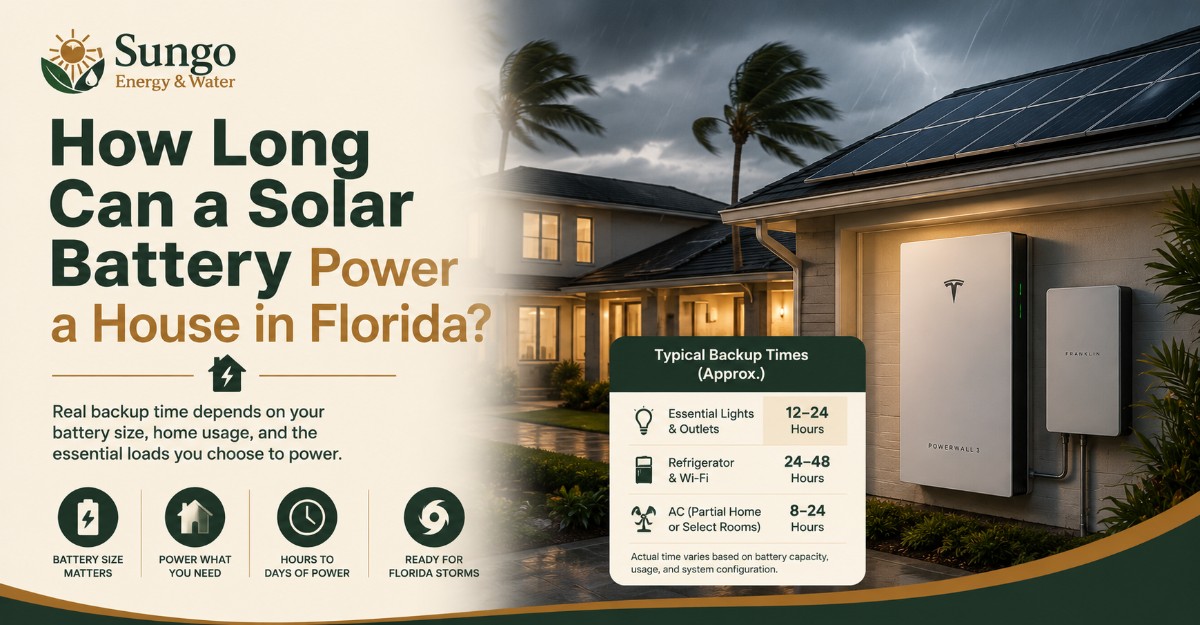
A solar battery can power a house in Florida for roughly 3 to 4 hours running central air conditioning, 8 to 10 hours on average whole-home loads, or 27 to 45 hours on critical appliances alone, using one standard 13.5 kWh battery. Paired with daytime solar generation, runtime extends indefinitely when production covers your loads.
Runtime comes down to one equation: usable battery capacity divided by your continuous electrical load. A single 13.5 kWh lithium iron phosphate (LFP) battery, the most common size installed in Florida through 2026, runs a 3.5 kW central air conditioner for under 4 hours, yet the same battery sustains a refrigerator, Wi-Fi router, phone chargers, and LED lighting for well over a full day.
Florida complicates this math because the average household consumes 37 to 40 kWh per day, according to U.S. Energy Information Administration (EIA) residential data, nearly double a mild-climate home, driven almost entirely by year-round cooling. Battery size sets your ceiling. Load management sets your reality. Daytime solar recharging turns a few hours of backup into open-ended resilience during a long outage.
Key Facts at a Glance
- ▸ A 13.5 kWh battery runs critical loads (fridge, Wi-Fi, lights, chargers) for 27 to 45 hours with no sun.
- ▸ The same battery lasts under 4 hours running a 3-ton central air conditioner continuously.
- ▸ Florida homes average 37 to 40 kWh per day, among the highest loads in the U.S. (EIA).
- ▸ With 4.5 to 5.5 peak sun hours, daytime solar can fully recharge a battery and extend runtime indefinitely.
- ▸ LFP batteries deliver 100% usable capacity and 6,000 or more charge cycles.
- ▸ Major hurricanes cause outages lasting 3 to 14 days, far longer than one battery covers alone.
What decides how long a solar battery lasts in Florida?
Three variables decide how long a solar battery lasts in Florida: usable capacity in kWh, your continuous load in kW, and how much energy daytime solar can push back into the battery. The runtime formula is simple: hours of backup equal usable kWh divided by the load in kW. A 13.5 kWh battery under a 1.5 kW load lasts nine hours; under a 3.5 kW load it lasts under four.
Usable capacity matters more than nameplate capacity. An LFP battery gives you 100% of its rated kWh, while an older lead-acid bank surrenders only 50% before damage. Load is where Florida homes differ from the national picture, because central cooling can pull 3 to 4 kW on its own. Solar recharge is the third lever, and it is the only one that can make runtime effectively unlimited.
How Backup Power Flows During a Florida Outage
How long will a 13.5 kWh battery run in a Florida home?
A 13.5 kWh battery runs a full-load Florida home with central AC for 3 to 4 hours, an average whole-home load for 8 to 9 hours, essentials with a window unit for 11 to 13 hours, and critical loads only for 27 to 45 hours. Runtime falls as continuous draw rises, which is why load management, not battery brand, is the real lever during an outage. The table below shows measured runtime by scenario for a single 13.5 kWh LFP unit with 100% usable capacity.
| Load scenario | Continuous draw | Runtime with no sun |
|---|---|---|
| Central AC (3-ton) plus normal home | 3.5 to 4.0 kW | 3 to 4 hours |
| Whole home, Florida daily average | 1.5 to 1.7 kW | 8 to 9 hours |
| Essentials plus one window AC unit | 1.0 to 1.2 kW | 11 to 13 hours |
| Critical loads only (fridge, Wi-Fi, lights, chargers) | 0.3 to 0.5 kW | 27 to 45 hours |
| Refrigerator only | 0.15 to 0.2 kW | 65 to 90 hours |
How long can it run central air conditioning?
A 13.5 kWh battery runs a 3-ton central air conditioner for under 4 hours of continuous compressor operation. In practice the compressor cycles rather than running flat out, so a well-insulated home may stretch cooling to 6 to 8 hours as the thermostat rests the unit between calls.
The bigger obstacle is not capacity but surge: a standard AC compressor demands a startup spike two to three times its running wattage, and a battery inverter that cannot deliver that instantaneous kW simply trips offline. A soft-starter on the compressor cuts the surge by 50 to 70% and often makes the difference between AC that runs and AC that stalls the whole system.
How long can it run critical appliances only?
Restricted to critical appliances, a 13.5 kWh battery lasts 27 to 45 hours with no solar input. A refrigerator draws about 150 to 200 watts averaged over its cycle, a Wi-Fi router and modem draw 15 watts, LED lighting for a room or two draws 50 watts, and phone or medical-device charging adds 20 to 40 watts.
Combined, these essentials pull 0.3 to 0.5 kW, so one battery carries a family through a full day and most of a second night without sun. Add even partial daytime solar and that window opens further.
Can a solar battery power a Florida house indefinitely?
Yes, a solar battery can power a Florida house indefinitely, but only when daytime solar production exceeds daytime consumption and refills the battery before nightfall. Florida averages 4.5 to 5.5 peak sun hours per day (National Renewable Energy Laboratory irradiance data), so a 10 kW array can generate 45 to 55 kWh on a clear day. If your outage loads stay under that and the battery recharges to full by late afternoon, you loop forever.
The catch is the weather that causes most Florida outages in the first place. Hurricane and tropical-storm bands blanket panels in heavy cloud for two to five days, cutting production to 20 to 40% of clear-sky output exactly when you need it. That is the honest limitation: the “indefinite” runtime assumes sunshine, and the storms that knock out the grid also starve your recharge. Plan capacity for several zero-sun days rather than trusting the perpetual loop during a hurricane.
How do Florida heat and humidity shorten battery runtime?
Florida heat shortens effective runtime mostly by raising your cooling load, not by draining the battery directly. Lithium iron phosphate cells hold their rated capacity well from 0°C to about 45°C (32°F to 113°F), so a hot garage costs you little usable energy on any given day. The real penalties are indirect and long-term, and the table below separates myth from mechanism.
| Heat factor | Real effect on runtime | Practical fix |
|---|---|---|
| Rising indoor temperature | AC runs longer, load climbs to 3.5 kW or more | Pre-cool the home, raise thermostat to 78°F |
| Ambient above 40°C (104°F) sustained | Accelerated cell degradation, not instant loss | Mount battery in shade or a conditioned space |
| High humidity | Heat index raises perceived cooling demand | Use dehumidification, run fans to feel cooler |
| Direct sun on enclosure | Long-term capacity fade over years | Avoid west-facing exterior walls |
The counterintuitive truth is that heat is a durability problem, not a runtime problem. A battery on a sun-baked wall will still deliver near-full kWh this year, but it may lose 10 to 15% of its cycle life over a decade compared with a shaded install. Runtime today is governed by how hard your AC works, which is why load discipline beats worrying about cell temperature.
How long do Florida power outages actually last?
Everyday Florida outages last minutes to a few hours, but major hurricanes cause outages of 3 to 14 days in hard-hit areas, according to restoration reports from Florida Power & Light (FPL) and Duke Energy Florida following recent storms. That gap is the single most important planning fact, because a single battery covers a routine flicker easily yet falls far short of a multi-day hurricane restoration on its own.
| Outage cause | Typical duration | Single 13.5 kWh battery verdict |
|---|---|---|
| Grid fault or afternoon storm | 15 minutes to 4 hours | Fully covers critical and most home loads |
| Tropical storm, moderate damage | 1 to 3 days | Covers critical loads with daytime solar top-up |
| Category 3 to 5 hurricane, direct hit | 3 to 14 days | Insufficient alone, needs stacked batteries plus solar |
| Rural or barrier-island restoration | Up to 2 weeks | Requires multi-battery plus large array or generator |
The practitioner rule that follows: size your system to the outage you fear, not the outage you expect. Most Florida homeowners buy one battery for daily flickers, then discover during a Category 4 that critical-loads-only runtime and cloudy skies do not carry them through week-long restoration.
How many solar batteries do you need for a hurricane?
For a multi-day Florida hurricane, plan on 27 kWh or more of usable storage (two stacked batteries) paired with an active 8 to 10 kW solar array feeding a dedicated critical-load sub-panel. That combination carries essential loads through cloudy days when solar recharge drops to a fraction of normal. The table maps storage tiers to realistic hurricane coverage.
| Storage tier | Example configuration | Critical-loads runtime, cloudy days |
|---|---|---|
| 13.5 kWh | One Tesla Powerwall 3 | 1 to 2 days |
| 27 kWh | Two stacked LFP units | 2 to 4 days |
| 40 kWh | Three units plus 10 kW array | 4 to 7 days with partial sun |
| 40 kWh plus generator | Battery for silence, generator for AC | Effectively unlimited |
Modular systems make this scalable. A Tesla Powerwall 3 adds 13.5 kWh per unit, while an Enphase IQ Battery 5P stacks in 5 kWh increments for finer sizing. Prioritize a critical-load sub-panel over whole-home backup, because backing up the entire panel, pool pump and EV charger included, can bleed a full bank dry within two hours of a grid failure.
Solar battery vs generator: which powers a Florida house longer?
A generator powers a Florida house longer during a prolonged outage as long as fuel keeps flowing, while a solar battery powers it silently and refuels itself from the sun but cannot sustain continuous central AC for days. The right answer depends on fuel access and noise tolerance, not on which technology is newer. The comparison below weighs the factors that decide duration.
| Factor | Solar battery (13.5 to 27 kWh) | Standby generator (Generac, Kohler) |
|---|---|---|
| Runtime on critical loads | 1 to 7 days with solar recharge | Days to weeks while fuel lasts |
| Runs central AC continuously | No, drains in under 4 hours per battery | Yes, indefinitely with fuel |
| Fuel dependence in a hurricane | None, recharges from daytime sun | High, propane and gas sell out fast |
| Noise and cutover | Silent, switches in 10 to 20 ms | Loud, cutover delay of seconds |
| Florida sales tax on equipment | Exempt for solar and storage | Not exempt |
The verdict by scenario: for silent, fuel-free resilience covering essentials, the battery wins. For running whole-home central AC through a two-week restoration, the generator wins, provided you can source fuel during a regional shortage. Many storm-hardened Florida homes pair both, using the battery for quiet daily backup and the generator for extended AC.
How can you make a solar battery last longer during an outage?
You make a solar battery last longer during a Florida outage by cutting continuous load and protecting daytime recharge. The order below reflects what actually extends runtime in the field, from highest impact to lowest.
- Shed the central AC and switch to one inverter mini-split or window unit, dropping cooling load from 3.5 kW to under 1 kW.
- Move the pool pump and EV charger off the backup sub-panel so they cannot silently drain the bank.
- Set a backup reserve of 20 to 30% in the app so a surprise storm never finds the battery at zero.
- Pre-cool the home before the battery takes over, then raise the thermostat to 78°F to slow the next cooling cycle.
- Clean the panels, because agricultural-burn ash and dust in Florida can cut recharge below the level needed to run loads and refill at once.
- Add a soft-starter to any large compressor so surge trips do not force a full system restart.
The counterintuitive practitioner insight: the largest runtime gains come from load reduction, not from buying a bigger battery. Dropping from central AC to a mini-split roughly triples how long any battery lasts, which is cheaper and faster than adding a second unit.
Frequently Asked Questions
How long will a Tesla Powerwall 3 last in a Florida home? A Tesla Powerwall 3 holds 13.5 kWh of usable capacity and runs critical Florida loads for 27 to 45 hours, whole-home average loads for 8 to 9 hours, or central AC for under 4 hours. Daytime solar recharge extends these figures whenever production exceeds consumption.
Can a solar battery run my pool pump during an outage? A solar battery can run a pool pump, but most owners exclude it from the backup sub-panel. A single-speed pump draws 1.5 to 2 kW and can empty a 13.5 kWh battery in two hours, so backing it up sacrifices the runtime you need for a refrigerator and medical devices.
How much solar battery storage does a 2,000 sq ft Florida home need? A 2,000 sq ft Florida home needs 13.5 kWh for critical-loads backup or 27 kWh or more for extended, partial whole-home coverage. Cooling load, not square footage, drives the requirement, so a home relying on central AC needs the higher tier plus an 8 to 10 kW array.
Does net metering change whether a battery is worth it in Florida? Yes. Because FPL and other Florida utilities still credit exported solar at the full retail rate under 1-to-1 net metering, batteries rarely pay for themselves through bill savings. They are resilience tools for storm backup, so buy one for outage protection, not for a fast financial return.
How long does it take to recharge a solar battery from empty? A 13.5 kWh battery recharges from empty in roughly 2.5 to 3.5 hours on a clear Florida day with an 8 to 10 kW array, or overnight from the grid at a typical 5 kW charge rate. Cloud cover during storms can extend solar recharge to a full day or longer.
The Bottom Line
How long a solar battery can power a house in Florida ranges from under 4 hours on central air conditioning to more than 45 hours on critical loads with a single 13.5 kWh unit, and indefinitely when daytime solar keeps pace with consumption.
Florida’s 37 to 40 kWh daily average and multi-day hurricane outages mean one battery excels at silent, essentials-level backup but cannot run whole-home AC through a week-long restoration. Size storage to the outage you fear, isolate a critical-load sub-panel, protect your recharge, and pair with a generator only if uninterrupted central cooling is non-negotiable.