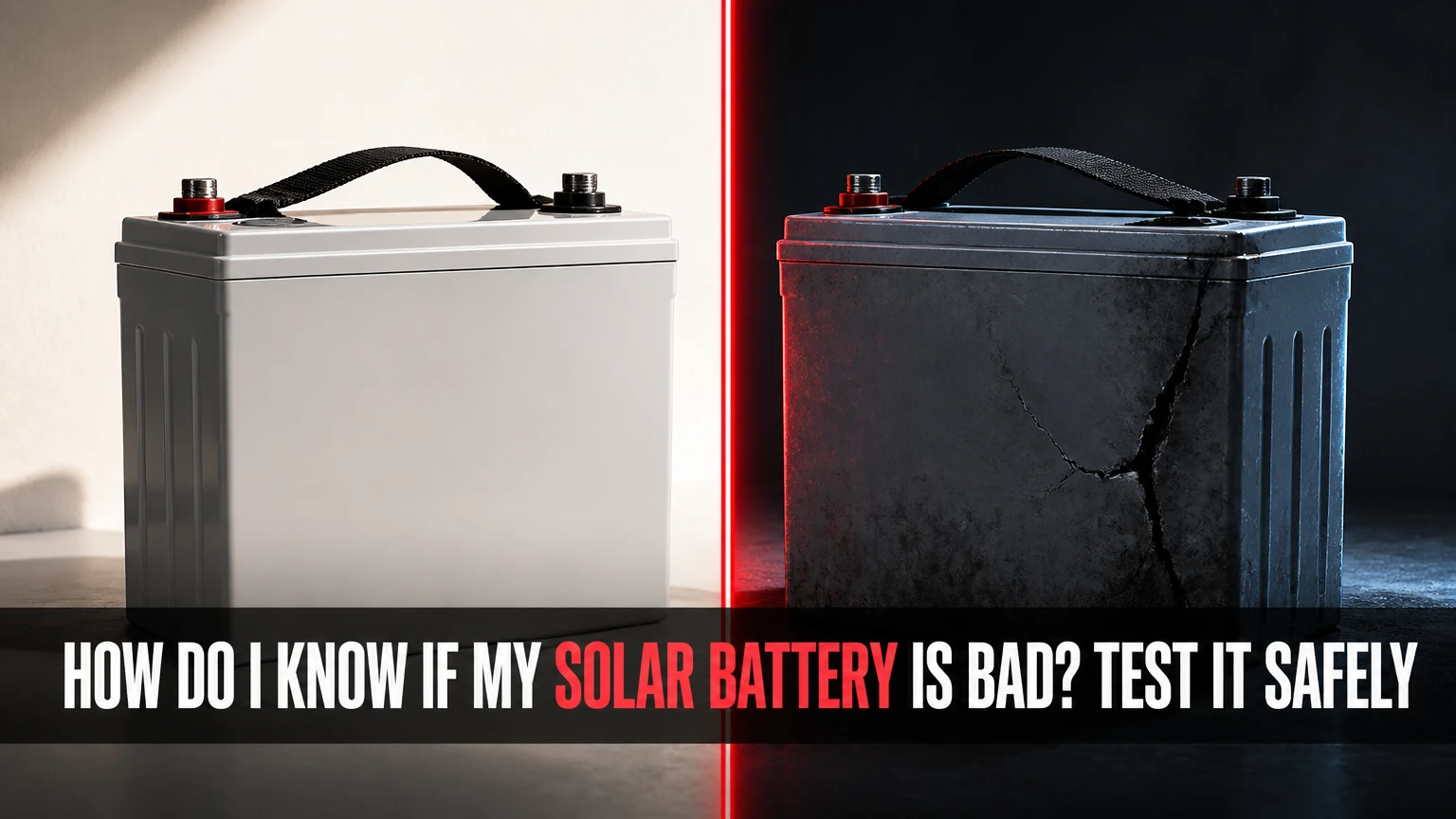
A solar battery is probably bad when it has physical damage, loses voltage rapidly under a known load, delivers substantially less usable energy than its rated capacity, or repeatedly reports a battery-management fault after connections and settings are verified. Voltage alone cannot prove failure because temperature, state of charge, cabling, the inverter, and the battery chemistry all affect the reading.
Key Facts at a Glance
A swollen, cracked, leaking, smoking, or unusually hot battery is unsafe and should not be tested.
A fully rested 12-volt lead-acid battery commonly reads about 12.6-12.8 volts; a 12-volt LiFePO4 battery commonly reads about 13.2-13.6 volts.
A battery that reaches 100% quickly and falls to empty within minutes usually has low usable capacity, incorrect settings, or a faulty state-of-charge estimate.
Lithium batteries require BMS, inverter, and manufacturer diagnostics; do not open, equalize, or manually balance a sealed lithium pack.
A capacity test is more reliable than a single voltage measurement for confirming end of life.
A replacement battery must match chemistry, voltage, charge profile, and, for a bank, age and capacity closely.
How Do I Know If My Solar Battery Is Bad?
A solar battery is likely failing if two or more independent symptoms appear together: rapid runtime loss, severe voltage sag, repeated low-voltage shutdowns, physical damage, abnormal heating, or a verified capacity below the manufacturer’s replacement threshold. One symptom alone is weaker evidence because a loose terminal, incorrect charge profile, cold temperature, or failed sensor can produce similar behavior.
Start with the battery’s monitoring app, inverter display, installation date, and warranty document. Record state of charge, battery voltage, charge or discharge power, temperature, and any fault code while the system is operating normally. A useful diagnosis compares those readings with actual energy delivered, rather than treating a displayed “100%” as proof that the cells are healthy.
The practical distinction is between a battery problem and a system problem. If the battery voltage looks normal at rest but the inverter loses power, inspect cables, fuses, disconnects, firmware, inverter limits, and communication wiring before buying a replacement.
What Signs Mean You Should Stop Testing Immediately?
A swollen, cracked, leaking, smoking, hissing, or burning-hot solar battery requires immediate isolation by a qualified installer, not a multimeter test. Keep people away, avoid sparks and metal tools, and follow the battery manufacturer’s emergency procedure; lithium batteries can remain hazardous after the visible symptom appears.
For a lead-acid battery, electrolyte leaks are corrosive and charging can produce hydrogen gas. Do not touch liquid with bare skin, smoke near the battery, or test an open battery in an unventilated room. For lithium batteries, swelling, a sharp solvent smell, venting, smoke, or rapid temperature rise indicates possible cell damage or thermal runaway.
A battery that is merely warm during a high-current charge is not automatically defective. The red flag is abnormal heat compared with neighboring batteries or the manufacturer’s temperature limit, especially when current is modest.
| Symptom | Possible cause | Safe first action | Replacement evidence |
|---|---|---|---|
| Case swelling | Overcharge, damaged cell, gas generation | Stop charging and isolate professionally | Strong evidence of failure |
| White or blue terminal corrosion | Acid vapor, moisture, poor connection | Turn off equipment before cleaning | Not by itself |
| Liquid leak | Cracked lead-acid case | Isolate, ventilate, use protective equipment | Strong evidence of failure |
| One battery much hotter | High resistance, shorted cell, overload | Stop charging and discharging | Strong evidence if repeated |
| BMS shutdown | Low or high cell, temperature, current fault | Read the fault code and manual | Not by itself |
Which Battery Type Changes the Diagnosis?
Battery chemistry determines normal voltage, allowable depth of discharge, maintenance, failure modes, and the tests that are safe to perform. Flooded lead-acid batteries can be inspected with a hydrometer, while sealed AGM, gel, and lithium batteries normally require voltage, current, capacity, and electronic diagnostics.
| Battery type | Typical service life | Typical usable depth of discharge | Main diagnostic method | Major hazard |
|---|---|---|---|---|
| Flooded lead-acid | 4-8 years | 30%-50% for long life | Rested voltage, hydrometer, load test | Acid and hydrogen gas |
| AGM lead-acid | 4-7 years | About 50% | Rested voltage and controlled load test | Overcharge and heat |
| Gel lead-acid | 5-10 years | About 50% | Rested voltage and capacity test | Overcharge damage |
| LiFePO4 lithium | 8-15 years or 3,000-8,000 cycles | 80%-100% by model | BMS data and controlled capacity test | Thermal and electrical energy |
| NMC lithium | 8-15 years or model-specific cycles | Usually 80%-90% | BMS, temperature, and capacity data | Thermal runaway |
These are typical ranges, not guarantees. The U.S. Department of Energy explains that battery life depends on cycle count, operating temperature, depth of discharge, and calendar aging. A lightly used battery in a temperature-controlled room can outlast a heavily cycled battery installed in a hot enclosure.
The often-repeated 70%-80% end-of-life rule is a useful planning convention, not a universal failure law. A manufacturer may define warranty end of life at 70%, 80%, a retained-energy figure, a fault condition, or a combination of those terms.
How Do I Test a Solar Battery’s Voltage?
Test rested voltage only after charging and discharging have stopped, because a charger can raise the terminal reading and a load can temporarily lower it. Turn off solar charging and household loads using the manufacturer’s shutdown procedure, wait at least 2-4 hours when practical, then measure DC voltage directly at the battery terminals.
Never disconnect live photovoltaic wiring unless the equipment manual identifies a safe disconnect sequence. Solar arrays can produce dangerous DC voltage in daylight, and many home storage systems contain lethal AC and DC energy even when the display is off.
| Nominal system | Rested reading commonly associated with full charge | Investigate when rested reading is | Important limitation |
|---|---|---|---|
| 12 V flooded lead-acid | 12.6-12.8 V | Below 12.2 V after a full charge | Temperature and surface charge matter |
| 12 V AGM | 12.7-12.9 V | Below the manufacturer’s low-charge value | AGM voltage varies by model |
| 12 V LiFePO4 | About 13.2-13.6 V | Below the BMS or manufacturer limit | Flat voltage curve hides state of charge |
| 24 V lead-acid bank | 25.2-25.6 V | Below about 24.4 V after full charge | Double the 12 V reference approximately |
| 48 V lithium system | Manufacturer-specific | Any BMS or inverter fault | Pack voltage is not cell health |
A single low reading proves the battery is discharged, not necessarily ruined. Recharge it using the correct profile, allow it to rest, and repeat the measurement. If the voltage falls quickly while disconnected, a self-discharge problem or damaged cell becomes more likely.
How Do I Test a Flooded Lead-Acid Battery?
A flooded lead-acid battery needs a full charge, a temperature-corrected hydrometer test, and a controlled load or capacity test. Wear eye protection and acid-resistant gloves, remove jewelry, ventilate the area, and never use a hydrometer on AGM, gel, or lithium batteries.
Specific gravity measures electrolyte density in each cell. A fully charged flooded lead-acid cell commonly measures approximately 1.265-1.280 at the manufacturer’s reference temperature, but the battery label or manual takes priority because formulations differ.
| Hydrometer result at reference temperature | Likely interpretation | Next action |
|---|---|---|
| 1.265-1.280 in every cell | Fully charged and reasonably balanced | Continue with a capacity or load test |
| 1.220-1.250 in every cell | Partly charged or undercharged | Charge fully and retest |
| Below 1.200 in every cell | Deep discharge or chronic undercharge | Charge correctly, then retest |
| One cell more than 0.030-0.050 below others | Weak or damaged cell | Obtain professional confirmation |
| Readings rise after controlled equalization | Possible stratification or sulfation | Follow the battery manual only |
Equalization is an occasional controlled overcharge for some flooded lead-acid batteries. It is not a universal repair, and it can destroy AGM, gel, and lithium batteries. Never add acid to “fix” a low reading; flooded batteries normally receive distilled water after charging, according to the manufacturer’s instructions.
How Do I Confirm Capacity Loss?
A capacity test confirms failure more reliably than resting voltage because capacity measures how much energy the battery can actually deliver. Fully charge the battery, apply a known load, record current and time, and stop at the manufacturer’s specified cutoff voltage, preferably with a battery analyzer or qualified technician.
For a rough calculation, delivered energy in watt-hours equals average battery voltage multiplied by average current in amps multiplied by test time in hours. For example, a 12-volt battery delivering 5 amps for 10 hours provides approximately 600 watt-hours before accounting for voltage variation and cutoff losses.
| Test result | Practical meaning | Likely decision |
|---|---|---|
| 90%-100% of rated capacity | Normal aging range | Keep monitoring |
| 80%-90% of rated capacity | Noticeable degradation | Compare with warranty terms |
| 70%-80% of rated capacity | Common planning end-of-life zone | Consider replacement |
| Below 70% of rated capacity | Severe capacity loss | Replace if economics support it |
| Voltage collapses immediately | High resistance or failed cell | Stop test and investigate |
A home appliance is a poor precision load because its power changes during operation. A controlled DC load, calibrated battery analyzer, or inverter energy report gives a more defensible result. Capacity also changes with discharge rate, so compare the test method with the rating conditions in the battery datasheet.
Why Does the Battery Reach 100% Quickly and Empty Fast?
A solar battery that reaches 100% rapidly and falls to empty within minutes usually has lost usable capacity, but incorrect charge settings and state-of-charge calibration can create the same pattern. Lead-acid sulfation, lithium cell imbalance, a conservative BMS cutoff, excessive standby loads, and inaccurate shunt calibration are common causes.
The “tiny cup instead of a large bucket” explanation is useful for capacity loss, but it is incomplete. A lithium battery may show 100% because the BMS sees the charge ceiling, even when one cell is limiting the pack. A lead-acid battery may reach absorption voltage quickly while accepting little current, despite having poor capacity.
Check these items in order:
- Compare overnight energy use with the battery’s usable kilowatt-hours.
- Check inverter standby consumption and hidden loads.
- Confirm battery chemistry and charge-voltage settings.
- Review BMS cell voltages, temperature, and state-of-health data.
- Perform a controlled capacity test before declaring the cells defective.
What Do Inverter and BMS Error Codes Mean?
An inverter or battery-management-system error code identifies a condition, not always a failed battery. Low-voltage, over-temperature, over-current, communication, isolation, and cell-voltage faults can result from wiring, firmware, sensors, configuration, or the battery itself.
Record the exact code, time, battery temperature, state of charge, charge or discharge current, and whether the fault occurs during charging or discharging. Then consult the battery and inverter manuals together, because a CAN or RS485 communication fault can make a healthy battery appear unavailable.
| Fault indication | Common non-battery cause | Battery-related cause | Useful check |
|---|---|---|---|
| Low voltage under load | Loose cable or undersized conductor | High internal resistance | Measure at battery and inverter |
| BMS over-temperature | Hot enclosure or blocked airflow | Failing cell or sensor | Compare sensor data with ambient |
| Communication loss | Cable, termination, firmware | BMS failure | Inspect approved communication wiring |
| Cell over-voltage | Incorrect charge profile | Imbalance or weak cell | Review individual cell values |
| Battery unavailable | Open disconnect or blown fuse | BMS protection state | Follow restart sequence |
Do not repeatedly reset a BMS without correcting the trigger. Repeated trips can interrupt essential loads and conceal a worsening fault.
Can a Loose Cable Make a Good Battery Look Bad?
A loose, corroded, undersized, or damaged cable can make a healthy solar battery look defective by creating voltage drop under load. Measure voltage at the battery terminals and again at the inverter terminals while the same load operates; a significant difference points toward the connection or conductor rather than the cells.
Turn off all sources using the approved procedure before tightening or cleaning connections. Use the specified torque, fuse rating, cable size, and terminal hardware. Do not bypass a fuse or substitute a larger protective device.
A practical field rule is to inspect the highest-current path first: battery terminals, disconnects, fuse holders, busbars, lugs, and inverter terminals. Heat discoloration or a hot connector is evidence of resistance and requires service, even if the battery voltage appears normal at rest.
How Should Temperature Affect the Diagnosis?
Temperature changes battery voltage, charge acceptance, available capacity, and safety limits. Lead-acid capacity typically falls in cold conditions, while lithium batteries must not be charged below the minimum temperature specified by the manufacturer, often around 0°C or 32°F without low-temperature protection.
Hot environments accelerate aging. The Battery Council International identifies heat as a major factor in lead-acid battery deterioration, and many lithium manufacturers restrict charging or discharging when cell temperatures leave the approved operating range.
| Condition | Lead-acid effect | Lithium effect | Diagnostic implication |
|---|---|---|---|
| Below 0°C / 32°F | Reduced available capacity | Charging may be blocked | Do not label failure from runtime alone |
| 10-25°C / 50-77°F | Near reference performance | Usually favorable range | Best testing conditions |
| Above 30°C / 86°F | Faster aging and water loss | Accelerated degradation risk | Check ventilation and temperature logs |
| Above manufacturer limit | Charging damage possible | BMS protection may trip | Stop and obtain service |
Testing at approximately 20-25°C gives more comparable results. Record temperature with every voltage or capacity measurement.
When Should You Replace the Battery?
Replace a solar battery when the manufacturer’s warranty threshold is reached, a controlled capacity test confirms severe loss, a cell fault persists, or physical damage makes continued operation unsafe. A battery that is old but still meets energy needs does not require replacement solely because it has reached a typical calendar age.
Replacement decisions should include the complete system. A new battery paired with older units can create unequal charging, current sharing, and state-of-charge behavior. In a series or parallel bank, match voltage, chemistry, capacity, model compatibility, and preferably age; follow the manufacturer’s rules for adding batteries.
| Replacement factor | Typical value or rule | Why it matters |
|---|---|---|
| Flooded lead-acid age | 4-8 years | Calendar aging becomes significant |
| AGM age | 4-7 years | Heat and deep discharge shorten life |
| LiFePO4 age | 8-15 years | Cycle count and temperature dominate |
| Planning capacity threshold | 70%-80% | Common warranty or economic benchmark |
| Home lithium system | Often 5-15 kWh | Size must match loads and backup goals |
| Professional diagnostic visit | Typically $100-$300 | Local labor and system complexity vary |
Typical U.S. replacement pricing varies widely. A 100 Ah lead-acid battery may cost roughly $120-$450, while a complete 10-15 kWh home lithium installation can reach several thousand to more than $10,000 after equipment, labor, permits, and balance-of-system costs. Obtain an itemized quote.
What Should You Avoid When Diagnosing a Solar Battery?
The most expensive diagnostic mistakes are testing a battery while the charger is active, using the wrong voltage reference, equalizing lithium chemistry, and replacing one unit in an aged bank without checking compatibility. Each mistake can produce a false diagnosis or create a safety hazard.
Avoid these specific practices:
- Do not use a car-battery test value as a universal deep-cycle or lithium threshold.
- Do not open a sealed lithium battery or bypass its BMS.
- Do not hydrometer-test AGM, gel, or lithium batteries.
- Do not charge lithium batteries below the specified temperature.
- Do not infer capacity from a single app percentage.
- Do not leave lead-acid batteries partially charged for extended storage.
- Do not clean terminals while the system remains energized.
- Do not install a battery with an incompatible charge profile.
One practitioner rule is especially useful: diagnose the measurement chain before diagnosing the cells. Confirm the meter, shunt, cables, fuses, sensors, and settings first.
Can a Bad Solar Battery Be Repaired?
Some apparent battery failures are recoverable, but a damaged cell, swollen case, persistent internal short, or thermal event is not a safe DIY repair. Lead-acid batteries may recover from ordinary undercharge if sulfation is limited, while lithium BMS faults require manufacturer-approved procedures or specialist service.
A technician may correct loose connections, replace a fuse, update firmware, recalibrate a shunt, repair communication wiring, or adjust an incorrect charge profile. Those repairs do not restore chemically lost capacity. Battery additives, acid replacement, and improvised cell balancing are unreliable and can void warranties.
Use repair only when the diagnosis identifies a reversible external cause. Replace the battery when the measured capacity, safety condition, or manufacturer diagnostic points to cell degradation.
How Can You Extend Solar Battery Life?
Correct charging, moderate temperature, appropriate depth of discharge, and timely fault response extend solar battery life more effectively than occasional emergency testing. Follow the exact charge and storage settings for the chemistry, because lead-acid maintenance rules and lithium operating rules differ substantially.
For lead-acid systems, maintain the specified state of charge, inspect flooded electrolyte levels, clean corrosion safely, and provide ventilation. For lithium systems, keep the BMS enabled, maintain approved temperature conditions, avoid unauthorized firmware or wiring changes, and use the manufacturer’s state-of-health data.
| Maintenance action | Flooded lead-acid | AGM or gel | Lithium |
|---|---|---|---|
| Inspect terminals | Monthly to quarterly | Quarterly | Quarterly or app-based |
| Add distilled water | Yes, if specified | Never | Never |
| Equalization | Only if manufacturer permits | Usually no | No |
| BMS review | Not applicable | Usually not applicable | Monthly or after faults |
| Storage target | Fully charged | Manufacturer-specific | Manufacturer-specific partial charge may apply |
Monitoring trends is more useful than checking one reading. A gradual fall in delivered kilowatt-hours, increasing voltage sag, or rising cell imbalance deserves attention before the battery stops unexpectedly.
Frequently Asked Questions
Can solar panels work if the battery is bad?
Solar panels can still produce electricity when a battery is failed, but a hybrid or off-grid inverter may stop charging, disconnect the battery, or shut down for protection. A grid-tied system can continue exporting power if its inverter is designed for that mode. Check the inverter architecture before disconnecting any battery.
How long should a solar battery hold a charge overnight?
Overnight runtime depends on usable capacity and load, not battery nameplate capacity alone. A 10 kWh battery with 8 kWh usable energy powering a continuous 500-watt load would theoretically run for about 16 hours before conversion losses and reserve limits. Measure actual loads with the inverter monitor.
Is a low voltage always proof that the battery is dead?
Low voltage is not proof of a dead solar battery. A discharged battery, cold temperature, loose cable, high load, incorrect meter range, or BMS protection state can produce a low reading. Recharge correctly, allow the battery to rest, compare terminal and inverter voltage, and use a capacity test for confirmation.
Should I replace only one battery in a solar bank?
Replacing one battery is acceptable only when the manufacturer permits it and the new unit matches the bank’s chemistry, voltage, capacity, model, and compatibility requirements. In an older series or parallel bank, replacing the complete bank is often more reliable because unequal internal resistance causes poor current sharing.
What does state of health mean on a lithium battery?
State of health estimates remaining capacity or performance compared with the battery’s original condition. The calculation differs by manufacturer and may combine cycle history, resistance, voltage behavior, and delivered energy. Treat a falling SOH trend as evidence, but confirm unexpected values through the manufacturer’s diagnostic process.
Does rain or cloudy weather damage a solar battery?
Rain and cloudy weather do not normally damage a correctly installed solar battery. Cloud cover reduces charging energy, so the battery may remain at a lower state of charge and appear to have shorter runtime. Water intrusion, condensation, flooding, and an outdoor enclosure with an unsuitable IP rating can cause genuine damage.
The Bottom Line
To determine how do i know if my solar battery is bad, first rule out unsafe physical damage, incorrect settings, temperature, cables, fuses, and inverter faults. Then compare rested voltage with chemistry-specific values, inspect BMS or hydrometer data where appropriate, and confirm suspected failure with a controlled capacity test. Replace the battery when safety, warranty criteria, or verified usable capacity justify it, rather than relying on one voltage reading or an app percentage.