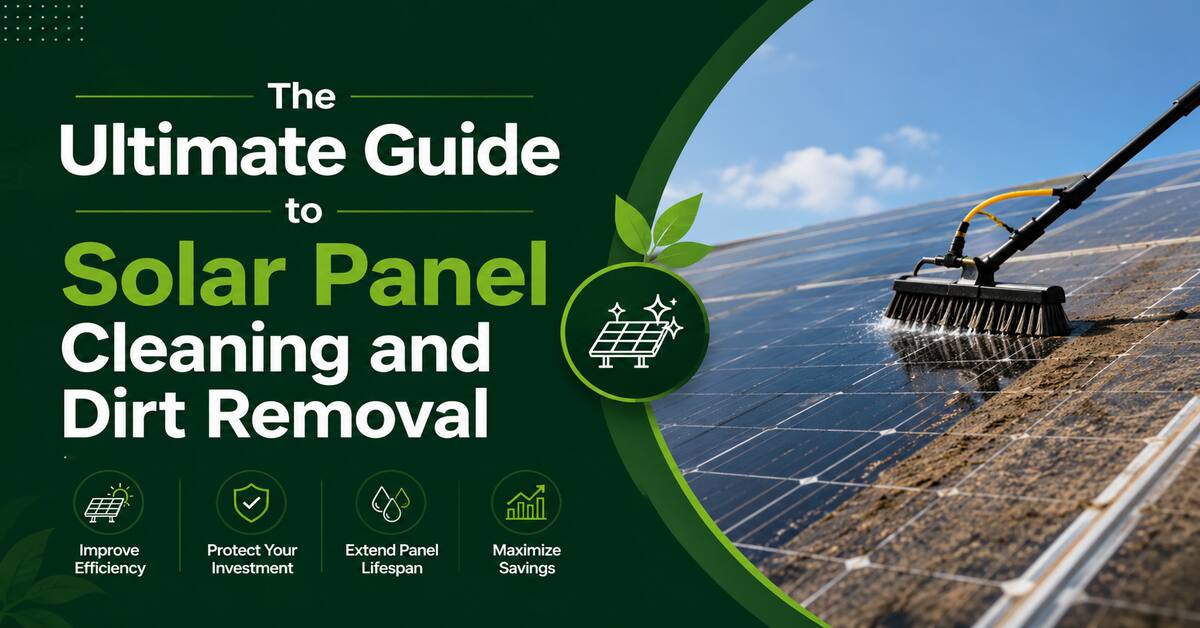
Solar panel cleaning is the systematic removal of accumulated environmental debris commonly known as “soiling” from the glass surface of photovoltaic (PV) modules. Routine cleaning restores optimal light transmittance through the tempered glass, prevents localized electrical resistance (hot spots), and ensures the solar array produces its maximum designed energy yield.
Key Facts / Quick Answer
- Soiling defined: The accumulation of airborne pollutants, dust, bird droppings, and pollen that creates a light-blocking film over photovoltaic cells.
- Performance impact: Uncleaned panels lose 2% to 5% efficiency annually in temperate zones, and up to 40% in arid or desert regions.
- Water requirements: Cleaning requires deionized or reverse-osmosis purified water with under 10 parts per million (ppm) Total Dissolved Solids to prevent mineral scaling.
- Pressure limits: Water delivery systems must remain under 50 psi to avoid breaking module laminate seals and causing inverter ground faults.
- Thermal safety: Panels must be cleaned when ambient module temperatures are below 40°C (104°F) to prevent catastrophic thermal shock and glass shattering.
What is Solar Panel Soiling and Why Does It Matter?
Solar panel soiling is the buildup of particulate matter on a solar array that blocks photons from reaching the underlying silicon wafers. This accumulation triggers a measurable multi-stage electrical degradation process within the photovoltaic system.
How does dirt accumulation affect photovoltaic performance? Soiling reduces total solar irradiance reaching the cells, causes electrical current mismatches across series-wired modules, and forces shaded cells to dissipate power as destructive heat.
The degradation process follows a predictable sequence:
- Light Attenuation: Particulate matter resting on the glass reflects and absorbs incoming photons. This directly limits the photovoltaic effect, reducing the total direct current (DC) generated by the cell.
- Current Mismatch: Solar panels are wired in series strings. When one cell is heavily shaded by dirt (such as an opaque bird dropping), the electrical current of the entire string drops to match the bottleneck created by the lowest-performing cell.
- Thermal Stress and Hot Spots: A severely shaded cell stops producing power and instead acts as an electrical resistor. The power generated by adjacent, clean cells is forced through this resistor, dissipating as extreme heat. This localized heat creates “hot spots” that can permanently burn through the polymer backsheet or destroy the module’s bypass diodes.
Expert Insight: The most overlooked consequence of soiling is bio-soiling on the lower aluminum frame. Dust pools at the bottom edge of panels pitched under 15 degrees. When wet, this dust breeds lichen and fungi, which grow upward over the lowest row of cells, permanently destroying the string’s voltage if not chemically treated.
How to Clean Solar Panels Manually: A Step-by-Step Guide
Manual solar panel cleaning requires a specific operational sequence to prevent electrocution, glass damage, and warranty voiding. For residential and commercial arrays lacking automated washing systems, operators must follow these five steps.
1. Pre-Inspection and Safety Isolation
Operators must physically shut down the system via the AC isolator switch and the DC inverter disconnect before water touches the roof. Once isolated, visually inspect the modules for cracked glass, exposed internal wiring, or loose MC4 connectors. Applying water to compromised electrical components creates lethal arc-flash hazards.
2. Thermal Management Timing
Cleaning must be scheduled during early morning, late evening, or on heavily overcast days when ambient panel temperatures remain below 40°C (104°F). Applying ambient-temperature water to sun-heated tempered glass causes immediate thermal shock. The rapid contraction of the surface layer against the expanded inner layer will shatter the glass instantly.
3. Dry Debris Clearance
Technicians must use a soft-bristled, dry nylon brush or microfiber broom to sweep away loose dust, leaves, and large particulate matter. Skipping this dry-clearance phase forces the dirt into an abrasive mud paste when water is introduced. Scrubbing this paste acts like liquid sandpaper, permanently scratching the ultra-thin anti-reflective (AR) coating applied to the glass.
4. Controlled Wash and Agitation
Cleaning requires applying low-mineral or deionized water through a low-pressure delivery system restricted to under 50 psi. Operators scrub the glass gently using a water-fed pole equipped with a soft microfiber mop or dedicated, non-abrasive solar brush head. For localized, baked-on dirt like bird droppings, operators use a specialized plastic scraper or a soft nylon pad to agitate the area without gouging the glass.
5. Thorough Rinse and Squeegee Dry
The process concludes by flushing the panel surface with a final stream of pure water to wash away all suspended dirt particles. Technicians then use a soft rubber squeegee to pull all remaining water droplets from the glass, working systematically from the top edge to the bottom. Manual drying prevents the formation of hard-water spots caused by evaporating trace minerals.
What Are the Primary Solar Panel Cleaning Methods?
The optimal solar panel cleaning method depends entirely on the scale of the array, regional water availability, and the specific site topography.
| Method | Description | Best Suited For | Efficiency Recovery |
| Manual (Squeegee & Brush) | Human operator utilizing telescopic water-fed poles, soft brushes, and rubber squeegees. | Residential rooftops, small commercial arrays, complex roof layouts. | 95% – 99% |
| Pure Water Systems | Reverse osmosis (RO) and deionization (DI) systems producing water with <10 ppm TDS. | Commercial flat roofs, mid-scale ground mounts, agricultural arrays. | 98% – 100% |
| Robotic (Crawler/Track) | Remote-controlled or autonomous tractor-robots utilizing dry microfiber rotating rollers. | Large utility-scale plants (>5MW), expansive flat industrial roofs. | 97% – 99% |
| Fixed Sprinkler Systems | Automated overhead water nozzles integrated directly into the module racking framework. | Arid, high-dust zones with access to cheap, plentiful water. | 85% – 92% |
| Anti-Soiling Coatings | Hydrophobic (water-repelling) or hydrophilic chemical films applied over the factory glass. | High-pollution sites requiring extended intervals between manual washes. | Prevents 30% – 50% of loss |
How Much Does Solar Panel Cleaning Cost?
Solar panel cleaning costs scale inversely with system size; residential homeowners pay the highest per-panel premium, while utility-scale operators achieve massive economies of scale.
Residential, Commercial, and Utility-Scale Pricing
Residential systems (typically 3 kW to 10 kW) cost between $150 and $350 per service, requiring 1 to 2 hours of labor. Commercial systems (10 kW to 100 kW) transition to per-panel pricing, averaging $5 to $10 per module, or flat day-rates ranging from $500 to $1,500 for a 4 to 8-hour shift. Utility-scale systems exceeding 1 Megawatt utilize robotic or tractor-mounted machinery, driving costs down to $1.00 to $2.50 per panel, though the process spans multiple weeks.
Regional Soiling Losses vs. Cleaning ROI
The return on investment for cleaning depends on regional geography and the array’s tilt angle. In temperate or rainy regions, natural precipitation cleans panels effectively, limiting annual soiling losses to 2% to 5%. In arid or desert regions, unchecked dust accumulation causes severe irradiance blocking, resulting in 15% to 40% efficiency losses over a single dry season. Installations adjacent to heavy industry, highways, or agriculture routinely suffer 10% to 25% localized efficiency drops due to soot, diesel exhaust, and chemical fertilizers.
What Are the Most Common Solar Cleaning Mistakes?
Improper solar panel cleaning causes irreversible hardware damage that instantly voids manufacturer performance warranties.
- Using Hard Tap Water: Unfiltered municipal water contains high levels of calcium, magnesium, and iron. When this water evaporates on the hot glass, it leaves behind white, crystalline calcium carbonate scales. This scaling permanently shadows the underlying cells and requires aggressive chemical acid treatments to remove.
- Deploying High-Pressure Washers: Utilizing pressure washers outputting over 50 psi forces water past the perimeter laminate seals bridging the glass and the aluminum frame. This water migrates into the electrical junction box, causing immediate ground faults and rapid corrosion of the copper contacts.
- Applying Harsh Chemical Detergents: Household products like dish soap, ammonia-based window cleaners, or abrasive degreasers chemically strip the anti-reflective (AR) coating from the tempered glass. Removing this AR coating permanently lowers the panel’s ability to trap off-angle sunlight.
- Using Abrasive Cleaning Tools: Scrubbing with wire brushes, steel wool, or coarse sponges inflicts microscopic scratches across the glass surface. These micro-scratches scatter incoming sunlight away from the cells and create physical ridges that trap future dirt at an accelerated rate.
Expert Insight: If a homeowner uses standard dish soap, it leaves a microscopic surfactant film on the glass. This sticky residue acts as a magnet for airborne pollen and dust, ensuring the panel gets dirtier twice as fast as it would have if cleaned with pure water alone.
How to Troubleshoot Persistent Solar Dirt and Cleaning Errors
When solar cleaning results in system errors or stubborn residues, operators must diagnose the root cause before attempting corrective action.
Issue: Persistent White Smeared Stains After Drying
White smeared stains indicate that mineral deposits have bonded to the glass, caused either by utilizing hard tap water or cleaning when the panel was too hot, resulting in flash-evaporation. To correct this, technicians must immediately re-wash the array using pure deionized water (<10 ppm TDS) and a squeegee. If the calcium deposits have cured and hardened, operators must apply a specialized, manufacturer-approved oxalic or citric-acid solar cleaner to safely dissolve the scale without etching the glass.
Issue: Inverter Throws “Ground Fault” or “Isolation Error”
A ground fault error following a wash means water has penetrated the electrical system—typically through an unsealed junction box, a micro-cracked polymer backsheet, or an improperly seated MC4 connector. Do not attempt to reset the system. Keep the AC and DC isolators turned off and allow the array to dry naturally in the sun for 24 to 48 hours. If the error persists, technicians must use a thermal imaging camera or an insulation resistance tester (Megger) to pinpoint the specific leaking module before restarting the string.
Issue: Sticky Saps or Bird Droppings Will Not Move
Organic matter like tree sap and concentrated bird guano often bakes into the glass surface under intense UV heat, calcifying into a hard resin. Never use a metal blade or razor to scrape these off. Instead, soak the affected localized area with warm pure water mixed with a specialized, pH-neutral organic emulsifier. Let the emulsifier dwell for 5 minutes to break down the proteins, then gently agitate the remaining mass with a soft nylon pad.
Expert Recommendations by System Size and Location
Solar panel maintenance strategies must align with the specific infrastructure, budget, and environmental exposure of the system owner.
1. Suburban Residential Homeowner
Suburban homeowners should rely on natural rainfall for cleaning if their roof pitch exceeds 15 degrees. Action plan: Conduct a visual inspection twice a year. If the property sits near major highways, active construction zones, or heavy tree cover, execute a manual cleaning once annually in late spring (post-pollen season). Homeowners should use only a soft microfiber cloth, pure water, and an extension pole from ground level never climbing onto a wet, slippery roof structure.
2. Commercial / Industrial Property Manager (50kW – 500kW)
Commercial property managers with flat-roof arrays must implement a scheduled, data-driven preventative maintenance program. Action plan: Outsource cleaning to insured, specialized solar technicians twice a year. Property managers must mandate in the service contract that vendors use pure-water (RO/DI) delivery systems. To verify the financial return on investment, managers should demand pre- and post-cleaning inverter output logs to quantify the exact energy yield recovery.
3. Utility-Scale Plant Operator (>5MW in Arid Regions)
Utility-scale operators managing multi-megawatt desert installations must rely on automated or mechanical deployment to maintain viability. Action plan: Deploy waterless, autonomous track-driven cleaning robots or tractor-mounted rotating brush assemblies. Operators should execute a strict cleaning rotation every 2 to 4 weeks during dry seasons to preempt exponential soiling losses. To optimize OPEX, plants should install an optical soiling sensor array that automatically triggers robotic deployment based on real-time efficiency drops rather than fixed calendar dates.
Frequently Asked Questions About The Ultimate Guide to Solar Panel Cleaning and Dirt Removal
Will rain adequately clean my solar panels?
Rain effectively clears loose dust and pollen only if the solar panels are installed at a tilt angle greater than 15 degrees. However, rain cannot remove baked-on bird droppings, sticky tree sap, or heavy industrial soot. Furthermore, light rain in dusty environments can actually create a muddy residue that worsens light transmittance.
How often should solar panels be cleaned?
Cleaning frequency depends entirely on location. Arrays in temperate, rainy climates with steep roof pitches may only require cleaning every 1 to 2 years. Conversely, arrays in arid deserts, near agricultural operations, or adjacent to heavy industrial zones require professional cleaning every 3 to 6 months to prevent severe yield degradation.
Do I need to clean snow off my solar panels in the winter?
Generally, you do not need to manually remove snow. Solar panels are dark and retain heat, causing snow to melt and slide off naturally, which provides an excellent free cleaning effect. Attempting to rake heavy snow off panels frequently results in severe scratching of the glass or damage to the underlying racking framework.
Can professional cleaning void my solar panel warranty?
Yes, improper professional cleaning can void your warranty. If a cleaning vendor uses pressure washers exceeding the manufacturer’s psi limits, applies harsh chemical detergents that strip the anti-reflective coating, or uses hard water that causes calcium scaling, the manufacturer will reject any subsequent performance claims. Always ensure your vendor uses deionized water and soft-brush techniques.
What is the difference between Reverse Osmosis (RO) and Deionization (DI) for cleaning?
Both methods purify water to prevent mineral spotting. Reverse Osmosis forces water through a semi-permeable membrane to remove 90-95% of dissolved solids, making it cost-effective for high-volume use. Deionization uses positively and negatively charged resin beads to remove 100% of mineral ions. Commercial solar cleaners typically use an RO system followed by a DI resin filter to achieve perfect zero-TDS water.