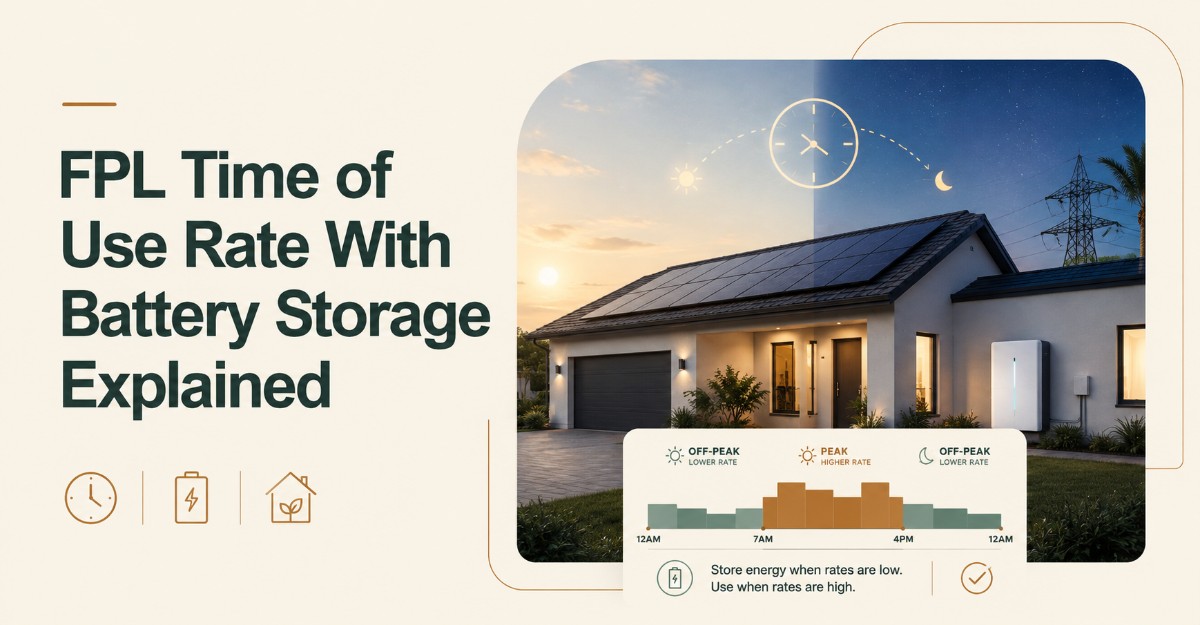
FPL’s RTR-1 time of use rate charges roughly 26 cents per kWh during on-peak hours and near 9 cents off-peak. Pairing this Florida Power & Light rate with a home battery lets you charge on cheap off-peak power and discharge during peak, cutting the expensive peak portion of your bill through automated energy arbitrage.
The catch most guides skip: the raw spread is not what you keep. Battery round-trip losses of 8-13 percent, fixed monthly charges, and a nine-hour summer peak window all shrink the real benefit. This guide covers the RTR-1 rate mechanics, exact peak schedules, per-kWh pricing, hardware choices, and a payback outlook that reflects the 2026 loss of the residential federal battery tax credit.
Off-peak ≈ 9¢/kWh
Noon–9 PM, Mon–Fri
$10k–$16k (10–15 kWh)
Solar+battery 7–10 yrs
8–13% eats the spread
Ended for 2026 buys
What is FPL’s RTR-1 time of use rate?
FPL’s RTR-1 is a voluntary residential time of use rate that prices electricity by clock and calendar instead of a single flat number. On the default RS-1 flat plan, Florida Power & Light bills every kilowatt-hour at roughly the same 12-14 cents regardless of when you use it. RTR-1 replaces that with two energy prices: a high on-peak charge during defined weekday windows and a low off-peak charge for all remaining hours.
The rate is enrollment-based, meaning you opt in and can typically revert to RS-1. It changes only the energy charge structure. Fixed elements stay: the monthly customer charge, fuel and capacity riders, the minimum bill, and Florida’s gross-receipts tax all apply on either plan. RTR-1 rewards households that can genuinely move load, whether by behavior, an EV charging schedule, or a battery that time-shifts consumption automatically.
How does battery storage cut your FPL time of use bill?
A home battery cuts your FPL time of use bill by buying grid energy when it costs about 9 cents and spending it during the 26-cent peak, a process called energy arbitrage. The battery, not the grid, powers your air conditioner, refrigerator, and lights during peak hours, so the house draws close to zero expensive kilowatt-hours from FPL in that window.
Modern systems automate this end to end. You enter FPL’s RTR-1 schedule once, select a cost-optimization or time-based mode, and the inverter charges overnight and discharges on peak without daily input. The value is the avoided peak price minus what you paid to store the energy.
Grid charges battery at ~9¢
Battery discharges to home loads
Home reverts to grid, reserve held
Cycle repeats daily
Why round-trip efficiency shrinks the spread
The 17-cent gap between peak and off-peak is not pure profit, because storing energy wastes some of it. AC-coupled batteries like the Tesla Powerwall run about 89-90 percent round-trip efficient, so 10 kWh charged returns roughly 9 kWh. If you buy at 9 cents and lose 11 percent, your effective stored cost rises to about 10.1 cents per kWh. You still avoid 26 cents, netting close to 15.9 cents saved per delivered kilowatt-hour. Solar-charged energy skips the purchase entirely, which is why solar plus battery beats grid-only arbitrage on every math test.
What are FPL’s peak and off-peak hours?
FPL’s on-peak hours fall on weekday afternoons in summer and split into morning and evening blocks in winter, with all weekends and listed federal holidays counted as off-peak around the clock. The schedule flips on fixed calendar dates, and your battery software must follow those dates or it will discharge at the wrong times.
| Period | Season | On-peak windows (Mon–Fri) | Off-peak |
|---|---|---|---|
| Summer | Apr 1 – Oct 31 | 12:00 PM to 9:00 PM | All other hours |
| Winter | Nov 1 – Mar 31 | 6:00 AM to 10:00 AM and 6:00 PM to 10:00 PM | All other hours |
| Weekends | Year-round | None | 24 hours |
| Holidays | Year-round | None | New Year’s, Memorial Day, July 4, Labor Day, Thanksgiving, Christmas |
The summer profile is the hard one. A continuous nine-hour peak from noon to 9 PM demands real usable capacity, which is exactly why a 5 kWh battery fails at this job. Winter is friendlier because the two four-hour blocks let the battery recharge midday.
How much do FPL TOU rates cost per kWh?
FPL’s time of use energy prices run about 26 cents per kWh on-peak against roughly 9 cents off-peak, versus a blended 12-14 cents on the RS-1 flat rate. These figures move with fuel-cost recovery riders each year, so confirm the current tariff before modeling savings.
| Metric | RS-1 flat rate | RTR-1 on-peak | RTR-1 off-peak |
|---|---|---|---|
| Typical energy cost per kWh | 12¢ to 14¢ | ~26¢ | ~9¢ |
| When it applies | All hours | Weekday peak windows | Nights, weekends, holidays |
| Peak-vs-off spread | n/a | ~17¢ per kWh | baseline |
| Best user fit | No load flexibility | Avoid running loads | Charge battery, EV, laundry |
Two line items catch newcomers. First, a fixed monthly customer charge near 9-10 dollars applies no matter how little energy you draw, so shifting every kilowatt-hour off-peak never zeroes the bill. Second, the minimum bill floor and gross-receipts tax ride on top. Peak avoidance reduces the variable energy portion only.
Standalone battery vs solar plus battery: which setup wins?
For pure savings, solar plus battery wins decisively, because free daytime solar covers the first half of the summer peak and refills the battery for the 5 PM to 9 PM stretch. A standalone grid-charged battery still works, but it only arbitrages the 17-cent spread minus round-trip losses, which is a thinner margin.
| Setup | Charge source | Best summer coverage | Typical payback | Storm backup |
|---|---|---|---|---|
| Standalone battery (grid-only) | Off-peak grid at 9¢ | Battery-limited, held for evening | 11 to 15+ years | Yes |
| Solar + battery (hybrid) | Solar first, grid backup | Solar handles noon–5, battery 5–9 PM | 7 to 10 years | Yes, stronger |
Standalone battery quick verdict: worth it mainly if you already want hurricane backup and treat TOU savings as a bonus. Solar plus battery quick verdict: the stronger financial play, and the only configuration where noon-to-9 summer peaks get covered without draining reserve. One interaction to check: FPL net-metering credits for exported solar affect the math, so a battery that self-consumes solar can be worth more than exporting it, depending on the current netting terms.
What does a battery cost and how long is payback on FPL TOU?
A fully installed 10-15 kWh residential battery typically costs 10,000 to 16,000 dollars before any incentive, and payback on TOU alone now runs long. Standalone grid-charged systems commonly land in the 11 to 15-plus year range; solar plus battery compresses that to roughly 7 to 10 years by displacing peak energy with zero-cost solar.
Here is the correction the AI Overview misses. The 30 percent Residential Clean Energy Credit under Section 25D, which covered standalone home batteries of 3 kWh or larger, was terminated for expenditures made after 31 December 2025 under the 2025 federal budget law. A homeowner buying a battery in 2026 generally cannot claim that 30 percent on a self-owned residential install. Some third-party-owned or leased structures and business-side credits follow different rules, so confirm your exact situation with a tax professional and current IRS guidance rather than assuming the old credit still applies.
Without the 30% credit, a grid-only battery bought purely to dodge peaks can take longer to pay back than its 10-year warranty lasts. Buy for backup + savings, not savings alone.
There is a durability angle too. Most current batteries use LFP chemistry rated for daily cycling, so the AI Overview’s degradation warning is overstated for modern hardware. A daily arbitrage cycle is about 365 cycles per year, and a 10-year, roughly 4,000-cycle warranty absorbs that comfortably. The real risk is buying a battery whose savings never catch up to its price before the warranty window closes.
Which battery works best for FPL time of use?
The strongest FPL TOU batteries are the Tesla Powerwall 3, Enphase IQ Battery 5P, and FranklinWH aPower 2, all LFP systems with native time-of-use scheduling. The right pick depends on usable capacity, continuous output for AC startup, and how the software handles seasonal schedule changes.
| Battery | Usable capacity | Continuous output | Chemistry | Throughput / warranty |
|---|---|---|---|---|
| Tesla Powerwall 3 | ~13.5 kWh | 11.5 kW | LFP | 10-year warranty |
| Enphase IQ Battery 5P | ~5 kWh (stackable) | 3.84 kW | LFP | 15-year / 6,000-cycle |
| FranklinWH aPower 2 | ~15 kWh | 10 kW | LFP | 15-year / limited-throughput |
For a nine-hour summer peak, prioritize usable kilowatt-hours and a healthy continuous rating so the battery can start a central AC compressor. A single Powerwall 3 or aPower 2 near 13-15 kWh usable is a practical floor for whole-home peak coverage; the modular Enphase approach suits homes that want to size in 5 kWh steps. Honest limitation: none of these fully covers noon-to-9 PM cooling load in peak Florida summer on battery alone, which loops back to why solar is the better partner.
Should you switch to FPL time of use? Quick verdicts by household
Whether you should switch to FPL time of use depends on your load flexibility, and the answer flips hard between household types. TOU rewards a home that can move consumption; it penalizes one that runs heavy loads at 5 PM with no storage or shifting ability.
- EV owner, no battery: Recommended. Charging an EV overnight at roughly 9 cents instead of 12-14 cents flat can save real money on its own, and a 40 kWh weekly charge shifted off-peak trims a few dollars per week. Keep major daytime appliance use light.
- Solar plus 13+ kWh battery: Strongly recommended. This is the configuration TOU was built to reward, and it is the only one that neutralizes the summer peak reliably.
- Solar only, no battery: Cautious. Flat RS-1 is often safer, because without storage your evening peak load still pulls 26-cent grid power after the sun drops.
- No solar, no EV, no battery: Not recommended for savings. Buying a standalone battery only to dodge peaks carries a payback longer than its warranty now that the federal credit has lapsed. Consider it only if hurricane backup is your priority.
Common mistakes and how to avoid them
The most damaging FPL TOU mistakes are undersizing the battery, discharging your storm reserve, and letting the software fall out of sync with FPL’s seasonal schedule. Each one quietly erases savings or your backup safety net.
Undersizing is mistake one. A 5 kWh battery drains in two to three hours and dumps you back onto the 26-cent grid mid-peak, so match usable capacity to the nine-hour summer window, not to a spec-sheet headline number.
Forgetting the reserve is mistake two. Setting the battery to discharge 100 percent for daily savings leaves nothing if an afternoon thunderstorm knocks out power, so hold 20-30 percent as backup reserve during storm season.
Ignoring fixed charges is mistake three. Moving all usage off-peak still leaves the monthly customer charge, minimum bill, and taxes, so model net savings, not a zero bill.
Two operational fixes worth setting once: pre-cool the house to 70°F at 11 AM before the noon peak, then let it drift to 76°F so the battery serves a lighter load, and verify your app re-syncs the tariff on 1 April and 1 November when FPL flips seasons, or the battery will discharge during the wrong hours for weeks.
Frequently asked questions
Does FPL let you charge a battery from the grid on RTR-1? Yes, grid-charging a home battery during off-peak hours is standard practice on FPL’s time of use rate and is how standalone arbitrage works. Solar customers should confirm how grid-charging interacts with current net-metering terms, since exported-solar credits can change the most profitable charging strategy.
Can a battery get my FPL bill to zero? No. FPL’s fixed monthly customer charge, minimum bill floor, and gross-receipts tax apply regardless of usage, so a battery reduces the variable energy portion of the bill, not the fixed portion. Even perfect peak avoidance leaves a base charge every month.
Is the 30% federal tax credit still available for batteries in 2026? Generally no for self-owned residential installs. The Section 25D Residential Clean Energy Credit was terminated for expenditures made after 31 December 2025, so a 2026 homeowner purchase typically does not qualify. Confirm your specific case with a tax professional, since leased and business structures differ.
How big should the battery be for FPL’s summer peak? Aim for roughly 13-15 kWh of usable capacity or more to cover the noon-to-9 PM window without falling back to the grid. Smaller batteries suit winter’s shorter blocks or solar-assisted homes where daytime generation carries the first half of the peak.
Will daily cycling wear out the battery fast? Not on modern LFP hardware. Systems like the Powerwall 3 and Enphase 5P are rated for daily cycling, and one arbitrage cycle per day stays within a 10 to 15-year warranty. The bigger risk is financial payback, not physical degradation.
The bottom line
The FPL time of use rate with battery storage works best as a savings-plus-backup play for solar homes and a backup-first choice for everyone else. The mechanics are sound: charge near 9 cents, avoid 26 cents, let software run the daily cycle. The economics are honest only when you subtract round-trip losses, fixed charges, and the now-expired federal credit from the headline spread. Solar plus a 13-plus kWh LFP battery reaches 7 to 10-year payback; a standalone battery bought purely to dodge peaks rarely pays for itself before its warranty ends, so buy it for storm resilience and treat the peak savings as the bonus.