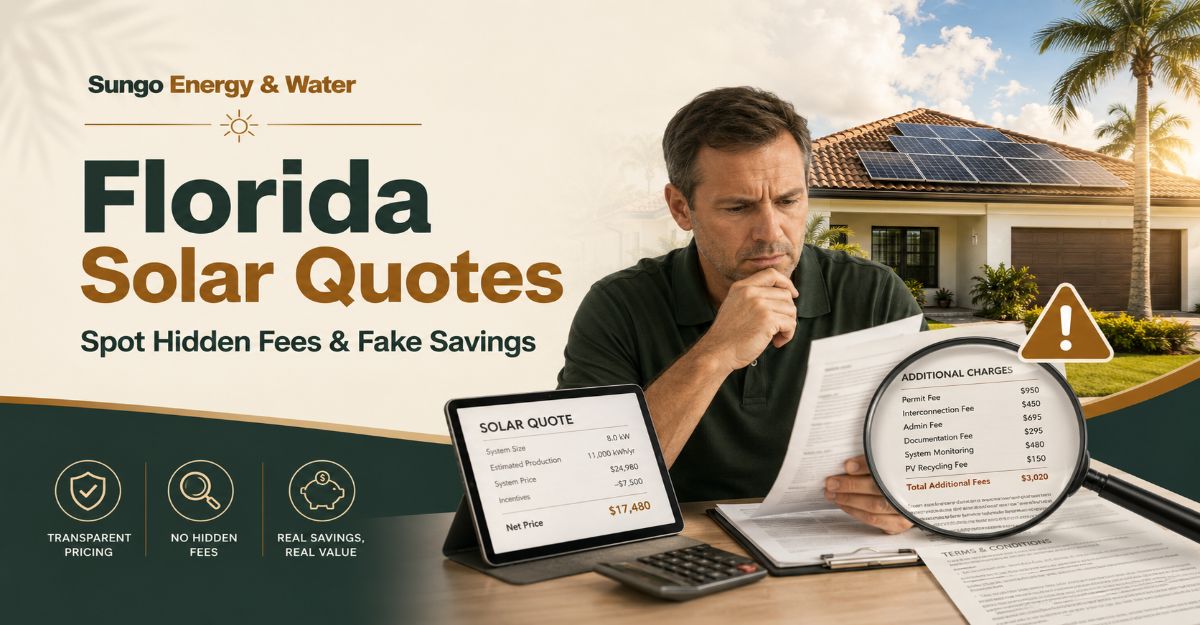
Florida solar quotes frequently contain hidden dealer fees that inflate the principal by 15% to 35% and use aggressive 6% to 10% utility rate escalation assumptions to create fake, long-term savings projections. To avoid overpaying, homeowners must demand the cash price, calculate the true price-per-watt (aiming for $2.60 to $3.20/W), and verify the costs of main panel upgrades or Tier 2 insurance requirements for systems over 11.76 kW DC.
Key Facts / At a Glance
- Dealer Fees: Low-APR solar loans (e.g., 1.49%) usually mask a 15% to 35% upfront fee rolled directly into the loan principal.
- Target Price: A fair Florida solar quote should sit between $2.60 and $3.20 per watt based on the cash price, not the financed total.
- Tax Credit Trap: Most loans require a lump-sum payment equal to the 30% federal tax credit within 18 months, or your monthly payment will spike.
- Utility Math: Sales reps often assume utility rates will increase 8% to 10% annually for 25 years to artificially inflate your “savings.” Realistic averages are 3% to 5.5%.
- Hidden Costs: Systems exceeding 11.76 kW DC in Florida require $1 million in Tier 2 personal liability insurance, which installers often omit from their initial quotes.
What Are Hidden Dealer Fees in Solar Financing?
A solar dealer fee is an upfront charge paid by the solar installer to the lender to “buy down” the interest rate on your loan. The installer does not absorb this cost; they add it directly to the total cost of your solar system.
If a salesperson offers you a 25-year loan at 1.99% APR, the lender is likely charging a 25% to 35% dealer fee to facilitate that low rate. According to a 2024 Consumer Financial Protection Bureau (CFPB) report, these hidden markups frequently increase loan costs by 30% or more above the cash price of a solar project. For a solar system with a cash value of $30,000, a 30% dealer fee adds $9,000 to your loan. You are now financing $39,000 and paying interest on that inflated principal for decades. Because this fee is baked into the principal amount rather than listed as a finance charge, it rarely appears in the federally mandated APR disclosure.
How Do Installers Fake Solar Savings?
Fake savings in solar quotes rely on a concept called utility rate escalation. This is the estimated percentage by which your local utility company (like FPL, TECO, or Duke Energy) will increase their electricity rates every year.
Sales proposals often model a 6% to 10% annual utility increase over 25 years. While Florida utilities have seen recent spikes of 5% to 6% due to storm hardening and data center demands, modeling a compounding 8% or 10% increase for a quarter-century is mathematically manipulative. It creates a chart where your future utility bill looks catastrophic (e.g., $800 a month), making the fixed cost of the solar loan look like massive savings. A realistic, conservative quote should model utility escalation at 3% to 5.5%.
The “Net Cost” Tax Credit Illusion
Many quotes prominently display the “Net System Cost.” This number subtracts the 30% Federal Residential Clean Energy Credit from the total price. However, this is a non-refundable tax credit. You only receive the full 30% if you actually owe that much in federal income taxes. Furthermore, almost all solar loans require you to pay this 30% amount as a lump sum to the lender, usually around month 18. If you do not have the tax liability to get the refund—or if you spend the refund on something else—your monthly loan payment will drastically re-amortize and increase.
What Are the Hidden Installation Costs in Florida?
A standard quote covers the panels, inverter, racking, and labor. However, Florida’s specific grid rules and older housing stock introduce hidden expenses that unscrupulous salespeople leave out to make the deal look cheaper.
Tier 2 Interconnection Insurance
Florida utilities separate residential solar into tiers. Tier 1 covers systems up to 10 kW AC (roughly 11.76 kW DC of panel capacity). If your system is larger than 11.76 kW DC, it falls into Tier 2. Florida law requires Tier 2 system owners to carry a $1 million Personal Liability Policy (PLP) or umbrella policy to connect to the grid. This insurance costs between $200 and $400 annually. Sales reps frequently design systems at 12 kW or 13 kW DC without mentioning the recurring insurance mandate.
Main Service Panel (MSP) Upgrades
Solar systems require significant electrical capacity. If your home has an older 100-amp or 150-amp electrical panel, adding solar will likely require a Main Service Panel upgrade to a 200-amp system. This electrical work typically adds $2,500 to $4,500 to the project. A trustworthy quote will identify this need during the site survey; a deceptive one will spring it on you as a “change order” after you have already signed the contract.
How to Evaluate a Florida Solar Quote
Do not rely on the monthly payment figure to evaluate a solar deal. The only accurate way to compare quotes is by analyzing the cash price per watt.
Step 1: Demand the Cash Price
Tell the sales representative you intend to pay in cash or source your own financing through a local credit union. This forces them to strip away the 15% to 35% dealer fees and reveals the true cost of the hardware and labor.
Step 2: Calculate the Price Per Watt (PPW)
Divide the total cash price (before the 30% tax credit is applied) by the total system size in watts.
- Example: A $28,000 cash price for a 10-kilowatt (10,000 watts) system.
- Math: $28,000 / 10,000 = $2.80 per watt.
- Target: A fair price in Florida is between $2.60 and $3.20 per watt. If a quote exceeds $3.50 per watt on a cash basis, you are overpaying.
Step 3: Verify the Equipment Specs
Ensure the quote specifically names the panel manufacturer (e.g., REC, Qcells, Panasonic) and the inverter type (Enphase microinverters or SolarEdge string inverters). Vague terms like “Tier 1 Premium Panels” are a red flag allowing the installer to use cheaper equipment on installation day.
Step 4: Check the Math on Production
Use the National Renewable Energy Laboratory’s free PVWatts Calculator. Input your zip code, system size, and roof direction to see an unbiased estimate of how much power the system will actually produce in Florida. Compare this to the installer’s projection to ensure they aren’t inflating the system’s capabilities.
Are “Free Solar” Programs in Florida Real?
There is no federal, state, or utility program that installs solar panels on your home for free. Marketing that claims “Florida will pay you to go solar” or implies government affiliation is deceptive.
What these companies are actually selling is either a Power Purchase Agreement (PPA), a solar lease, or a $0-down loan. With a PPA or lease, a third-party company puts panels on your roof, and you agree to buy the power those panels produce. You do not own the system, you do not receive the 30% tax credit, and you are tied to a 20- or 25-year contract that contains its own annual rate escalators. The FTC and the Florida Attorney General have issued repeated warnings regarding this specific brand of predatory marketing.
FAQ: Florida Solar Quotes
Can I avoid dealer fees entirely?
Yes. You can avoid dealer fees by paying cash or by securing an independent solar loan or home equity loan through a local credit union or bank. Credit unions do not charge installers hidden dealer fees.
What happens if I sell my house before the loan is paid off?
If you have a loan, you must either pay off the remaining balance using the proceeds from the home sale or convince the buyer to assume the loan. Buyers are often hesitant to assume solar loans, especially if the equipment is older.
Is a 1.49% solar loan ever a good idea?
Rarely. The 25% to 35% dealer fee required to secure a 1.49% APR increases your principal so drastically that you are paying far more overall. A standard 7% to 9% loan with zero dealer fees (based on the true cash price) is mathematically superior if you plan to pay the loan off early or sell the home.
Does Florida have net metering?
Yes. Florida currently mandates 1:1 net metering. This means for every kilowatt-hour of excess energy your panels send to the grid during the day, the utility company credits your account at the full retail rate, which offsets the power you use at night.
Are batteries required for solar in Florida?
No. Solar panels work without batteries by using the grid for storage via net metering. However, a standard grid-tied solar system will shut off during a hurricane blackout for safety reasons. If you want backup power during grid outages, you must purchase a battery system (like a Tesla Powerwall), which adds $10,000 to $15,000 to the total cost.