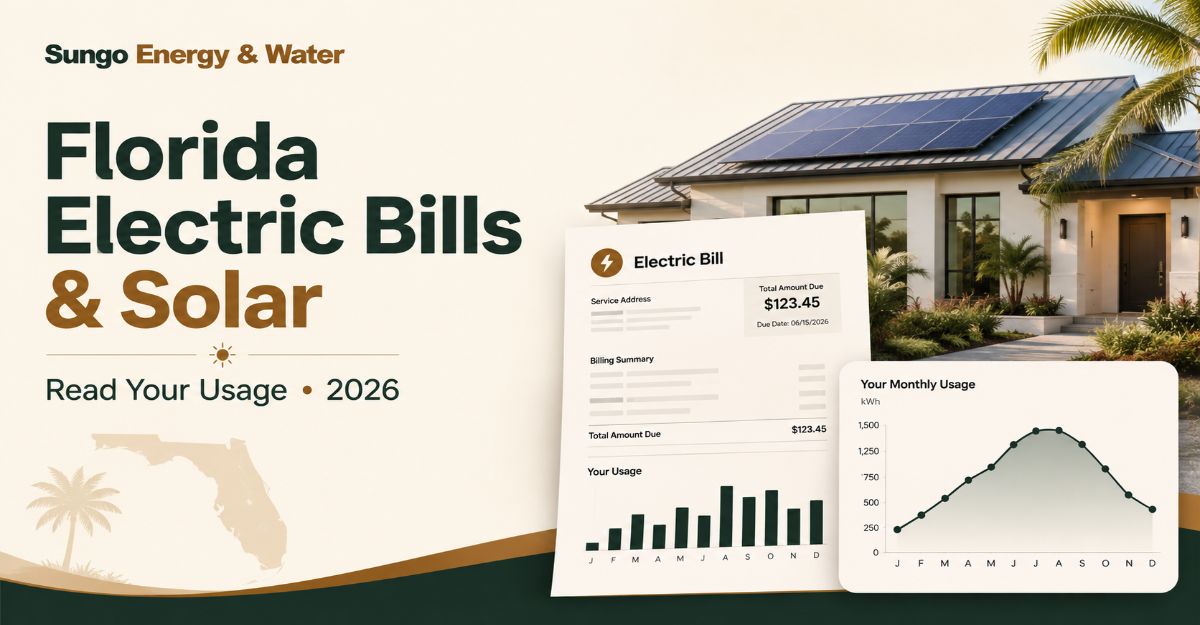
Reading your Florida Electric Bills & Solar: How to Read Your Usage (2026) relies entirely on mastering net metering. By following these six precise steps to locate your summary, extract your delivered and received data, and verify it against your inverter app, you will completely demystify your monthly charges in under 10 minutes. The single biggest factor determining your success is recognizing that your utility bill never shows your total home energy consumption.
Before You Start
- Time Required: 10 minutes.
- Difficulty: Beginner.
- Cost: $0.
- Tools & Materials:
- Your most recent full-cycle utility bill (paper or PDF).
- Access to your solar inverter app (Enphase Enlighten, SolarEdge mySolarEdge, or Tesla).
- A standard calculator.
- Prerequisites: You must have official Permission to Operate (PTO) from your utility, and at least one full 30-day billing cycle must have passed since activation.
Step 1: Verify Bi-Directional Export on the Physical Meter
Check your physical utility meter outside your house to ensure it is actively registering exported power. Walk to your meter between 11:00 AM and 2:00 PM on a sunny day with major appliances (AC, oven, dryer) turned off. Look at the digital display; it will cycle through several screens. You will know it worked when the screen displaying standard kWh shows a negative sign (-) or a reverse arrow indicating power is flowing back to the grid.
- Common Mistake: Checking the meter at night or while the AC is running on full blast. The meter only runs backward when your panels are producing more power than the house is currently demanding.
Step 2: Locate the Net Metering Summary on Your Bill
Find the dedicated solar accounting section on your document, which utilities separate from standard payment data. Open your PDF bill and scroll past the page 1 summary. For FPL, look for the box titled “Meter Summary” on page 2. For Duke Energy, look for the “Net Energy Charge” breakdown. For TECO, find the “Renewable Generation” block. You will know it worked when you see two distinct meter readings with the exact same meter number.
- Common Mistake: Relying on the front-page payment summary. The front page only shows dollars owed; the actual kWh energy exchange data is buried on the second or third page.
Step 3: Extract Your “Delivered” Grid Energy
Identify exactly how much electricity you pulled from the grid when your solar panels were inactive. Locate the line item labeled “kWh Delivered” (FPL), “Grid Usage” (Duke), or “Total Used” (TECO). Write this number down. You will know it worked when this number accurately reflects grid dependency, typically peaking during winter heating or peak summer nights.
- Common Mistake: Assuming “kWh Delivered” means the total power your house consumed. It only represents the power the grid delivered to you at night or during heavy cloud cover.
Step 4: Extract Your “Received” Solar Energy
Identify how much surplus energy your solar system pushed back into the utility grid. Find the line item labeled “kWh Received” or “Generation to Grid”. Write this number down. You will know it worked when this number is highest during cool, sunny spring months (March–May) when your panels produce peak power but your AC is off.
- Common Mistake: Assuming this number is your total solar production. The utility meter only counts the leftover solar power that spilled out of your house; it does not measure the solar power your house consumed instantly.
Step 5: Calculate Your Net Usage and Reserve Balance
Subtract your Received energy from your Delivered energy to find your billable usage. Enter your “Delivered” number into your calculator, hit minus, and enter your “Received” number. If the result is a positive number, you pay for those extra kWh at the ~16¢/kWh retail rate. If the result is negative, you owe $0 for energy, and that exact negative number is added to your “Reserve Amount” credit bank. You will know it worked when your calculated number matches the “Net Usage” line on your bill perfectly.
- Common Mistake: Thinking a negative net usage means a $0 bill. Even with negative net usage, you must pay the mandatory $25–$30 monthly fixed customer charge.
Step 6: Cross-Reference with Your Solar Inverter App
Calculate your actual total home consumption by combining utility data with your solar app data. Open your Enphase or SolarEdge app and find your “Total Produced” number for the exact billing cycle dates. Subtract the utility’s “kWh Received” number from your app’s “Total Produced” number. The result is your “Self-Consumption”—the solar power you used instantly. Add your “Self-Consumption” to the utility’s “kWh Delivered” number to find the true total energy your house required that month. You will know it worked when you can finally track whether your home is becoming more or less energy-efficient over time.
- Common Mistake: Skipping this step entirely and complaining that the solar system isn’t generating the power promised in the sales contract.
Common Mistakes and How to Fix Them
- Mistaking the January True-Up for a Rate Hike: In January, Florida utilities empty your accumulated reserve credit bank and pay you for it at the wholesale rate (~3¢/kWh) instead of the retail rate (~16¢/kWh). If you see a sudden bill in February, it is because your credit bank reset to zero. Fix: Do not panic; expect a standard utility bill in January and February while you rebuild your solar credits during the spring.
- Expecting a Zero Dollar Bill: Solar credits only offset energy charges (per-kWh). They do not offset fixed customer charges, gross receipts taxes, or local franchise fees. Fix: Budget for a permanent $25 to $35 minimum monthly bill, regardless of how much solar you produce.
- Undersizing the System for EV Charging: Buying an electric vehicle adds roughly 300 to 400 kWh of monthly consumption. If you charge at night, you drain your solar credits instantly. Fix: Schedule your EV charger to pull power strictly between 10:00 AM and 3:00 PM to maximize self-consumption directly from the panels.
- Oversizing the System for Profit: Some homeowners install excessive panels expecting large checks from the utility. Because excess credits are cashed out annually at 3¢/kWh, buying extra panels at $3.00/watt to sell power at 3¢/kWh results in a catastrophic return on investment. Fix: Cap your system size at 95% to 105% of your historical 12-month usage.
Variations by Utility Provider
Florida Power & Light (FPL)
FPL utilizes standard 1:1 net metering. Their bills are notoriously confusing because they group solar generation under a generic “Meter Summary” section. Ensure you are looking strictly at the “RC” (Received) code on your physical meter to match the bill. FPL processes its annual true-up credit cash-out on the January billing cycle.
Duke Energy Florida (DEF)
Duke Energy requires immediate attention. Customers installing solar in 2026 are placed on the “Net Metering Bridge Rider,” which guarantees 1:1 retail credits for 15 years. However, this rider permanently expires on December 31, 2026. After this date, new Duke solar customers will likely be forced onto Time-of-Use (TOU) net billing, significantly reducing savings. Duke’s charts graphically display “Net Energy Charge,” completely hiding your gross consumption.
Tampa Electric (TECO)
TECO labels their grid-delivered energy as “Total Used,” which is highly deceptive for solar owners. It means “Total Grid Power Used,” not total home consumption. TECO separates your solar credits onto a completely different line item called “Renewable Generation Credit,” which applies a negative dollar amount against your gross charges.
How Long Does It Take / What Does It Cost
A standard 7.5 kW solar system in Florida in 2026 costs approximately $15,750 after the 30% federal tax credit (assuming $3.00/watt gross). At a retail rate of 16¢/kWh, this system offsets roughly $1,800 to $2,200 in utility costs annually. The cash payback period is currently 7.2 to 8 years. Daily bill monitoring takes less than 2 minutes using an inverter app, while reconciling your monthly physical bill takes about 10 minutes.
Frequently Asked Questions
Why am I still paying for power at night if I have solar?
Solar panels stop producing when the sun goes down. Without a home battery system like a Tesla Powerwall, you must pull energy from the grid every night. You rely on the excess credits generated during the day to cancel out this nighttime financial cost.
What happens to my solar credits if I sell my house?
Banked net metering credits belong to the utility account holder, not the physical address. If you close your utility account to move, the utility will cash out your remaining reserve credits at the wholesale true-up rate (approx. 3¢/kWh) on your final bill.
Does a bi-directional meter require special Wi-Fi?
No. The bi-directional meter communicates your net usage directly to the utility via their secure cellular or radio frequency network. Your home Wi-Fi is only required for your personal solar inverter app (Enphase/SolarEdge) to track panel-level production.
Can I roll over my true-up balance to the next year?
No. Florida law mandates that utilities settle the net metering accounts annually. Your credit bank will forcefully reset to zero on January 1, and you will be issued a credit or check for the remaining balance at the avoided-cost rate.
Understanding Florida Electric Bills & Solar: How to Read Your Usage (2026) ensures you capture every dollar of your expected return on investment. By taking 10 minutes each month to extract your delivered and received metrics, you protect yourself from billing errors and optimize your home’s energy consumption.