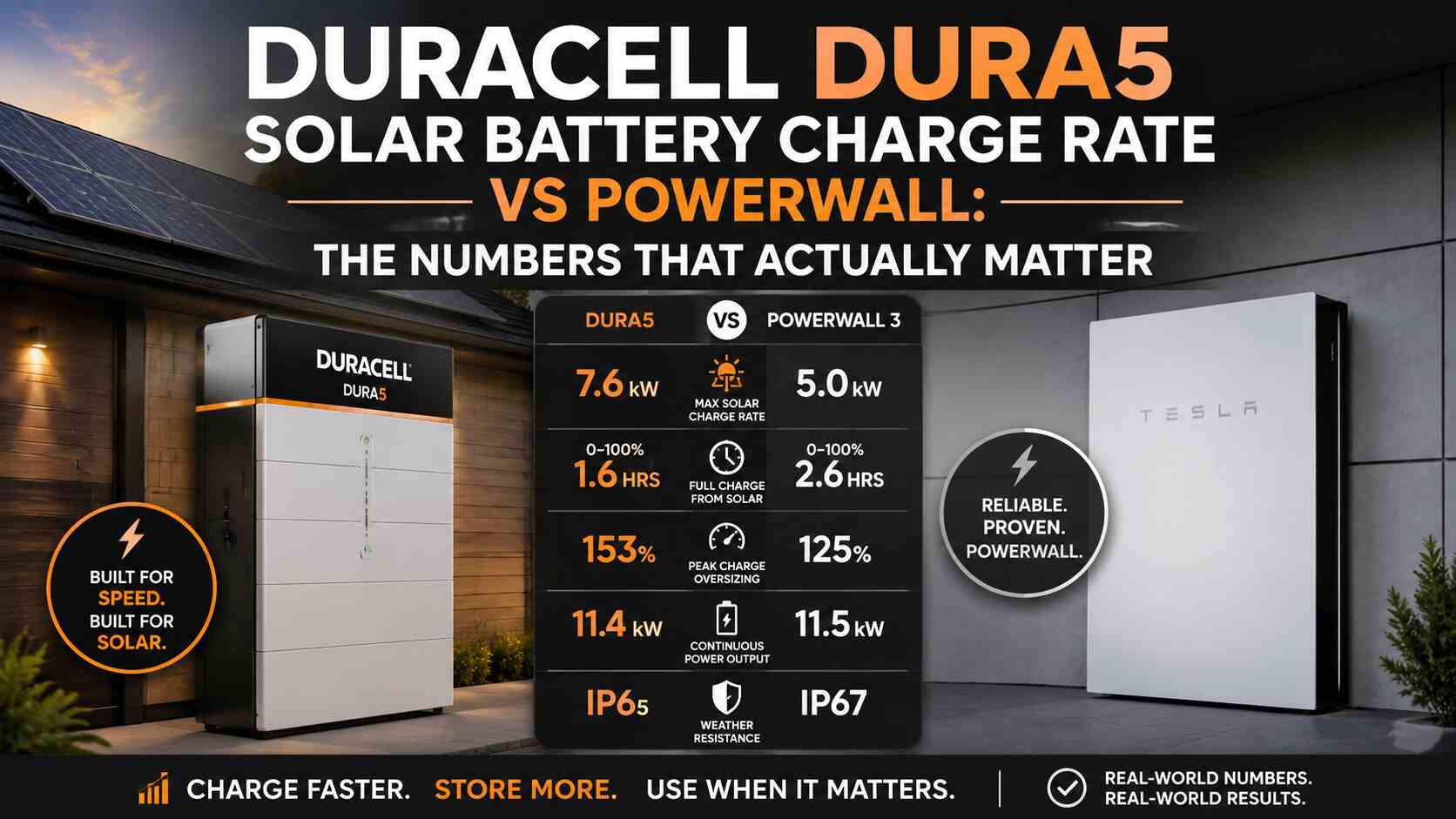
Every spec sheet says the Duracell Dura5 charges at 5 kW and the Tesla Powerwall 3 charges at 5 kW. Identical, apparently. That single line hides the most important difference between these two batteries, and it is the reason a lot of homeowners buy the wrong one.
Charge rate is not a headline number. It is a relationship between three things: battery capacity, the inverter feeding it, and the energy source doing the filling. Get that relationship wrong and you end up with a battery that sits half empty through a cloudy week, or one that finishes charging at 2am and then idles for five hours while you keep paying peak rates.
This guide breaks down how both systems actually charge, shows the maths that most comparison pages skip, and gives you a five minute method for deciding which one fits your roof, your tariff and your evening load.
The short verdict
The Duracell Dura5 wins on speed relative to size. Feeding 5 kW into 5.12 kWh is a true 1C rate, so a single module fills in roughly one hour. The Tesla Powerwall 3 wins on absolute energy and on solar charging, because its onboard inverter can push far more than 5 kW into the pack from a DC array. Fast refill favours Duracell. Long outages and heavy appliances favour Tesla.
Duracell Dura5 vs Tesla Powerwall 3 charge rate compared
| Specification | Duracell Dura5 | Tesla Powerwall 3 |
|---|---|---|
| Usable capacity | 5.12 kWh per module | 13.5 kWh |
| Chemistry | LFP, lithium iron phosphate | LFP, lithium iron phosphate |
| Charge rate from grid | 5 kW | 5 kW |
| Charge rate from solar DC | 5 kW, capped by hybrid inverter | Well above 5 kW, capped by array |
| Effective C rate | 1.0C | 0.37C on grid |
| Time to fill from empty | About 1 hour | About 2 hours 42 minutes on grid |
| Continuous output | 5 kW | 11.5 kW |
| Inverter | Separate hybrid inverter required | Solar inverter built in |
| Maximum stack | Very high, 28 modules and beyond | 54 kWh with expansion units |
| Warranty | 10 years | 10 years, unlimited cycles |
What C rate really tells you about a home battery
C rate is charge power divided by capacity. A 1C battery fills in an hour. A 0.5C battery takes two hours. A 0.37C battery takes just under three. It is a ratio, not a measure of raw speed, and that distinction is where the Duracell marketing claim earns its asterisk.
Time to fill from empty
Shorter bar is faster. Grid charging at rated power.
Chart: Duracell Dura5 solar battery charge rate vs Powerwall, effective charge time by configuration
The inverter bottleneck that comparison pages ignore
Here is the insight that changes the entire comparison. The Dura5 only holds a 1C charge rate as a single module. Stack a second one and you have 10.24 kWh of storage sitting behind the same 5 kW hybrid inverter, so your effective rate halves to roughly 0.49C. Add a third and you are down to 0.33C, which is slower than a Powerwall 3.
In other words, the famous one hour refill describes the smallest possible Duracell system. The moment you scale storage to cover a genuine evening load, the advantage evaporates unless you scale inverter capacity too, which means a larger hybrid inverter or a second unit. That is a cost line most quotes bury in the small print.
Ask your installer one question before signing: what is the total inverter charge power for the full stack, not for a single module? If the answer is 5 kW for a 15 kWh system, the fast charging claim no longer applies to you.
Why the Powerwall 3 charges faster than its 5 kW figure suggests
The Powerwall 3 is not an AC battery bolted onto an existing system. It contains its own solar inverter, so panels connect to the unit directly in DC. That matters because the 5 kW number quoted everywhere is the grid charge limit. When the sun is producing, the pack charges through the internal converter at power levels well beyond 5 kW, limited by array size rather than by an artificial cap.
On a bright summer day with an 8 kWp array, a Powerwall 3 can go from empty to full inside a couple of hours while still running the house. A Dura5 system on a 5 kW hybrid inverter cannot, because household load, battery charging and export all share the same 5 kW doorway.
| Scenario | Dura5 behaviour | Powerwall 3 behaviour |
|---|---|---|
| Four hour cheap night tariff | Fills roughly 20 kWh if inverter allows | Fills 13.5 kWh comfortably |
| Two hour cheap window | Single module charged twice over | Reaches roughly 75 percent |
| Bright day, large array | Capped at hybrid inverter rating | Charges above 5 kW on DC |
| Winter, weak generation | Rate irrelevant, both trickle | Rate irrelevant, both trickle |
| Outage with heavy appliances | 5 kW ceiling limits large loads | 11.5 kW starts AC and pumps |
Does a faster charge rate actually save you money?
Only in specific situations. Charge speed converts into cash in three cases:
- Short cheap tariff windows. If your supplier offers a two or three hour off peak block, a high C rate lets you bank full capacity before the price climbs. On a long overnight window a slower battery catches up anyway and the advantage disappears.
- Volatile solar days. Broken cloud produces sharp generation spikes. A high power charge path captures those bursts instead of exporting them at a poor rate.
- Twice daily cycling. Homes that discharge in the morning and again after sunset benefit from a midday top up that completes quickly.
If none of those describe your household, charge rate is close to a vanity metric and usable capacity should drive the decision instead.
Where each battery earns its keep
Suitability by household priority
What owners report in the field
Across solar communities and owner forums, a consistent picture emerges. These are recurring themes reported by real users rather than laboratory measurements, so treat them as directional evidence.
- Dura5 owners confirm that the fast refill is real on single and double module setups, and they rate the low entry price highly. The most common complaint concerns inverter pairing, because the battery is only as quick as the hybrid inverter chosen alongside it and some installers specify undersized units.
- Powerwall 3 owners praise the seamless changeover during outages and the ability to run air conditioning, well pumps and induction hobs without tripping. The common frustration is the 5 kW grid charge cap, which feels slow to anyone on a short off peak tariff.
- Both camps agree that installation quality affects real world performance more than the spec sheet gap between these two products.
How to choose in five minutes
- Calculate your evening load. Take twelve months of bills, divide total kWh by 365, then estimate the share used between sunset and sunrise. Most homes land between 40 and 60 percent.
- Check your surge need. Air conditioning, heat pumps and electric ovens push past 5 kW on startup. If you need those during an outage, the Powerwall 3 output ceiling settles the question on its own.
- Look at your tariff window. Short cheap blocks reward the Dura5. Long overnight blocks neutralise its advantage completely.
- Size the array. Below 5 kWp, the two batteries charge from solar almost identically. Above 8 kWp, the Powerwall 3 DC path pulls clearly ahead.
- Compare price per usable kWh. Divide installed cost by usable capacity rather than comparing hardware prices, and remember to include the hybrid inverter inside the Duracell figure.
Frequently asked questions
Is the Duracell Dura5 genuinely twice as fast as a Powerwall?
Relative to its own capacity, yes. In absolute energy per hour, no. Both move about 5 kW from the grid. The Dura5 simply has less to fill.
Can I stack Dura5 modules to match Powerwall capacity?
Yes. Three modules give you 15.36 kWh, slightly more than a Powerwall 3. Charge speed then drops below Powerwall level unless inverter capacity rises with it.
Which lasts longer under fast charging?
Both use LFP chemistry, which tolerates rapid cycling well. Sustained 1C operation generates more heat than gentle charging, so thermal management and warranty terms matter more than the rate itself.
The bottom line
The Duracell Dura5 solar battery charge rate advantage is real but narrow. It applies to small stacks, short tariff windows and homes that value modular growth over raw power. The Powerwall 3 trades a modest grid charge rate for far greater usable capacity, much higher output during outages and a faster solar charge path through its integrated inverter.
Choose the Dura5 if you want to start small, refill quickly and expand over time. Choose the Powerwall 3 if you want one box that carries your entire home through an outage without you ever thinking about inverter sizing.
Get a sizing check before you buy
Send your last twelve months of energy bills and your roof size, and receive a free written assessment showing the exact capacity, charge rate and inverter pairing your home needs.
Request your free battery sizing report