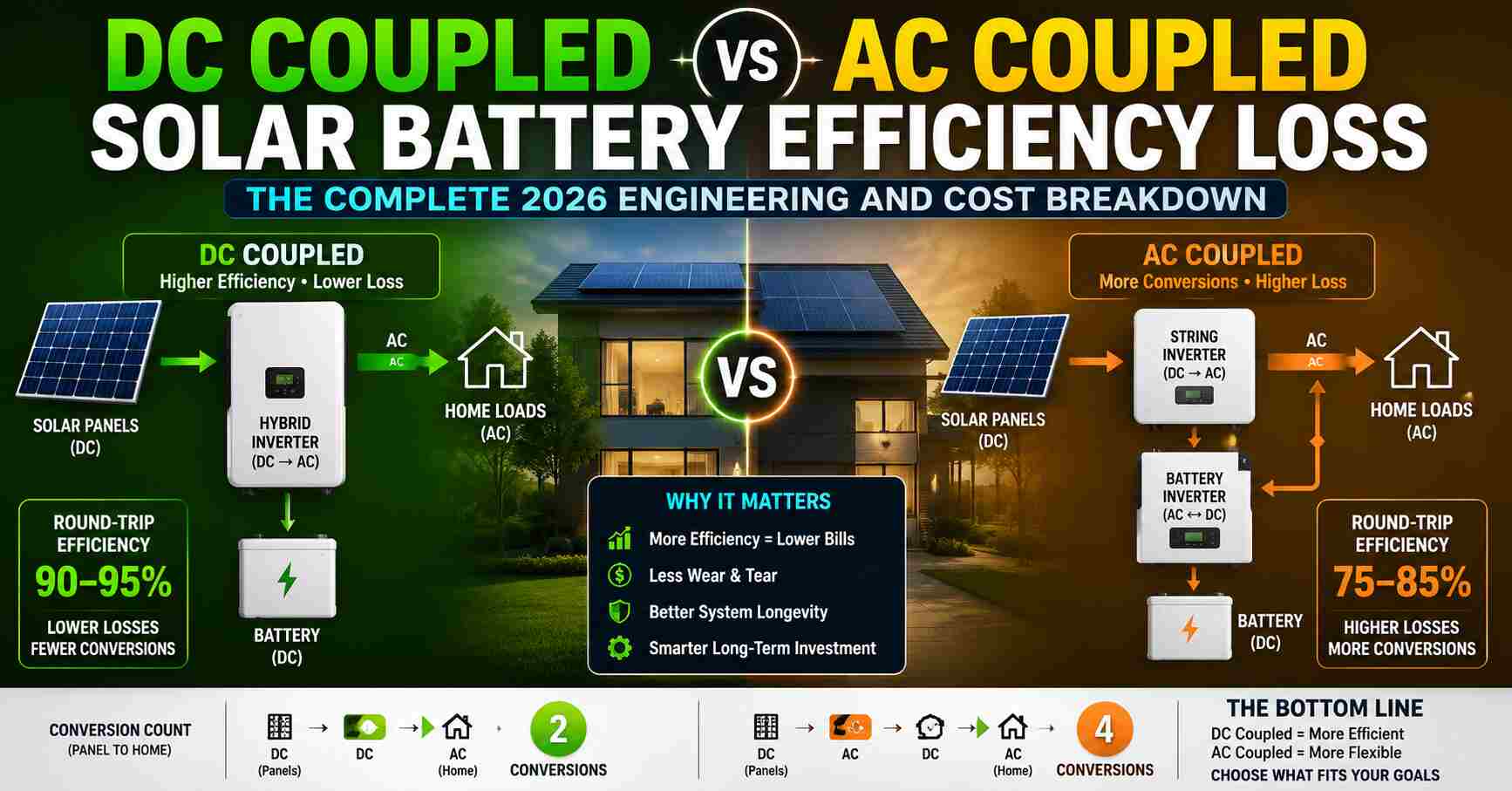
Every solar battery comparison you read repeats the same headline: DC coupled systems are more efficient than AC coupled systems. That statement is true. It is also close to useless on its own, because it does not tell you the one thing you actually need to know.
How much is that efficiency worth in your currency, on your roof, with your existing equipment?
This guide answers that question with the arithmetic laid out in full. It also covers something almost no competing article does: the efficiency losses that are not conversion losses at all, and which frequently dwarf the DC versus AC gap that everyone argues about. By the end you will be able to look at any quote and know whether the “more efficient” option is the better financial decision or just the better marketing line.
The 40 Second Answer
- DC coupled systems deliver roughly 93 to 97 percent round trip efficiency, because solar energy travels from panel to battery as DC and gets converted to AC only once, on the way out.
- AC coupled systems deliver roughly 86 to 90 percent round trip efficiency, because the same energy is converted DC to AC, back to DC for storage, then AC again for use.
- The realistic gap for a modern residential install is 5 to 7 percentage points, which is around 270 kWh of wasted energy per year on a 10 kWh daily cycle.
- At 16 cents per kWh that costs about 43 dollars a year, or roughly 864 dollars over 20 years before electricity price inflation.
- DC coupling wins on new installations. AC coupling usually wins on retrofits, because the labour savings and preserved warranties are worth far more than the efficiency penalty.
- The tie breaker is rarely efficiency. Standby power draw, clipping recapture, and net metering grandfathering all move more money than the conversion gap does.
How Energy Actually Flows Through Each Architecture
Understanding the efficiency loss requires seeing the conversion steps, because each conversion is where energy escapes as heat.
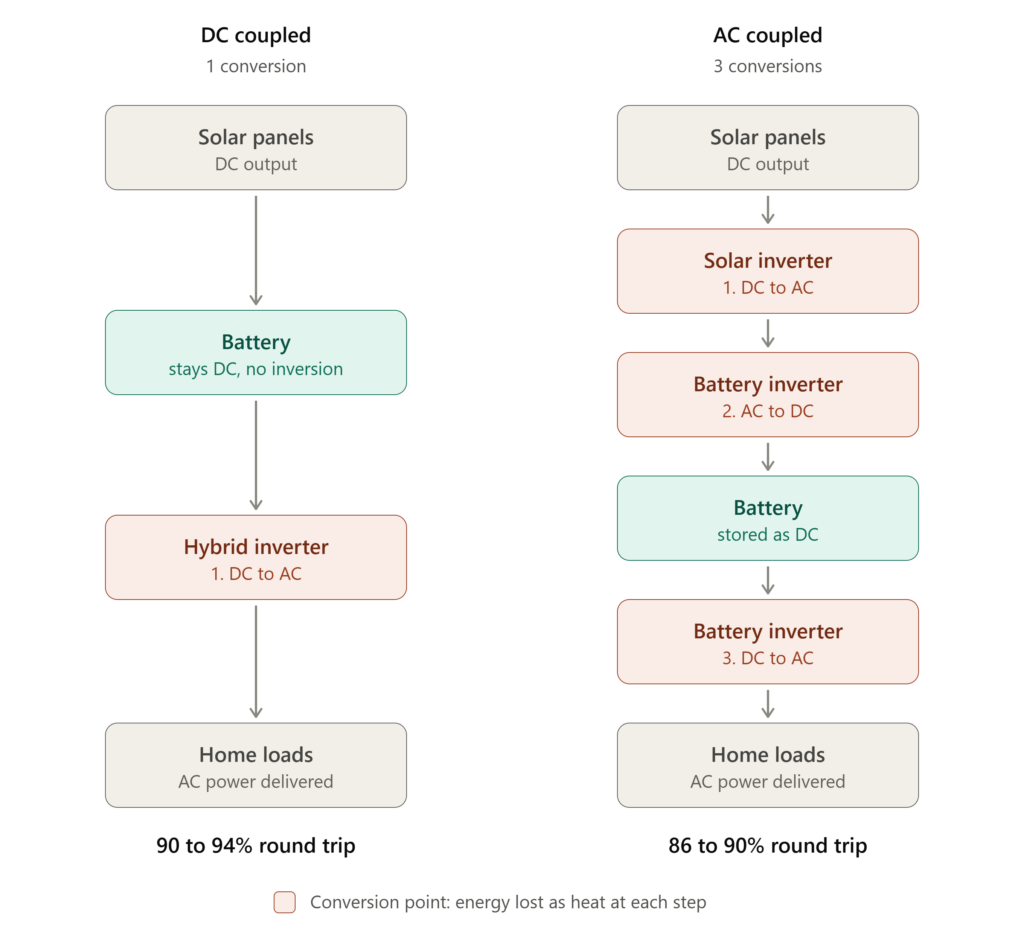
DC Coupled: One Conversion on the Way Out
One Conversion on the Way Out
Solar energy remains in DC form through generation and storage, then converts to AC before powering the home or exporting to the grid.
Solar Panels
Generate direct-current electricity
MPPT / Charge Controller
Optimizes solar production and controls battery charging
98–99% efficientBattery
Stores energy in DC form
Hybrid Inverter
Converts stored or solar DC electricity into usable AC
96–97% efficientHome Loads / Grid
Powers appliances or exports electricity to the utility grid
Sunlight to storage stays in the DC domain. The only conversion happens when the stored energy is called out of the battery to run your house. Charge and discharge across the DC bus typically loses 2 to 4 percent, and the final DC to AC inversion loses another 3 to 4 percent.
AC Coupled: Three Conversions
Three Energy Conversions
In an AC-coupled system, solar electricity is converted several times before stored battery energy reaches home loads.
Solar Panels
Generate direct-current electricity
Solar Inverter
First conversion: DC electricity becomes AC
DC → AC Loss #1: approximately 3–4%Home AC Panel
Distributes solar power throughout the property
House Loads / Grid Export
Solar power serves appliances or exports to the utility grid
Battery Inverter
Second conversion: surplus AC becomes DC for storage
AC → DC Loss #2: approximately 3–5%Battery
Stores electricity in DC form
Battery Inverter
Third conversion: stored DC becomes AC for household use
DC → AC Loss #3: approximately 3–5%Home Loads / Grid
Stored energy powers the home or exports to the grid
The Round Trip Efficiency Numbers, and the Spec Sheet Trap
Round trip efficiency (RTE) is the percentage of energy you get back out of a battery relative to what you put in. It is the single most abused number in the storage industry, because manufacturers measure it at different boundaries.
| Measurement Boundary | Typical Quoted Figure | What It Includes |
|---|---|---|
| Cell level (DC to DC) | 96 to 98 percent | Only chemical and internal resistance losses |
| Battery terminal (DC to DC) | 94 to 96 percent | Adds BMS, contactors, and wiring losses |
| System level DC coupled (DC in, AC out) | 90 to 94 percent | Adds MPPT and one inversion |
| System level AC coupled (AC in, AC out) | 86 to 90 percent | Adds two full inversions |
The trap: when a DC coupled product advertises “97 percent efficient” and an AC coupled product advertises “89 percent efficient,” you are frequently comparing a DC to DC figure against an AC to AC figure. The genuine apples to apples gap between well engineered modern systems is closer to 4 to 7 points, not the 8 to 11 points the marketing implies.
How to check any quote in one question: ask the installer, “Is that round trip figure measured AC to AC at the meter, or DC to DC at the battery terminals?” A competent installer will answer immediately. A salesperson will not.
The Long Term Financial Cost of Efficiency Loss
Here is the arithmetic that turns percentages into money. Assumptions: 10 kWh of usable battery energy delivered per day, an electricity rate of 0.16 dollars per kWh, and 365 cycles per year.
| Metric / Timeline | DC Coupled (93% Efficient) | AC Coupled (87% Efficient) | The Efficiency Penalty |
|---|---|---|---|
| Daily solar input needed | 10.75 kWh | 11.49 kWh | +0.74 kWh per day |
| Annual energy wasted | 274 kWh | 544 kWh | 270 kWh lost per year |
| 1 year financial cost | $43.84 | $87.04 | -$43.20 |
| 10 year financial cost | $438.40 | $870.40 | -$432.00 |
| 20 year financial cost | $876.80 | $1,740.80 | -$864.00 |
At 0.30 dollars per kWh (California, much of Europe, parts of Australia after export credits are stripped out), the 20 year penalty roughly doubles to about 1,620 dollars.
Three Corrections Nobody Else Makes to This Table
This is where most published comparisons stop. They should not, because the raw table overstates the case in one direction and understates it in another.
1. The wasted kWh is only worth retail rate if you had a use for it. If your array is oversized and you are already exporting surplus at a low feed in tariff (5 cents in much of Australia, near zero under California NEM 3.0 during midday), then the extra 0.74 kWh the AC system needs is energy you were giving away anyway. Valued at export rate instead of retail, the 20 year penalty collapses from 864 dollars to roughly 270 dollars. Conversely, if your array is undersized and every stored kWh displaces a grid import, the retail rate figure is correct.
2. Electricity prices do not stay flat for 20 years. Applying a conservative 3 percent annual rate escalation, the 20 year penalty rises from 864 dollars to roughly 1,160 dollars. Any comparison table using a static rate for two decades is understating the DC advantage.
3. Battery degradation shrinks the annual figure over time. A battery at 70 percent of original capacity in year 15 is cycling less energy, so the absolute loss per year falls. The real world curve is front loaded, not linear.
The honest summary: somewhere between 300 and 1,200 dollars over 20 years, depending on your tariff structure. That is a real number. It is also, for most households, less than the labour cost of removing a functioning solar inverter.
The Losses Everyone Forgets: Standby Draw and Partial Load Efficiency
This is the section that should change how you read every other comparison article.
Parasitic Standby Consumption
Every inverter draws power simply by being switched on and waiting. Typical figures:
| Component | Typical Idle Draw | Annual Consumption |
|---|---|---|
| Hybrid inverter (DC coupled) | 15 to 40 W | 131 to 350 kWh |
| Solar inverter + battery inverter (AC coupled) | 25 to 60 W combined | 219 to 526 kWh |
| Battery BMS and thermal management | 5 to 30 W | 44 to 263 kWh |
Compare that to the 270 kWh per year conversion penalty calculated above. A poorly specified hybrid inverter with a 40 W idle draw can waste more energy standing still than an efficient AC coupled system wastes converting. Two boxes generally idle harder than one, which is a genuine point for DC coupling, but the spread within each category is wider than the spread between categories.
Action item: request the “night time tare loss” or “standby consumption” figure from the datasheet of every inverter you are quoted. It is usually buried on page 3 or 4. This single number has moved more money than the coupling architecture in many real installations.
Inverter Efficiency Curves Are Not Flat
An inverter rated at 97.5 percent peak efficiency achieves that number at roughly 40 to 70 percent of rated load. At 5 percent load it may be running at 88 to 92 percent.
This matters because batteries frequently discharge at low power. A 10 kW battery inverter covering a 400 W overnight base load is operating at 4 percent of capacity, deep in the inefficient region of its curve. Oversizing your battery inverter for “future proofing” quietly imposes an efficiency penalty every single night, and it can exceed the DC versus AC gap entirely.
Look for the European weighted efficiency or CEC weighted efficiency figure rather than peak efficiency. Weighted figures account for real operating distributions.
Where DC Coupling Wins Beyond Round Trip Efficiency
Clipping Recapture: The Underrated DC Advantage
If your array is oversized relative to your inverter (a DC to AC ratio of 1.25 or higher, which is standard practice), your inverter clips output on bright days. It physically cannot pass more than its rated power.
- In a DC coupled system, that clipped energy is captured before the inverter bottleneck and diverted straight into the battery. It would otherwise have been lost entirely.
- In an AC coupled system, clipped energy is gone. The battery sits behind the same inverter bottleneck.
For a system with a 1.3 DC to AC ratio in a sunny climate, recaptured clipping can add 2 to 6 percent to annual yield. That is frequently larger than the conversion efficiency advantage, and almost no consumer facing article mentions it.
Superior Off Grid Black Start
If your battery reaches 0 percent state of charge during an extended outage:
- DC coupled: morning sun feeds DC directly into the battery through the MPPT. The system boots itself. No grid, no generator, no service call.
- AC coupled: the solar inverter needs a stable AC waveform before it will produce power, and the battery inverter needs charge to produce that waveform. This is the classic deadlock.
An important accuracy note that competing articles get wrong: many current generation AC coupled systems do include black start functionality, using a small reserve of energy the BMS holds back specifically to bootstrap the microgrid, or a manual black start button on the gateway. Do not assume your AC coupled system is stranded. Do ask the manufacturer directly: “Does this system black start from PV alone at 0 percent SOC without grid or generator?” Get the answer in writing if backup resilience is your reason for buying.
Fewer Boxes, Fewer Failure Points, Simpler Commissioning
One hybrid inverter means one firmware stack, one monitoring platform, one warranty claim, and one manufacturer to blame. Multi vendor AC coupled systems can produce firmware compatibility issues where the battery inverter and solar inverter disagree about export limits or frequency response.
Where AC Coupling Wins, and Why It Still Sells More Units
Retrofit Economics Are Not Close
If you already have working panels and a working solar inverter, going DC coupled means removing that inverter, rewiring high voltage DC strings, re permitting the array, and likely voiding the original inverter warranty.
| Scenario | DC Coupled Cost Position | AC Coupled Cost Position |
|---|---|---|
| New solar plus battery, same day | Cheaper by roughly $1,500 to $2,500 (one hybrid inverter instead of two devices) | More hardware, higher cost |
| Retrofit to existing solar, inverter under 5 years old | Requires inverter replacement plus DC rewiring plus re permitting | Wires into the AC panel, existing PV untouched |
| Retrofit to existing solar, inverter near end of life | Competitive, since the inverter needs replacing anyway | Still simpler, but the DC case improves substantially |
The decision rule: if your existing solar inverter has more than 4 years of warranty remaining, the retrofit case for DC coupling collapses almost regardless of efficiency.
Microinverter and Optimizer Compatibility
If you have Enphase microinverters, or a module level architecture where the conversion to AC happens on the roof, you are AC coupled by definition. There is no DC bus at ground level to tap into. The efficiency comparison is not a choice you have. This applies to a large share of the US residential market and is a fact competing articles bury or omit.
Scalability and Frequency Shift Control
AC coupled batteries scale by adding units to the AC bus without touching the PV array at all. In off grid operation, AC coupled systems curtail excess solar using frequency shift power control: the battery inverter deliberately raises grid frequency (typically toward 50.5 or 60.5 Hz) to signal the solar inverter to ramp down when the battery is full. It is elegant, and it is also the mechanism that makes cross vendor compatibility testing essential. Not every solar inverter responds to frequency shift the same way.
No Single Point of Failure
If a hybrid inverter fails, you lose solar production and battery function simultaneously. In an AC coupled system, a failed battery inverter leaves your solar generating and exporting normally. For households where solar output matters more than storage, that redundancy has real value.
The Factor That Beats Efficiency: Tariff Grandfathering
This is the largest financial variable in the entire decision, and it appears in almost none of the top ranking articles.
In many jurisdictions, replacing or resizing your solar inverter can trigger a re application to your utility, which may move you from a legacy net metering agreement onto a far less favourable current one. In California, moving from NEM 2.0 to NEM 3.0 can reduce export value by roughly 75 percent. In parts of Australia, legacy premium feed in tariffs are forfeited on system modification.
The value at stake there can run into thousands of dollars, dwarfing an 864 dollar efficiency penalty.
Before you accept any DC coupled retrofit quote, call your utility and ask: “Does replacing my inverter with a hybrid unit of the same or smaller AC rating require a new interconnection agreement, and would that change my export tariff?”
If the answer is yes, AC coupling has likely won the argument before efficiency is even discussed.
What Real Owners Say: Community Sentiment
Recurring themes worth verifying and quoting:
- “The efficiency difference is real but smaller than the sales pitch.” Experienced owners consistently report that the money moved by tariff structure, self consumption rate, and load shifting behaviour is larger than the money moved by coupling architecture.
- “Do not rip out a working inverter.” Near universal agreement that replacing functional equipment to chase a few percentage points rarely pencils out.
- “Standby draw surprised me.” A common post pattern involves owners discovering their new system consumes 30 to 60 W around the clock and calculating that it partially cancels their expected savings.
- “Check cross vendor compatibility before you buy.” Frequent reports of AC coupled pairings where frequency shift curtailment or export limiting did not behave as expected until firmware updates landed.
- “Clipping recapture sold me on DC.” Owners with heavily oversized arrays in sunny regions report this as the deciding factor more often than round trip efficiency.
- “Ask about black start explicitly.” Owners who experienced multi day outages report this as the specification they wish they had confirmed in writing beforehand.
The Decision Framework
The Decision Framework
Follow the questions below to identify whether an AC-coupled or DC-coupled battery system may be the better fit.
Do you already have solar installed?
DC-Coupled System
Often offers lower hardware cost, higher conversion efficiency, and improved black-start capability for a new installation.
Are microinverters or power optimizers already installed?
AC-Coupled System
AC coupling is typically the practical option when an existing system uses microinverters or panel-level AC architecture.
Does the existing inverter have more than four years of warranty remaining?
AC-Coupled System
Keeping a newer inverter may reduce replacement cost and preserve the value of its remaining warranty.
Would replacing the existing inverter change your utility tariff, net-metering status, or interconnection agreement?
AC-Coupled System
Retaining the current inverter may help avoid changes to grandfathered rates or utility approvals.
DC-Coupled System
Replacing older equipment with a hybrid inverter may improve efficiency and simplify the solar-plus-storage architecture.
DC coupling usually fits:
New solar installations, aging string inverters, higher-efficiency priorities, and projects where replacing equipment will not affect utility agreements.
AC coupling usually fits:
Existing solar systems, microinverter installations, newer inverters with substantial warranty remaining, and protected tariff or net-metering arrangements.
Questions to Ask Before You Sign Any Quote
- Is the quoted round trip efficiency measured AC to AC or DC to DC?
- What is the standby or tare consumption in watts, and what does that cost per year at my rate?
- What is the weighted efficiency (CEC or European), not the peak efficiency?
- What is the DC to AC ratio of my array, and how much energy is currently being clipped?
- Does this system black start from PV alone at 0 percent state of charge?
- Will this installation change my interconnection agreement or export tariff?
- If this is AC coupled, has this specific inverter pairing been certified by both manufacturers?
- What is the battery inverter continuous output rating, and is it oversized relative to my overnight loads?
- Who handles the warranty claim if the battery and the solar hardware are from different manufacturers?
- What is the projected capacity retention at year 10, and under what cycling assumption?
Quick Comparison Summary
| Factor | DC Coupled | AC Coupled |
|---|---|---|
| Round trip efficiency (AC to AC) | 90 to 94 percent | 86 to 90 percent |
| Conversions from panel to battery to load | 1 | 3 |
| Best for | New installations | Retrofits |
| Typical hardware cost position | Lower for new builds | Lower for retrofits |
| Clipping recapture | Yes | No |
| Black start from PV | Standard | Model dependent, verify |
| Redundancy if a device fails | Solar and storage both offline | Solar continues |
| Compatible with microinverters | No | Yes |
| Scalability after install | Limited by hybrid inverter | Add units to the AC bus |
| Retrofit permitting complexity | High | Low |
Frequently Asked Questions
Is DC coupling always more efficient than AC coupling? For energy that passes through the battery, yes. DC coupling eliminates two conversion steps and typically delivers 4 to 7 percentage points more round trip efficiency. For solar consumed directly by your home in real time, the two architectures are effectively identical.
How much energy does an AC coupled battery lose? An AC coupled system typically loses 10 to 14 percent of the energy routed through the battery, versus 6 to 10 percent for DC coupled. On a 10 kWh daily cycle that is roughly 270 kWh more wasted per year.
Can I convert an AC coupled system to DC coupled later? Technically yes, but it requires replacing the solar inverter with a hybrid unit, rewiring DC strings, and re permitting. In most cases the cost exceeds the lifetime value of the efficiency gained.
Is the Tesla Powerwall AC coupled or DC coupled? Powerwall 2 and Powerwall 3 differ. Powerwall 2 is AC coupled and wires into the main panel alongside any existing solar inverter. Powerwall 3 includes an integrated solar inverter, enabling DC coupled operation for new arrays while retaining AC coupling capability for existing ones. Confirm the current specification with the manufacturer before purchase.
Does AC coupling work with microinverters? Yes, and it is the only option. Microinverters convert to AC on the roof, so there is no accessible DC bus for a DC coupled battery.
Which lasts longer, DC coupled or AC coupled? Coupling architecture has no direct effect on battery lifespan. Cell chemistry, depth of discharge, cycle count, and thermal management determine longevity. DC coupled systems have fewer devices that can fail, though a hybrid inverter failure takes solar and storage offline together.
Does DC coupling help during a blackout? Yes, notably in extended outages. A DC coupled system can restart from morning sunlight after a full battery depletion. Many AC coupled systems now offer this too, but it is model dependent and should be confirmed in writing.
Conclusion: Efficiency Is a Tiebreaker, Not a Trump Card
The DC versus AC coupled efficiency loss debate is real, quantifiable, and worth understanding. A 5 to 7 point round trip efficiency gap costs a typical household somewhere between 300 and 1,200 dollars across a 20 year system life, depending on tariff structure and rate inflation.
But that figure sits alongside several others that are frequently larger:
- Clipping recapture on an oversized array can be worth 2 to 6 percent of annual yield, favouring DC.
- Standby power draw can waste 130 to 520 kWh a year, and varies more within each architecture than between them.
- Inverter oversizing pushes nightly discharge into the inefficient part of the efficiency curve.
- Tariff grandfathering can be worth thousands, and usually favours AC coupled retrofits.
- Retrofit labour and permitting costs commonly exceed the entire 20 year efficiency penalty in a single invoice.
The clean recommendation:
- Building new? Go DC coupled. You get the efficiency, the clipping recapture, the cheaper hardware, and the more robust off grid behaviour in one decision.
- Retrofitting working solar? Go AC coupled, unless your existing inverter is already near end of life and your utility confirms no tariff change. The efficiency penalty is the cheapest line item in that comparison.
Do not let a percentage point on a spec sheet make a decision that a spreadsheet should be making.
Next Step: Get Your Own Numbers, Not Generic Ones
Every figure in this guide is a model. Your actual answer depends on your tariff, your self consumption rate, your array’s DC to AC ratio, and what is already mounted on your wall.
Book a free 20 minute Solar Coupling Assessment. Send us your current inverter model, your annual solar production, and a recent electricity bill, and we will return a personalised comparison showing:
- Your true round trip efficiency under both architectures
- The 20 year cost of the efficiency penalty at your actual rate, with inflation applied
- Whether your array is clipping, and how much a DC coupled battery would recapture
- Whether a hybrid retrofit would put your export tariff at risk
No obligation, no sales pressure, and you keep the analysis whether you buy from us or not.