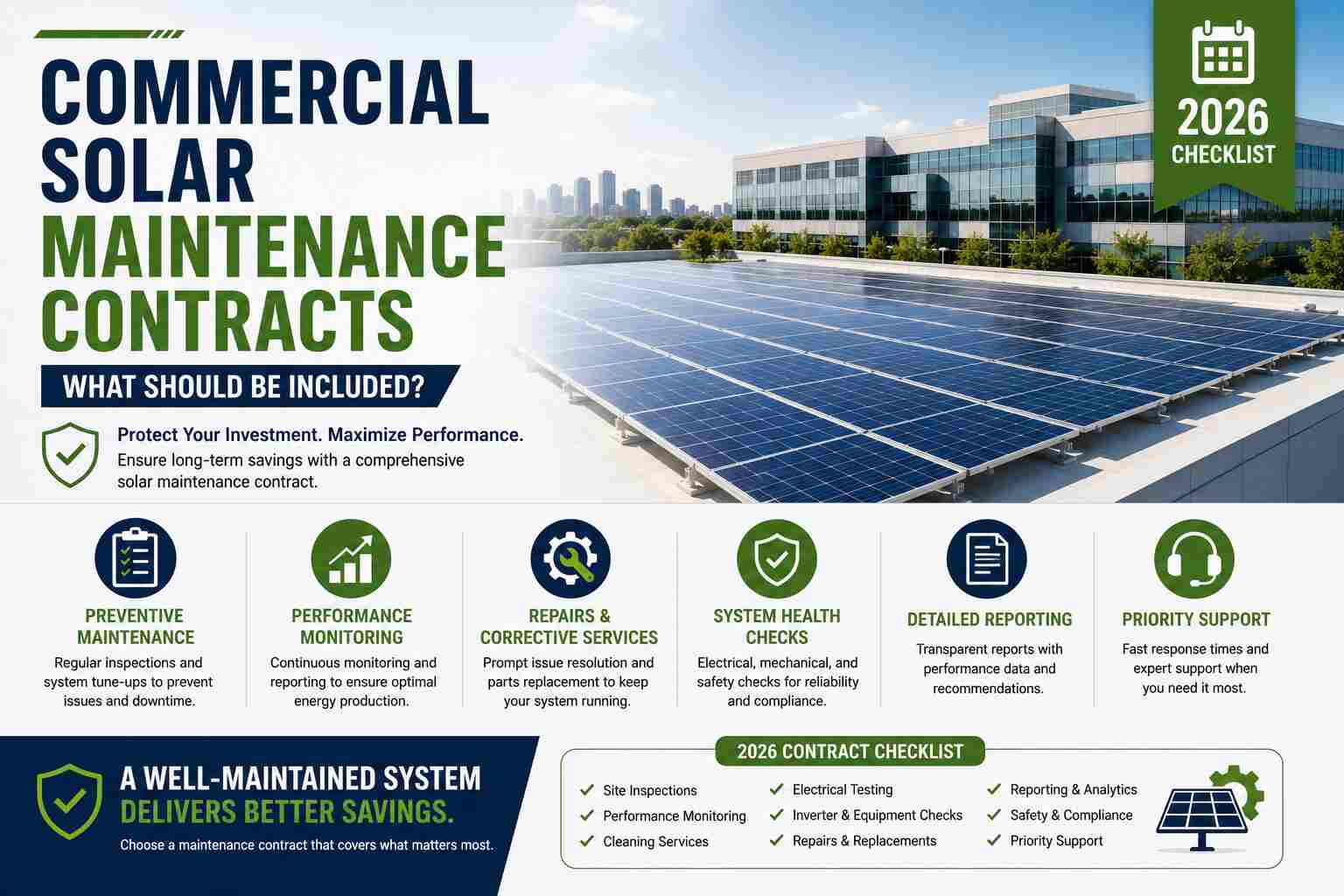
A commercial solar array is a seven-figure asset that only pays you back if it keeps producing. Yet many businesses sign a maintenance agreement they never actually read, then wonder why a dead inverter went unnoticed for three months or why a “guaranteed” cleaning never happened. A strong commercial solar maintenance contract is the difference between a system that quietly loses 15 percent of its output over five years and one that performs at spec for two decades.
This guide walks through everything a commercial solar maintenance agreement should contain, why each clause matters in dollars, and the exact benchmarks you should negotiate for. By the end you will have a complete solar maintenance contract checklist you can hold any O&M provider against.
Why a Commercial Solar Maintenance Contract Matters
Solar panels have no moving parts, so vendors love to say the systems are “maintenance free.” That marketing line quietly ignores inverters, combiner boxes, wiring, soiling, mounting hardware, monitoring software, and warranty administration, all of which degrade or fail on a schedule.
Without a formal solar O&M contract, three expensive things tend to happen. Faults stay invisible because nobody is watching the monitoring portal. Small issues such as a blown fuse or a loose MC4 connector escalate into full string outages. And warranty claims lapse because no one filed the paperwork inside the manufacturer window. A proper operation and maintenance agreement closes all three gaps and ties the provider to measurable performance rather than vague promises.
Think of the contract as an insurance policy on your energy yield. The premium is the annual O&M fee. The payout is guaranteed uptime, fast response, and documented proof that your asset is healthy.
The Core Sections Every Solar O&M Contract Should Contain
A well-drafted commercial solar maintenance agreement is organized into clear sections. Below is the structure we recommend, followed by a deep dive into each one.
1. Scope of Services: Draw a Hard Line Around What Is Covered
The scope section is where most disputes begin, so it deserves the most precision. Vague language like “routine maintenance as needed” gives the provider room to skip work and still claim compliance. Insist on a scope that separates preventive solar maintenance, corrective maintenance, and condition-based tasks.
Preventive (scheduled) tasks should be spelled out with frequency:
- Annual or bi-annual physical inspection of panels, racking, and mounting torque
- Inverter testing, firmware updates, filter cleaning, and cooling checks
- Combiner box and DC/AC wiring inspection for corrosion and loose terminals
- Thermal imaging scans to find hot spots on cells, connectors, and busbars
- Vegetation, shading, and drainage management around ground mounts
- Panel cleaning on a defined solar panel cleaning schedule tied to local soiling
Corrective (reactive) tasks should define who pays and how fast:
- Replacing failed fuses, optimizers, wiring, and cracked modules
- Inverter troubleshooting, board swaps, or full replacement coordination
- Re-torquing and re-sealing after wind or thermal cycling
Condition-based tasks should include triggers:
- Post-storm inspection after hail, high wind, or lightning events
- Extra cleaning when monitoring shows soiling losses beyond a set threshold
A best-practice scope also names an explicit exclusion list. Root cause damage from vandalism, force majeure, owner modifications, or animal intrusion is often billed separately, so you want that written down before signing, not discovered on an invoice.
2. Performance Guarantees: Tie the Provider to Real Output
This is the section that separates a premium solar O&M contract from a glorified cleaning schedule. A genuine solar performance guarantee clause makes the provider financially accountable for how much energy your system produces.
Uptime Guarantee
An uptime or availability guarantee promises the system will be operational for a set percentage of the year, commonly 97 to 99 percent. If availability drops below the threshold because of slow repairs, the provider owes you a credit. Make sure the definition excludes only genuine outside causes such as grid outages and true force majeure, not the provider’s own delays.
Performance Ratio and Energy Guarantee
Uptime alone can be gamed. A system can be technically “on” while producing 12 percent below spec because of soiling or a degraded string. A stronger contract adds a performance ratio (PR) or a weather-adjusted energy guarantee, where the provider commits to a minimum PR such as 0.80 after correcting for irradiance and temperature.
True-Up and Liquidated Damages
The true-up period, usually annual, is where promises turn into money. If measured production falls short of the guaranteed figure because of maintenance failures, the provider pays liquidated damages equal to the lost energy value. Insist the true-up formula is written out with the exact kWh price used.
Sample Performance Guarantee Benchmarks to Negotiate
Bars are illustrative negotiation targets. Actual figures depend on climate, system age, and technology.
3. Response Times and Service Level Agreements
A guarantee is meaningless without a clock attached. Your commercial solar maintenance agreement must define service level agreements (SLAs) that specify how quickly the provider responds and resolves issues by severity.
The best contracts use a tiered structure. A critical fault such as a full site outage should trigger remote acknowledgment within hours and an on-site visit within one to two business days. A minor fault such as a single underperforming string can carry a longer window. Always confirm whether the response time is measured to acknowledgment, to arrival on site, or to full resolution, because those are very different commitments.
4. Solar System Monitoring and Reporting
A modern solar monitoring service is the nervous system of the whole agreement. The contract should require 24/7 remote monitoring with automated alerts, and it should name who owns and maintains the monitoring hardware and data platform. This matters at contract end, because you do not want to lose your production history when you switch providers.
Reporting requirements should be explicit. At minimum, expect monthly or quarterly reports covering energy yield versus expected yield, performance ratio, availability, all fault events with resolution times, and a running log of completed preventive tasks. These reports are also your evidence if you ever need to enforce the performance guarantee, so treat them as a contractual deliverable rather than a courtesy.
5. Pricing, Escalation, and What Drives Solar O&M Cost
Transparent pricing prevents surprise invoices. A commercial O&M agreement is usually priced per kilowatt of installed capacity per year, or as a flat annual fee, sometimes with a separate per-incident rate for corrective work. Commercial solar O&M pricing commonly falls in the range of a few dollars up to roughly fifteen dollars per kW per year, depending on system size, technology, and how much corrective work is bundled in.
Your contract should clearly separate three cost buckets: the fixed preventive fee, hourly labor for corrective work (with standard versus emergency and holiday rates), and parts. Watch for these details:
- Escalation clause. Multi-year contracts often build in a 2 to 4 percent annual increase or a CPI-linked adjustment. Cap it.
- Exclusion threshold. A monetary cap, for example 500 dollars per incident, below which the technician just fixes the issue without seeking approval. This speeds up small repairs.
- Emergency call-out fees. Confirm whether these are included in the base fee or billed separately.
Where Your Annual O&M Fee Typically Goes
Corrective repairs and parts are usually billed on top of this base fee, which is why the exclusion threshold and labor rates matter so much.
6. Liability, Safety, and Compliance
A technician on your roof is a risk event. The agreement must state clear liability clauses for property damage, especially roof membrane punctures during service, and confirm the provider carries adequate general liability and workers compensation insurance. Request certificates of insurance naming you as additional insured.
Compliance language should require strict adherence to OSHA safety standards, the National Electrical Code (NEC), and local utility and interconnection rules. Add indemnification so the provider covers claims arising from its own negligence, and include a weather-event provision so post-storm inspections are triggered automatically rather than left to memory.
7. Term, Termination, and Transferability
Finally, govern the relationship itself. Commercial O&M terms usually run one to five years. Read the automatic renewal language carefully, because auto-renew with a long notice window can trap you with an underperforming vendor.
Your termination clause should provide a clean exit for cause, such as repeated SLA failures, with a defined notice period and, ideally, a right to terminate for convenience. Transferability is easy to overlook and expensive to miss: if you sell the property, you want the right to assign the maintenance contract to the new owner so the asset stays covered without renegotiation.
The Assumptions Hiding in the Fine Print
The best contracts state their baseline assumptions openly, because those assumptions define when a guarantee applies. Look for language covering assumed annual degradation of 0.5 to 0.7 percent, inverter replacement expected around years 10 to 15, soiling loss baselines that justify the cleaning schedule, and operational assumptions such as safe site access during business hours, reliable owner-provided internet for monitoring, and the fact that guarantees are void during utility grid outages. When these are written down, both sides know exactly where responsibility begins and ends.
Your Commercial Solar Maintenance Contract Checklist
Before you sign, confirm the agreement includes every item below.
- Detailed scope separating preventive, corrective, and condition-based tasks
- Named frequencies for inspection, cleaning, and thermal imaging
- Uptime guarantee of 97 percent or higher
- Performance ratio or weather-adjusted energy guarantee
- Annual true-up with a written liquidated damages formula
- Tiered response-time SLAs by fault severity
- 24/7 monitoring with data ownership defined
- Monthly or quarterly performance reporting
- Transparent pricing with capped escalation and an exclusion threshold
- Insurance, indemnification, and OSHA/NEC compliance clauses
- Roof and property damage liability terms
- Term length, renewal terms, termination rights, and transferability
Conclusion
A commercial solar array only delivers its promised return when someone is accountable for keeping it healthy. A thorough commercial solar maintenance contract turns vague reassurance into enforceable performance, covering scope, uptime and performance guarantees, response times, monitoring, pricing, liability, and exit terms. Every clause you tighten today protects real kilowatt-hours and real dollars across the next twenty years of production.
Use the checklist above as your negotiating standard. If a provider hesitates to commit to measurable guarantees or transparent reporting, that hesitation tells you everything you need to know before you sign.
Next Step
Ready to protect your investment? Have your current or prospective O&M provider send their draft agreement, then measure it clause by clause against this checklist. If you want a professional second opinion, contact our team for a free commercial solar maintenance contract review and we will flag any gaps in scope, guarantees, or pricing before you commit.