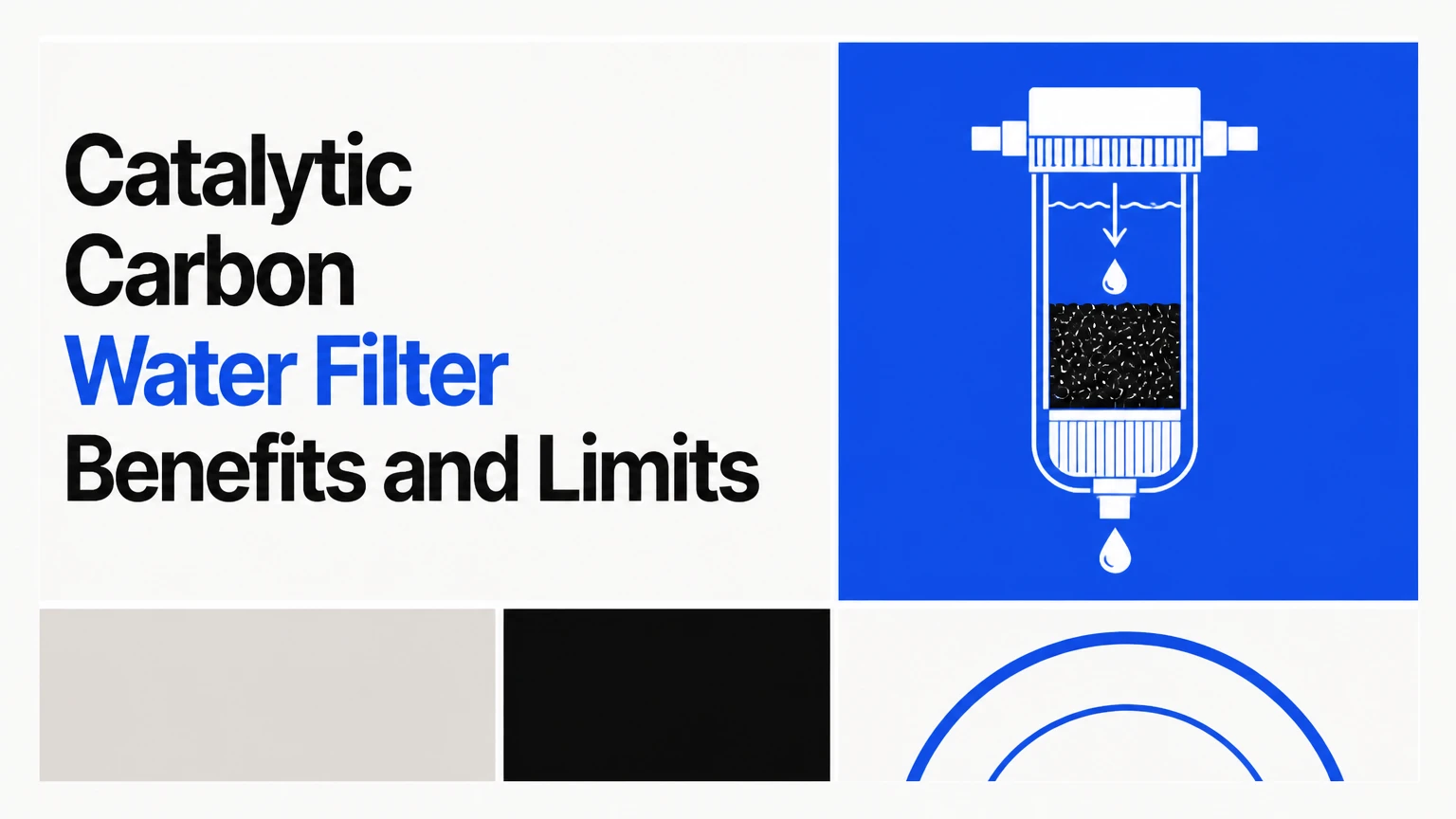
Catalytic carbon water filter benefits include stronger chloramine reduction, effective chlorine and odor control, broad adsorption of many organic contaminants, and longer service life than ordinary carbon in some applications. Catalytic carbon does not soften water, lower TDS, disinfect reliably, or guarantee PFAS removal without product-specific testing and certification.
Key Facts at a Glance
- Catalytic activated carbon combines adsorption with a surface that accelerates selected oxidation-reduction reactions.
- Catalytic carbon is generally more useful than ordinary activated carbon for chloramine-treated municipal water.
- Carbon filtration does not remove hardness minerals, nitrate, sodium, or total dissolved solids.
- Hydrogen sulfide treatment depends on pH, dissolved oxygen, concentration, iron, manganese, and contact time.
- A certified contaminant-reduction claim matters more than the word “catalytic” on a product label.
- Typical residential cartridge replacement occurs every 6-12 months, but capacity depends on water chemistry and gallons treated.
What Is Catalytic Carbon?
Catalytic carbon is activated carbon modified to provide greater surface reactivity than conventional activated carbon. The media still adsorbs compounds inside its pores, but its surface can also accelerate reactions involving oxidants such as chlorine, chloramine, or dissolved sulfide under suitable water conditions.
Activated carbon has an enormous internal pore network. A commonly cited range for commercial activated carbon is approximately 500-1,500 square meters of surface area per gram, although the actual value depends on the carbon source, activation method, and measurement technique.
The word “catalytic” does not mean every contaminant is chemically destroyed. Chloramine may be reduced through a sequence of surface reactions, while VOCs are primarily adsorbed. PFAS performance varies substantially by chain length, media design, empty-bed contact time, and competing organic matter.
The U.S. Environmental Protection Agency describes granular activated carbon as a “porous adsorption media.” That description remains accurate for catalytic carbon because catalytic activity adds a reaction pathway without replacing adsorption.
How Is Catalytic Carbon Made?
Manufacturers begin with a carbon substrate such as coconut shell, bituminous coal, or another high-carbon material. Activation creates pores, while subsequent thermal or gas treatment modifies surface chemistry and increases reactivity toward selected compounds.
Two products labeled catalytic carbon can therefore perform differently. Carbon source, iodine number, pore-size distribution, surface oxygen groups, bed depth, and manufacturing process all affect results.
What Makes It Different From Ordinary Carbon?
Ordinary activated carbon primarily removes contaminants by adsorption. Catalytic carbon retains that function and is engineered to react more effectively with compounds that ordinary carbon handles slowly, especially chloramine and, in some systems, hydrogen sulfide.
How Does Catalytic Carbon Work?
Catalytic carbon works through two linked mechanisms: adsorption captures molecules on internal pore surfaces, while catalytic surface reactions accelerate the conversion of selected oxidants or reduced sulfur compounds. Performance depends on contact time, bed depth, flow rate, temperature, pH, contaminant concentration, and competing substances.
Water must contact enough media for treatment to occur. Engineers often describe this relationship with empty-bed contact time, or EBCT, calculated as the empty volume of the carbon bed divided by the water flow rate.
A practical EBCT target is application-specific. Chloramine systems may require several minutes of contact, while a small drinking-water cartridge may use a dense carbon block and a slower rated flow to create sufficient contact. A manufacturer’s tested flow rate is more useful than a generic claim that catalytic carbon works “fast.”
What Happens to Chloramine?
Chloramine treatment involves surface reactions that consume or transform the disinfectant. The final products can include chloride, ammonia-related species, and other nitrogen compounds, depending on the chloramine form, carbon chemistry, pH, and operating conditions.
That distinction matters. A filter can produce a low chloramine reading while releasing measurable ammonia or changing the water’s oxidation chemistry. Municipal water utilities commonly use monochloramine, but the concentration and chemistry vary by distribution system.
What Happens to Chlorine?
Chlorine is usually reduced efficiently by activated carbon through reduction at the carbon surface and adsorption of associated compounds. Catalytic carbon can provide rapid chlorine reduction, but ordinary high-quality carbon is also effective, so the upgrade may provide little value when chlorine is the only concern.
What Happens to Hydrogen Sulfide?
Catalytic carbon can reduce hydrogen sulfide odor by adsorbing sulfide and accelerating oxidation at the media surface. Treatment becomes less predictable when well water has high sulfide, low dissolved oxygen, low pH, iron, manganese, or substantial sediment.
Hydrogen sulfide is a gas, so an aeration or air-injection stage may outperform carbon alone at higher concentrations. A rotten-egg odor that returns quickly can indicate exhausted media, sulfide loading beyond design capacity, or iron and manganese fouling.
What Are the Main Catalytic Carbon Water Filter Benefits?
The main catalytic carbon water filter benefits are chloramine reduction, chlorine and odor control, broad organic-compound adsorption, mineral preservation, and potentially longer useful service in chloraminated water. Benefits are strongest when the system has a verified reduction claim, adequate contact time, and suitable pretreatment.
Municipal Water Benefits
Catalytic carbon is especially relevant where a utility uses chloramine instead of free chlorine. Chloramine can persist longer in distribution pipes and may create medicinal taste or odor that a small, poorly sized ordinary-carbon cartridge removes inconsistently.
Catalytic carbon can also improve water aesthetics by reducing chlorine taste, some VOCs, and certain odor compounds. It does not remove beneficial calcium and magnesium ions, so the water’s hardness remains essentially unchanged.
Well Water Benefits
For private wells, catalytic carbon can help with low-to-moderate hydrogen sulfide and certain organic contaminants. The media can also improve taste and odor after a separate treatment stage removes sediment and excessive iron.
Well owners should test raw water before selecting carbon. The U.S. Centers for Disease Control and Prevention recommends private-well testing at least annually for common indicators, with additional testing based on local hazards and changes in taste, odor, or appearance.
| Potential benefit | Main target | Typical result | Important condition |
|---|---|---|---|
| Chloramine reduction | Monochloramine | Low or non-detectable residual on tested products | Adequate EBCT and certified capacity |
| Chlorine taste control | Free chlorine | Strong reduction | Ordinary carbon may already perform well |
| Odor reduction | Hydrogen sulfide | Low to moderate concentrations | pH, oxygen, iron, and sulfide control |
| Organic adsorption | VOCs and pesticides | Compound-specific reduction | Media capacity and influent concentration |
| Mineral preservation | Calcium and magnesium | Minerals remain in water | No softening resin is present |
| PFAS reduction | Selected PFAS compounds | Product-specific result | Require certified, compound-specific data |
Which Catalytic Carbon Configuration Fits Your Application?
Carbon blocks suit point-of-use drinking water, granular carbon suits moderate-flow applications, and whole-house carbon tanks suit high-volume treatment. The correct configuration depends on peak flow, contaminant concentration, available space, drain access, and whether sediment pretreatment is installed.
Carbon Block Cartridges
A catalytic carbon block compresses powdered carbon into a dense cartridge. The format can combine chemical treatment with physical filtration, often at nominal or absolute ratings between approximately 0.5 and 5 microns.
Carbon blocks are practical for an under-sink faucet, refrigerator line, or reverse-osmosis prefilter. Their limitation is hydraulic restriction: a cartridge rated for 0.5-2 gallons per minute should not be expected to supply a whole home.
Granular Carbon Cartridges
Granular activated carbon cartridges contain loose particles inside a housing. They generally create less pressure drop than dense blocks, but channeling can occur if water finds a low-resistance path through the bed.
Granular cartridges are useful for moderate-flow inline applications, including some RV and equipment systems. They require careful orientation, flushing, and replacement because loose media can release fines.
Whole-House Carbon Tanks
A point-of-entry tank places a deep bed of catalytic carbon before the home’s plumbing branches. Typical residential beds contain roughly 1-3 cubic feet of media, although the correct volume depends on flow, water analysis, and the supplier’s design calculations.
Upflow systems can operate without a drain or electrical control valve. Backwashing systems use periodic reverse flow to loosen the bed and remove accumulated sediment, which is usually preferable for particulate-bearing well water.
| Configuration | Typical flow | Typical location | Main limitation |
|---|---|---|---|
| Catalytic carbon block | 0.5-3 gpm | Under-sink or refrigerator | Pressure drop at high flow |
| Granular cartridge | 1-5 gpm | Inline, RV, equipment | Channeling and media fines |
| Small upflow tank | 5-10 gpm | Small home point of entry | Limited sediment tolerance |
| Backwashing tank | 8-15+ gpm | Whole-house well or city system | Needs drain, space, and maintenance |
| Commercial carbon vessel | 15-100+ gpm | Multi-unit or industrial site | Requires engineered pretreatment |
What Contact Time and Flow Rate Does Catalytic Carbon Need?
Catalytic carbon needs sufficient bed contact time, and practical residential designs commonly target roughly 3-5 minutes for demanding chloramine applications. The exact requirement is not universal because carbon type, chloramine concentration, temperature, pH, bed depth, and test protocol change performance.
For example, a 1.5-cubic-foot bed contains about 11.2 gallons of media volume before accounting for bed packing. At 3 gallons per minute, the nominal empty-bed contact time is approximately 3.7 minutes. At 8 gallons per minute, it falls to about 1.4 minutes.
Peak household demand makes sizing difficult. A shower, washing machine, and kitchen faucet can exceed the flow rate used in a countertop test. A system that reduces chloramine at 2 gallons per minute may produce breakthrough at 8 gallons per minute.
How Should You Size a System?
Use the following sequence:
- Obtain the utility’s chlorine or chloramine information, or test the incoming water.
- Measure peak flow rather than average daily consumption.
- Match the media volume to the manufacturer’s tested flow and capacity.
- Add sediment pretreatment when turbidity, sand, rust, or well silt is present.
- Confirm pressure loss at both a clean and near-exhausted cartridge condition.
| Sizing input | Typical residential value | Why it matters | Verification method |
|---|---|---|---|
| Kitchen drinking flow | 0.5-1.5 gpm | Supports cartridge selection | Faucet flow test |
| Single shower flow | 1.5-2.5 gpm | Sets point-of-use demand | Fixture label or timed bucket |
| Whole-house peak | 6-12 gpm | Determines tank size | Simultaneous fixture estimate |
| Chloramine concentration | 1-4 mg/L | Determines media capacity | Utility report or laboratory test |
| Sediment prefilter | 5-20 microns | Protects carbon bed | Water analysis and pressure trend |
| Target EBCT | About 3-5 minutes | Supports chloramine contact | Bed volume divided by flow |
Catalytic Carbon Compared With Other Treatment Options
Catalytic carbon is usually the better choice for chloramine and taste, but reverse osmosis is stronger for dissolved salts and many regulated contaminants. Standard carbon may be the better value for free chlorine alone, while aeration or oxidation treatment can be better for heavy hydrogen sulfide.
| Treatment option | Chloramine | Hardness and TDS | PFAS or nitrate | Hydrogen sulfide |
|---|---|---|---|---|
| Standard activated carbon | Variable to poor | No reduction | Compound-specific | Limited and variable |
| Catalytic carbon | Strong when tested and sized | No reduction | Product-specific | Low to moderate cases |
| Reverse osmosis | Strong with carbon stages | Strong reduction | Often strong with certification | Usually requires pretreatment |
| Water softener | No meaningful reduction | Strong hardness reduction | No meaningful reduction | No meaningful reduction |
| Air injection oxidation | No meaningful reduction | No reduction | No meaningful reduction | Strong for suitable well chemistry |
| Ultraviolet disinfection | No chemical reduction | No reduction | No reduction | No meaningful reduction |
Is Catalytic Carbon Better Than Standard Activated Carbon?
Catalytic carbon is better when chloramine is the principal disinfectant or when a tested system must handle difficult sulfur odor. Standard activated carbon is often sufficient for free chlorine, taste, and many organic compounds at a lower purchase price.
The comparison changes when flow is high. A larger bed of standard carbon can sometimes compensate for lower reactivity, while an undersized catalytic bed can fail despite superior media chemistry.
Can Catalytic Carbon Remove PFAS?
Catalytic carbon should not be assumed to remove PFAS. PFAS reduction depends on the exact compound, carbon type, bed depth, flow rate, influent concentration, and exhaustion point; look for an independently certified claim or complete performance data.
The EPA’s drinking-water framework identifies PFAS as a contaminant group requiring compound-specific treatment evaluation. A label stating “reduces chemicals” is not evidence of reliable reduction for PFOA, PFOS, GenX, or other PFAS compounds.
What Catalytic Carbon Cannot Remove
Catalytic carbon does not soften water or lower total dissolved solids. It also does not reliably remove nitrate, fluoride, sodium, arsenic, dissolved metals, bacteria, viruses, or sediment unless the system includes a separate treatment technology designed for that contaminant.
| Contaminant or property | Catalytic carbon result | Better-suited technology | Testing or design note |
|---|---|---|---|
| Calcium and magnesium | Remains in water | Ion-exchange softener | Measure hardness as grains per gallon |
| TDS and sodium | Little or no reduction | Reverse osmosis | Confirm rejection percentage |
| Nitrate | Not a dependable treatment | RO or nitrate-selective resin | Laboratory test required |
| Bacteria and viruses | No reliable disinfection | UV, chlorination, or validated membrane | Test private wells |
| Sand and silt | Limited protection only | Sediment filter | Install upstream |
| Iron and manganese | Variable adsorption and fouling risk | Oxidation or specialty media | Test concentration and form |
| PFAS | Compound-specific | Certified carbon or RO | Check exact compounds and capacity |
How Much Does Catalytic Carbon Cost and How Long Does It Last?
Typical catalytic carbon cartridges cost approximately $35-$75 and last 6-12 months, while whole-house systems commonly cost about $1,200-$2,500 installed or configured, with media replacement often required after 3-5 years. Actual cost depends on gallons, concentration, peak flow, pretreatment, and local labor.
A cartridge’s calendar life is only a planning estimate. Chloramine concentration, organic loading, sediment, and water use determine when capacity is exhausted. A family using 500 gallons per month creates a different load from a household using 1,500 gallons per month.
Whole-house media can last longer when the bed is protected by sediment filtration and correctly backwashed. A non-backwashing tank exposed to well silt may lose performance long before the carbon chemistry is exhausted.
| Cost item | Typical range | Replacement interval | Main cost driver |
|---|---|---|---|
| Under-sink catalytic cartridge | $35-$75 | 6-12 months | Gallons and chloramine load |
| Sediment prefilter | $10-$35 | 2-12 months | Turbidity and well silt |
| Small point-of-entry tank | $800-$1,500 | Media often 3-5 years | Tank size and valve |
| Whole-house catalytic system | $1,200-$2,500 | Media often 3-5 years | Flow and installation |
| Backwash service | $100-$300 per visit | Annual or as needed | Valve and local labor |
| Laboratory water panel | $75-$300 | Before purchase and periodically | Number of analytes |
How Do You Install and Maintain Catalytic Carbon?
Install sediment filtration upstream, verify flow direction, flush new carbon thoroughly, and replace the media before measurable contaminant breakthrough. Initial commissioning commonly takes 5-15 minutes of flushing for a cartridge, while a tank may require a longer startup and one or more backwash cycles.
Step 1: Test the Source Water
Test municipal or well water for disinfectant type, pH, hardness, iron, manganese, turbidity, hydrogen sulfide, nitrate, and any contaminant relevant to the property. A carbon filter cannot be selected intelligently from odor alone.
Step 2: Install Sediment Protection
Place a washable screen or cartridge sediment filter before the carbon stage when the water contains particles. A typical 5-20 micron prefilter protects the carbon surface from rapid blockage.
Step 3: Match Flow to the Rating
Install a flow restrictor or choose a larger bed when the application exceeds the tested rate. The filter should not be judged by its maximum housing connection size, because a 1-inch port does not prove adequate carbon contact time.
Step 4: Flush the Media
Flush until the water is clear and free of carbon fines. Black specks during initial startup are usually loose carbon particles, but persistent particles after proper flushing indicate a damaged cartridge, poor seal, or unsuitable housing.
Step 5: Record Pressure and Capacity
Record inlet and outlet pressure, installation date, meter reading, and the manufacturer’s rated gallon capacity. Replace a cartridge when its schedule or capacity is reached, or sooner if taste, odor, pressure, or laboratory results indicate breakthrough.
Common Problems and Their Fixes
| Symptom | Probable cause | Immediate check | Corrective action |
|---|---|---|---|
| Sudden low pressure | Sediment or carbon fines | Compare inlet and outlet gauges | Change prefilter and flush |
| Chloramine taste returns | Exhaustion or excessive flow | Test before and after filter | Replace media or reduce flow |
| Rotten-egg odor returns | Sulfide overload or fouling | Test sulfide, iron, manganese | Add oxidation pretreatment |
| Black particles persist | Fines, broken cartridge, bad seal | Inspect cartridge and housing | Reflush or replace cartridge |
| Scale remains | Hardness was never treated | Measure grains per gallon | Add a softener or RO |
| Water remains cloudy | Sediment, air, or microbial issue | Test turbidity and bacteria | Add appropriate pretreatment |
A common practitioner mistake is treating a pressure problem as a media-life problem. Measure pressure before changing expensive carbon; a blocked $15 sediment cartridge can imitate exhausted catalytic media.
Another mistake is selecting a whole-house tank by household size alone. Peak flow and contaminant concentration determine bed requirements more directly than the number of occupants.
Which System Should You Choose?
Choose a catalytic carbon block for one drinking faucet, a properly sized whole-house tank for chloraminated municipal water, and a backwashing carbon or oxidation system for a private well with sulfur odor. The best choice changes when the main problem is hardness, nitrate, bacteria, or dissolved metals rather than taste and disinfectant residual.
City Renter or Small Household
Select an under-sink catalytic carbon block when the goal is chloramine and taste reduction at one faucet. A 0.5-1.5 gallon-per-minute rated cartridge avoids unnecessary whole-house expense and treats water used for drinking and cooking.
Municipal Homeowner
Select a whole-house catalytic carbon tank when chloramine affects showers, laundry, appliances, and every faucet. Confirm that the tank’s rated flow matches peak demand and that the product provides a chloramine capacity claim rather than only a generic carbon description.
Private-Well Owner
Test first, then consider catalytic carbon for low-to-moderate sulfide after sediment and iron conditions are understood. Choose backwashing equipment when the well carries particles, and consider air injection, oxidation, or specialty media when sulfide concentration is high.
Household With Hardness or Scale
Do not buy catalytic carbon as a softener substitute. Use a water softener for calcium and magnesium hardness, or reverse osmosis at a drinking tap when dissolved solids and specific contaminants also require reduction.
Expert Selection Checklist
- Identify the disinfectant: free chlorine and chloramine require different capacity assumptions.
- Obtain a laboratory report for private-well water before choosing media.
- Demand a tested flow rate, capacity, and contaminant claim.
- Check whether certification applies to the exact cartridge or tank model.
- Install sediment protection before carbon when particles are present.
- Plan for pressure monitoring, cartridge dates, and media replacement.
- Treat PFAS, nitrate, microbes, and hardness as separate design problems.
- Confirm drain and backwash requirements before purchasing a whole-house tank.
FAQ
Does catalytic carbon make water safe to drink?
Catalytic carbon can reduce specific chemicals, tastes, and odors, but it does not make every water source safe by itself. Private wells require testing for bacteria, nitrate, metals, and local contaminants, while treatment claims should match the exact filter model and certified reduction data.
Can catalytic carbon remove lead?
Catalytic carbon is not a universal lead treatment. Some carbon block products include lead-reduction claims because of their formulation and physical filtration rating, but the claim must appear in the product’s certification or performance sheet. Test older plumbing and replace uncertified cartridges on schedule.
Does catalytic carbon change water pH?
Catalytic carbon usually produces little deliberate pH change, although influent chemistry, carbon ash, and startup conditions can cause temporary variation. Measure pH before and after installation when well water is acidic or when treatment depends on sulfide oxidation.
Is a catalytic carbon filter useful for shower water?
A whole-house catalytic carbon tank can reduce chlorine, chloramine, and some odors at showers when its flow and bed volume are correctly sized. A small faucet cartridge generally cannot supply a shower because its rated flow and contact time are too low.
Can catalytic carbon remove ammonia from water?
Catalytic carbon treatment can change ammonia-related chemistry during chloramine reduction, but it should not be treated as a dependable standalone ammonia-removal process. Use a treatment system specifically tested for ammonia when ammonia is the measured contaminant.
When should catalytic carbon be replaced?
Replace catalytic carbon according to the tested gallon capacity, manufacturer schedule, pressure loss, or contaminant breakthrough, whichever occurs first. Typical household cartridges last 6-12 months, while protected whole-house media commonly lasts 3-5 years, although difficult well chemistry can shorten both intervals.
The Bottom Line
Catalytic carbon water filter benefits are greatest for chloramine-treated municipal water, chlorine taste, selected organic compounds, and some low-to-moderate hydrogen sulfide problems. Catalytic carbon is not a softener, TDS reducer, universal PFAS filter, or substitute for well-water disinfection. Select the media only after matching the contaminant, flow rate, contact time, certification, and pretreatment requirements.