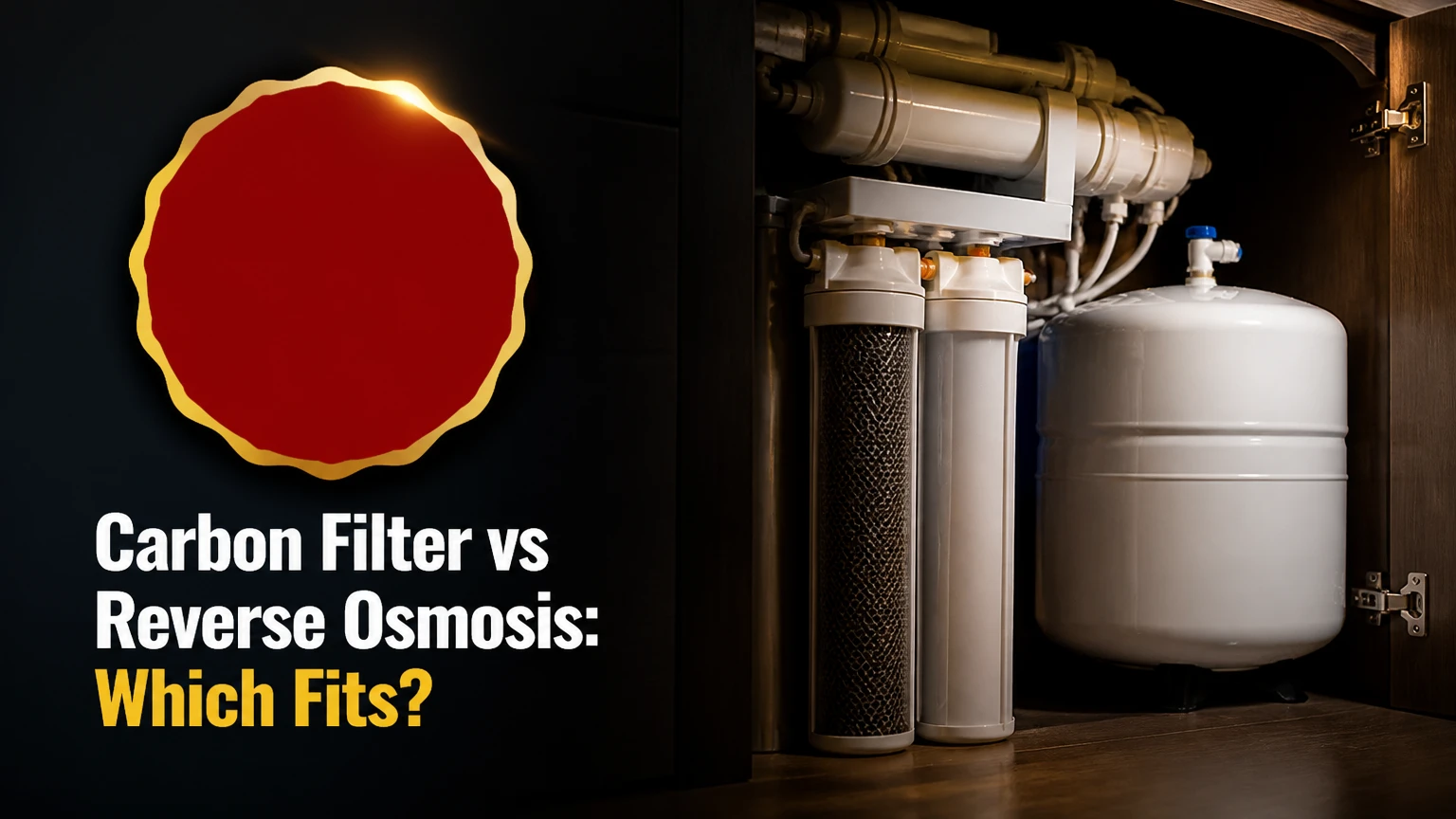
Carbon filtration is usually the better choice for improving municipal tap water taste, chlorine, odor, and many organic chemicals at low cost with no wastewater. Reverse osmosis is the better choice when testing identifies dissolved contaminants such as nitrate, fluoride, arsenic, or high salinity, provided the system has suitable pressure and maintenance.
Key Facts at a Glance
- Activated carbon removes contaminants mainly through adsorption, while reverse osmosis separates dissolved substances through a pressure-driven membrane.
- A standard carbon filter does not remove hardness minerals, nitrate, fluoride, or most dissolved salts.
- A properly specified residential RO system commonly reduces TDS by about 90-99 percent, but performance varies with pressure, temperature, membrane condition, and feed-water chemistry.
- Carbon filters normally waste no water; residential RO systems typically send 1-4 gallons to the drain for each gallon produced, although efficient models can perform better.
- Carbon filtration and RO are not interchangeable: carbon targets chlorine and organic compounds, while RO targets dissolved inorganic contaminants.
- The correct purchase decision begins with a water report or laboratory test, not with TDS alone.
What Is the Difference Between Carbon Filtration and RO?
Carbon filtration improves water by holding selected chemicals on the internal surfaces of activated carbon. Reverse osmosis sends pressurized water across a semipermeable membrane that allows water to pass more readily than dissolved salts and many larger contaminants. Carbon is selective adsorption; RO is broad dissolved-solids separation.
The technologies also operate at different points in a treatment train. A carbon cartridge can sit directly on a cold-water line and deliver water at near-normal flow. An RO membrane produces water slowly, so most under-sink systems use a storage tank, automatic shutoff valve, drain connection, and carbon prefilters.
The comparison is not between a weak purifier and a strong purifier. Each technology addresses a different contaminant profile. A solid carbon block may be ideal for chlorinated city water, while an RO membrane may be necessary for nitrate in private-well water.
Master Comparison
| Decision criterion | Activated carbon | Reverse osmosis |
|---|---|---|
| Main mechanism | Adsorption and physical filtration | Pressure-driven membrane separation |
| Typical TDS reduction | 0-10% | 90-99% |
| Chlorine reduction | 95-99% with suitable cartridge | Usually handled by carbon prefilter |
| Nitrate and fluoride | Usually 0% | Commonly 90-98%, model dependent |
| Typical operating pressure | 20-60 psi | 40-80 psi |
| Water discharged | 0 gallons per gallon filtered | About 1-4 gallons per gallon produced |
| Typical cartridge interval | 3-12 months | Prefilters 6-12 months |
| Membrane replacement | Not applicable | Commonly 2-5 years |
These figures are typical residential ranges, not universal guarantees. NSF/ANSI certification for the named contaminant is more meaningful than a manufacturer’s general “removes impurities” statement.
How Do Carbon Filters Work?
Activated carbon works through adsorption, in which chlorine, volatile organic compounds, taste compounds, and odor compounds attach to carbon surfaces inside a porous cartridge. Carbon does not generally destroy every contaminant, and its capacity ends when available binding sites become occupied.
Granular activated carbon contains loose particles and can provide good flow at modest cost, but water may form preferential channels through the bed. A solid carbon block compresses carbon into a denser structure, improving contact consistency and often adding particulate filtration. Catalytic carbon is chemically modified for difficult targets such as chloramine and hydrogen sulfide.
A carbon cartridge has two practical limits: contact time and capacity. A small cartridge running at excessive flow may show poor removal even when the same media performs well at a slower rated flow. Replacement timing must account for gallons, chlorine concentration, sediment load, and periods of nonuse.
Carbon Types and Practical Use
| Carbon format | Typical flow | Strongest use | Main limitation |
|---|---|---|---|
| GAC cartridge | 0.5-2.0 gallons per minute | Taste, chlorine, odor | Channeling can reduce contact time |
| Solid carbon block | 0.5-1.5 gallons per minute | Chlorine, VOCs, fine particles | Pressure drop rises as sediment loads |
| Catalytic carbon | 0.25-1.0 gallons per minute | Chloramine, sulfur odor | Higher media cost and specific sizing |
| Lead-rated carbon block | 0.5-1.0 gallons per minute | Certified lead reduction | Requires certification and timely replacement |
A carbon filter is not a water softener. Calcium and magnesium remain in the water, so carbon cannot stop scale in a kettle, shower heater, humidifier, or espresso boiler.
How Does Reverse Osmosis Work?
Reverse osmosis applies pressure to feed water so water molecules cross a thin-film composite membrane while much of the dissolved salt load remains in the concentrate stream. The membrane’s separation performance depends on feed pressure, temperature, pH, recovery, contaminant concentration, and maintenance.
A typical under-sink RO system uses a sediment filter, one or two carbon prefilters, the RO membrane, a storage tank or pump, and a post-carbon filter. The prefilters protect the membrane from particles and chlorine. The membrane rejects dissolved ions and many microorganisms, while the postfilter improves stored-water taste.
The often-repeated “0.0001-micron pore size” comparison is an oversimplification. RO membranes do not act like a simple sieve with uniform holes; diffusion, charge, solubility, and membrane chemistry also influence rejection. The practical specification is the tested contaminant-reduction claim under stated conditions.
Typical RO Stages
| Stage | Component | Primary purpose | Usual replacement |
|---|---|---|---|
| 1 | 5-micron sediment filter | Removes sand, rust, and silt | 6-12 months |
| 2 | Carbon block | Removes chlorine and organic compounds | 6-12 months |
| 3 | RO membrane | Reduces dissolved salts and selected contaminants | 2-5 years |
| 4 | Storage tank or pump | Provides usable faucet flow | Tank 5-10 years, pump varies |
| 5 | Post-carbon filter | Polishes taste after storage | 6-12 months |
| 6 | Remineralization cartridge | Adds calcium or magnesium | 6-12 months |
RO does not automatically make unsafe source water safe. A damaged membrane, unsanitary tank, inadequate pretreatment, or untested pathogen can undermine the result. Private wells with microbiological risk may require disinfection and a validated UV stage in addition to RO.
Which Contaminants Does Each Technology Remove?
Carbon filtration is strongest against chlorine, many VOCs, synthetic organic chemicals, and taste or odor compounds. Reverse osmosis is stronger against dissolved salts, nitrate, fluoride, arsenic species, and many heavy metals, but neither system should be assumed to remove a contaminant without a product-specific test claim.
The Environmental Protection Agency’s consumer guidance treats treatment as contaminant-specific: a filter should be selected according to the substance present and the reduction claim verified for that product. NSF/ANSI 42 generally addresses aesthetic effects such as chlorine and taste, while NSF/ANSI 53 covers specific health-related contaminant claims, and NSF/ANSI 58 applies to residential RO systems.
| Contaminant or issue | Carbon filter | Reverse osmosis | Better treatment decision |
|---|---|---|---|
| Chlorine taste and odor | Usually 95-99% with rated media | Carbon prefilter required | Carbon for simple improvement |
| Chloramine | Catalytic carbon may reduce it | Catalytic or adequate carbon pretreatment required | Certified catalytic carbon or RO package |
| VOCs and many pesticides | Often effective when certified | Often reduced, with carbon support | Verify named contaminant claim |
| Lead | Only lead-certified media | Commonly reduced, model dependent | Certified carbon or RO |
| Nitrate | Generally ineffective | Commonly reduced 90-98% | RO after laboratory testing |
| Fluoride | Generally ineffective | Commonly reduced 90-98% | RO or specialty media |
| Calcium and magnesium hardness | No meaningful reduction | High reduction | Softener for whole-house scale, RO for drinking |
| PFAS | Some specialty carbon works | Many systems reduce PFAS | Certified carbon or RO claim |
| Bacteria and viruses | Standard carbon is not a disinfectant | Membrane may reduce many organisms | UV or disinfection when pathogens are a risk |
| Sediment and rust | Carbon block may trap fine particles | Sediment prefilter protects membrane | Dedicated sediment filter first |
Why TDS Alone Does Not Settle the Choice
Total dissolved solids measure the combined concentration of dissolved material, usually in milligrams per liter, but TDS meters do not identify individual substances. A low TDS reading does not rule out lead, nitrate, or PFAS, and a high TDS reading does not identify which mineral causes the reading.
Use an accredited laboratory when a private well, nearby agricultural activity, old plumbing, flooding, industrial land use, or a regulated water advisory raises concern. A utility water-quality report is a useful starting point for municipal supplies, but the report describes the distribution system broadly and may not represent plumbing inside one building.
Which System Costs Less to Own?
Carbon filtration generally costs less because cartridges are inexpensive, installation is simple, and the system does not require a drain, tank, pump, or electricity. RO costs more to install and maintain, especially when membranes, pumps, remineralizers, and wastewater charges are included.
Typical United States household pricing varies by brand and installation conditions. Cartridge prices also depend on whether the replacement part is a proprietary design or a widely available standard size.
| System type | Typical purchase price | Replacement interval | Typical annual maintenance |
|---|---|---|---|
| Pitcher or countertop carbon | $30-$80 | 1-4 months | $40-$120 |
| Under-sink carbon block | $80-$250 | 6-12 months | $50-$150 |
| Whole-house carbon | $300-$1,200 | 1-3 years for media | $100-$300 |
| Tanked under-sink RO | $150-$350 | Filters 6-12 months | $80-$200 |
| Tankless under-sink RO | $400-$900 | Filters 6-12 months | $120-$300 |
| Countertop RO | $250-$500 | Filters 6-24 months | $100-$250 |
RO wastewater deserves a household-level calculation. At a 1:4 product-to-drain ratio, producing 3 gallons of drinking and cooking water sends about 12 gallons to the drain. A permeate pump, adequate pressure, efficient membrane, or tankless design can reduce that ratio, but advertised efficiency depends on test conditions.
Which Configuration Fits Your Water and Space?
Municipal water with acceptable regulatory results usually needs a point-of-use carbon block when the main complaint is chlorine taste, odor, or a small number of certified organic contaminants. Private-well water requires testing before equipment selection because nitrate, arsenic, bacteria, hardness, iron, manganese, and sulfur odor can require separate treatment.
| Household situation | Recommended starting point | Reason | Additional requirement |
|---|---|---|---|
| City water, chlorine taste | Solid carbon block | High chlorine and taste reduction | NSF/ANSI 42 claim |
| City water, lead concern | Lead-certified carbon or RO | Plumbing can add lead after treatment plant | Test first-draw and flushed samples |
| Private well, nitrate | RO at drinking tap | Carbon does not remove nitrate | Certified nitrate claim and testing |
| Hard water with scale | Water softener or scale strategy | RO is inefficient for whole-house flow | RO only for drinking water |
| Well water with bacteria | Disinfection and filtration | RO is not a complete microbial plan | UV or validated disinfection |
| Small apartment kitchen | Compact carbon or countertop RO | No tank or drain changes may be possible | Check faucet and power requirements |
| Low pressure below 40 psi | Carbon or RO with booster | RO production falls at low pressure | Measure dynamic pressure |
| PFAS concern | Certified carbon or RO | Media performance varies by compound | Verify the exact PFAS claim |
Should You Use Carbon and RO Together?
Carbon and RO often work best together when the source contains both chlorine and dissolved contaminants. Carbon protects the RO membrane from chlorine, while RO handles the dissolved fraction that carbon leaves behind.
A practical combination is a sediment prefilter, carbon block, RO membrane, storage tank, and post-carbon filter. A remineralization cartridge can improve taste, but it does not restore the source water’s original chemistry exactly, and it should not be treated as a health necessity for most people.
What Are the Main RO Configurations?
Tanked RO systems produce water slowly and store it under pressure, so they remain the common value choice for under-sink installation. Tankless systems use a pump and higher-output membrane to produce water on demand, saving cabinet space but adding electrical components and usually increasing purchase cost.
Countertop RO units avoid permanent plumbing changes and suit renters, but their reservoirs require filling and emptying. Whole-house RO is rarely the first choice for an ordinary residence because it creates large concentrate volumes and treats water that does not need drinking-water purity.
| RO configuration | Space requirement | Typical output | Best fit |
|---|---|---|---|
| Tanked under-sink | 12-18 inches of cabinet height | 20-75 gallons per day membrane rating | Lowest initial cost |
| Tankless under-sink | 6-12 inches of cabinet height | 400-1,200 gallons per day rating | Limited cabinet space |
| Countertop | Counter surface and reservoir | 0.1-0.5 gallon per minute | Renters and no-drain installations |
| Whole-house RO | Utility-room equipment | Hundreds of gallons per day | Specialized high-salinity supplies |
Membrane ratings are laboratory or standardized ratings, not guaranteed faucet flow. Cold water, low pressure, high TDS, and fouling can reduce actual output substantially.
What Are the Biggest Operating Mistakes?
The most damaging mistake is selecting treatment from a symptom rather than a contaminant test. Cloudy water may indicate air, sediment, hardness, or a plumbing problem, while a taste complaint does not prove that dissolved contaminants are present.
Four practitioner rules prevent most avoidable failures:
- Never run hot water through a drinking-water carbon cartridge. Use cold water only, because heat can reduce adsorption performance and release previously held compounds.
- Replace carbon before capacity is exhausted. Carbon breakthrough can occur without a dramatic visual warning, especially when chlorine concentration or daily use increases.
- Protect RO membranes from chlorine. Replace carbon prefilters on schedule and verify the membrane’s chlorine tolerance before changing the design.
- Do not treat a low TDS meter reading as proof of safety. TDS cannot detect every important contaminant and cannot replace certified reduction data.
RO tanks also require sanitation during filter changes or according to the manufacturer’s procedure. A neglected tank can create taste or odor problems even when the membrane still reduces dissolved solids effectively.
Common Failure Modes
| Symptom | Likely cause | Corrective action | Prevention |
|---|---|---|---|
| Black particles after carbon change | Carbon fines | Flush until clear | Follow cartridge flush volume |
| Sudden carbon flow reduction | Sediment loading | Replace cartridge or add sediment prefilter | Use a 5-micron prefilter |
| RO drain runs continuously | Faulty shutoff valve or low tank pressure | Check valve, tank, and feed pressure | Service annually |
| RO faucet produces little water | Empty or low-pressure tank, clogged filters | Empty tank, check pressure, replace filters | Maintain 5-8 psi empty tank pressure when specified |
| Sour or stale RO taste | Exhausted postfilter or dirty tank | Replace filter and sanitize | Use water regularly |
| Chlorine appears after RO | Exhausted carbon prefilter | Replace prefilter and test membrane | Keep a replacement schedule |
An empty RO storage tank commonly requires approximately 5-8 psi of air pressure, but the exact value belongs to the equipment manufacturer. Adding air to a full tank gives a misleading reading and can damage the bladder.
Which Should You Choose?
Choose Carbon for Municipal Taste and Odor
Choose a certified solid carbon block when municipal water meets local safety requirements and the main problem is chlorine, chloramine, taste, odor, or selected organic compounds. Carbon preserves calcium and magnesium, maintains normal flow, uses no electricity, and produces no drain water.
Carbon is not the right answer for nitrate, fluoride, hardness, high salinity, or a confirmed heavy-metal problem unless the exact cartridge carries a verified reduction claim. The cartridge must also be sized for the household flow rate and replaced by capacity or the manufacturer’s gallon limit.
Choose RO for Dissolved Contaminants
Choose reverse osmosis when a laboratory report identifies nitrate, fluoride, arsenic, high salinity, or multiple dissolved contaminants that carbon cannot reliably reduce. RO is especially useful at one drinking-water faucet, where the higher maintenance and wastewater volume remain limited.
RO does not replace a softener for whole-house hardness, and it does not replace UV or disinfection for a pathogen-prone well. A qualified installer should check pressure, drain routing, air-gap requirements, feed-water temperature, and storage capacity before installation.
Choose a Combined System for Complex Water
Choose carbon plus RO when water contains chlorine or chloramine alongside dissolved contaminants. The carbon stage protects the membrane, and the membrane supplies the broad dissolved-solids reduction.
For a private well, add treatment only after testing iron, manganese, hardness, pH, nitrate, arsenic, sulfur compounds, and bacteria where relevant. Pretreatment prevents fouling and can cost less than repeatedly replacing a damaged RO membrane.
FAQ
Does a carbon filter remove calcium and magnesium?
No. Standard activated carbon does not meaningfully reduce calcium or magnesium, the minerals responsible for most water hardness. A water softener exchanges hardness ions throughout the home, while RO reduces hardness only at the treated faucet and produces a concentrate stream.
Is reverse osmosis water healthier than carbon-filtered water?
Neither technology automatically produces healthier water in every home. Reverse osmosis is advantageous when testing identifies dissolved contaminants that carbon cannot reduce, while carbon is sufficient for many aesthetic municipal-water concerns. Mineral removal alone is not a health benefit, and certified contaminant performance matters more than the purification label.
Can reverse osmosis remove chlorine?
An RO membrane is normally protected by an activated-carbon prefilter that removes chlorine before the membrane. Carbon stages in an RO system perform the chlorine treatment, so replacing those stages is essential. A membrane exposed to chlorine may lose rejection performance or fail prematurely, depending on its construction.
Does a water softener replace reverse osmosis?
No. A water softener targets calcium and magnesium hardness, while reverse osmosis targets a much broader range of dissolved substances. A softener can protect an RO membrane from scale, but it does not reliably remove nitrate, fluoride, arsenic, or many other contaminants from drinking water.
How often should an RO system be sanitized?
Many residential systems are sanitized annually or during a complete filter change, but the manufacturer’s procedure controls. Sanitation typically involves shutting off the feed, removing or bypassing sensitive components, applying the specified sanitizer, flushing thoroughly, and preventing sanitizer from reaching the membrane unless the instructions permit it.
Can carbon filtration remove PFAS?
Some activated-carbon products reduce specific PFAS compounds when sufficient media volume and contact time are provided. Performance varies by compound, concentration, competing organic matter, and cartridge capacity. Select a product with a named PFAS reduction claim, replace it on schedule, and consider RO when the laboratory result and certified product data support that choice.
The Bottom Line
Carbon filter vs reverse osmosis is a contaminant-matching decision, not a universal quality ranking. Choose carbon for chlorine, odor, taste, and selected organic compounds with low operating cost and zero wastewater. Choose RO for confirmed dissolved contaminants such as nitrate, fluoride, arsenic, or high salinity. Test the water, verify a certified reduction claim, and combine technologies when the source requires both organic-compound control and dissolved-solids reduction.