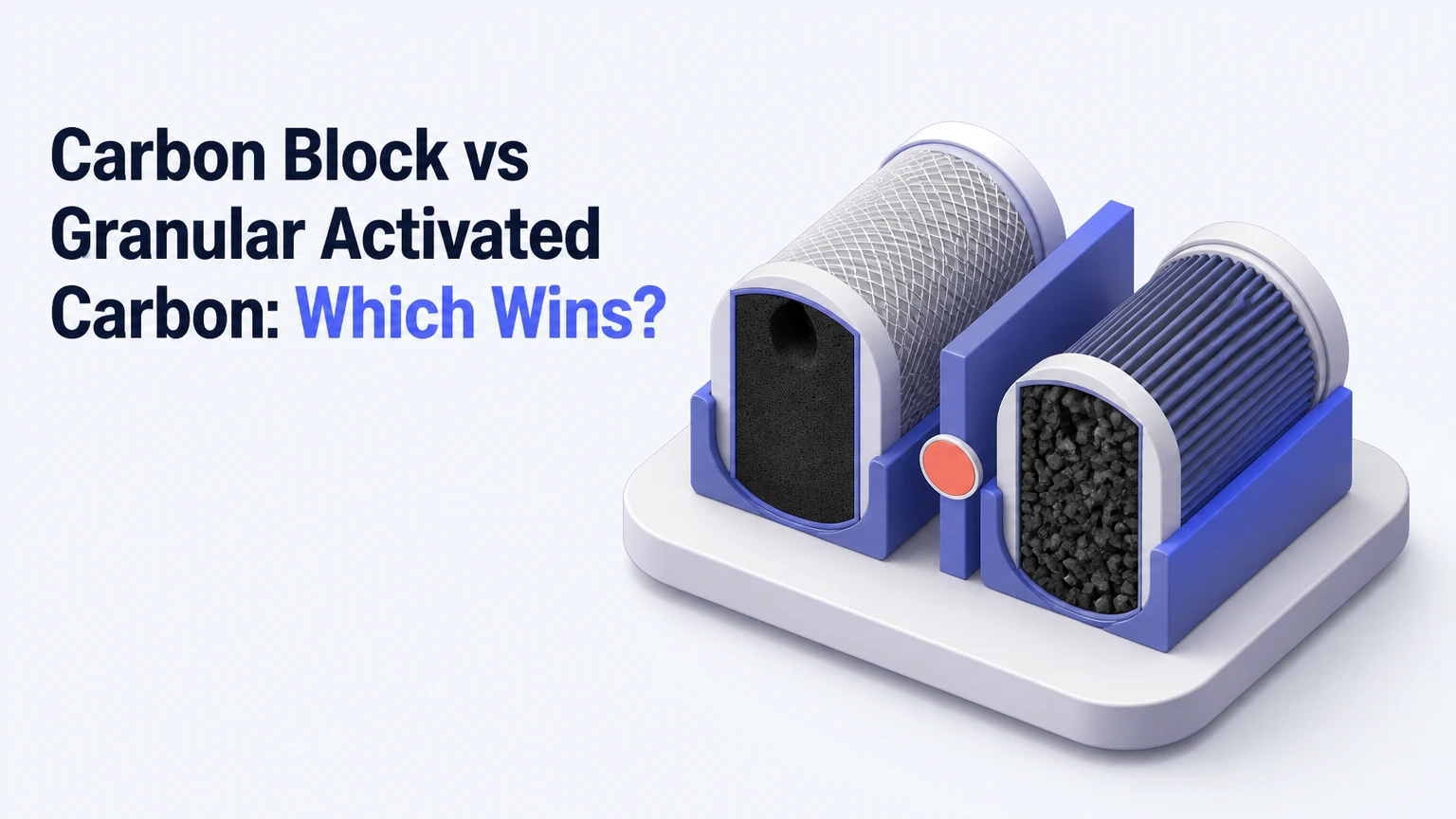
Carbon block generally wins for point-of-use drinking water because its compact structure provides finer particle filtration and more uniform carbon contact. Granular activated carbon (GAC) generally wins for whole-house treatment because a correctly sized bed supports higher flow with less pressure loss. The right choice depends on contaminant, flow demand, bed depth, and certification.
Key Facts at a Glance
- Carbon block filters commonly provide a 0.5-10 micron particle rating, while small GAC cartridges commonly use roughly 20-50 micron granular media.
- A carbon block usually removes particles more effectively, but sediment can clog its outer surface quickly without a prefilter.
- GAC usually maintains higher flow, but shallow or poorly packed beds can develop preferential channels that reduce chemical contact.
- Chlorine removal depends on carbon type, carbon mass, water temperature, flow rate, and contact time, not on cartridge shape alone.
- Standard activated carbon is less suitable for chloramine, PFAS, nitrate, fluoride, and dissolved salts unless the product has a specific reduction claim.
- NSF/ANSI certification for the named contaminant is more meaningful than a generic label such as “premium carbon.”
What Are Carbon Block and GAC Filters?
Carbon block is a rigid cartridge made by compressing activated-carbon particles with a binder or by forming an extruded carbon structure. Water usually travels from the outside of the cylindrical cartridge toward a central core, passing through a dense depth-filtering matrix before leaving the housing.
Granular activated carbon is loose particulate carbon held inside a cartridge, vessel, or backwashing tank. Water flows around and between granules, and the media bed must be deep and evenly distributed enough to provide chemical contact. A small cartridge and a whole-house backwashing tank are therefore both GAC systems, but they do not provide equivalent treatment.
The word “carbon” describes the sorbent, not the performance level. Coconut-shell, bituminous-coal, wood-based, catalytic, pelletized, and powdered carbons have different pore distributions and surface chemistry.
How Does Activated Carbon Remove Contaminants?
Activated carbon removes many dissolved organic compounds by adsorption, meaning molecules accumulate on internal carbon surfaces through surface forces and pore interactions. Activated carbon also promotes chemical reactions with oxidants such as free chlorine, while chloramine generally requires catalytic carbon, greater carbon mass, or longer contact time.
Adsorption is not a magnetic process. Carbon does not attract every contaminant, and pore volume alone does not predict performance. Molecular size, polarity, concentration, pH, temperature, competing organic matter, and empty bed contact time all affect removal.
Carbon also does not sterilize water by default. A fine carbon block may physically reduce some protozoan cysts when its tested absolute rating supports that claim, but a standard carbon cartridge should not be treated as a complete barrier against bacteria, viruses, or unsafe source-water contamination.
| Contaminant or property | Carbon behavior | Format that often has an advantage | Important limitation |
|---|---|---|---|
| Free chlorine | Chemical reduction and adsorption | Carbon block or GAC | Capacity varies by flow and carbon mass |
| Chloramine | Slow catalytic reaction | Catalytic GAC or catalytic block | Standard carbon may provide poor reduction |
| Lead | Adsorption or electrochemical surface interaction | Certified carbon block | Requires a specific lead claim and low flow |
| PFAS | Adsorption under controlled conditions | Certified high-capacity carbon bed | Media exhaustion and competing organics matter |
| Nitrate | Usually little useful removal | Neither standard format | Consider ion exchange or reverse osmosis |
| Fluoride | Usually little useful removal | Neither standard format | Use a fluoride-rated process |
| Sediment | Mechanical straining | Carbon block | Prefilter prevents rapid clogging |
| Bacteria and viruses | No dependable broad protection | Neither by default | Use disinfection or a certified microbiological barrier |
How Do the Two Filter Formats Work?
Carbon block filtration uses radial flow through a dense, tortuous matrix. The outer layers capture sediment, while the internal carbon provides adsorption sites; this combination creates finer particle control but also increases pressure drop as the surface loads with solids.
GAC filtration uses axial flow through loose particles in a cartridge or tank. The water path is more open, which supports higher flow, but poor packing, insufficient bed depth, or excessive flow can create preferential channels that reduce the fraction of water contacting fresh carbon.
A GAC tank is not normally a fluidized bed during ordinary operation. The bed remains packed during service and expands during backwashing. Calling every GAC cartridge fluidized can lead to incorrect assumptions about contact time and media movement.
Carbon block flow path
- Water enters the cartridge’s outer surface.
- A depth-filtering layer captures suspended particles.
- Water moves through compressed carbon and binder pathways.
- Dissolved compounds contact internal carbon surfaces.
- Treated water exits through the central core and downstream screen.
GAC flow path
- Water enters the top or upstream end of the media container.
- Water passes between loose carbon granules.
- Dissolved compounds contact the granule surfaces and pores.
- A screen retains carbon fines in cartridge designs.
- A backwashing tank periodically lifts and redistributes the bed.
What is empty bed contact time?
Empty bed contact time, or EBCT, is the theoretical time water would occupy the empty volume of a carbon bed at the operating flow rate. It is calculated as bed volume divided by flow, and it is a design measure rather than a guarantee that every molecule receives equal contact.
For example, a 1-cubic-foot bed contains about 7.48 gallons of nominal volume. At 5 gallons per minute, its theoretical EBCT is about 1.5 minutes before accounting for void spaces, flow distribution, channeling, and actual media density. A short drinking-water cartridge has much less carbon mass and should not be compared with a full tank by cartridge diameter alone.
Carbon Block vs Granular Activated Carbon: Which Performs Better?
Carbon block usually performs better for point-of-use particle filtration and consistent contact through a small cartridge. GAC usually performs better for high-volume service when the vessel contains enough media depth and distributes water evenly. Neither format automatically has superior chemical capacity because carbon grade and mass control adsorption.
| Decision criterion | Carbon block | GAC cartridge | GAC tank |
|---|---|---|---|
| Typical particle rating | 0.5-10 microns | 20-50+ microns | Media-dependent, often no fine rating |
| Typical residential flow | 0.5-3 gallons per minute | 1-5 gallons per minute | 5-15+ gallons per minute |
| Typical pressure drop | 2-10 psi when clean or loaded | Under 1-2 psi when clean | Under 1-5 psi when correctly sized |
| Channeling risk | Low within intact block | Moderate to high if shallow or loose | Low with distributor and adequate bed depth |
| Sediment tolerance | Low without prefilter | Moderate in cartridge service | Moderate, with backwash requirement |
| Carbon fines | Low after initial flush | Noticeable after installation | Noticeable after installation or media change |
| Best installation | Faucet, undersink, refrigerator | Faucet, undersink, prefilter stage | Whole-house entry point |
| Replacement pattern | Commonly 6-12 months | Commonly 3-6 months | Commonly 3-5 years, media-dependent |
Which filter removes more particles?
A carbon block normally removes more suspended particles because its compressed matrix provides a defined depth-filtering barrier. A GAC cartridge leaves larger open paths between granules, so its stated chemical capacity should not be mistaken for fine sediment filtration.
Micron ratings require careful interpretation. A nominal rating means the filter captures a stated percentage of particles near that size under a test method, while an absolute rating indicates a tighter maximum-particle claim under specified conditions. A “1 micron” label without a test basis is incomplete.
Carbon block is not automatically a microbiological filter. Look for a product certification or performance claim for cyst reduction, lead reduction, or another named contaminant.
Winner verdict: Carbon block wins for fine particle control when the cartridge has a documented rating and a suitable sediment prefilter.
Which filter provides better chemical contact?
A properly sized GAC tank can provide more total carbon mass and longer service life than a small carbon block cartridge. A carbon block can nevertheless provide more uniform local contact because compression reduces large bypass paths through the media.
Chemical performance depends on flow, carbon type, carbon mass, bed depth, water chemistry, and contaminant concentration. The Water Quality Association describes EBCT as a primary design consideration for adsorption systems, but EBCT alone cannot compensate for unsuitable carbon or exhausted media.
Free chlorine is comparatively easy for many activated carbons to reduce. Chloramine reacts more slowly, so catalytic carbon and lower service flow are commonly required. PFAS treatment also requires a product with a specific claim and a replacement schedule based on measured capacity, not a universal calendar.
Winner verdict: A deep, correctly sized GAC bed wins for total chemical capacity, while a certified carbon block can win for compact point-of-use treatment.
Which filter preserves water pressure?
GAC usually preserves water pressure better because water moves through open spaces between granules. Carbon block creates greater resistance, and pressure loss rises as sediment accumulates across its external surface.
Typical pressure loss depends on cartridge length, diameter, micron rating, flow, temperature, and loading. A 20-inch block with a 5-micron rating can carry more flow than a small 10-inch block with a 0.5-micron rating, so format comparisons must use matched housing and manufacturer flow data.
Whole-house demand creates the largest practical difference. A carbon block sized for a kitchen faucet may restrict a shower or washing machine, whereas a properly sized GAC tank can support several fixtures.
Winner verdict: GAC wins for flow and pressure preservation when the tank is sized for peak demand and backwashed correctly.
Which carbon type matters most?
Carbon feedstock influences pore distribution, but activation method and surface treatment also determine results. Coconut-shell carbon often has abundant micropores, bituminous coal carbon offers a broader micropore and mesopore distribution, and wood carbon often provides larger pores suited to color and large organic molecules.
Catalytic carbon is chemically modified to accelerate reactions with compounds such as chloramine and hydrogen sulfide. It is not interchangeable with ordinary GAC, even when both products use the same word on the label.
| Carbon type | Common pore tendency | Typical target | Selection warning |
|---|---|---|---|
| Coconut shell | Micropore-rich | Chlorine, taste, odor, smaller organics | May be less suited to large color molecules |
| Bituminous coal | Micropore and mesopore mix | Broad organic adsorption, industrial compounds | Confirm the supplier’s contaminant data |
| Wood-based | Larger pores and macropores | Color, humic substances, large molecules | Trace contaminant capacity may be lower |
| Catalytic carbon | Modified reactive surface | Chloramine, hydrogen sulfide | Requires adequate EBCT and carbon mass |
| Extruded block carbon | Formed carbon matrix | Point-of-use chemical and particle reduction | Binder and micron rating affect flow |
What Do Carbon Block and GAC Filters Cost?
A typical 10-inch residential carbon block cartridge costs about $15-$35, while a standard GAC cartridge commonly costs about $10-$25. Whole-house GAC systems cost more initially because the vessel, valve, distributor, installation, and media are separate expenses.
Replacement cost depends on gallons treated and contaminant loading rather than elapsed months alone. A household with rusty plumbing may exhaust or clog a cartridge long before a low-sediment household reaches the same calendar interval.
| System type | Typical purchase or replacement cost | Typical service interval | Typical capacity or design basis |
|---|---|---|---|
| 10-inch carbon block | $15-$35 per cartridge | 6-12 months | 1,000-5,000 gallons |
| Specialty lead-rated block | $40-$75 per cartridge | Manufacturer-specific | Certified gallon claim |
| 10-inch GAC cartridge | $10-$25 per cartridge | 3-6 months | 2,500-10,000+ gallons |
| Whole-house GAC tank | $500-$2,000 installed, typical | Media often 3-5 years | 0.75-2 cubic feet of media |
| Catalytic GAC tank | $800-$2,500 installed, typical | 2-5 years, water-dependent | Flow and EBCT controlled |
| Sediment prefilter | $5-$20 per cartridge | 1-6 months | Turbidity and particulate load |
These figures are typical residential ranges, not universal prices. Replacement schedules should follow the manufacturer’s gallon limit, pressure-drop limit, contaminant test data, or the earliest applicable condition.
How Should Each Filter Be Installed?
Carbon block and GAC filters should be installed on cold water after a sediment stage when suspended solids could cause clogging. A common sequence is sediment filter first, carbon treatment second, and a final polishing or disinfection stage only when the system design requires it.
Use the manufacturer’s flow arrow, housing dimensions, gasket position, and pressure limits. Flush new carbon until the water is clear, because both block and GAC products can release manufacturing dust, although loose GAC commonly releases more visible fines.
Carbon block installation
- Install a 5-micron sediment prefilter when water contains rust, sand, or visible turbidity.
- Fit the carbon block in the correct direction.
- Open cold water slowly to prevent hydraulic shock.
- Flush the cartridge at the specified flow, commonly 5-10 minutes.
- Record the installation date and initial pressure.
- Replace the block at the rated gallon limit or when pressure loss becomes excessive.
GAC installation
- Confirm that the cartridge or tank contains the correct carbon grade.
- Install an upstream sediment stage for turbid or well water.
- Flush until black fines and air bubbles disappear.
- Keep the bed upright and fully supported in tank systems.
- Set backwash frequency according to bed loading and valve instructions.
- Shut off or bypass the system during prolonged stagnation when the manufacturer permits it.
Do not send hot water through a drinking-water carbon cartridge. The common claim that heat simply “opens” pores and releases every trapped contaminant is oversimplified, but higher temperature can change adsorption equilibrium and accelerate desorption or biological activity. Use carbon on cold water unless the product is specifically rated for heat.
Which Should Municipal-Water Users Choose?
Municipal users seeking better taste, chlorine reduction, and kitchen-scale treatment usually should choose a certified carbon block. A GAC tank becomes more appropriate when the home needs whole-house flow, chloramine treatment, or a larger carbon inventory.
First identify the disinfectant. A water utility’s annual consumer confidence report can indicate whether the system uses free chlorine or chloramine, while utility treatment can change over time or differ by service area.
| Municipal situation | Preferred format | Typical specification | Reason |
|---|---|---|---|
| Faucet taste and free chlorine | Carbon block | 0.5-5 micron, chlorine-rated | Compact treatment with particle control |
| Refrigerator dispenser | Carbon block | Manufacturer-rated flow, 0.5-5 micron | Low flow and point-of-use installation |
| Whole-house free chlorine | GAC tank | 1-2 cubic feet, sized for demand | Higher carbon mass and lower restriction |
| Whole-house chloramine | Catalytic GAC tank | Vendor-specified EBCT | Standard GAC may react too slowly |
| Lead from interior plumbing | Certified block | NSF/ANSI 53 claim | Treatment must occur at the tap |
| PFAS concern | Certified carbon system | Named PFAS reduction claim | Capacity depends on water chemistry |
Certification matters. NSF/ANSI 42 commonly addresses aesthetic effects such as chlorine and taste, while NSF/ANSI 53 covers health-effect claims such as lead for products certified to specific reductions. Certification does not mean removal of every contaminant.
Which Is Better for Well Water?
Well-water treatment should begin with laboratory testing, not a choice between carbon formats. Carbon can improve taste and odor, but hydrogen sulfide, iron, manganese, hardness, bacteria, and nitrate may require oxidation, filtration, ion exchange, disinfection, or reverse osmosis.
Catalytic GAC can help with low-to-moderate hydrogen sulfide under suitable flow and contact conditions. Strong sulfur odor, high iron, or bacterial growth can rapidly consume capacity and may require aeration, oxidant injection, or a specialized media filter before carbon.
Carbon is a poor first response to unknown well contamination. Test for coliform bacteria, nitrate, arsenic, iron, manganese, hardness, pH, turbidity, and sulfide when symptoms indicate those risks.
When Is Neither Carbon Format Enough?
Neither standard carbon block nor ordinary GAC reliably removes nitrate, fluoride, hardness, sodium, or total dissolved solids. Reverse osmosis, ion exchange, distillation, oxidation, UV, or a sediment process may be required depending on the measured contaminant.
Carbon also does not make untreated surface water safe by itself. Microbiological safety requires a validated barrier and source protection, and a carbon cartridge can become a nutrient-rich surface for microbial growth during long stagnation periods.
| Water problem | Carbon suitability | More appropriate process | Verification method |
|---|---|---|---|
| Sand and rust | Limited as first stage | Pleated sediment filter | Turbidity and visual inspection |
| Nitrate | Poor | Reverse osmosis or ion exchange | Laboratory nitrate test |
| Hardness | Poor | Water softener or specialty membrane | Calcium and magnesium analysis |
| Bacteria | Insufficient alone | UV, chlorination, or validated barrier | Certified microbial test |
| Arsenic | Product-specific | Certified adsorption or RO | Laboratory arsenic test |
| PFAS | Product-specific | Certified carbon or RO | Laboratory PFAS panel |
| Chloramine | Standard carbon limited | Catalytic carbon | Utility disinfectant data and effluent test |
A ceramic filter can outperform carbon block for some microbiological particle barriers, but ceramic media do not replace carbon’s chemical adsorption function. Reverse osmosis can reduce dissolved salts and many small contaminants, but it creates reject water and normally needs carbon pretreatment to protect the membrane from chlorine.
What Problems Occur in Service?
Most service failures arise from incorrect flow, sediment loading, exhausted media, poor distribution, or prolonged stagnation. Cartridge shape is rarely the only cause.
| Symptom | Likely cause | Immediate action | Prevention |
|---|---|---|---|
| Sudden pressure loss | Carbon block blinded by sediment | Replace block and add 1-5 micron prefilter | Track inlet and outlet pressure |
| Black water after startup | GAC fines or loose carbon dust | Flush cold water until clear | Follow the full flush procedure |
| Chemical taste returns | Carbon capacity exhausted | Replace media and test effluent | Use gallon and contaminant limits |
| Stale taste after non-use | Biofilm or stagnant water | Flush, sanitize housing, replace cartridge if needed | Use a scheduled flush routine |
| Good flow but poor contaminant removal | GAC channeling or excessive flow | Reduce flow and inspect bed design | Increase bed depth or use tested tank |
| Leaking housing | Pinched gasket or overtightening | Depressurize and reseat gasket | Lubricate and inspect seals |
A sudden flow reduction is often a sediment problem, not proof that the carbon has chemically exhausted. Conversely, normal flow does not prove that adsorption capacity remains. Carbon can be chemically exhausted while water still passes freely.
A practitioner rule is to monitor both pressure and contaminant performance. Pressure tells you about loading; a properly timed replacement plan or laboratory test tells you about adsorption capacity.
How Can You Choose the Correct Filter?
Choose the format by matching the treatment point, contaminant, peak flow, and certified performance claim. Use carbon block for low-flow drinking-water points when particle reduction and consistent passage matter; use GAC tank media for high-flow service when the design provides sufficient carbon mass and EBCT.
Follow this decision sequence:
- Test the source water or obtain the municipal water report.
- Name the target contaminant, such as chlorine, lead, chloramine, PFAS, or sulfide.
- Check the product’s certification for that exact contaminant.
- Calculate peak flow, not average daily use.
- Add sediment pretreatment when turbidity, rust, or sand is present.
- Compare replacement cost at the actual household gallon demand.
- Install a pressure gauge or shutoff arrangement when flow loss would be difficult to diagnose.
- Plan replacement before the manufacturer’s rated capacity is reached.
Which filter suits common household situations?
Apartment kitchen faucet
Choose a certified carbon block when the main goals are chlorine, taste, odor, and plumbing-related particles. A 0.5-5 micron block usually fits the low flow of a faucet better than a whole-house tank.
Large home with high simultaneous demand
Choose a properly sized GAC tank when showers, appliances, and multiple taps must receive treated water. Size the vessel for peak flow and disinfectant type, then verify that the tank’s carbon mass and EBCT support the claim.
Home with chloramine
Choose catalytic carbon rather than assuming ordinary coconut-shell GAC will perform adequately. Confirm the utility disinfectant, rated flow, contact time, and replacement capacity.
Home with lead risk
Choose a carbon block certified for lead reduction at the intended flow and install it at the drinking-water outlet. Flush plumbing before use, maintain the cartridge, and test water if lead exposure has serious consequences.
Well with rotten-egg odor
Test for sulfide, iron, manganese, pH, and bacteria before selecting catalytic GAC. A carbon tank may work for modest sulfide loading, while severe odor or co-contamination often requires pretreatment.
FAQ
Is carbon block safer than GAC?
Carbon block is not inherently safer than GAC. Carbon block usually contains the media in a more controlled structure and releases fewer visible fines after flushing, while GAC can perform safely when the bed, screen, flow rate, and sanitation practices are appropriate. Certification and maintenance determine suitability.
Can carbon block remove chloramine?
A carbon block can reduce chloramine only when its carbon formulation, contact time, flow rate, and certification support that claim. Ordinary activated carbon often removes free chlorine more readily than chloramine. Catalytic carbon, including catalytic block products, is usually the better choice for chloraminated water.
Does GAC remove lead?
GAC may reduce lead under specific water conditions, but generic GAC should not be assumed to provide reliable lead protection. Lead reduction depends on carbon chemistry, pH, flow, contact time, and plumbing particles. Select a product with an NSF/ANSI 53 lead claim and observe its rated capacity.
How often should a carbon filter be replaced?
Replace a carbon filter at the earliest of the manufacturer’s time limit, gallon limit, pressure-drop limit, or contaminant-capacity limit. Typical blocks last 6-12 months and GAC cartridges 3-6 months, but sediment, high usage, PFAS, chloramine, and stagnant storage can shorten those intervals.
Can GAC be used before reverse osmosis?
GAC is commonly used before reverse osmosis to reduce chlorine that could damage some thin-film composite membranes. A sediment filter normally precedes the carbon stage. Chloramine requires a membrane-compatible catalytic-carbon design or another validated pretreatment method.
Is carbon filtration enough for drinking water?
Carbon filtration is enough only for contaminants covered by the specific product claim and for water that is already microbiologically safe. Carbon does not generally remove nitrate, hardness, fluoride, or dissolved salts. Untreated well or surface water requires testing and, when indicated, a validated disinfection barrier.
The Bottom Line
Carbon block vs granular activated carbon is primarily a question of treatment point and design, not a universal winner. Choose a certified carbon block for low-flow drinking-water filtration, fine particle reduction, and consistent compact contact. Choose a correctly sized GAC or catalytic GAC tank for whole-house flow, greater carbon mass, and longer bed contact. Test the water, match the contaminant claim, control flow, and replace the media before capacity is exhausted.