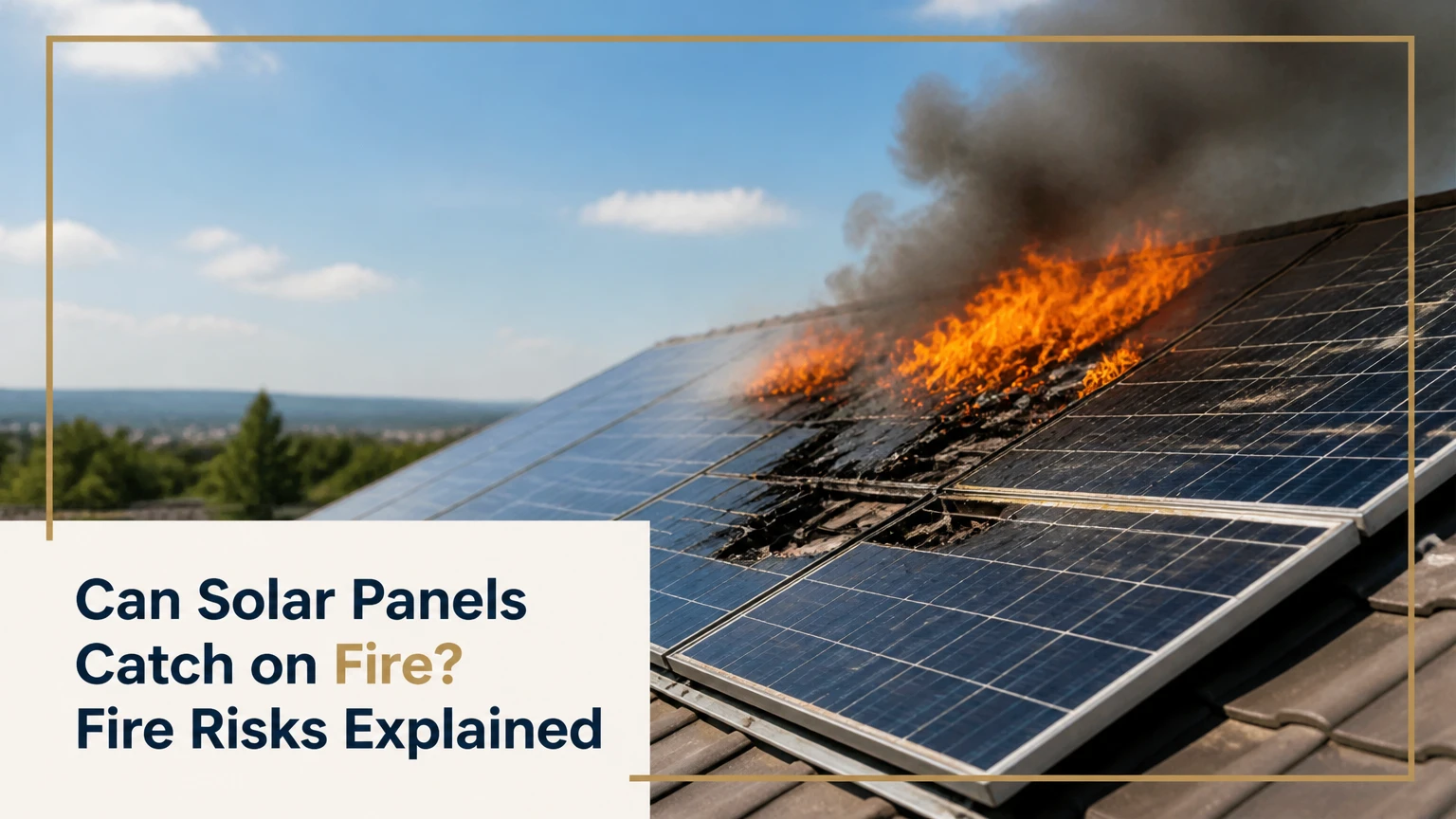
Solar panels can catch fire, although photovoltaic system fires are uncommon compared with the large number of systems in service. The panel itself is less often the ignition source than a failed DC connector, damaged cable, junction box, isolator, inverter, combiner box, or battery, where heat and electrical arcing can ignite plastic and roofing materials.
Key Facts at a Glance
- Solar photovoltaic systems can ignite, but published incident rates vary by country, system age, installation quality, and reporting method.
- High-voltage DC components usually create more fire exposure than the silicon cells inside a functioning module.
- A loose or incompatible connector can develop resistance, heat under load, and eventually produce a sustained DC arc.
- A solar module can remain capable of producing voltage in daylight after the inverter or AC breaker is switched off.
- Rapid shutdown reduces electrical hazard near the array, but it does not make a damaged system safe to touch.
- Smoke, melted plastic, burn marks, repeated isolation faults, and unexplained output loss require professional inspection.
How Common Are Solar Panel Fires?
Solar panel fires are rare, but the commonly repeated estimate of 0.006%-0.01% per year should not be treated as a universal industry statistic. Those figures come from limited datasets and may count different events, including small thermal incidents, equipment fires, or fires that spread beyond the photovoltaic array.
QBE Europe reported that solar-related fire claims in its analyzed portfolio increased 133% between 2022 and 2025, while installations increased 52%. That comparison signals a growing loss-prevention concern, especially as older systems remain in service, but it does not mean that every individual installation became 133% more likely to burn.
| Risk statement | What the evidence supports | What it does not prove |
|---|---|---|
| PV fires are uncommon | Incidents are a small fraction of installed systems | A precise worldwide annual probability |
| QBE Europe reported a 133% increase | More claims occurred in its analyzed population | A 133% increase in risk for every system |
| Older systems appear in fire investigations | Aging insulation and connectors can degrade | Every system over a set age is unsafe |
| Installation quality affects risk | Poor crimping, routing, and connector selection create faults | Certified equipment cannot ever fail |
| Batteries can burn | Lithium-ion storage introduces additional thermal hazards | A battery fire starts in the solar modules |
Risk rises when a system combines aging components, rooftop heat, moisture, mechanical movement, combustible roofing, poor documentation, and no effective maintenance. A well-designed system with listed equipment can still fail, but the probability and consequences are generally lower.
Which Solar Components Usually Ignite?
DC balance-of-system components usually ignite before the photovoltaic cells. The highest-concern locations are connectors, cable terminations, rooftop isolators, junction boxes, combiner boxes, inverters, and battery interfaces because each location contains conductors, contacts, insulation, or electronics carrying electrical current.
| Component | Typical electrical role | Common failure mode | Possible fire consequence |
|---|---|---|---|
| DC connector | Joins module and array cables | Incompatible mating or poor crimp | Resistance heating and arcing |
| PV cable | Carries string current | Abrasion, ultraviolet damage, loose routing | Insulation breakdown and arc |
| Module junction box | Connects cell strings to cables | Seal failure, diode fault, overheated terminal | Local backsheet or plastic ignition |
| DC isolator | Disconnects array wiring | Contact wear, water ingress, poor enclosure seal | Internal arcing and enclosure fire |
| String inverter | Converts DC to AC | Cooling failure, terminal fault, electronics damage | Inverter enclosure ignition |
| Combiner box | Merges multiple strings | Fuse, busbar, or gland failure | Localized cabinet fire |
| Battery system | Stores electrical energy | Cell damage, overheating, control failure | Thermal runaway and difficult suppression |
The silicon wafer is not a fuel source in the way that polymer insulation, backsheets, cable jackets, and roof membranes are. A module can still be involved in a fire because its junction box, encapsulant, backsheet, or bypass diode can overheat.
Why do DC arcs create severe heat?
A DC arc can continue because direct current does not naturally pass through the repeating zero-voltage points found in alternating current. When a connector separates under load, the array voltage can sustain a plasma path across the gap, producing intense localized heat that melts contacts and ignites nearby polymers.
The exact arc temperature depends on voltage, current, gap length, circuit impedance, and environmental conditions. Claims that every solar arc exceeds 3,000°C are too broad, but a DC arc can become hot enough to melt metal and ignite adjacent combustible materials.
How Does a Solar Electrical Fault Become a Fire?
A solar fire commonly develops through a chain of mechanical, electrical, and environmental failures rather than one sudden panel defect. A weak connection creates resistance, current produces heat, heat damages the connection, and the resulting separation can sustain an arc.
- Installation defect: A connector is cross-mated, a cable is poorly crimped, or a terminal is under-torqued.
- Mechanical damage: Wind vibration rubs a cable against a rail, roof edge, clamp, or sharp metal surface.
- Moisture exposure: Water enters a connector, isolator, junction box, or damaged cable.
- Resistance increase: Corrosion or a loose contact raises resistance at one small point.
- Load heating: Current produces heat according to (P=I^2R), so a small resistance increase can create substantial local heating.
- Insulation failure: Plastic softens, carbonizes, and loses its insulating properties.
- Arc formation: A separating contact allows current to jump across an air gap.
- Material ignition: Cable insulation, connector plastic, the module backsheet, or roofing material catches fire.
What does (P=I^2R) mean in practice?
The formula means that heat increases with the square of current and directly with resistance. For example, a 10-ampere current through a 0.1-ohm fault produces 10 watts at one small connection, while the same current through 0.5 ohms produces 50 watts concentrated in a connector that may have little ability to shed heat.
Solar arrays can operate for years before a marginal termination becomes dangerous. Thermal cycling, ultraviolet exposure, salt air, rodents, snow movement, and repeated wind loading gradually change the mechanical condition of the installation.
Can a Panel Fire Spread to the Roof?
A photovoltaic module fire can spread to a roof when flames, hot fragments, or melted polymers reach combustible shingles, membranes, insulation, timber, or accumulated debris. The module’s fire classification helps limit flame spread, but it does not guarantee that the complete roof and array assembly will resist every fire scenario.
| Fire classification or condition | Meaning | Important limitation |
|---|---|---|
| Class A module or assembly | Highest listed flame-spread performance | The mounting and roof assembly still affect results |
| Class B module or assembly | Intermediate flame-spread performance | Not equivalent to Class A protection |
| Class C module or assembly | Lower flame-spread performance | More vulnerable in some roof configurations |
| UL 61730 listing | Modern US safety and construction standard | Does not promise zero fire probability |
| UL 1703 listing | Earlier US PV module standard | Many newer products transition to UL 61730 |
| Combustible roof membrane | Fuel beneath or around the array | Can increase spread and suppression difficulty |
UL 1703 and UL 61730 address module safety and fire performance, but buyers should verify whether the listed rating applies to the complete roof-mounted configuration. Roof pitch, module spacing, racking, membrane type, and underside ventilation can alter fire behavior.
A counterintuitive practitioner rule is that a high fire-rated module cannot compensate for a badly terminated connector. Fire classification limits flame spread after ignition; it does not prevent an electrical fault from starting.
Which System Architecture Has Lower Fire Exposure?
Microinverter systems generally reduce the length of high-voltage DC wiring because each module converts power near the panel, while string inverter systems carry higher-voltage DC across the array. DC optimizer systems add module-level controls but still retain high-voltage DC conductors in many designs, so architecture alone does not remove fire risk.
| Architecture | Roof-side electrical condition | Main fire exposure | Practical trade-off |
|---|---|---|---|
| String inverter | Often 300-600 V DC residential, higher in larger systems | Long DC strings, connectors, isolators | Lower equipment cost in many installations |
| Microinverter | Module-level DC input, AC output from each unit | Module connectors, microinverter electronics, AC cabling | More roof electronics and potentially higher replacement labor |
| DC optimizer | Module-level conversion or control with DC strings | High-voltage string conductors remain | Detailed monitoring and rapid-shutdown functions |
| Central inverter | High-voltage DC collection to one inverter | Combiner boxes, collection circuits, inverter | Common in larger commercial or utility arrays |
| Ground-mounted string system | DC wiring outside the building | Cable damage, vegetation, combiner equipment | Easier access than a roof in many sites |
Microinverters do not make a module’s output harmless in daylight, and the exact voltage depends on the product and wiring. Rapid shutdown can lower conductors to a defined limit after activation, but local code, equipment design, and system status determine the result.
The best architecture depends on roof access, array size, shading, local electrical rules, serviceability, and battery integration. A carefully installed string system can be safer than a poorly installed microinverter system.
Can Safety Equipment Prevent a Solar Fire?
Arc-fault circuit interrupters, overcurrent protection, grounding, listed connectors, and rapid-shutdown equipment can reduce hazard, but no device prevents every solar fire. AFCI equipment detects electrical signatures associated with arcing and can interrupt a circuit, while rapid shutdown reduces energized conductors during an emergency.
AFCI protection can miss faults outside its detection range, malfunction, or respond after an arc has already damaged nearby material. Rapid shutdown also requires compatible equipment, correct commissioning, and a functioning initiation method.
| Protection measure | Primary function | Typical limitation | Inspection question |
|---|---|---|---|
| AFCI | Detects and interrupts some arc faults | Detection depends on equipment and fault signature | Is the feature enabled and tested? |
| Rapid shutdown | Reduces array conductor voltage after initiation | Modules may still generate voltage in sunlight | Where is the shutdown initiator? |
| Ground-fault protection | Detects leakage to ground | Does not replace mechanical inspection | Are insulation faults recurring? |
| Overcurrent fuse | Limits excessive current | May not clear every series arc | Are fuse ratings matched to design? |
| Module-level monitoring | Identifies abnormal production | A warning may arrive after damage begins | Are alerts reviewed promptly? |
The safest installation uses listed components that are electrically compatible, correctly torqued, protected from abrasion, documented, and inspected. No control system substitutes for sound workmanship.
What Warning Signs Require Attention?
The most useful warning signs are repeated inverter faults, unexplained production loss, hot or discolored equipment, melted connectors, unusual odors, and visible cable damage. A single low-production day does not prove a fire hazard, but an electrical error combined with heat or physical damage requires prompt isolation by a qualified technician.
| Warning sign | Likely location | Safe homeowner action | Professional test |
|---|---|---|---|
| Isolation or ground-fault error | Cable, connector, or module | Contact installer and keep clear of wet equipment | Insulation-resistance test |
| Burn smell or smoke | Inverter, isolator, junction box | Call emergency services for active smoke | Visual and thermal inspection |
| Brown, yellow, or blistered backsheet | Module or junction box | Do not touch or remove module | Module and diode testing |
| Repeated arc-fault alert | Connector, cable, inverter | Stop resetting the fault | Arc-fault diagnosis and circuit tracing |
| Sudden string output loss | Fuse, diode, connector, or module | Record the time and error code | Current-voltage and thermal tests |
| Crackling or buzzing | Isolator or inverter | Move away and arrange urgent service | Enclosure and termination inspection |
Do not climb onto a roof to inspect a suspected fault. Do not disconnect live PV connectors, cover modules with improvised materials, or reset an arc-fault alarm repeatedly.
What Should You Do If a PV System Is Smoking?
If a photovoltaic system is smoking or burning, move people away, call the local emergency number, tell responders that solar panels and possibly batteries are present, and avoid touching equipment or spraying water yourself. Switch off accessible AC and DC controls only if the equipment is designed for safe operation and you can do so without approaching fire, smoke, or damaged wiring.
Firefighters may isolate the building supply while treating the array as energized in daylight. Turning off the main breaker does not necessarily remove voltage from the modules or conductors between the array and disconnecting equipment.
| Situation | Immediate action | Do not do this |
|---|---|---|
| Smoke from inverter | Evacuate the area and call emergency services | Open the inverter enclosure |
| Fire on roof array | Leave the building and warn responders | Climb onto the roof |
| Battery smoke or hissing | Increase distance and report battery storage | Move, cool, or dismantle the battery |
| Burned connector after rain | Keep people away and request urgent service | Unplug the connector |
| Fire after grid shutdown | Follow fire-service instructions | Assume the array is de-energized |
The Fire Protection Research Foundation has summarized the operational problem for responders as follows: “PV systems cannot be simply turned off.” The statement describes a daylight limitation, not an instruction to abandon standard fire tactics. Fire crews use local procedures, electrical isolation, safe approach distances, and ventilation decisions based on the building and equipment involved.
Are Battery Storage Fires Different?
Battery storage fires differ from ordinary PV equipment fires because damaged lithium-ion cells can enter thermal runaway, release flammable gases, reignite, and require prolonged monitoring. A solar panel normally produces power while illuminated, whereas a charged battery can retain substantial stored energy after the array and grid connection are disconnected.
| Equipment | Stored or generated energy | Distinctive fire concern | Typical response priority |
|---|---|---|---|
| PV module | Daylight-generated DC | Arc and polymer ignition | Treat as energized in daylight |
| String inverter | Converted electrical power | Electronics and terminal fire | Isolate without opening damaged equipment |
| Lithium-ion battery | Stored DC energy | Thermal runaway and reignition | Evacuate and notify responders |
| AC-coupled battery | Battery energy behind inverter | Battery plus inverter faults | Identify both disconnects |
| Backup generator | Fuel-based stored energy | Combustible fuel and exhaust heat | Shut down fuel source if safe |
Battery installation requires its own location, ventilation, spacing, thermal management, emergency labeling, and code review. A panel-only inspection cannot certify a battery system.
How Should a PV System Be Maintained?
A qualified solar electrician should inspect a residential PV system at least every 1-2 years when the system is aging, exposed to harsh weather, or showing alerts; newer systems should still receive checks after severe storms, roof work, flooding, or unexplained performance changes. Commercial arrays often require more frequent documented inspections based on insurer, owner, and risk requirements.
| Maintenance activity | Typical interval | Equipment or method | Useful result |
|---|---|---|---|
| Visual connector and cable check | Every 1-2 years | Roof inspection where safe | Finds abrasion and melting |
| Inverter error review | Monthly by owner | App or display history | Identifies recurring faults |
| Thermal imaging | Every 1-2 years or after alerts | Certified technician camera | Finds abnormal heating under load |
| Torque verification | During service or component replacement | Calibrated torque tool | Confirms terminal tightness |
| Vegetation and debris control | Seasonally | Ground inspection or safe cleaning | Reduces shading and external fuel |
| Battery inspection | Per manufacturer schedule | Installer or qualified electrician | Checks thermal and enclosure status |
Thermal imaging is useful only when the array is operating under enough load and the operator interprets patterns correctly. A cool-looking connector at dawn does not prove that it remains safe at midday.
One expert rule of thumb is to compare neighboring components, not merely absolute temperature. A connector that is 20°C hotter than identical connectors under the same load deserves investigation even if it has not reached a dramatic temperature.
What Installation Mistakes Cause Solar Fires?
The most preventable causes are incompatible connectors, poor crimping, incorrect torque, unsupported cables, undersized or unsuitable conductors, water entry, and unprotected contact with sharp edges. These defects often begin during installation and become dangerous only after months of thermal cycling and weather exposure.
| Installation mistake | Failure mechanism | Corrective action | Typical urgency |
|---|---|---|---|
| Cross-mating brands | Poor contact fit and resistance | Replace with one approved connector family | Immediate if heated |
| Generic plier crimp | Loose conductor strands | Re-terminate with specified crimp tooling | Before commissioning |
| Unsupported cable loop | Wind abrasion and water retention | Re-route with approved clips | Prompt |
| Incorrect terminal torque | Contact heating or mechanical failure | Verify with calibrated tool | Before energizing |
| Cable against metal edge | Insulation cuts through | Add protection and replace damaged cable | Immediate if conductor exposed |
| Unsealed gland or enclosure | Moisture and corrosion | Replace seal and inspect internals | Prompt |
| Incorrect fuse or conductor size | Overheating or protection failure | Redesign to approved electrical values | Immediate |
“MC4-compatible” is not a universal engineering standard. A connector that fits physically may not be approved for mating with a particular manufacturer’s connector, and the safest practice is to use the same listed connector family exactly as specified by the equipment manufacturer.
What Do Inspection and Repairs Cost?
Typical US residential costs range from about $150-$400 for a basic professional inspection, $1,000-$5,000 for localized electrical remediation, and substantially more when a roof, inverter, battery, or fire-damaged structure needs replacement. Prices vary with roof height, permitting, access, region, equipment availability, and the extent of concealed damage.
| Service | Typical US price | Typical duration | Main cost variable |
|---|---|---|---|
| Basic PV inspection | $150-$400 | 1-3 hours | Roof access and reporting |
| Thermal imaging add-on | $200-$600 | 1-2 hours | Array size and reporting detail |
| Connector or cable repair | $300-$1,500 | 2-8 hours | Number of terminations |
| Inverter replacement | $1,500-$4,000 | 3-8 hours | Capacity, labor, and permitting |
| Roof and array remediation | $5,000-$25,000+ | 2 days to several weeks | Fire and structural damage |
| Battery replacement | $5,000-$15,000+ | 1-2 days | Capacity and manufacturer |
A low-cost visual check cannot substitute for electrical testing after a thermal event. Insurance claims may also require photographs, fire-service reports, invoices, equipment serial numbers, and an assessment by a licensed contractor.
How Does Wildfire Exposure Change the Risk?
Wildfire exposure adds an external ignition source, airborne embers, radiant heat, and possible damage to cables and roof coverings. Solar panels do not cause a wildfire merely by being present, but an array can complicate roof access, create damaged electrical equipment, and leave combustible debris beneath modules.
Wildfire hardening should begin with a Class A roof assembly, ember-resistant vents, clear vegetation, protected cable routing, accessible disconnect labels, and equipment placement away from likely flame paths. Local building codes and fire authorities determine the required measures.
Ground-mounted systems have different exposure. Dry grass can ignite near low cables, combiner boxes, or inverter pads, while roof systems face embers and restricted firefighter access.
Do Solar Panels Cause Roof Fires?
Solar panels can contribute to a roof fire when an electrical fault ignites module polymers or when installation damage exposes combustible roofing, but correctly installed panels do not normally heat a roof to ignition. Roof penetrations, trapped debris, poor cable routing, and unapproved mounting details can create indirect risks even without a panel electrical fault.
A roof assessment should confirm that the covering remains serviceable, penetrations are sealed, drainage is not blocked, and the array layout matches the approved design. Installing solar on a roof near the end of its useful life can turn a minor module repair into a costly array removal and reinstallation project.
FAQ
Can lightning make solar panels catch fire?
Lightning can damage modules, inverters, wiring, and roof structures, although a direct strike is uncommon. Surge protection, bonding, grounding, and a design appropriate to local lightning exposure reduce damage. After a nearby strike, inspect the inverter, surge devices, monitoring data, and visible wiring before reconnecting equipment that shows errors.
Are older solar panels more dangerous?
Older solar panels are not automatically dangerous, but aging connectors, cable insulation, junction boxes, seals, and inverters have had more time to degrade. Systems installed before current rapid-shutdown or arc-fault requirements may also have different protection. Age combined with faults, moisture, heat, or poor maintenance is more informative than installation year alone.
Can rain put out a solar panel fire?
Rain may cool external materials, but it cannot be relied on to extinguish a photovoltaic fire or make the wiring safe. Water can create shock hazards around damaged electrical equipment. Keep away, call emergency services, identify the PV and battery equipment, and follow instructions from trained responders.
Should I clean solar panels to prevent fire?
Routine removal of leaves, nesting material, and heavy debris can reduce combustible loading and shading stress, but cleaning does not correct electrical faults. Never wash or brush a suspected damaged module, connector, or inverter. Use a qualified technician when access requires roof work or when the array has burn marks or alarms.
Does home insurance cover a solar panel fire?
Coverage depends on the policy, ownership arrangement, installation permits, exclusions, and whether the equipment is attached to the home or leased from a third party. Report a fire promptly, preserve damaged equipment when authorities allow it, and request the insurer’s documentation requirements before arranging major repairs.
Can firefighters extinguish a solar panel fire safely?
Firefighters can manage PV fires using electrical safety procedures, isolation controls, defensive tactics, and equipment-specific guidance, but daylight arrays remain an electrical hazard after some shutdown actions. Tell emergency responders about the array’s location, inverter, disconnects, and battery storage when calling.
The Bottom Line
Can solar panels catch on fire? Yes, but the most common ignition path involves a failed electrical connection or other balance-of-system component rather than healthy silicon cells. Use listed, compatible equipment, insist on calibrated installation practices, maintain clear documentation, respond to inverter warnings, and treat any smoke, burning odor, melted plastic, or battery alarm as an emergency requiring professional help.