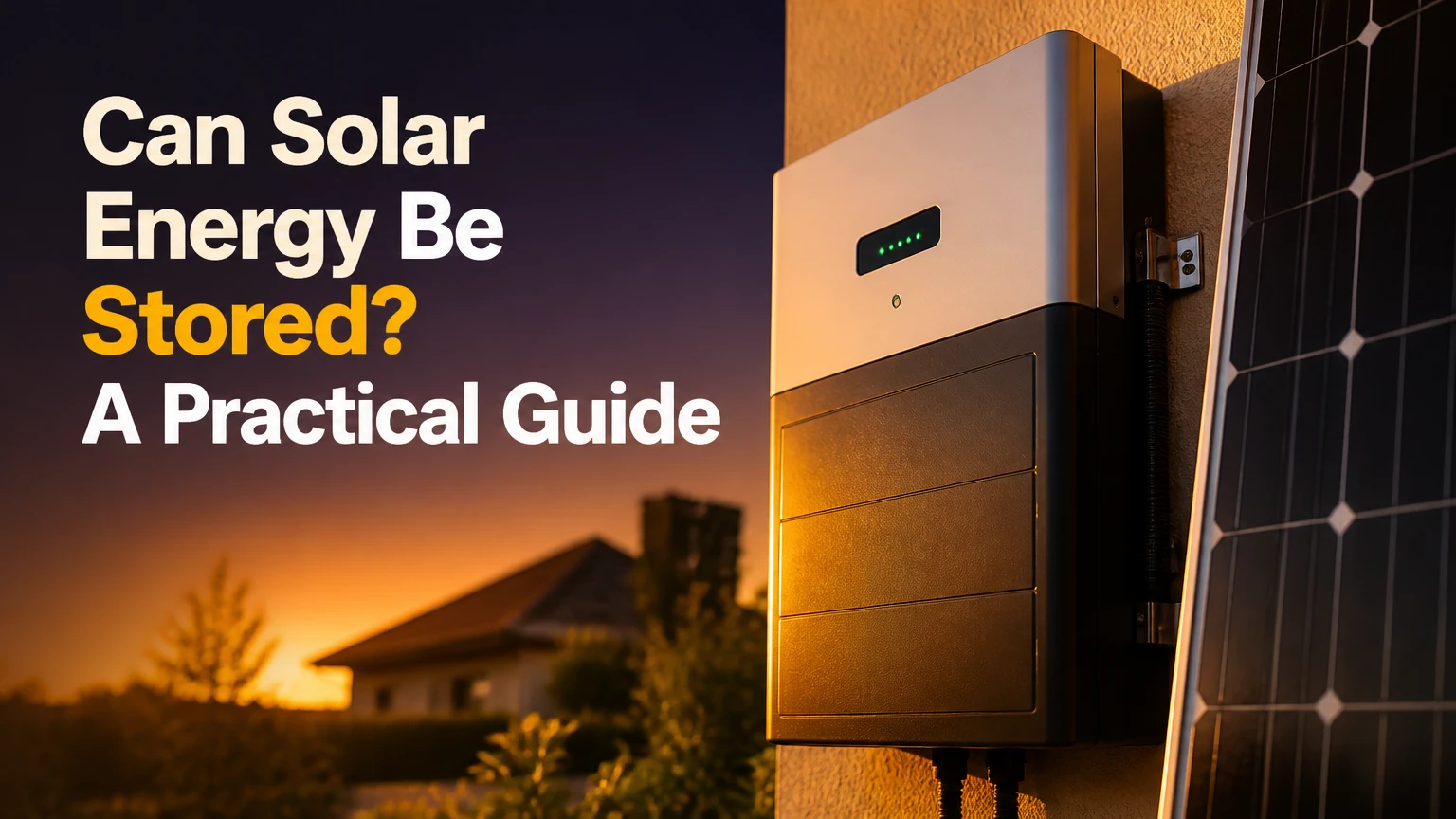
Solar energy can be stored after photovoltaic panels produce electricity, most commonly in a battery for use at night, during cloudy periods, or during an outage. Solar energy can also be stored as heat, elevated water, compressed air, or other physical forms, but lithium iron phosphate batteries are the usual choice for modern homes and short-duration grid storage.
Key Facts at a Glance
- Solar panels generate electricity only when sunlight reaches the photovoltaic cells, but solar storage shifts that electricity to a later time.
- A home battery stores electrical energy chemically, then an inverter converts the battery’s direct current into appliance-ready alternating current.
- Battery capacity is measured in kilowatt-hours, while the inverter’s maximum output is measured in kilowatts.
- Typical lithium iron phosphate systems deliver approximately 90-95% round-trip efficiency under suitable operating conditions.
- A solar battery does not automatically provide outage power; the installation needs compatible backup equipment, islanding protection, and selected backup circuits.
- Storage is most valuable when evening electricity costs exceed daytime export credits, outages are frequent, or grid access is unavailable.
Can Solar Energy Be Stored?
Yes, solar energy can be stored, but the storage method depends on the form of energy and the required duration. A photovoltaic system usually stores surplus electricity in batteries, while concentrating solar power plants store solar heat in materials such as molten salt. Grid operators also use pumped hydropower, compressed air, and other technologies to shift solar-generated electricity across hours or seasons.
The key limitation is timing. A panel produces power when sunlight is available, whereas household demand often continues after sunset. Without storage, surplus electricity is consumed immediately, exported to the grid, or curtailed when generation exceeds local and grid demand.
Storage does not preserve every watt-hour. Charging, holding, inverting, and discharging create losses, so a battery rated at 10 kWh cannot normally return 10 kWh of usable AC electricity. The U.S. Department of Energy describes energy storage as capturing energy at one time so it can be used later, which accurately captures the function without implying perfect retention.
What does solar storage actually store?
A solar battery stores electrical energy as chemical potential. Thermal storage retains heat, and pumped hydro stores gravitational potential energy by moving water uphill. The original sunlight is not held inside a battery as light; the panel first converts sunlight into electricity, and the storage system converts that electricity into another energy form.
This distinction matters when comparing technologies. A molten-salt plant may store heat cheaply for turbine generation, but it is not a practical replacement for a wall-mounted home battery. A battery can respond quickly and provide backup, while pumped hydro can store enormous quantities of energy but requires suitable reservoirs, transmission, and permitting.
How Does Solar Storage Work?
A solar-plus-storage system follows a repeating path: photovoltaic cells generate DC electricity, a controller or inverter routes surplus power, the storage device retains energy, and an inverter supplies AC power when loads need it. An energy-management system decides whether solar power serves current loads, charges the battery, exports to the grid, or performs a mixture of those functions.
A typical grid-connected home follows this sequence:
- Generation: PV modules produce direct-current electricity from sunlight.
- Load service: The system supplies appliances that are operating immediately.
- Charging: Surplus electricity passes through a charge controller or hybrid inverter into the battery.
- Monitoring: A battery-management system tracks voltage, temperature, current, and state of charge.
- Discharging: After solar production falls, the battery supplies DC electricity to an inverter.
- Conversion: The inverter produces synchronized AC electricity for household circuits.
- Grid interaction: The system imports electricity when the battery is empty and exports surplus power when programmed or required.
What is the difference between AC and DC coupling?
DC-coupled systems connect the solar array and battery on the DC side, reducing some conversion steps when solar power charges the battery. AC-coupled systems connect a separate battery inverter to the building’s AC wiring, making them easier to add to many existing solar installations.
| System arrangement | Typical application | Main advantage | Main limitation |
|---|---|---|---|
| DC-coupled | New solar installation | Fewer conversion stages during charging | More complex retrofit |
| AC-coupled | Existing PV system | Compatible with many installed inverters | Additional conversion losses |
| Hybrid inverter | New residential system | One coordinated control platform | Inverter replacement may be required |
| Backup-only battery | Outage protection | Smaller battery and lower initial capacity | Limited bill savings |
The best architecture depends on the age of the solar array, the existing inverter, local electrical rules, and whether the battery must recharge during a grid outage. A battery connected only on the AC side may not recharge from solar during an outage unless the inverters and controls are designed to form a stable microgrid.
What Happens Inside a Solar Battery?
In a lithium-ion battery, charging moves lithium ions through an electrolyte while electrons travel through the external circuit; discharging reverses that movement and releases electrical energy. The battery-management system limits voltage, current, and temperature to reduce damage and prevent unsafe operating conditions.
LFP chemistry uses lithium iron phosphate as its cathode material. LFP generally has lower energy density than nickel manganese cobalt chemistry, but stationary systems benefit from its thermal stability, long cycle life, and reduced reliance on nickel and cobalt. Actual performance still depends on temperature, charge rate, enclosure design, and manufacturer limits.
Four specifications require careful reading:
| Specification | Meaning | Typical residential value | Buying implication |
|---|---|---|---|
| Nameplate capacity | Total stored energy | 10-15 kWh | Not all energy may be usable |
| Usable capacity | Energy available within warranty limits | 8-14 kWh | Use this value for sizing |
| Continuous power | Output maintained over time | 5-10 kW | Determines simultaneous appliance load |
| Peak power | Short surge output | 7-15 kW | Helps start pumps and compressors |
| Round-trip efficiency | Energy returned after charging and discharging | 85-95% | Affects solar utilization and bills |
| Depth of discharge | Portion routinely used | 80-100% for many LFP systems | Affects capacity and degradation |
A 10 kWh battery with 90% round-trip efficiency may return roughly 9 kWh after a complete charge-discharge cycle, before additional household wiring or standby losses. The precise result varies because efficiency changes with power level and state of charge.
Which Storage Technologies Are Available?
Lithium-ion batteries are the leading practical option for residential and short-duration commercial solar storage, while pumped hydro and thermal storage dominate some utility-scale applications. Lead-acid remains viable for low-cost, occasional-use systems, and flow batteries can suit long-duration industrial projects where footprint matters less than cycle life.
| Technology | Typical round-trip efficiency | Duration or response | Best-fit application | Main constraint |
|---|---|---|---|---|
| LFP lithium-ion | 90-95% | 2-8 hours | Homes, commercial systems | Upfront cost and thermal controls |
| NMC lithium-ion | 88-95% | 2-6 hours | Vehicles, compact systems | Higher thermal-management demands |
| Lead-acid AGM or gel | 70-85% | 2-8 hours | Cabins and infrequent backup | Lower usable depth and shorter life |
| Vanadium flow battery | 65-85% | 4-12+ hours | Industrial long-duration storage | Large tanks and lower energy density |
| Pumped hydro | 70-85% | 8-24+ hours | Regional grid balancing | Requires elevation and reservoirs |
| Molten salt | 40-50% electric-to-electric | 6-15 hours | Concentrating solar power | Utility-scale heat and turbine plant |
| Flywheel | 80-95% | Seconds to minutes | Frequency regulation | Poor fit for overnight energy |
Can solar energy be stored as heat?
Yes, solar energy can be stored as heat, either directly from sunlight or by using solar electricity to heat a medium. Concentrating solar power facilities commonly heat molten salt, then use a heat exchanger and steam turbine to generate electricity after sunset.
Thermal storage is often more economical when the final demand is heat rather than electricity. A water tank can store solar heat for domestic hot water, and a phase-change material can retain heat within a controlled temperature range. Converting that heat back into electricity adds equipment and losses, so thermal storage is rarely the best choice for a small home seeking electrical backup.
How Large Should a Solar Battery Be?
A solar battery should be sized from the loads that need power during the intended storage period, not from the solar array’s nameplate capacity. For a grid-connected home seeking evening load shifting, the relevant value is usually usable overnight consumption; for outage protection, the relevant value is the energy and starting power of critical circuits.
A practical sizing equation is:
Required battery capacity = planned load energy ÷ usable depth of discharge ÷ system efficiency
Example: a home uses 8 kWh between 5 p.m. and 7 a.m. If the battery allows 90% usable depth of discharge and the system returns 90% of charged energy, the minimum nameplate capacity is approximately:
8 ÷ 0.90 ÷ 0.90 = 9.9 kWh
A designer should then check winter solar production, reserve settings, inverter output, and battery warranty conditions. The 10 kWh result may be inadequate if the household also expects to run a 4 kW heat pump, well pump, or electric vehicle charger during an outage.
| Household objective | Typical usable capacity | Typical power requirement | Design note |
|---|---|---|---|
| Evening bill shifting | 5-10 kWh | 3-7 kW | Match high-rate hours |
| Essential outage circuits | 10-15 kWh | 5-10 kW | Exclude electric heating where possible |
| Whole-home short outage | 15-30 kWh | 8-15 kW | Requires load management |
| Off-grid daily operation | 20-60+ kWh | 5-15 kW | Add generator or several cloudy-day reserves |
Power and energy are different. A 15 kWh battery may run a 3 kW load for about five hours in ideal conditions, but a 5 kW inverter may be needed to start motors or support several appliances simultaneously.
How Much Does Solar Storage Cost?
A typical installed residential battery costs roughly $6,000-$14,000 for a system in the 10-15 kWh class in the United States, although labor, electrical upgrades, brand, location, incentives, and backup hardware can move the total substantially. Battery prices quoted per kilowatt-hour are not directly comparable unless they include the inverter, installation, controls, permits, and usable capacity.
| Project scale | Typical installed or project cost | Typical capacity | Cost caveat |
|---|---|---|---|
| Residential battery | $6,000-$14,000 | 10-15 kWh | Local labor and backup panel affect total |
| Small commercial system | $100,000-$500,000 | 250 kWh-1 MWh | Fire code and interconnection add cost |
| Utility battery project | Project-specific | 10-500+ MWh | Land, transmission, and augmentation matter |
| Pumped hydro | Site-specific civil construction | 100 MWh to many GWh | Reservoir and transmission dominate |
| Thermal storage | Site-specific plant cost | 100 MWh thermal to many GWh | Electricity conversion adds losses |
The financial case depends on the value of stored electricity. A battery can improve self-consumption, avoid time-of-use prices, provide demand-charge reduction, and supply backup value. Strong net metering, low evening rates, or rare outages can make a battery financially unattractive even when the system performs well technically.
The U.S. Internal Revenue Service has treated qualifying battery storage as eligible for the federal residential clean energy credit under applicable rules, including standalone storage, but tax eligibility and local programs change. Confirm current requirements with the IRS and a qualified tax professional rather than relying on a sales quote.
When Does Solar Storage Make Sense Financially?
Solar storage usually makes the strongest financial sense where evening electricity costs are high, exported solar receives a low credit, demand charges are significant, or the battery can participate in an approved demand-response or virtual power plant program. Backup value can justify storage even when bill savings alone do not produce an attractive payback.
A simple comparison is:
Annual storage value = avoided grid purchases + export-credit improvement + grid-service income – battery operating costs
A battery’s payback is not guaranteed. If a home exports daytime solar at nearly the same retail rate it would otherwise pay, charging a battery may add conversion losses without meaningful savings. Conversely, a home with a low export credit and high 4 p.m. to 9 p.m. rates may shift several kilowatt-hours daily into a more valuable period.
Practitioner rule: calculate savings from the utility tariff before comparing battery brands. The tariff often changes the answer more than a small difference in battery efficiency.
Will a Solar Battery Keep the House Running?
A solar battery can keep selected home circuits operating during a grid outage, but only when the system includes an automatic transfer device, anti-islanding controls, and an inverter approved for backup operation. A standard grid-tied solar array normally shuts down during an outage to protect utility workers, even when sunlight is available.
| Backup configuration | Circuits supported | Typical outage behavior | Main limitation |
|---|---|---|---|
| Critical-load panel | Refrigerator, lights, internet | Automatic transfer in seconds | Excludes large loads |
| Whole-home backup | Most circuits | Battery manages total demand | Higher inverter and battery cost |
| Solar plus battery microgrid | Selected or whole-home circuits | Solar can recharge battery | Requires compatible controls |
| Battery plus generator | Extended essential loads | Generator starts at low state of charge | Fuel, noise, and maintenance |
A battery reserve setting commonly withholds 10-30% of capacity for outages, depending on the owner’s priorities. High-demand loads such as resistance heating, electric water heaters, welders, and EV chargers can drain a residential battery quickly, so load shedding is often more effective than buying an oversized battery.
What Can Go Wrong With Solar Storage?
The most common solar-storage problems are incorrect sizing, inverter incompatibility, temperature exposure, poor reserve programming, and unrealistic outage expectations. Battery systems also lose capacity over time, and the manufacturer’s warranty normally defines acceptable degradation, throughput, operating temperature, and service conditions.
Use these checks before commissioning a system:
- Verify usable capacity: Compare the warranty’s usable kWh with the advertised nameplate figure.
- Check cold-weather charging: Many lithium batteries restrict or stop charging near 0°C unless the enclosure has heating.
- Review heat exposure: Avoid unconditioned attic locations where sustained high temperatures accelerate degradation.
- Match inverter power: Confirm that continuous and surge output cover pumps, compressors, and essential loads.
- Set an outage reserve: Keep a defined percentage available if emergency backup matters.
- Inspect expansion rules: Do not combine incompatible battery generations or chemistry without manufacturer approval.
- Plan service access: Installers need safe clearances, disconnects, ventilation where required, and accessible monitoring equipment.
If a battery stops charging at 99%, the battery-management system may be balancing cells or enforcing temperature and voltage limits. If the battery discharges unexpectedly, inspect logged loads, reserve settings, communication faults, and thermal warnings before attempting a manual reset.
Battery fires are uncommon but serious. Use certified equipment, listed installation methods, correct overcurrent protection, and a licensed electrician. Never open a damaged lithium battery or place a swollen battery back into service.
Batteries Versus Other Storage Methods
Batteries are better than mechanical or thermal storage for compact, fast-response applications, while pumped hydro and compressed air are better suited to large sites with long operating durations. The best technology is determined by storage duration, response speed, geography, required power, safety conditions, and the value of the stored output.
| Decision factor | Home lithium battery | Flow battery | Pumped hydro | Thermal storage |
|---|---|---|---|---|
| Installation footprint | 1-3 m² per modular unit | Large tank area | Reservoir-scale | Plant-scale |
| Response time | Milliseconds to seconds | Seconds | Seconds to minutes | Minutes to hours |
| Typical duration | 2-8 hours | 4-12+ hours | 8-24+ hours | 6-15 hours |
| Small-site suitability | High | Low to moderate | Very low | Very low |
| Cycle frequency | Daily capable | Daily capable | Daily or seasonal | Daily |
| Primary output | AC electricity | AC electricity | AC electricity | Heat, then electricity |
Flywheels provide excellent short-duration frequency response but cannot economically power a home overnight. Compressed-air energy storage can support long-duration grid operation, but suitable caverns, compressors, expanders, and transmission connections limit deployment. No single storage technology is best across every duration.
Which System Fits Your Situation?
A grid-connected homeowner usually benefits from an LFP battery when evening rates are high, export credits are weak, or backup power has real value. A 10-15 kWh usable system is a common starting point, but the tariff and critical-load list should determine the final size.
A homeowner with strong net metering may prefer solar without a battery if bill savings are the only objective. Direct export can be more economical than storing and later recovering electricity through an inefficient cycle.
An off-grid property needs more than a battery. Solar array oversizing, winter production, generator integration, reserve autonomy, and load discipline determine reliability, with several days of low-sun operation requiring substantially more capacity than ordinary evening shifting.
A commercial facility should evaluate demand charges, peak intervals, operating schedules, power quality, and demand-response revenue. A battery that reduces a short monthly demand peak can need high power but modest energy capacity.
A utility or large microgrid may combine LFP batteries for fast response with long-duration technologies such as pumped hydro, flow batteries, or thermal storage. Transmission constraints and capacity-market rules can outweigh cell-level efficiency.
FAQ
Can solar panels work without a battery?
Yes. A grid-connected solar system can send surplus electricity to the utility and draw power from the grid after sunset. An off-grid system generally needs a battery, generator, or another dispatchable source because panels alone cannot supply loads when sunlight disappears.
Can I add a battery to existing solar panels?
Often, yes. An AC-coupled battery can retrofit many existing PV systems, but the installer must check inverter compatibility, service-panel capacity, backup requirements, interconnection rules, and whether the existing array is large enough to recharge the battery.
How long does a solar battery last?
Many residential lithium batteries carry warranties around 10 years, with capacity retention commonly specified near 70-80% at the warranty limit. Actual life depends on cycles, temperature, charging rate, state-of-charge history, and maintenance.
Do solar batteries work during winter?
Solar batteries can operate in winter, but low temperatures may restrict charging and short daylight reduces recharge energy. Heated enclosures, indoor placement, a larger winter solar array, conservative reserves, or a generator can maintain reliability in cold or cloudy regions.
Can a solar battery be recycled?
Yes. Lithium-ion batteries can enter recycling streams that recover materials, although collection rules and recycling capacity vary by country. Keep installation records and use the manufacturer, installer, or local hazardous-waste authority for end-of-life handling.
Is solar storage worth buying?
Solar storage is most defensible when it combines a clear time-of-use savings opportunity with outage protection or another paid service. Solar storage is less compelling when retail and export prices are nearly equal, outages are rare, and the owner does not value energy independence.
The Bottom Line
Can solar energy be stored? Yes, and batteries are the practical answer for most homes that need electricity after sunset or during outages. Choose capacity from overnight and critical loads, choose power from appliance demand, and judge the investment against the local electricity tariff rather than the solar array size alone. Thermal, pumped-hydro, flow, and compressed-air systems extend solar storage to larger or longer-duration applications, but each requires different infrastructure.