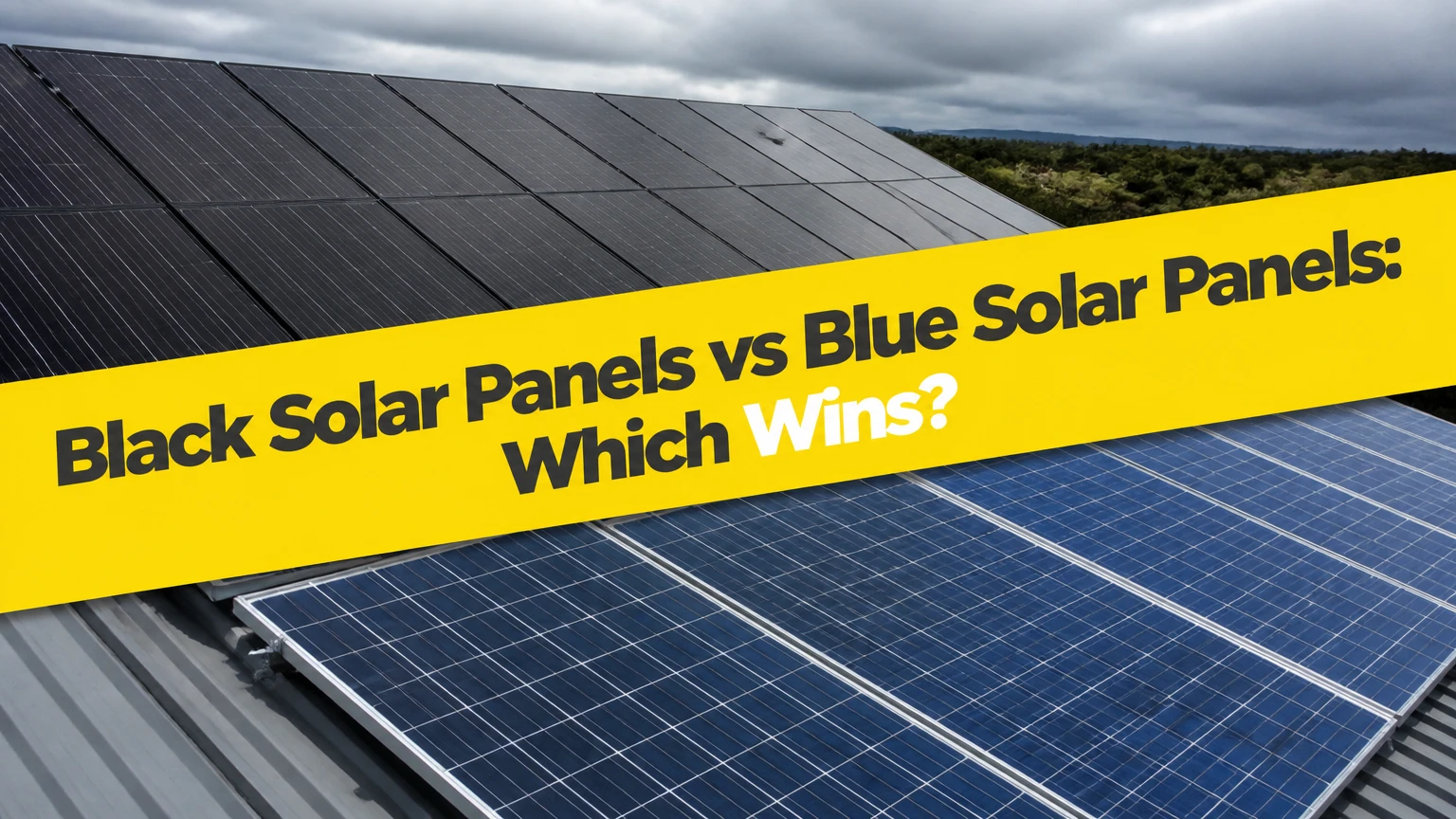
Black solar panels usually provide the better choice for new installations because modern monocrystalline modules deliver more power in limited roof space and remain widely available. Blue panels are commonly older polycrystalline modules with lower efficiency and fewer current warranties, but panel color alone does not determine performance, durability, or silicon technology.
Key Facts at a Glance
- Monocrystalline solar cells commonly appear black, while polycrystalline cells commonly appear blue.
- Panel color is not a technical specification; a black module can use PERC, TOPCon, HJT, or another cell architecture.
- Modern residential modules commonly reach approximately 20% to 24% efficiency, while many older polycrystalline modules rated about 15% to 18% are legacy stock.
- A 10 kW array using 18% modules needs about 56 square meters of active module area; a 22% array needs about 45.5 square meters.
- Temperature coefficient, shading, inverter design, orientation, and installation quality affect annual production more than color.
- New black monocrystalline modules generally offer stronger availability, higher power density, and longer current product warranties.
What Is the Difference Between Black and Blue Solar Panels?
Black and blue solar panels are usually visual labels for monocrystalline and polycrystalline photovoltaic modules, but the labels are not interchangeable with engineering specifications. Monocrystalline cells are cut from a single silicon crystal and commonly look uniform black; polycrystalline cells solidify from multiple crystals and commonly show a blue, mottled pattern.
The visible result also depends on the anti-reflective coating, cell metallization, frame, backsheet, and viewing angle. A black panel may have a black frame and backsheet, or it may have a silver frame with a white backsheet behind black cells.
Does color prove the cell technology?
No. Color provides a useful clue, not proof. Product datasheets identify the actual technology through terms such as monocrystalline silicon, P-type PERC, N-type TOPCon, heterojunction, bifacial, or polycrystalline silicon.
A buyer should verify the model number, nominal power, module efficiency, temperature coefficient, warranty, and certification rather than relying on a photograph. This distinction matters because a premium black module and an older blue module can differ because of cell architecture, age, warranty, and power rating, not because black absorbs sunlight in a uniquely powerful way.
How Are Monocrystalline and Polycrystalline Cells Made?
Monocrystalline cells begin with a single silicon crystal, commonly produced through the Czochralski process. Manufacturers grow a cylindrical ingot, slice it into wafers, apply doping and surface treatments, print or deposit electrical contacts, and assemble the cells under glass.
Polycrystalline cells begin with melted silicon fragments poured into a mold. The material cools into a block containing many crystal grains, which manufacturers cut into wafers before cell processing and module assembly. Grain boundaries historically reduced carrier movement, so polycrystalline modules generally achieved lower efficiency than comparable monocrystalline products.
| Manufacturing attribute | Monocrystalline | Polycrystalline |
|---|---|---|
| Silicon structure | One crystal | Multiple crystal grains |
| Typical wafer shape | Pseudo-square | Square |
| Common historical module efficiency | 18%-23% | 15%-18% |
| Common visual pattern | Uniform dark surface | Blue speckled surface |
| Current residential availability | High | Low in many markets |
| Typical use today | Residential, commercial, utility | Legacy, used, budget stock |
Does manufacturing determine the panel’s efficiency?
Manufacturing affects efficiency, but the final module also depends on wafer size, cell passivation, busbar design, interconnection, glass, and operating conditions. A modern N-type TOPCon module can outperform an older P-type monocrystalline module even though both appear black.
The old assumption that polycrystalline production has almost no waste also needs qualification. Polycrystalline casting can reduce some ingot-cutting losses, while monocrystalline manufacturing historically produced more kerf and off-cut material. Recycling, silicon reclamation, wafer thickness, factory energy mix, and the module’s lifetime output also influence environmental performance.
How Do Black and Blue Panels Compare on Performance?
Modern black monocrystalline panels usually win on efficiency and power density. Typical current residential modules produce about 400-500 watts at approximately 20%-24% efficiency, while older blue polycrystalline modules often produce 250-350 watts at roughly 15%-18%, although individual models vary.
| Decision criterion | Modern black monocrystalline | Older blue polycrystalline | Practical consequence |
|---|---|---|---|
| Typical module efficiency | 20%-24% | 15%-18% | Black modules need less roof area |
| Typical residential power rating | 400-500 W | 250-350 W | Blue modules require more units |
| Typical temperature coefficient | -0.24% to -0.35%/°C | -0.35% to -0.45%/°C | Black modules often lose less power in heat |
| Typical product warranty | 12-25 years | 10-15 years | New black modules usually have stronger coverage |
| Typical performance warranty | 25-30 years | 20-25 years | Black modules generally retain value longer |
| Typical first-year degradation | 0.25%-1.0% | 0.5%-1.0% | Model-specific, not color-specific |
| Low-irradiance behavior | Usually stronger | Usually weaker on older models | Black modules can produce more in dull conditions |
The ranges above are typical market figures, not guarantees. The datasheet remains authoritative.
Are black panels more efficient than blue panels?
Usually, yes, when the comparison involves current monocrystalline modules and older polycrystalline modules with similar dimensions. Efficiency describes the percentage of incoming sunlight converted into electricity, so a 22% module generates more watts from the same surface than an 18% module.
The advantage is most valuable on small or obstructed roofs. On a large ground-mount site with abundant land, lower efficiency can matter less because extra module area may be inexpensive compared with racking, wiring, and labor. Power density still affects the number of modules, string voltage, maintenance access, and balance-of-system costs.
Which type performs better in hot weather?
A panel with the less negative temperature coefficient generally performs better in heat, and that specification is model-specific rather than guaranteed by color. For example, a module rated at -0.29% per degree Celsius loses less output above its 25°C test condition than one rated at -0.42% per degree Celsius.
A 400 W module with a -0.29% coefficient operating at a 65°C cell temperature loses approximately 46.4 W relative to its rated condition, using a 40°C increase. A 400 W module at -0.42% loses approximately 67.2 W. Roof ventilation, mounting gap, wind, and module construction can alter actual cell temperature.
Do blue panels work better in cloudy weather?
Neither color guarantees superior cloudy-weather performance. Low-light output depends on the cell design, spectral response, bypass-diode behavior, inverter startup voltage, shading, and the irradiance level.
Modern monocrystalline modules often produce more energy in overcast conditions because their higher nameplate efficiency and newer cell designs capture more available light. A well-positioned older polycrystalline module can still produce useful energy, but its lower rated power and aging may outweigh any theoretical spectral advantage.
How Much Roof Space Does Each Type Need?
A 22% module requires about 18% less active surface area than an 18% module for the same theoretical power output. Real roof layouts need additional allowances for setbacks, fire pathways, vents, hips, valleys, access routes, and module dimensions.
| Target array | 18% module area | 22% module area | Approximate difference |
|---|---|---|---|
| 5 kW | 27.8 m² | 22.7 m² | 5.1 m² |
| 7.5 kW | 41.7 m² | 34.1 m² | 7.6 m² |
| 10 kW | 55.6 m² | 45.5 m² | 10.1 m² |
| 12 kW | 66.7 m² | 54.5 m² | 12.2 m² |
The calculation uses power density only, with one square meter receiving approximately 1,000 watts of test irradiance. Module dimensions, not efficiency alone, determine the final layout.
A typical 400 W module measuring about 1.72 by 1.13 meters covers approximately 1.94 square meters. A 280 W legacy module of similar dimensions may need 36 modules for a roughly 10 kW array, compared with 25 modules at 400 W. The blue array adds module count, mounting points, connectors, and labor.
Do All-Black Panels Perform Better Than Standard Black Panels?
All-black panels do not automatically produce more electricity than standard black monocrystalline panels. All-black construction usually changes the frame, backsheet, and cell appearance, while electrical performance comes from the cell architecture and module design.
| Appearance type | Cell appearance | Frame | Backsheet | Typical reason to choose |
|---|---|---|---|---|
| All-black | Dark uniform cells | Black | Black | Roof aesthetics |
| Standard black | Dark cells | Silver | White | Lower price or heat management |
| Blue polycrystalline | Blue mottled cells | Silver | White | Existing system or legacy stock |
| Black bifacial | Dark or patterned cells | Black or silver | Transparent rear glass | Rear-side light collection |
Black frames and backsheets can raise operating temperature slightly in some designs, but the magnitude depends on glass, ventilation, mounting, and construction. A white backsheet may reflect more heat, yet a high-efficiency all-black module can still produce more annual energy because it has better cells.
The practical rule is simple: compare the datasheet temperature coefficient and annual energy estimate, not the visual finish.
How Much Do Black and Blue Solar Panels Cost?
New black monocrystalline modules commonly cost more than old blue polycrystalline modules at the equipment level, but a complete installed system can erase or reverse that difference. Labor, permitting, racking, inverter capacity, electrical upgrades, sales overhead, and financing often exceed the panel-price difference.
| Cost component | New black monocrystalline | Legacy blue polycrystalline | Buyer implication |
|---|---|---|---|
| Typical module-only price | $0.15-$0.40/W | $0.10-$0.25/W | Blue may look cheaper per watt |
| Typical residential installed price before incentives | $2.00-$4.00/W | $2.00-$4.00/W | Labor often dominates |
| Typical 10 kW installed range | $20,000-$40,000 | $20,000-$40,000 | Local quotes vary substantially |
| Typical equipment warranty | 12-25 years | 10-15 years | Verify seller and manufacturer |
| Typical performance warranty | 25-30 years | 20-25 years | Older stock may have weaker terms |
| Replacement availability | High for current models | Limited for discontinued models | Blue repairs can require redesign |
These are broad typical ranges for residential projects in the United States and are not a quote. EnergySage has repeatedly reported that system prices vary by market, project size, equipment, and financing structure, so an installer’s total price requires a line-item comparison.
Are blue panels cheaper over the full system lifetime?
Blue panels can be cheaper when a buyer already owns compatible modules or finds verified surplus at a substantial discount. For a new system, lower module cost may not compensate for extra racking, wiring, labor, roof area, and reduced warranty support.
A used 250 W blue module priced at $50 costs $0.20 per watt before testing, transport, mounting, and replacement risk. A new 450 W black module priced at $100 also costs $0.22 per watt, but the new module may deliver more power, carry a current warranty, and simplify design. Per-watt comparison alone is incomplete.
Are Blue Solar Panels Still Available?
Blue polycrystalline panels remain available in some regions through distributors, used-equipment channels, off-grid suppliers, and surplus inventories, but major manufacturers have largely shifted mainstream production toward monocrystalline designs. Availability depends on country, voltage class, certification, and the exact model.
A discontinued module creates practical risks. The same wattage does not guarantee the same operating voltage, current, connector type, dimensions, or fire certification. A replacement must match the electrical design or a qualified installer may need to reconfigure strings, add module-level electronics, or replace a larger section of the array.
Can old blue panels be mixed with new black panels?
Old blue and new black panels can be used in one property, but they should not be placed randomly on the same series string. Series strings carry the same current, so a weaker or mismatched module can constrain string output; parallel strings also require compatible voltage ranges.
| Compatibility check | Typical requirement | Failure risk |
|---|---|---|
| Maximum power current, Imp | Within the inverter design range | Current mismatch |
| Maximum power voltage, Vmp | Similar for series modules | Uneven operating point |
| Open-circuit voltage, Voc | Below inverter maximum in cold weather | Overvoltage damage |
| Connector type | Same approved connector family | Poor contact or arcing |
| Module dimensions | Compatible with racking | Rework and labor |
| Certification | Local electrical and fire requirements | Inspection failure |
Microinverters or independent MPPT inputs can reduce mismatch, but they do not repair damaged cells or eliminate age-related failure. Have a designer inspect the electrical layout before purchasing replacement stock.
Which Panel Is Best for Each Buyer?
Modern black monocrystalline panels are the default choice for most new residential systems, while blue polycrystalline panels make sense mainly for verified surplus, existing-system repairs, or projects with abundant space and a large price discount. The correct selection depends on roof area, annual energy target, climate, aesthetics, and warranty risk.
Home with limited roof space
Choose a high-efficiency black monocrystalline module, especially when chimneys, dormers, trees, or setbacks reduce usable area. A 22% module can fit an energy target that an 18% module cannot, avoiding a larger roof section or a second orientation.
Home with a large, simple roof
A standard black monocrystalline module remains the safer new-build choice, but the efficiency premium may have lower value when the roof can accommodate many modules. Compare installed price per annual kilowatt-hour rather than module price alone.
RV, boat, or off-grid cabin
Choose based on weight, dimensions, vibration resistance, charge-controller limits, and replacement access. Monocrystalline modules commonly provide more watts per square meter, but a marine or flexible module may fit curved surfaces better than a rigid residential panel.
Commercial roof or ground-mount site
Compare module efficiency with land, racking, labor, and maintenance costs. Large projects can justify a lower-cost module with slightly lower efficiency if the engineering model shows lower total cost per lifetime kilowatt-hour, but bankability and warranty support remain important.
Buyer prioritizing roof appearance
Select all-black modules when uniformity matters, then compare their temperature coefficient and warranty against standard black modules. A black backsheet can make cell gaps less visible, but it does not create additional electrical output by itself.
What Problems Should Buyers Inspect?
Black and blue panels can develop the same physical defects because both use glass, encapsulant, silicon cells, conductors, and a junction box. Color does not make a module immune to microcracks, delamination, hot spots, moisture ingress, or connector failure.
| Visible or measured symptom | Likely cause | Recommended action | Urgency |
|---|---|---|---|
| White or cloudy patch | Delamination or moisture ingress | Photograph and contact warranty provider | High |
| Dark rectangular cell area | Hot spot or bypass-diode issue | Shut down if overheating is suspected | High |
| Winding brown or dark lines | Microcracks, often called snail trails | Obtain electrical and infrared testing | Medium-high |
| Sudden string voltage loss | Open circuit, connector, or diode fault | Have an electrician test the string | High |
| Gradual annual output decline | Soiling, shading, degradation, or inverter aging | Compare monitoring data with irradiance | Medium |
| Burned connector or junction box | Loose connection or incompatible connector | Isolate circuit and replace correctly | High |
Snail trails are not a diagnosis by themselves. They can indicate cell cracks and moisture-related discoloration, but a technician should confirm the condition with electroluminescence imaging, insulation testing, infrared inspection, or string measurements.
A milky patch is more concerning than a cosmetic color difference because delamination can expose cells and contacts to moisture. Do not walk on modules, apply household cleaners, drill the frame, or disconnect energized connectors.
What Should You Check Before Signing a Quote?
A solar quote should identify the exact module model, not merely say black panel or premium panel. Compare the following items in writing:
- Module power and efficiency: Record watts, dimensions, efficiency percentage, and the number of modules.
- Temperature coefficient: Compare the power coefficient at temperatures above the 25°C test condition.
- Warranty terms: Separate product warranty, performance warranty, labor coverage, exclusions, and manufacturer location.
- Annual production: Request the modeled first-year kilowatt-hours, assumptions, shading analysis, and degradation rate.
- Inverter compatibility: Check string voltage, cold-weather open-circuit voltage, maximum current, and MPPT windows.
- Roof layout: Confirm setbacks, fire access, vents, azimuth, tilt, and the number of modules on each roof plane.
- Replacement plan: Ask whether the installer will support a discontinued module five or ten years later.
- Price structure: Separate modules, inverter, racking, labor, permitting, electrical work, battery equipment, and financing fees.
A practitioner’s rule of thumb is to reject any comparison that gives only price per panel. The relevant figure is expected lifetime energy per installed dollar after roof constraints, degradation, maintenance, and warranty limitations.
What Are the Most Common Buying Mistakes?
The most expensive mistake is treating color as a performance specification. A black P-type PERC module can have lower efficiency and a weaker temperature coefficient than a newer black N-type TOPCon module, while a blue module may be perfectly adequate for a low-cost shed with ample roof area.
Other frequent mistakes include:
- Buying discontinued blue modules without confirming replacement availability.
- Comparing module-only prices while ignoring extra labor and racking.
- Assuming all-black modules generate more electricity than silver-framed modules.
- Ignoring shade on one roof plane and averaging production across the entire array.
- Mixing modules with incompatible current, voltage, connectors, or warranty conditions.
- Accepting a projected output without reviewing the software assumptions.
- Choosing a lower-efficiency module when roof setbacks leave no expansion space.
One counterintuitive truth matters in hot climates: a lighter-looking backsheet may reduce heat absorption, but cell architecture and temperature coefficient usually matter more than the panel’s apparent color. Another is that a premium panel can be poor value if the roof has heavy shade, because shade management and layout may deliver more benefit than a two-point efficiency increase.
The Bottom Line
For most new homes, black solar panels, meaning current monocrystalline modules, are the better decision because they offer higher power density, stronger market availability, and more current warranty options. Blue polycrystalline panels can still work for large roofs, existing-system repairs, or deeply discounted surplus, but color alone should never determine the purchase.
Compare the exact model’s efficiency, temperature coefficient, degradation warranty, electrical ratings, annual production, and installed price. The best answer to black solar panels vs blue solar panels is therefore black monocrystalline for most new installations, with the final decision controlled by roof space, climate, system design, and verified lifetime cost.
Frequently Asked Questions
Do black solar panels absorb more sunlight than blue panels?
Black monocrystalline panels usually appear darker because their cell structure and coatings reflect less visible light, but appearance is not a complete measure of absorption or energy production. Module efficiency, spectral response, temperature coefficient, orientation, shading, and inverter behavior determine electricity output. A datasheet comparison is more reliable than visual darkness.
Do black solar panels get hotter than blue solar panels?
Black and blue appearance does not reliably predict operating temperature. A black backsheet may absorb more visible and infrared radiation than a white backsheet, while mounting ventilation, glass design, wind, and roof clearance often have larger effects. Compare the manufacturer’s temperature coefficient and modeled annual output for the exact modules.
How long do black and blue solar panels last?
New monocrystalline panels commonly carry 25-30 year performance warranties and may continue producing electricity beyond 30 years, although output declines over time. Polycrystalline panels can also operate for decades, but older examples often have shorter remaining warranties and greater replacement risk. Age, moisture, heat cycles, installation, and defects matter more than color.
Are blue solar panels bad for a house?
Blue polycrystalline panels are not inherently unsafe or unusable. A certified, undamaged blue module can produce electricity reliably when correctly matched to an inverter and mounting system. The disadvantages for a new home are usually lower power density, limited current availability, weaker long-term support, and the possibility that replacement modules will not match.
Is a higher-efficiency black panel always the best investment?
No. Higher efficiency is most valuable when roof area is limited, electricity usage is high, or adding another roof plane would increase installation cost. On an unshaded ground-mount project with abundant space, a lower-cost module can produce a better financial return if its warranty, degradation rate, reliability, and balance-of-system costs remain competitive.