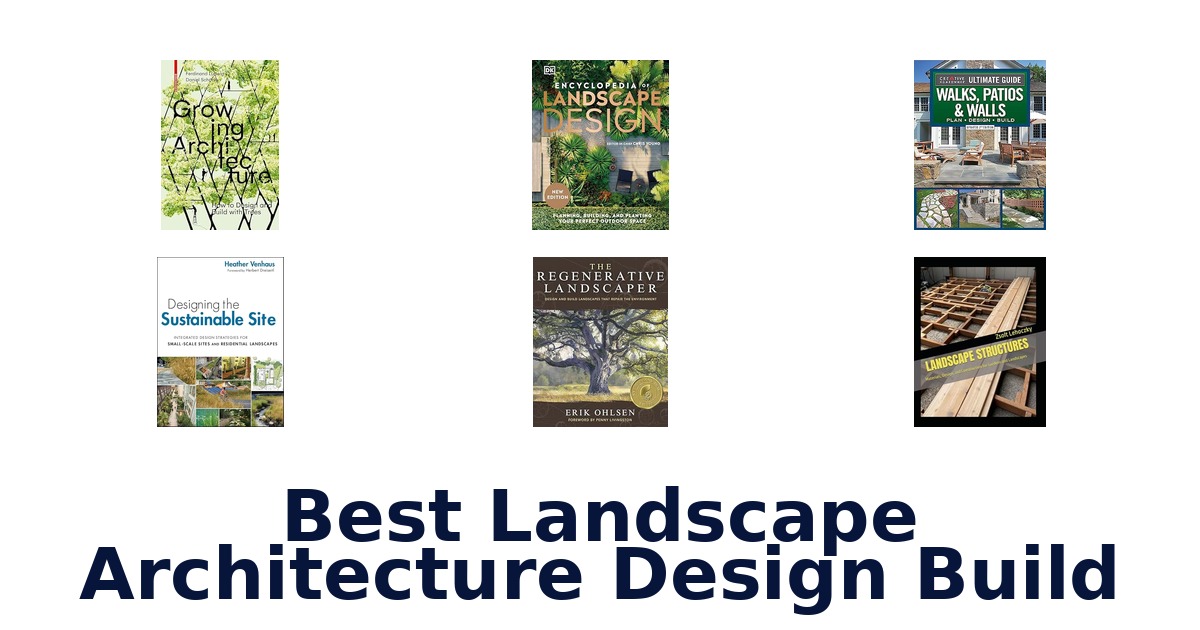
A strong landscape architecture design-build book connects planning decisions to the materials, planting, and construction methods needed to shape an outdoor space. The Best Landscape Architecture Design Build choices here suit different readers: homeowners planning a complete garden, designers exploring sustainable or tree-based approaches, and DIYers building specific features. The Regenerative Landscaper leads for its direct focus on designing and building landscapes that repair the environment.
Other titles narrow in on residential sustainability, structures, or hardscape projects such as walks, patios, walls, and stone features. Because the supplied listings do not provide comparable technical specifications, choose by the project and design approach named in each title rather than assuming a book includes particular plans, calculations, or construction details.
This guide matches each book to its clearest use case.
The Regenerative Landscaper is the best overall match because its title directly addresses designing and building landscapes, with an explicit regenerative focus: repairing the environment. It suits readers who want a landscape design-build approach shaped by environmental aims rather than a guide limited to one material or feature. For tree-centered design, Growing Architecture is a more focused alternative; for a broad outdoor-space reference, Encyclopedia of Landscape Design covers planning, building, and planting.
Our Top Picks
 Best Overall
Its title directly combines landscape design and building with the distinctive goal of repairing the environment, making it the clearest broad design-build match.
View on Amazon Best for Tree Design
It explicitly explains how to design and build with trees, a distinctive architectural approach for readers whose project centers on living structures.
View on Amazon Broadest Project Scope
Encyclopedia of Landscape Design
Its subtitle spans planning, building, and planting an outdoor space, making it the broadest stated reference for a complete landscape project.
View on Amazon- Best for Site Sustainability Designing the Sustainable Site
- Best for Hardscape DIY Ultimate Guide to Walks, Patios & Walls
Compare the Guides by Project Focus
| # | Product | Buy |
|---|---|---|
| 1 | 1. The Regenerative LandscaperBest Overall | View on Amazon |
| 2 | 2. Growing ArchitectureBest for Tree Design | View on Amazon |
| 3 | 3. Encyclopedia of Landscape DesignBroadest Project Scope | View on Amazon |
| 4 |  4. Designing the Sustainable SiteBest for Site Sustainability | View on Amazon |
| 5 |  5. Landscape StructuresLandscape-structure design readers | View on Amazon |
| 6 |  6. Ultimate Guide to Walks, Patios & WallsBest for Hardscape DIY | View on Amazon |
| 7 |  7. Landscaping with StoneNatural-stone project planners | View on Amazon |
Detailed Reviews: Best Landscape Architecture Design Build
#1 · Best Overall
1. The Regenerative Landscaper
Best for: Regenerative landscape practitioners.
Why it ranks #1: Its title directly combines landscape design and building with the distinctive goal of repairing the environment, making it the clearest broad design-build match.
Its regenerative focus centers landscape design and construction on repairing the environment, giving readers a clear lens for considering ecological outcomes alongside the work of shaping a site. The title identifies both design and build, so it speaks to readers interested in connecting landscape concepts with implementation.
The combination of “regenerative” landscaping and design-and-build coverage gives this book a specific orientation: landscapes are considered in relation to environmental repair, not solely as finished outdoor spaces. That focus can help readers frame project decisions around the ecological purpose identified in the title. The supplied information does not specify particular techniques, project types, or step-by-step instructions, so it is best approached as a concept-led choice rather than a verified construction manual.
- Explicitly focuses on regenerative landscaping
- Connects landscape design with building
- Centers environmental repair as a project goal
- Authored by Erik Ohlsen
- The supplied information does not identify specific techniques or project instructions.
Skip it if you need a clearly listed project-by-project construction guide; Creative Homeowner’s Ultimate Guide to Walks, Patios & Walls specifies step-by-step DIY instructions.
Choose it if environmental repair is central to how you want to think about landscape design and construction. Its title supports a regenerative focus, but the supplied details do not establish a step-by-step method for building projects.
Listed on Amazon as: The Regenerative Landscaper: Design and Build Landscapes That Repair the Environment
View on Amazon#2 · Best for Tree Design
2. Growing Architecture
Best for: Tree-integrated design readers.
Why it ranks #2: It explicitly explains how to design and build with trees, a distinctive architectural approach for readers whose project centers on living structures.
Designing and building with trees is the defining focus here, making this book relevant to readers exploring trees as part of architectural landscape work. The title connects living elements with construction, a distinct angle for projects where tree-based design matters more than a general survey of garden planning.
The title pairs architecture with trees and explicitly addresses both design and building. That combination gives readers a focused way to consider tree-related work as an architectural and construction subject, rather than treating trees only as one element in a broad planting guide. It is a perfect paperback by Ferdinand Ludwig and Daniel Schönle. The supplied information does not name techniques or project examples, so its specific practical procedures cannot be established from the listing.
- Focuses on architecture involving trees
- Covers design and building
- Offers a focused alternative to general landscape coverage
- Written by Ferdinand Ludwig and Daniel Schönle
- The supplied information does not identify specific tree-building techniques or project examples.
Skip it if you need broad planning, building, and planting coverage; DK’s Encyclopedia of Landscape Design names all three areas.
Consider it if tree-integrated architecture is the subject you want to explore through both design and building. The listing establishes that narrow focus, but does not specify construction methods or examples for a particular site.
Listed on Amazon as: Growing Architecture: How to Design and Build with Trees
View on Amazon#3 · Broadest Project Scope
3. Encyclopedia of Landscape Design
Best for: Whole-garden planning readers.
Why it ranks #3: Its subtitle spans planning, building, and planting an outdoor space, making it the broadest stated reference for a complete landscape project.
Planning, building, and planting appear together in this landscape-design encyclopedia, giving readers a broad framework for thinking across the stages of an outdoor space. That combined scope suits someone who wants garden design and implementation topics gathered in one hardcover reference rather than a book centered on one material.
The title’s planning, building, and planting coverage links early outdoor-space decisions with construction and planting considerations. For a reader working through a garden project, that range offers a way to consult one reference across several landscape-design stages. The listing identifies it as a hardcover encyclopedia, but supplies no project count, specific techniques, or image details; readers seeking a narrowly defined construction method should weigh that broad scope against a specialized guide.
- Covers planning, building, and planting
- Addresses outdoor-space design broadly
- Identified as an encyclopedia
- Hardcover format
- The supplied details do not specify particular methods, projects, or step-by-step instructions.
Skip it if you want instructions focused on stone projects; Pat Sagui’s Landscaping with Stone specifies 12 natural-stone projects.
A fit for readers seeking broad coverage of planning, building, and planting across an outdoor space. Its encyclopedic scope is the draw; choose a more specialized title if your immediate task centers on one construction material.
Listed on Amazon as: Encyclopedia of Landscape Design: Planning, Building, and Planting Your Perfect Outdoor Space
View on Amazon#4 · Best for Site Sustainability
4. Designing the Sustainable Site
Best for: Sustainable residential-site planners.
Why it ranks #4: It focuses on integrated design strategies for small-scale sites and residential landscapes, serving readers prioritizing sustainable site planning.
Integrated design strategies for small-scale sites and residential landscapes define this book’s niche, giving sustainability-minded readers a site-specific frame for design decisions. Its focus is narrower than an all-purpose landscaping guide, making the title especially relevant when the work concerns a home or similarly small site.
The title links sustainable-site design with integrated strategies, which frames sustainability as part of how a site is considered rather than as a separate decorative feature. Its explicit focus on small-scale sites and residential landscapes helps readers judge whether the scale matches their project. The supplied listing does not identify specific strategies, construction instructions, or project examples, so the book’s exact methods cannot be assessed from the available details.
- Focuses on sustainable-site design
- Emphasizes integrated design strategies
- Addresses small-scale sites
- Specifically includes residential landscapes
- The supplied information does not name particular strategies or construction procedures.
Skip it if you need named natural-stone project examples; Pat Sagui’s Landscaping with Stone specifies 12 projects.
A relevant choice for readers planning sustainable design on a small site or residential landscape. Its stated scale and integrated-strategy focus are clear, but the supplied information does not confirm specific methods or hands-on building instructions.
Listed on Amazon as: Designing the Sustainable Site: Integrated Design Strategies for Small Scale Sites and Residential Landscapes
View on Amazon#5
5. Landscape Structures
Best for: Landscape-structure design readers.
Why it ranks #5: The title covers materials, design, and construction for garden and landscape structures, though its scope is narrower than whole-site design.
Materials, design, and construction are brought together around garden and landscape structures, making this title a focused option for readers considering built features outdoors. That structure-centered scope can help identify a match for projects where material and construction decisions matter more than planting or whole-site planning.
By naming materials alongside design and construction, the book frames landscape structures as both a design subject and a building subject. Its garden-and-landscape setting clarifies the intended context for those structures, helping readers distinguish it from a general planting guide. The listing identifies Zsolt Lehoczky as author and the format as paperback. It does not provide specific materials, project examples, or construction procedures, so those details should not be assumed.
- Covers materials, design, and construction
- Focuses on landscape structures
- Places structures in garden and landscape settings
- Authored by Zsolt Lehoczky
- The supplied information does not specify materials, projects, or construction procedures.
Skip it if you need step-by-step DIY guidance for walks, patios, and walls; Creative Homeowner’s Ultimate Guide to Walks, Patios & Walls specifies instructions and 500 photos.
Consider it if your project centers on built structures in a garden or landscape and you want materials, design, and construction considered together. The listing confirms that scope, but not specific project instructions or material selections.
Listed on Amazon as: LANDSCAPE STRUCTURES: Materials, Design, and Construction for Gardens and Landscapes
View on Amazon#6 · Best for Hardscape DIY
6. Ultimate Guide to Walks, Patios & Walls
Best for: DIY paths, patios, and walls.
Why it ranks #6: It offers step-by-step DIY instructions with 500 photos and covers walks, patios, and walls in brick, mortar, concrete, flagstone, and tile.
Step-by-step DIY instructions and 500 photos distinguish this guide for readers planning walks, patios, or walls. Its named materials—brick, mortar, concrete, flagstone, and tile—make the subject matter concrete, helping a homeowner identify whether the book’s construction focus matches a proposed hardscape project.
The title combines planning, design, and building with step-by-step DIY instructions, giving home project readers a route from considering a feature to working through its construction. Its 500 photos support the visual side of those instructions, while the listed materials—brick, mortar, concrete, flagstone, and tile—show the range of hardscape subjects covered. The focus is specifically walks, patios, and walls, so readers seeking tree-centered or broad planting coverage may want a different scope.
- Step-by-step DIY instructions
- 500 photos
- Covers walks, patios, and walls
- Names brick, mortar, concrete, flagstone, and tile
- Its stated focus is walks, patios, and walls rather than whole-garden planting.
Skip it if you need natural-stone projects specifically; Pat Sagui’s Landscaping with Stone lists 12 projects using natural stone.
A strong subject match for DIY readers planning walks, patios, or walls with the listed hardscape materials. Its focus is construction of those features, so it is not the broad planting reference for a complete garden.
View on Amazon#7
7. Landscaping with Stone
Best for: Natural-stone project planners.
Why it ranks #7: Its 12 projects focus on planning, designing, and working with natural stone for patios, walkways, walls, and other landscape features.
Twelve projects give this guide a defined natural-stone focus for readers planning patios, walkways, walls, or other landscape features. The title also covers planning, design, and working with stone, connecting project selection with the material-specific subject rather than offering an all-purpose landscape overview.
The book’s 12 projects provide a project-based frame for exploring natural stone in landscape features, while its stated planning and design coverage addresses the earlier decisions that accompany building. Patios, walkways, and walls are named examples, helping readers match the book to a specific hardscape ambition. It is a paperback by Pat Sagui, edited by Mark Wolfe. The supplied facts do not identify individual project techniques or establish coverage of other materials.
- Includes 12 projects
- Focuses on natural stone
- Names patios, walkways, and walls
- Covers planning and design with stone
- Its stated material focus is natural stone, not a range of hardscape materials.
Skip it if you need instructions across brick, mortar, concrete, flagstone, and tile; Creative Homeowner’s Ultimate Guide to Walks, Patios & Walls lists those materials.
Choose this for planning and design centered on natural stone, especially patios, walkways, and walls. The 12-project scope is specific; readers wanting instructions across several named hardscape materials should consider a broader materials guide.
Listed on Amazon as: Landscaping with Stone, Third Edition: Create Patios, Walkways, Walls, and Other Landscape Features (Creative Homeowner) Learn to Plan, Design, and Work with Natural Stone – 12 Projects
View on AmazonWhere landscape design-build plans can go wrong
The main risk is treating a design concept as a complete construction plan. These titles identify different approaches and project types, but the supplied listings do not confirm site-specific dimensions, engineering calculations, drainage details, or local code guidance. A tree-based design in Growing Architecture, for example, has a different living-material focus from the stone features in Landscaping with Stone; neither title alone establishes that a particular design suits your soil, climate, or site conditions.
Likewise, the broad scope of Encyclopedia of Landscape Design does not guarantee that it covers every technical requirement for a specific build. Before construction, verify conditions on site and establish whether the project needs professional design, structural review, permits, or specialist trades.
Use the book to shape questions and concepts, not as proof that a plan is safe or compliant.
Choose the right scope before choosing materials
Start with the project’s scope, because a whole-site plan and a single hardscape feature call for different kinds of guidance. The Regenerative Landscaper and Encyclopedia of Landscape Design address landscapes more broadly, while Ultimate Guide to Walks, Patios & Walls names a tightly bounded set of features and lists five material types: brick, mortar, concrete, flagstone, and tile. Landscaping with Stone is narrower still, centering natural stone and 12 projects.
That focus can help a reader who has already chosen stone, but it may be a mismatch for someone still deciding the overall layout or planting approach. The listings do not specify project dimensions or material compatibility, so check the book’s contents and confirm that its examples suit your proposed feature and site.
A focused title is most useful after you have identified what you intend to build.
How to Choose a Landscape Design-Build Book
Whole landscape or a defined feature
Choose a book whose scope matches whether you are planning an entire outdoor space or building one feature. Encyclopedia of Landscape Design explicitly covers planning, building, and planting a perfect outdoor space, while The Regenerative Landscaper focuses on designing and building landscapes with an environmental repair goal. At the narrower end, Ultimate Guide to Walks, Patios & Walls targets those three features, and Landscaping with Stone lists 12 stone projects.
Readers still shaping a complete garden should favor the broader titles; DIYers who have already settled on a patio, wall, or walkway may benefit more from the focused guides. The listing details do not establish how deeply each book treats every subtopic, so check the contents before relying on it for a particular build.
Design approach and priorities
Look for an approach that reflects what you want the landscape to do, not just how it should look. The Regenerative Landscaper explicitly aims to repair the environment, Designing the Sustainable Site offers integrated strategies for small-scale sites and residential landscapes, and Growing Architecture focuses on designing and building with trees. These are distinct priorities rather than interchangeable labels.
A reader interested in environmental repair can start with The Regenerative Landscaper; someone focused on a residential site’s sustainability can compare Designing the Sustainable Site; and a project centered on trees points toward Growing Architecture. The listings do not provide measurable sustainability outcomes or site requirements, so treat the titles as indicators of subject matter, then assess whether the book’s detailed methods fit your actual location and goals.
Materials and construction detail
If you are building hardscape, match the book’s named materials and level of practical instruction to your project. Ultimate Guide to Walks, Patios & Walls specifies step-by-step DIY instructions and 500 photos, covering brick, mortar, concrete, flagstone, and tile. Landscaping with Stone instead focuses on natural stone and identifies 12 projects.
Landscape Structures covers materials, design, and construction for garden and landscape structures, without naming particular materials in the supplied listing. The feature guide is the clearest match when you need its listed materials and illustrated DIY orientation; the stone book fits a natural-stone project; and Landscape Structures suits readers looking at structures more generally.
Confirm that the actual project type and material are covered before treating any book as a construction manual.
Which landscape design-build book should I choose?
Choose The Regenerative Landscaper if you want the closest overall match to landscape design-build and an explicit environmental repair focus. For a landscape centered on trees, choose Growing Architecture; for a broad planning, building, and planting reference, choose Encyclopedia of Landscape Design. Readers planning sustainable small-scale or residential sites should consider Designing the Sustainable Site.
If your project is a garden structure, Landscape Structures addresses materials, design, and construction. For a DIY walkway, patio, or wall, Ultimate Guide to Walks, Patios & Walls is the most specific match and lists 500 photos plus five material types.
Choose Landscaping with Stone when natural stone and its 12 projects are the central interest. Check the contents and site requirements before construction.
Frequently Asked Questions
How should I adapt a landscape design-build plan to my site’s soil, drainage, and climate?
Begin by observing your site’s soil, drainage patterns, sun, and local climate before choosing plants or materials. Use those conditions to shape the plan, and check whether the guide you select addresses your project type. For complex drainage or uncertain site conditions, consult a qualified local professional before construction.
When should I hire a landscape architect or contractor instead of building a feature myself?
Hire a professional when the project involves conditions or construction decisions you cannot confidently assess, such as challenging drainage, structural work, or coordination across several features. A DIY guide may help with a focused walkway, patio, or wall, but confirm that its instructions suit your site and abilities before starting.
What permits, accessibility requirements, or local rules could affect a landscape project?
Requirements depend on your location and the work proposed. Before building, contact your local authority to ask about permits, setbacks, drainage rules, and accessibility obligations that may apply. Check requirements before selecting a design or ordering materials, and consult a qualified professional if the rules or their application are unclear.
Which guide fits my landscape project best?
Match the title to the project: choose The Regenerative Landscaper for design-build with an environmental repair focus, Growing Architecture for tree-centered design, or Encyclopedia of Landscape Design for broad planning, building, and planting. The other titles focus on sustainable sites, garden structures, walkways and walls, or natural stone.
What should I check before following a landscape design guide?
Review the contents to confirm the guide covers your feature, materials, and level of detail. Then compare its approach with your site’s conditions and local requirements. The listed titles vary from broad landscape references to focused guides for trees, structures, stone, and DIY walks, patios, or walls.
Final Words
Choose The Regenerative Landscaper for the closest overall match to landscape design-build and an explicit environmental repair focus. For tree-centered work, consider Growing Architecture; for broad planning, building, and planting, use Encyclopedia of Landscape Design. Match the remaining guides to sustainable residential sites, garden structures, DIY walks and walls, or natural stone.
Before building, check the book’s contents against your site conditions and local requirements.