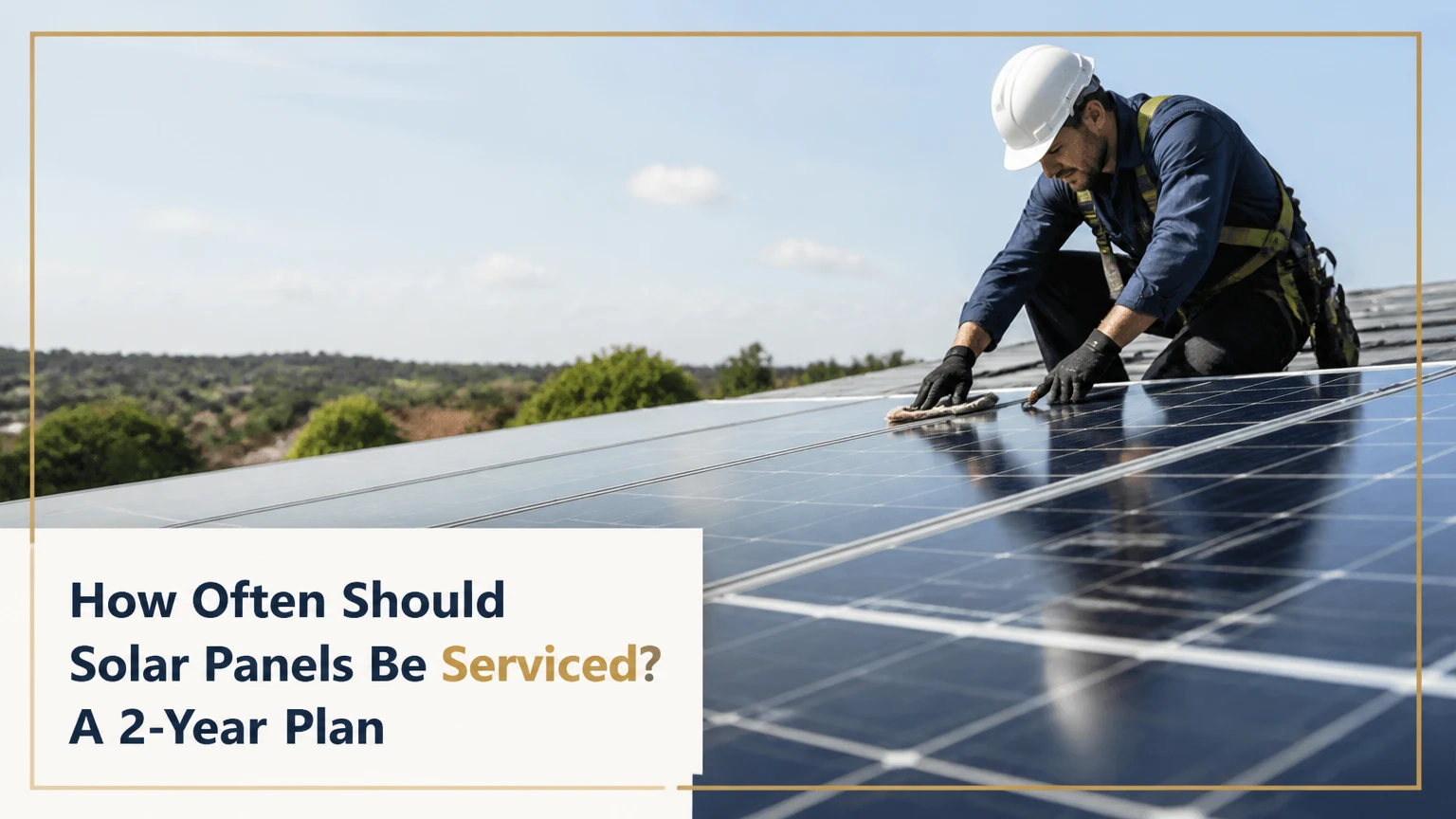
Solar panels should receive a professional technical service every 1-2 years, while cleaning typically occurs 1-4 times annually according to local soiling, rainfall, roof angle, and output loss. Newer systems in mild climates may need less attention; dusty, coastal, shaded, storm-prone, or commercial systems often need more frequent checks.
Key Facts at a Glance
- A residential photovoltaic system usually needs a professional inspection every 1-2 years.
- Panel cleaning is condition-based, ranging from once yearly in rainy climates to monthly in dusty locations.
- A 5% output loss can justify cleaning when the recovered electricity exceeds the cleaning price.
- Storms, leaks, burning smells, exposed wiring, and sudden production loss require prompt service.
- Solar servicing includes electrical, mechanical, inverter, structural, and performance checks, not merely washing glass.
- Most module warranties cover 25-30 years, while many string inverters have a practical replacement window around 10-15 years.
How Often Should Solar Panels Be Serviced?
Most homeowners should book a qualified solar inspection every two years, then shorten the interval to annually when the system is older, exposed to harsh weather, or showing abnormal production. A professional visit normally takes 1-3 hours for a residential system and should follow the panel, inverter, racking, and electrical equipment manufacturers’ instructions.
A two-year interval is a sensible baseline, not a universal rule. A 15-year-old array with a central inverter deserves closer attention than a three-year-old system with module-level monitoring. Local rules also matter because electrical work, roof access, and testing of direct-current circuits may require a licensed electrician or certified installer.
| System condition | Technical service interval | Typical cleaning interval | Main reason |
|---|---|---|---|
| New system, mild and rainy climate | Every 24 months | Every 12-24 months | Rain removes much of the loose dust |
| Urban home with pollen and trees | Every 12-24 months | Every 6-12 months | Pollen, leaves, bird droppings, and shading |
| Coastal property | Every 12 months | Every 3-6 months | Salt deposits and corrosion exposure |
| Desert or high-dust property | Every 6-12 months | Every 1-3 months | Windblown dust can form persistent soiling |
| Commercial rooftop system | Every 12 months | Monthly to quarterly | Larger losses and warranty obligations |
| System with an active fault | Immediately | As needed | Fault diagnosis takes priority over washing |
The best schedule combines calendar maintenance with performance monitoring. A fixed visit every 12-24 months catches aging hardware, while monthly review of generation data catches failures between visits.
What Does Professional Solar Servicing Include?
Professional solar servicing is a documented condition assessment of the photovoltaic system, including generation data, modules, wiring, inverter, protection equipment, racking, and roof interfaces. Cleaning alone removes surface contamination but cannot identify insulation breakdown, loose terminals, hot spots, water entry, or inverter faults.
A competent technician normally begins with the system history. The technician compares recent production with weather-adjusted expectations, reviews inverter alarms, and checks whether one string or module is underperforming. The inspection then moves from visible conditions to electrical and mechanical tests, because opening equipment before understanding the symptoms can create unnecessary risk.
What happens during a service visit?
- Review performance data. Compare daily and monthly generation with the previous year, local irradiance, seasonal expectations, and inverter records.
- Inspect modules visually. Look for cracked glass, delamination, yellowing, frame distortion, burn marks, standing water, lichen, bird damage, and displaced components.
- Check cabling and connectors. Examine cable clips, MC4-compatible connectors, insulation, conduit, junction boxes, and signs of rodent or ultraviolet damage.
- Test electrical performance. Depending on the system and technician’s equipment, measure open-circuit voltage, short-circuit current, polarity, insulation resistance, string balance, and AC output.
- Scan for abnormal heat. Infrared imaging can reveal hot cells, failing bypass diodes, loose connections, or overloaded components under suitable sunlight and load.
- Inspect the inverter. Review fault codes, operating temperature, fan or filter condition, clearances, isolators, firmware status, and ventilation.
- Check mounting and roof interfaces. Examine clamps, rails, bolts, ballast, flashings, penetrations, seals, corrosion, and movement after wind or hail.
- Clean only where justified. Use cool modules, demineralized water, and nonabrasive brushes when soiling materially affects output.
- Record findings. Obtain test values, photographs, faults, repairs, parts used, and recommended follow-up dates for warranty and insurance records.
Thermal imaging is useful, but it is not a complete diagnosis. An infrared camera needs adequate irradiance and a meaningful electrical load; a cool, cloudy inspection can miss a defect that appears during high production.
How Often Should Solar Panels Be Cleaned?
Solar panels should be cleaned when soiling causes measurable production loss, commonly 1-4 times per year, rather than automatically every month. Rainfall, roof pitch, dust, pollen, bird activity, nearby agriculture, road traffic, and the value of the electricity determine whether cleaning is financially worthwhile.
Flat or low-angle modules retain more water, dust, and bird residue than panels installed at a steeper pitch. Rain may remove loose dust but usually does not remove baked-on bird droppings, oily pollution, salt crystals, or lichen. Cleaning is more valuable when a visible deposit covers a large area or monitoring shows output below a comparable weather period.
A practical decision rule is to clean when expected recoverable electricity exceeds the cleaning price. For example, a system losing 10% of 6,000 kWh of annual production loses about 600 kWh. At an electricity value of $0.20 per kWh, the theoretical annual loss is $120, so a $200 cleaning may not pay back in one year unless the soiling continues or the cleaning also prevents permanent residue.
What is the safest cleaning method?
Clean cool modules in the early morning or under overcast conditions with demineralized or low-mineral water and a soft, nonabrasive brush. Avoid pressure washers, wire brushes, abrasive powders, harsh detergents, and cold water sprayed onto glass that has been heated by intense midday sun.
Never walk on photovoltaic modules. Do not disconnect electrical equipment with wet hands, remove covers, or work near exposed conductors without the required qualifications. A steep roof, fragile tiles, skylights, overhead lines, or uncertain electrical condition changes a simple washing task into a professional safety job.
| Cleaning condition | Recommended action | Typical timing | Avoided risk |
|---|---|---|---|
| Loose dust after ordinary rain | Monitor first | 1-2 weeks | Paying for unnecessary cleaning |
| Dried bird droppings on 10% or more of array | Spot-clean or hire service | Within 1-4 weeks | Localized shading and residue |
| Salt film near ocean | Professional wash | Every 3-6 months | Frame, fastener, and racking corrosion |
| Heavy desert dust | Scheduled wash | Every 1-3 months | Persistent 5-25% soiling loss |
| Lichen or baked mineral deposits | Qualified cleaning assessment | Within 1 month | Glass scratching from aggressive tools |
| Snow cover | Follow local manufacturer guidance | After safe melt or removal | Roof and module damage |
The 5-25% soiling-loss range often cited by solar maintenance providers is highly site-dependent. It should be treated as a planning range, not a guaranteed loss for every array.
Which Components Need the Most Attention?
Inverters, connectors, protection devices, and roof penetrations often deserve more diagnostic attention than the photovoltaic glass because electronic and connection failures can stop an entire string or system. Modules usually degrade gradually, while a failed inverter, isolator, or connector can cause an abrupt production loss.
The service priority changes with system architecture. A central inverter can make one failure affect the whole array; string inverters divide the system into circuits; microinverters allow module-level faults but increase the number of rooftop electronics. Monitoring data helps distinguish a single-module issue from a system-wide problem.
| Component | Typical service concern | Warning sign | Common milestone |
|---|---|---|---|
| PV module | Cracks, delamination, hot cells | Mismatched module output | 25-30-year product warranty |
| DC connector | Loose fit, heat, moisture | Hot connector or string fault | Inspect every service visit |
| DC isolator | Contact failure, water entry | Intermittent generation | Immediate diagnosis after alarm |
| String inverter | Fans, capacitors, firmware | Fault code or zero AC output | Often 10-15-year replacement window |
| Microinverter | Rooftop heat and moisture | One module underperforms | Commonly 10-25-year warranty |
| Mounting system | Corrosion, movement, loose clamps | Rattling or shifted rails | Inspect after severe weather |
| Roof penetration | Seal failure, flashing damage | Interior staining or leak | Check annually on older roofs |
A module warranty does not guarantee free labor for every future repair. Confirm whether the warranty covers product defects, power output, shipping, labor, inverter replacement, and installer workmanship separately.
How Can You Tell That a System Needs Service?
A solar system needs service when production drops beyond normal seasonal variation, an inverter reports a fault, physical damage appears, or the roof and electrical equipment show unsafe conditions. A persistent 10-20% decline against a weather-adjusted baseline deserves investigation, especially when nearby shading has not changed.
Do not compare a winter month with a summer month and call the difference a fault. Compare similar months, equivalent sunlight conditions, and the same monitoring period, then check whether one string or several arrays changed together.
| Symptom | Likely causes | Safe first check | Professional response |
|---|---|---|---|
| Monitoring shows 0 kW in daylight | Grid outage, inverter trip, isolator issue | Read inverter code and check utility status | Electrical and inverter diagnosis |
| Output falls 10-20% gradually | Soiling, new shade, degradation, sensor error | Compare weather-adjusted production | IV curve, shading, and insulation tests |
| One module underperforms | Microinverter, connector, diode, or module fault | Review module-level app data | Thermal and electrical testing |
| Repeated shutdowns | Overtemperature, grid voltage, firmware, loose connection | Record time and fault code | Inverter and AC supply diagnosis |
| Water appears below array | Failed flashing, roof seal, or conduit path | Inspect indoors without climbing | Roofer and solar installer assessment |
| Burning smell or visible melting | Overheated connector or isolator | Keep clear and contact installer | Prompt isolation by qualified personnel |
A homeowner can photograph the inverter display, note the time of alarms, check visible shade from the ground, and compare monitoring data. A homeowner should not open an inverter, test live DC circuits, or reset unknown protection devices repeatedly.
When Should Solar Panels Be Serviced Immediately?
Solar panels should be serviced immediately after hail, high winds, lightning, flooding, fire, roof work, or a sudden unexplained production loss. Visible cracks, exposed cable, loose modules, water intrusion, burning odors, repeated inverter trips, and damaged isolators justify prompt professional assessment rather than waiting for the normal interval.
Severe weather can create defects that remain electrically active while appearing minor from the ground. A loose clamp can permit movement, and a damaged connector can heat under load. After lightning or grid disturbances, technicians may need to inspect surge protection, inverter logs, earthing, and AC equipment.
Keep people away from visibly damaged modules because photovoltaic modules can produce voltage whenever light reaches them, even after the inverter has stopped operating. Emergency isolation procedures vary by system, so follow the site’s shutdown instructions and contact the installer or utility when necessary.
How Much Does Solar Panel Servicing Cost?
Typical residential solar cleaning costs about $150-$300 per visit, while a broader technical inspection commonly costs $150-$450, excluding major repairs, difficult roof access, replacement parts, or travel. Commercial operations and maintenance pricing is often quoted by system size, with typical annual figures around $8-$18 per kW, although contracts differ substantially.
Prices depend on array size, roof height, access, location, testing depth, and whether the visit includes a written report. A quote for washing 12 accessible modules is not comparable with a quote that includes thermal imaging, insulation resistance, torque checks, inverter analysis, and roof inspection.
| Service item | Typical residential range | Typical duration | Usually excludes |
|---|---|---|---|
| Basic panel cleaning | $150-$300 | 1-2 hours | Repairs and difficult access |
| Visual maintenance visit | $100-$250 | 1-2 hours | Advanced electrical testing |
| Technical inspection | $150-$450 | 1-3 hours | Replacement components |
| Inverter replacement | $1,500-$4,000 or more | 2-6 hours | Roof repairs and upgrades |
| Connector or isolator repair | $150-$600 | 1-3 hours | Extensive rewiring |
| Commercial O&M contract | $8-$18 per kW yearly | Quarterly or monthly | Major capital replacement |
These are typical planning ranges, not fixed market prices. Angi’s published residential maintenance estimates and solar contractors’ service schedules show why location and access can move the final invoice substantially.
Which Service Strategy Should You Choose?
A hybrid strategy is usually the strongest choice for homeowners: schedule a technical inspection every 1-2 years, monitor output monthly, and trigger cleaning or repairs when evidence shows a problem. Reactive-only maintenance costs less initially but increases the chance of extended downtime and undocumented warranty issues.
| Strategy | Routine frequency | Best fit | Main weakness |
|---|---|---|---|
| Reactive only | Service after failure | Low-value, easily accessible systems | Faults can remain hidden for months |
| Fixed interval | Every 12-24 months | Warranty-focused homeowners | May over-service clean, rainy sites |
| Predictive monitoring | Monthly data review, service by threshold | Commercial and monitored systems | Requires capable monitoring equipment |
| Hybrid plan | 12-24-month inspection plus alerts | Most residential systems | Requires records and monthly attention |
Predictive maintenance does not mean artificial-intelligence software is mandatory. A homeowner comparing year-over-year production and responding to inverter alerts already uses a basic condition-based method.
How Should Climate Change the Schedule?
Climate should change cleaning frequency more than the basic electrical inspection interval. Dust, salt, pollen, humidity, freeze-thaw cycles, hail, and wind affect different components, so a coastal system may need frequent washing while a rainy inland system needs only periodic cleaning but still benefits from a two-year electrical review.
| Environment | Cleaning plan | Inspection plan | Extra check |
|---|---|---|---|
| Rainy inland climate | Every 12-24 months | Every 24 months | Moss, leaves, drainage |
| Dry urban climate | Every 6-12 months | Every 12-24 months | Traffic dust and pollen |
| Desert climate | Every 1-3 months in dry season | Every 6-12 months | Dust accumulation and heat |
| Coastal climate | Every 3-6 months | Every 12 months | Salt corrosion and fasteners |
| Snow and freeze climate | As safely required | Every 12-24 months | Ice, snow load, roof movement |
| Agricultural area | Every 3-6 months | Every 12 months | Pollen, dust, ammonia exposure |
Roof pitch is a second major variable. A steep array sheds water and loose debris more effectively than a low-slope array, but steep access increases cleaning risk and labor cost.
Do New Solar Panels Need Annual Maintenance?
New solar panels do not automatically require annual technical servicing when the installation is sound, accessible, monitored, and covered by clear warranty terms. A two-year inspection interval often fits a new residential system in a mild climate, while annual checks may be required by commercial contracts, insurers, or equipment manufacturers.
The first service should confirm installation quality rather than wait for a failure. Ask the installer for commissioning records, string voltages, inverter settings, protection-device details, roof photographs, warranty documents, and the expected annual production model.
Annual service becomes more defensible when the system has a central inverter, high-value commercial output, difficult-to-see rooftop equipment, frequent alarms, or a history of repairs. The correct interval comes from risk and evidence, not the age of the modules alone.
What Problems Does Servicing Prevent?
Regular servicing can identify developing electrical, mechanical, structural, and performance faults before they become extended outages or roof damage. Servicing cannot prevent normal module aging, eliminate every manufacturing defect, or guarantee a specific energy yield during cloudy weather.
| Preventive finding | Possible consequence if ignored | Typical service action | Priority |
|---|---|---|---|
| Loose DC connector | Heat damage or arc fault | Replace connector pair and test circuit | High |
| Blocked inverter ventilation | Thermal shutdown | Clear airflow and inspect fan | Medium-high |
| Corroded racking | Structural movement | Replace hardware and assess rails | High |
| Failed roof flashing | Interior water damage | Coordinate solar removal and roofing | High |
| Bird nesting | Cable damage and droppings | Remove safely and install mesh | Medium |
| New tree shading | Repeated generation loss | Prune or model shade impact | Medium |
| Module hot spot | Accelerated damage or fire risk | Test, isolate, and replace as needed | High |
One practitioner rule is to treat repeated inverter resets as a symptom, not a repair. Resetting the equipment can hide grid-voltage, insulation, connector, or temperature problems while the underlying fault continues.
What Can a Homeowner Safely Check?
A homeowner can review monitoring data, read inverter error codes, inspect the array from ground level, clear nearby vegetation without touching electrical equipment, and check for visible roof leaks indoors. A homeowner should leave roof access, live electrical measurements, inverter opening, torque testing, and damaged equipment to qualified personnel.
Monthly monitoring takes only a few minutes but creates a useful baseline. Record total monthly kilowatt-hours, inverter alarms, unusual shutdowns, snow or dust events, and major changes in nearby shade. Keep the service report with the original installation and warranty documents.
Do not use a pressure washer or household glass cleaner. Do not assume a breaker is safe because the inverter screen is blank, since DC modules can remain energized in daylight.
FAQ
Can rain clean solar panels effectively?
Rain removes loose dust from tilted modules but often leaves bird droppings, pollen, salt, oily residue, and mineral deposits. In a rainy climate, rain may reduce cleaning to once every 12-24 months, but monitoring data and visible deposits should determine the final decision.
Is solar panel maintenance tax deductible?
Tax treatment depends on jurisdiction, ownership structure, and whether the system serves a residence or business. Residential cleaning and repairs are not universally deductible, while business maintenance may qualify as an operating expense. Ask a local tax professional rather than relying on a general solar warranty statement.
How long does a solar service appointment take?
A basic residential cleaning usually takes 1-2 hours, while a technical inspection generally takes 1-3 hours. Difficult roof access, thermal imaging, string testing, repairs, or commercial equipment can extend the visit to 4-6 hours.
Do solar panels lose efficiency every year?
Solar modules gradually degrade, commonly under the manufacturer’s annual degradation specification, often around 0.25%-0.5% per year for modern products. A sudden 10%-20% decline is not normal module aging and should prompt checks for soiling, shade, inverter faults, connectors, and monitoring errors.
Should I service panels before selling my home?
A service report can document production, electrical condition, roof interfaces, warranties, and recent repairs before a sale. Service is particularly useful when monitoring records are incomplete or the system is more than 10 years old, but it does not replace a formal electrical or roof inspection.
Can dirty panels damage the solar system?
Ordinary dust usually reduces output without immediately damaging modules. Persistent bird droppings, lichen, salt, and moisture can create localized heat, staining, corrosion, or drainage problems, so heavily contaminated panels should be assessed rather than left until the next calendar visit.
The Bottom Line
How often should solar panels be serviced? Use a professional technical inspection every 1-2 years as the residential baseline, shorten it to annually in harsh or high-value conditions, and clean panels according to measurable soiling rather than habit. Review monitoring data monthly, act immediately after damage or sudden output loss, and retain every service record for warranty and resale purposes.