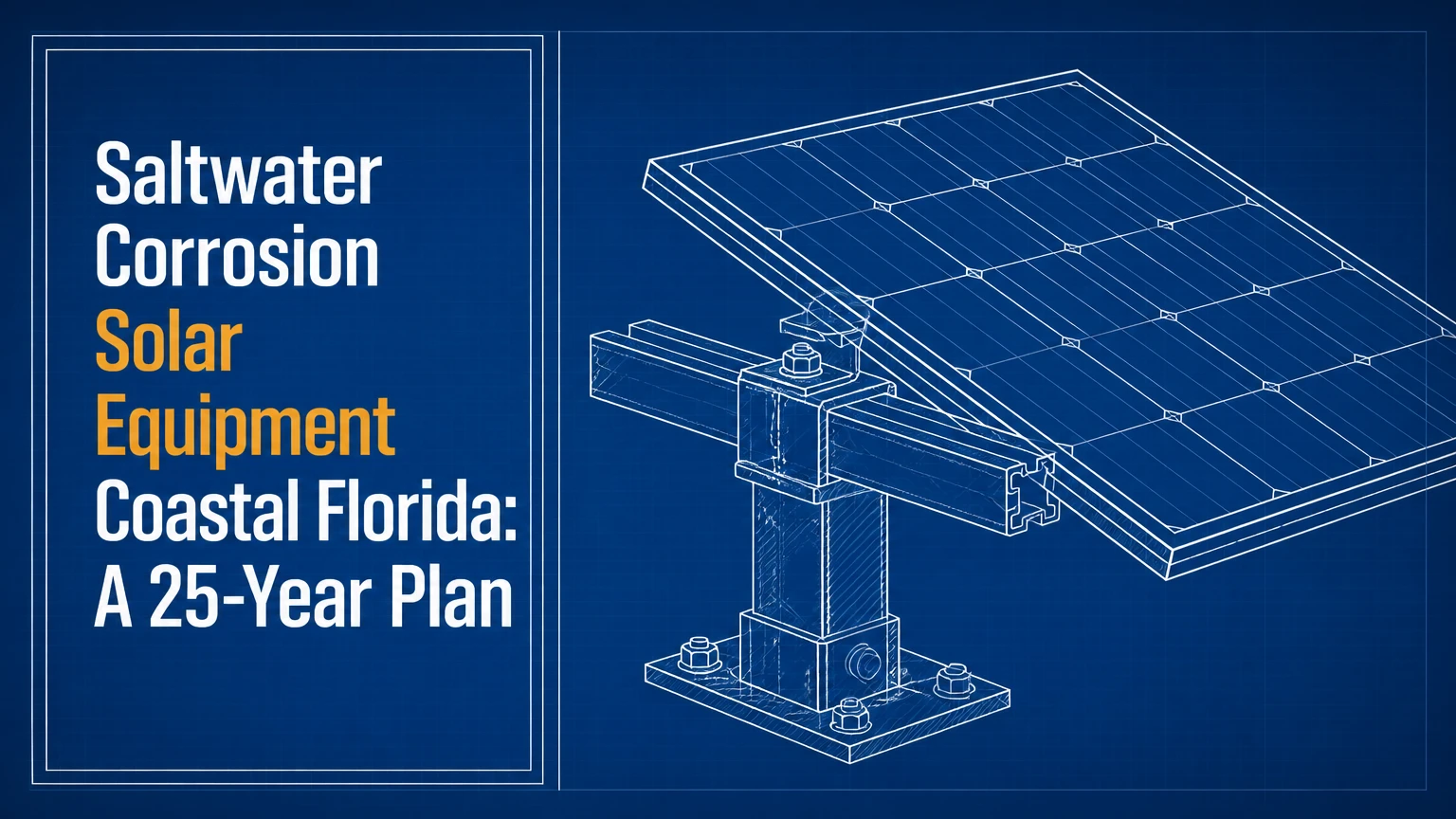
Saltwater corrosion in solar equipment in coastal Florida is chloride-driven metal and electrical degradation caused by salt deposits, humidity, heat, and wet-dry cycles. The most reliable defense combines salt-mist-tested modules, compatible aluminum and stainless-steel hardware, protected electrical enclosures, code-compliant wind design, freshwater cleaning, and scheduled inspections.
Key Facts at a Glance
- Coastal Florida solar equipment can corrode even when no red rust is visible, because aluminum pitting and connector oxidation often begin beneath clamps or inside joints.
- IEC 61701 evaluates photovoltaic module resistance to salt mist; the manufacturer must identify the tested severity and certificate scope.
- ASTM B117 salt-spray hours are laboratory exposure results, not a direct prediction of how many years a Florida rooftop will last.
- NEMA 4X addresses outdoor enclosure protection against water, dust, and corrosion, while IP68 alone does not guarantee salt-air durability.
- Grade 316 stainless steel improves chloride resistance, but direct contact with aluminum still requires compatible design, coatings, or electrical isolation.
- A typical coastal upgrade adds about 15-25% to an otherwise comparable residential solar installation, depending on distance, roof complexity, and equipment choices.
What Saltwater Corrosion Means
Saltwater corrosion solar equipment coastal Florida refers to the deterioration of photovoltaic modules, racking, fasteners, conductors, connectors, and enclosures after exposure to marine aerosols and moisture. The salt usually arrives as airborne droplets or particles, not as visible seawater flooding.
The American Association for Corrosion (AMPP) defines corrosion as “the deterioration of a material, usually a metal, that results from a chemical or electrochemical reaction with its environment.” That definition applies to aluminum rails, steel hardware, copper conductors, and plated terminals, although each material fails differently.
Distance from the shoreline matters, but distance alone does not predict exposure. An ocean-facing roof, elevated parapet, open barrier island, boat dock, or property exposed to onshore winds can receive more marine aerosol than a sheltered site several kilometers farther inland. Salt exposure also increases around inlets, bays, tidal waterways, and coastal roads where spray and wind combine.
Florida adds heat, ultraviolet radiation, intense rainfall, high humidity, and hurricanes. UV can embrittle cable jackets and plastics, while heat increases electrical stress and accelerates chemical reactions. Wind-driven rain may wet the array without removing deposits from the undersides of modules, clamp cavities, cable loops, or enclosure seams.
How Does Salt Air Damage Photovoltaic Systems?
Salt air damages photovoltaic systems when deposited chloride salts dissolve in humidity or dew, creating a conductive electrolyte that supports electrochemical reactions. Chloride ions can penetrate damaged coatings, concentrate in crevices, and connect dissimilar metals through a thin surface film.
The process normally follows four stages:
- Deposition: Wind carries marine aerosol onto module glass, frames, rails, fasteners, and exposed connectors.
- Deliquescence: Humidity, dew, or light rain dissolves salt crystals into a conductive film. Sodium chloride can attract moisture at ordinary atmospheric humidity.
- Metal reaction: The anode loses electrons and releases metal ions; the cathode consumes electrons through an oxygen-reduction reaction.
- Damage accumulation: Pits deepen, fasteners seize, joints loosen, insulation resistance falls, and current production may decline.
High temperatures accelerate reactions, but a single claim such as “corrosion increases 2.5 times at 35°C” should not be treated as a universal Florida rule. The actual rate depends on salt concentration, time of wetness, alloy, coating damage, oxygen availability, contaminants, and whether deposits remain trapped.
Four failure mechanisms to recognize
| Corrosion mechanism | Typical location | Visible symptom | Main consequence |
|---|---|---|---|
| Galvanic corrosion | Aluminum rail against stainless hardware | White corrosion product or joint erosion | Loss of clamping strength |
| Pitting corrosion | Scratched anodized aluminum or plated steel | Small cavities, often under residue | Deep local section loss |
| Crevice corrosion | Clamps, overlaps, washers, cable clips | Dark staining or swollen deposits | Hidden fastener and rail damage |
| Atmospheric oxidation | Frames, conduit fittings, enclosure surfaces | Chalk, dulling, red rust, powder | Coating breakdown and maintenance cost |
Potential-induced degradation, or PID, is related but should not be confused with ordinary salt corrosion. PID involves leakage-current effects within a module and depends on system voltage, module construction, humidity, temperature, and grounding configuration. Salt contamination can increase surface conductivity and aggravate leakage paths, but salt crust alone does not prove that PID is occurring.
Which Components Need Marine-Grade Protection?
The module, mounting system, fasteners, electrical connectors, inverter enclosure, cable management, and roof penetrations require different forms of protection. A marine-grade module cannot compensate for unprotected rails or poorly sealed connectors.
| Component | Inland specification | Coastal Florida preference | Reason |
|---|---|---|---|
| PV module | Glass-backsheet module with standard salt testing | Glass-glass module with documented IEC 61701 result | Fewer exposed polymer interfaces and better moisture resistance |
| Mounting rail | Standard anodized aluminum | Structural anodized aluminum with documented coating and alloy | Higher resistance to pitting and section loss |
| Fasteners | Zinc-plated steel or 304 stainless steel | 316 stainless steel with compatible washers and anti-seize | Better chloride resistance and reduced seizure risk |
| Connector | Outdoor PV connector from approved manufacturer | UV-rated, correctly mated connector with sealed cable entry | Prevents moisture and salt paths into contacts |
| Conduit | Standard exposed PVC | UV-rated Schedule 80 PVC or listed liquid-tight conduit | Resists sunlight, impact, and salt exposure |
| Inverter enclosure | NEMA 3R outdoor enclosure | NEMA 4X where appropriate, or sheltered indoor placement | Corrosion-resistant enclosure design |
| Grounding hardware | General-purpose lugs | Listed tin-plated copper or compatible stainless assemblies | Reduces galvanic and contact-resistance problems |
Is 316 stainless steel enough?
Grade 316 stainless steel is usually preferable to 304 stainless steel near saltwater, but 316 is not immune to corrosion. Chlorides can cause pitting or crevice corrosion in stainless steel when deposits remain wet and oxygen access is uneven.
The installer should use listed hardware as a system, rather than mixing random bolts, washers, lugs, and rail nuts. Aluminum-to-stainless contact requires attention to joint geometry, coating condition, drainage, and isolation. Nylon or polymer washers may reduce contact, but they must be UV-stable, mechanically suitable, and allowed by the mounting-system manufacturer.
What Does IEC 61701 Actually Tell You?
IEC 61701 is a salt-mist corrosion test for photovoltaic modules, and its result indicates how a tested module design performed under specified laboratory conditions. IEC 61701 does not certify an entire rooftop array, racking system, inverter, or installation for every coastal environment.
Ask for four details:
- The exact IEC 61701 edition and test severity.
- The module model covered by the report.
- Whether the report applies to the complete module construction, including frame and junction box.
- The post-test electrical and visual acceptance results.
Severity levels and test sequences have changed across editions, so claims that every Severity 6 test equals one fixed duration, such as 1,344 hours or 112 days, are unreliable without identifying the edition and laboratory procedure. Salt-mist testing also cannot translate directly into “20 years beside the ocean.”
ASTM B117 has a similar limitation. The test exposes specimens to a controlled salt fog, but laboratory hours do not equal field years. ASTM B117 is useful for comparing coatings under a specified protocol, not for guaranteeing that a particular rack will show no corrosion after a fixed number of Florida years.
Standards that should appear in a project review
| Standard or rating | What it evaluates | What it does not prove | Procurement question |
|---|---|---|---|
| IEC 61701 | PV module salt-mist resistance | Racking or inverter durability | Which severity and edition apply? |
| ASTM B117 | Laboratory salt-fog exposure | Direct field-life prediction | What coating and acceptance criteria were tested? |
| IP66 | Dust-tight enclosure and powerful water jets | Salt-air or immersion durability | Is the enclosure also corrosion resistant? |
| IP68 | Dust-tight enclosure and specified immersion | Universal depth, duration, or salt resistance | What immersion parameters did the manufacturer define? |
| NEMA 4X | Water, dust, and corrosion-resistant enclosure design | Module salt-mist performance | What corrosion-resistant material is used? |
| Florida Building Code | Structural and wind design requirements | Corrosion protection by itself | What site-specific wind design was submitted? |
IP68 deserves special caution. The testing authority or manufacturer must define immersion depth and duration, and an IP rating does not establish resistance to chloride attack. For many outdoor inverter and combiner-box applications, NEMA 4X and the manufacturer’s corrosion documentation are more informative than IP68 alone.
How Should Coastal Florida Solar Equipment Be Designed?
Coastal Florida solar equipment should be selected through a corrosion-control chain: reduce deposition, prevent water retention, separate incompatible materials, protect electrical interfaces, and verify structural design. The best material choice fails if the installation creates unsealed cut edges or salt-trapping crevices.
Design the mounting system first
Use the rail manufacturer’s approved alloy, finish, fasteners, splices, clamps, and grounding components. Avoid field-drilling anodized rails whenever possible because each cut exposes unprotected aluminum and can create a crevice where salt remains wet.
If field modification is unavoidable, the installer should follow the manufacturer’s repair procedure, remove burrs, restore the specified protective finish, and prevent water retention. A generic zinc-rich coating is not automatically suitable for aluminum, and household paint is not a structural corrosion-control method.
Design around drainage
Rails should not form pockets that retain saltwater. Cable loops need adequate drip paths, connectors should not rest directly on the roof, and module clamps should follow the manufacturer’s position and torque requirements.
A counterintuitive field rule is that a clean-looking top surface can hide the highest risk. The undersides of modules, rail channels, bonding points, and cable clips receive less washing from rain and often retain concentrated salt residue overnight.
Protect electrical interfaces
Use only compatible PV connectors from approved systems, and fully mate each connector according to the connector manufacturer’s instructions. Do not apply grease, sealant, or “dielectric” compounds inside a connector unless the connector manufacturer permits that product.
Tinned copper conductors can improve marine durability in suitable applications, but conductor size, insulation type, temperature rating, and listing still control compliance. Corroded copper should not be cleaned and reused when strands have lost section or the termination has overheated.
Which Coastal Equipment Combination Is Best?
For a waterfront home, the strongest practical combination is a salt-tested glass-glass module, documented anodized aluminum racking, 316 stainless fasteners, compatible isolation hardware, sealed connectors, and an inverter placed away from direct ocean-facing spray. For a sheltered inland site, standard equipment may be adequate if the exposure assessment and manufacturer documentation support it.
| Decision factor | Standard inland setup | Coastal-resilient setup | Best use case |
|---|---|---|---|
| Module construction | Glass-backsheet, standard frame | Glass-glass, documented IEC 61701 test | Waterfront and barrier-island roofs |
| Fastener grade | 304 stainless steel | 316 stainless steel | Salt-laden wind exposure |
| Inverter location | Exterior wall, NEMA 3R | Sheltered wall, NEMA 4X, or indoor room | Ocean-facing buildings |
| Maintenance interval | Annual visual inspection | Monthly to quarterly inspection | Properties within several kilometers |
| Cable protection | Exposed clips and ordinary conduit | UV-rated clips, drip loops, Schedule 80 conduit | High-wind and high-salt roofs |
| Cost premium | Baseline installation price | Typical 15-25% above baseline | New coastal construction |
| Failure tolerance | Easier component replacement | Lower access and outage risk | Difficult roofs or commercial sites |
Microinverters are not automatically more salt-resistant than string inverters. A sealed microinverter beneath a module can still receive salt-laden humidity, while an indoor string inverter may experience substantially less exposure. The location, enclosure construction, connector count, and serviceability matter more than the inverter architecture alone.
How Much Does Coastal Corrosion Protection Cost?
Coastal corrosion protection typically adds 15-25% to a residential solar project, although the premium can be lower for a sheltered site and higher for waterfront roofs, complex tile roofs, elevated structures, or marine installations. The largest cost drivers are access, structural engineering, premium racking, electrical relocation, and recurring maintenance.
| Upgrade item | Typical added cost | Typical quantity or basis | Main cost variable |
|---|---|---|---|
| Salt-tested module upgrade | 4-8% of module package | Per module or watt | Manufacturer and glass-glass construction |
| 316 hardware package | $300-$1,200 | Residential array | Rail length and clamp count |
| Premium coastal racking | $800-$2,500 | 5-15 kW rooftop system | Roof type and attachment layout |
| Inverter relocation indoors | $500-$2,000 | One inverter installation | Conduit distance and wall access |
| Extra conduit and cable protection | $250-$1,000 | Array-to-inverter route | Length, bends, and roof exposure |
| Coastal inspection and wash | $150-$450 per visit | Residential service visit | Roof access and water requirements |
| Full coastal premium | $2,000-$5,000 | Typical 8-12 kW home system | Site-specific design and labor |
These are typical planning ranges, not a Florida utility tariff or guaranteed contractor price. A quote should identify the exact equipment, labor, structural scope, permit fees, electrical upgrades, roof repairs, and maintenance assumptions rather than hiding the premium inside one line item.
How Long Will Coastal Solar Equipment Last?
A coastal photovoltaic system can retain a 25-30 year design life when the module warranty, mounting materials, electrical enclosures, structural design, and maintenance plan match the exposure. Waterfront equipment without corrosion controls can develop visible damage within two to five years, but failure timing varies too widely for a single universal lifespan.
PV module power warranties commonly extend 25-30 years, while inverter warranties often begin around 10-12 years and may be extended. A module warranty may cover power output without covering cosmetic frame oxidation, installation corrosion, connector damage, or environmental contamination.
| Asset | Typical warranty range | Coastal failure concern | Inspection focus |
|---|---|---|---|
| PV module | 25-30 years | Frame pitting, seal degradation, PID | Frame, junction box, output trend |
| Microinverter | 10-25 years | Moisture ingress and thermal cycling | Fault history and connector condition |
| String inverter | 10-15 years | Enclosure corrosion and fan failure | Housing, terminals, fault logs |
| Aluminum racking | 10-25 years or project term | Pitting and joint loss | Rails, clamps, splices, attachments |
| Stainless fasteners | Project term | Pitting, seizure, galvanic attack | Torque, washers, thread condition |
| PV connectors | Manufacturer-specific | Oxidation, poor mating, heat damage | Thermal scan and isolation testing |
The warranty question most installers overlook is environmental exclusion language. Ask whether salt spray, coastal atmosphere, flooding, water intrusion, improper washing, mixed-metal corrosion, and unapproved cleaning products are excluded.
How Do You Maintain a Coastal Solar System?
Coastal solar maintenance should combine freshwater rinsing, visual inspection, electrical testing, and structural checks. Waterfront arrays often need monthly observation and freshwater washing every two to eight weeks, while sheltered sites may need quarterly cleaning based on measured soiling and production loss.
Perform cleaning during low-light, cool conditions. Use clean freshwater, a soft non-abrasive brush or approved cleaning tool, and no pressure washer unless the module manufacturer expressly permits it. Hard-water deposits can leave minerals behind, so filtered or deionized water may be appropriate where municipal water has high dissolved solids.
A practical schedule is:
- Monthly: Check visible salt crust, white aluminum powder, rust staining, cable movement, and inverter alarms.
- Every two to eight weeks: Rinse waterfront arrays when salt deposits remain after ordinary rain.
- Quarterly: Inspect connectors, rail joints, clamps, roof attachments, conduit, and drainage paths.
- Annually: Review production data, torque and grounding requirements, roof condition, and structural attachments.
- After hurricanes: Have a qualified professional inspect the array before restarting equipment if damage, flooding, exposed conductors, or displaced modules are present.
Rain is not a dependable cleaning strategy. Rainwater may dissolve surface salt but leave a more concentrated residue in shaded crevices, beneath clamps, and on the undersides of modules.
What Are the First Signs of Corrosion?
The first signs of solar corrosion are often white aluminum powder, darkened connector contacts, green or black copper discoloration, rust staining, nuisance isolation faults, or a gradual unexplained production decline. Visible red rust is a late warning for some aluminum systems because pitting can progress underneath coatings first.
| Symptom | Likely cause | Safe first action | Professional test or repair |
|---|---|---|---|
| White chalk on frame | Aluminum oxidation | Photograph and rinse gently | Coating and section-loss inspection |
| Ground-fault alarm | Wet insulation or connector failure | Shut down per procedure | Insulation-resistance testing |
| Brown or green terminal | Copper or contact corrosion | De-energize and do not disturb | Connector replacement and thermal test |
| Falling production | Soiling, shading, PID, or equipment fault | Compare inverter data | String testing and module diagnostics |
| Loose clamp or stained joint | Galvanic or crevice corrosion | Keep personnel off damaged roof area | Torque, rail, and attachment assessment |
| Corroded inverter cabinet | Salt ingress or unsuitable enclosure | Isolate if safe | Electrical inspection and enclosure replacement |
Do not open energized inverter compartments or disconnect rooftop connectors as a homeowner troubleshooting step. A qualified solar electrician should isolate circuits, test insulation resistance, inspect connector heating, and replace damaged components with listed parts.
What Changes for Docks, Boats, and Marine Solar?
Boat and dock solar systems require more aggressive corrosion control than most residential rooftops because direct spray, vibration, movement, flooding, and limited ventilation occur together. Flexible ETFE-laminated modules can suit curved or walkable surfaces, but they may have different heat dissipation, serviceability, and warranty characteristics than framed glass modules.
Marine installations should use tinned marine cable where specified, adhesive-lined heat-shrink terminals, 316 stainless mounting hardware, sealed cable glands, drip loops, and charge controllers designed for the vessel’s battery chemistry. Silicone potting is not a substitute for a listed enclosure or a serviceable design.
A boat owner should also account for galvanic interaction with the vessel. Bonding a solar frame, rail, battery negative, DC system, and hull without a marine electrician’s design can create unintended galvanic-current paths. A residential rooftop recommendation cannot be transferred directly to an aluminum boat, steel dock, or saltwater mooring.
Common Design Mistakes and Corrections
- Mixing 304 or plated steel with aluminum: Replace the assembly with listed compatible hardware and inspect existing contact points for pitting.
- Drilling rails after anodizing: Use factory components where possible; repair unavoidable cuts according to the rail manufacturer’s written method.
- Mounting an inverter toward the ocean: Relocate it to a sheltered or indoor location while preserving required clearances and cable lengths.
- Leaving connectors on the roof: Create supported drip paths and keep connector bodies away from standing water.
- Using pressure washers: Replace high-pressure cleaning with low-pressure freshwater and approved soft tools.
- Applying household coatings: Use only products compatible with the metal, coating, electrical safety requirements, and manufacturer warranty.
- Treating salt-mist hours as years: Use IEC 61701 and coating test results for comparison, then design for the actual site exposure.
- Ignoring wind design: Require site-specific Florida Building Code calculations, attachment spacing, roof condition review, and hurricane-load documentation.
An experienced installer also avoids excessive isolation washers that alter clamp torque or interrupt a listed bonding path. Corrosion control must preserve electrical continuity where bonding is required and provide isolation only where the mounting system allows it.
How Should a Florida Homeowner Specify a System?
A homeowner should put the corrosion requirements into the proposal, equipment schedule, and warranty review before signing. Verbal descriptions such as “marine-grade” or “coastal ready” have little value without model numbers, test reports, material grades, and maintenance responsibilities.
Request these items:
- Module model number and IEC 61701 test severity.
- Rail alloy, anodization or coating specification, and manufacturer installation manual.
- Fastener grade, washer materials, grounding parts, and anti-seize compatibility.
- Inverter enclosure rating, corrosion-resistance statement, and proposed location.
- Connector brand, mating instructions, cable type, and conduit specification.
- Florida Building Code wind design basis and attachment schedule.
- Warranty exclusions for salt spray, flooding, cleaning, and corrosion.
- Annual production monitoring and inspection procedure.
- Cleaning frequency and whether service water leaves mineral deposits.
- Repair responsibility for roof penetrations, storm damage, and corroded hardware.
The most important site variable is not simply “within one kilometer” or “within 30 kilometers.” Measure exposure through shoreline direction, prevailing wind, elevation, barriers, waterway proximity, roof geometry, vegetation, and salt deposition observed during the first maintenance cycle.
FAQ
Can salt damage solar panels without visible rust?
Yes. Salt can promote aluminum pitting, connector oxidation, crevice corrosion, and surface leakage before red rust appears. Module production may remain normal while a clamp, rail cavity, or connector gradually loses material. A visual inspection should include undersides, fasteners, cable entries, and junction-box areas, not only the glass surface.
Should coastal Florida homes use microinverters?
Coastal Florida homes can use microinverters, but microinverters are not inherently corrosion-proof. Microinverters reduce high-voltage rooftop string wiring and can simplify module-level monitoring, while an indoor string inverter may receive less salt exposure. Choose based on enclosure protection, placement, connector count, warranty, service access, and the installer’s electrical design.
Can I use 304 stainless steel near the ocean?
Grade 304 stainless steel can work in sheltered or moderately exposed locations, but 316 stainless steel is generally the safer choice near direct salt spray. Neither grade eliminates galvanic corrosion or poor drainage. Hardware selection must match the rail manufacturer’s approved assembly, required torque, grounding path, and isolation strategy.
Does washing panels with tap water remove salt?
Freshwater rinsing removes much of the soluble salt, but tap water can leave calcium or mineral deposits as it dries. Wash during cool, low-sun conditions and use a soft tool. If water hardness is high, filtered or deionized water can reduce spotting. Never use abrasive pads or unapproved chemical cleaners.
Will homeowners insurance cover coastal solar corrosion?
Homeowners insurance often treats gradual corrosion, wear, maintenance failure, or manufacturer defects differently from sudden hurricane damage. Coverage depends on the policy, endorsements, cause of loss, installation records, and exclusions. Keep equipment invoices, photographs, inspection reports, storm documentation, and warranty correspondence for any claim.
Is IEC 61701 Severity 6 required for every Florida installation?
No universal Florida rule requires Severity 6 for every photovoltaic installation. Severity 6 may be a sensible procurement target for direct waterfront or severe marine exposure, while a sheltered inland site may justify a lower tested severity after professional assessment. The project should document why the selected module, racking, and maintenance plan fit the site.
The Bottom Line
Saltwater corrosion solar equipment coastal Florida is a system-design problem, not a panel-only problem. Use documented salt-mist performance, compatible 316 hardware, protected aluminum, corrosion-resistant enclosures, site-specific Florida wind design, proper drainage, and freshwater maintenance. Before choosing equipment, compare the manufacturer’s test evidence with the actual shoreline, wind, roof, water, and service conditions.