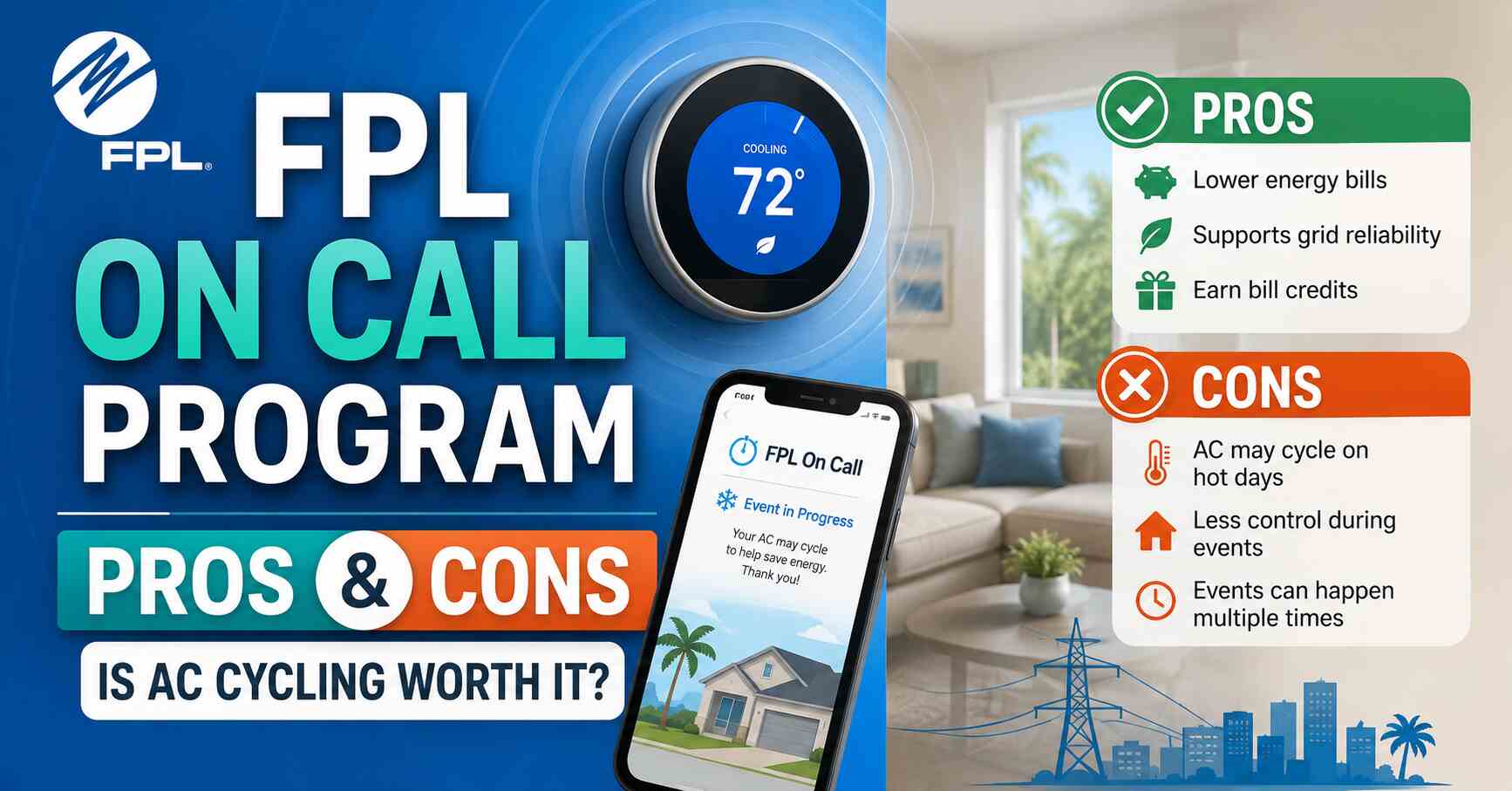
Florida Power & Light will pay you to let them briefly switch off your air conditioner. That is the entire pitch behind the FPL On Call program, and it triggers the same two reactions in almost every household: interest in the guaranteed bill credit, followed immediately by suspicion about losing cooling in August.
Both reactions are reasonable. This guide breaks down the FPL On Call program pros and cons with the numbers most articles leave out, including what participants actually report after years of enrollment, the specific scenarios where the program is a poor fit, and how the credits compare against other ways to lower a Florida electric bill.
How the FPL On Call Program Actually Works
FPL On Call is a demand response program, also called direct load control. You allow FPL to install a small radio-controlled switch (roughly 7 by 8 inches) on your central AC, electric water heater, pool pump, or central electric heat. When statewide demand spikes, FPL sends a signal that cycles those appliances off in short intervals.
Three details matter more than anything else in the fine print:
- You are paid whether or not FPL ever cycles you. The credit is guaranteed monthly, not event-based. This is the single strongest argument in the program’s favor.
- Normal cycling is brief. Typical control events run in short intervals within a one hour window, and your indoor fan generally keeps circulating air, so the temperature drift is small.
- Emergency cycling is longer. In a declared capacity emergency, your AC can be held off for up to three hours. This is rare, but it is the real risk you are accepting.
That last point is where most marketing copy goes quiet, and it is the honest center of any pros and cons discussion.
FPL On Call Program Credits Per Month: The Real Numbers
Credits are flat rate per appliance. Tonnage does not matter. A 2 ton condo unit and a 5 ton whole home system earn the identical credit, which quietly makes the program a better relative deal for small homes and a weaker one for large ones.
| Enrolled Appliance | Monthly Credit | Availability | Annual Value |
|---|---|---|---|
| Central Air Conditioner | $5.00 | April to October | $35.00 |
| Central Electric Heat | $2.00 | November to March | $10.00 |
| Pool Pump | $3.00 | Year-round | $36.00 |
| Electric Water Heater | $1.50 | Year-round | $18.00 |
| All eligible appliances | Up to $11.50 | Combined | Up to $91.75 |
Against a typical Florida bill of roughly $169 per month on about 1,100 kWh, here is what that means in percentage terms:
FPL On Call: annual savings by enrollment level
Guaranteed bill credits per year, by which appliances you enroll.
- AC only $35.00 1.7% of a typical annual bill
- AC + electric heat $45.00 2.2% of a typical annual bill
- AC + heat + pool pump $81.00 4.0% of a typical annual bill
- Everything eligible Maximum $91.75 4.5% of a typical annual bill
Scale check: the maximum credit against a full year of electricity
The honest read: this is a modest, reliable discount, not a transformative one. Anyone expecting the program to fix a $400 summer bill will be disappointed. Anyone treating it as free money attached to appliances they never think about will be satisfied.
Pros of the FPL On Call Program
1. Guaranteed credits with no performance requirement
You do not have to change behavior, monitor an app, or hit a savings target. The credit posts every month regardless of grid conditions. Compared to time-of-use rates, which punish mistakes, On Call has no downside scenario where you end up paying more.
2. Most participants never notice the cycling
Florida homes with reasonable insulation hold temperature well over a 15 to 30 minute compressor pause, especially with the air handler fan still moving air. The perceived impact is closest to zero for water heaters and pool pumps, both of which have built in buffers (a tank of hot water, a flexible daily runtime).
3. Free installation, free maintenance, free removal
FPL supplies the hardware, uses vetted licensed contractors, and removes the device at no charge if you leave the program. There is no equipment purchase, subscription, or repair liability on your side.
4. It stacks with everything else
On Call credits do not conflict with FPL rebates, efficiency upgrades, or a new high SEER2 system. You can enroll a brand new AC and still collect an equipment rebate.
5. Grid stability has real personal value
Every megawatt shaved during a peak event reduces the odds of rolling brownouts. During hurricane season strain and record heat days, that is not an abstraction for Florida residents.
Cons of the FPL On Call Program
1. The three hour emergency scenario is the actual risk
The worst case is not the routine cycle. It is an extended capacity emergency on the hottest afternoon of the year, precisely when you most want cooling. In a poorly insulated home, an older single pane condo, or a west facing house, indoor temperature can climb noticeably in that window.
2. AC enrollment is effectively mandatory to participate
You cannot cherry pick only the pool pump and water heater. Qualifying central AC (and central electric heat if you have it) must be enrolled, which means you cannot take the low risk credits while opting out of the comfort risk entirely.
3. The 12 month re-enrollment lockout
If you cancel, you generally have to wait a year before re-enrolling. It is not a fee, but it removes the ability to casually toggle in and out seasonally.
4. Weak economics for high consumption households
Because credits are flat, a 4,000 square foot home with a 5 ton system earns the same $5 as a small townhouse. The larger the home, the smaller the percentage benefit and the larger the comfort exposure.
5. Medical and work from home conflicts
Anyone with heat sensitive medical conditions, infants, elderly household members, or a home based business with heat sensitive equipment is accepting a risk that no monthly credit meaningfully offsets.
FPL On Call Program Reviews: What Real Participants Say
Public discussion on Reddit (notably in Florida city subreddits such as r/orlando and r/florida) and in FPL customer Facebook groups points in a consistent direction, with a clear minority dissent.
| Theme in user reports | Frequency | Representative sentiment |
|---|---|---|
| Never noticed any cycling | Most common | Multi year participants who forgot the device existed |
| Credits are small but painless | Very common | “It is not much, but it is free” |
| Noticed heat during a rare long event | Occasional | Reported mainly during summer grid strain |
| Installation was fast and clean | Common | Under one hour, no property damage |
| Frustration with the credit delay | Occasional | Credits take 2 to 3 weeks plus a billing cycle to appear |
| Regret and cancellation | Rare | Concentrated among work from home and thermostat sensitive users |
The pattern worth noting is that dissatisfaction correlates far more with home characteristics than with the program design. People in tight, well insulated, shaded homes report nothing. People in older or sun exposed properties are the ones who feel it.
Verdict: Should You Enroll?
Enroll if most of these describe you:
- Your home is reasonably well insulated with functional ductwork
- You are usually out of the house between 1:00 PM and 6:00 PM
- You have a pool pump or electric water heater to enroll alongside the AC
- Your household tolerates a two to three degree drift without complaint
- You want savings that require zero ongoing effort
Skip it if any of these apply:
- Anyone in the home is heat sensitive for medical reasons
- Your AC already struggles to keep up on hot afternoons
- You work from home in a room that heats quickly
- Your system is undersized or near end of life
- You keep the thermostat at 70 degrees or below year round
A useful sequencing rule: if your AC currently cannot hold setpoint on a 95 degree day, fix that first. Cycling will amplify an existing capacity problem rather than reveal a new one.
Smarter Order of Enrollment
If you want maximum credit with minimum comfort exposure, add appliances in this order:
- Electric water heater ($18/year). A full tank buffers any short interruption. Effectively invisible.
- Pool pump ($36/year). Runtime is flexible and water chemistry is unaffected by a brief pause. Largest single credit for the least risk.
- Central AC and heat ($45/year). Highest payout, only real comfort variable. Enroll last and evaluate over one full summer.
FPL On Call for Renters
Renters are eligible, with conditions:
- Landlord permission is required before the installation appointment can proceed
- The credit follows the bill payer, so it lands on your account, not the owner’s
- No structural modification occurs, which is why most landlords approve without friction
- Moving out cancels cleanly with no 12 month lockout, since the restriction applies to voluntary opt outs at the same address
The equipment stays with the property. The next tenant can activate it or request free removal.
How FPL On Call Compares to Other Florida Utilities
| Utility | Program | Structure | Notable difference |
|---|---|---|---|
| FPL | On Call | Flat monthly credits per appliance | Credits paid regardless of cycling events |
| Duke Energy Florida | EnergyWise Home | Free switch plus bill credits | Very similar model and appliance list |
| Tampa Electric (TECO) | Prime Time Plus | Monthly credits per appliance | Explicit annual cycling cap, includes Level 2 EV chargers |
| OUC | Smart thermostat programs | Gift cards or annual credits | Thermostat setpoint adjustment rather than hard cycling |
If you relocate within Florida but outside FPL territory, an equivalent program almost certainly exists.
How to Enroll in the FPL On Call Program
- Select appliances. Log into your FPL dashboard, open the On Call section, and choose eligible equipment.
- Schedule the visit. Pick a date for an FPL approved contractor. An adult over 18 must be present with clear access to the equipment.
- Free installation. The technician verifies eligibility and mounts the control device. Installation typically takes under an hour.
- Wait for credits. Devices activate roughly 2 to 3 weeks after installation, with credits appearing on the first full billing cycle after that.
Prefer the phone? Call FPL Customer Service at 1-800-226-3545 and ask for On Call enrollment. Have your 10 digit account number ready.
Track the Results Before You Judge the Program
Use the free FPL Energy Dashboard on FPL.com or the mobile app to evaluate your own outcome rather than relying on impressions:
- Hourly view shows exactly when consumption peaks and whether cycling windows align with discomfort
- Weather overlay graphs usage against outdoor temperature and humidity
- Projected bill dial catches surprises mid cycle
- Billing details itemize your On Call credits line by line
Give the program one full summer, check the hourly data on the two or three hottest afternoons, and decide with evidence.
Beyond On Call: Higher Impact Ways to Cut a Florida Electric Bill
The credits are real, but they are a rounding error compared to structural fixes:
- Upgrade to a high efficiency system. Equipment meeting or exceeding 15.2 SEER2 typically qualifies for FPL rebate incentives at installation, and the efficiency gain dwarfs $45 a year in credits.
- Seal and repair ductwork. Leaking ducts in a hot attic waste conditioned air continuously, not for three hours a year.
- Run a free FPL Residential Energy Survey to identify insulation gaps and air infiltration.
- Evaluate the voluntary Time of Use rate if your household can genuinely shift laundry, dishwashing, and pool pump runtime to off peak hours.
Conclusion
The FPL On Call program is a low risk, low reward proposition, and both halves of that description deserve equal weight. You get up to $91.75 a year in guaranteed credits, free equipment, free removal, and a small contribution to grid stability. You accept short routine cycling you almost certainly will not notice, plus a rare possibility of up to three hours without compressor operation on the most demanding days of the year.
For a well insulated home with a healthy AC system and occupants who are out during peak afternoon hours, it is close to free money. For a home that already struggles to stay cool, or a household with heat sensitivity, the credit does not justify the exposure.
The deciding factor is almost never the program. It is the condition of your home and your cooling system.
Next Step: Find Out If Your System Is Actually Ready for Cycling
Before you enroll, get an honest assessment of whether your AC can absorb a cycling event without your household noticing. A quick system evaluation will tell you your true capacity, duct integrity, and whether you qualify for current FPL equipment rebates that save far more than On Call credits ever will.
Schedule a professional AC performance and efficiency assessment today, and enroll in On Call from a position of strength rather than hope.