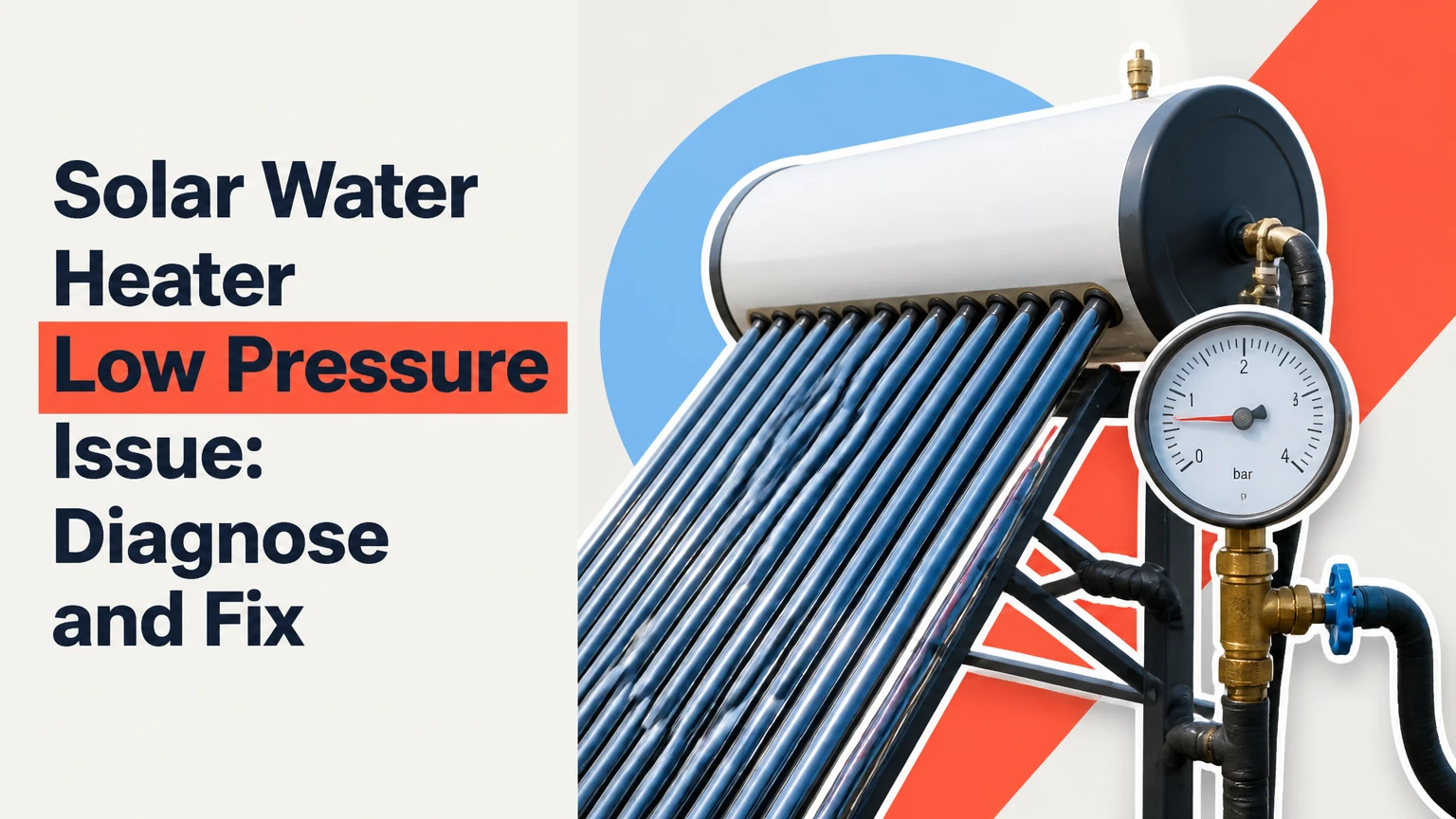
A solar water heater low pressure issue usually comes from either an intentional gravity-fed design or a restriction in the hot-water path. Compare hot and cold flow at the same fixture, measure pressure while water runs, and inspect valves, scale, air, leaks, and mixing cartridges before installing a pump.
Key Facts at a Glance
- A gravity-fed solar tank produces approximately 0.1 bar per metre of vertical height, before pipe and fixture losses.
- A sudden pressure loss in a previously adequate system usually indicates scale, a closed valve, trapped air, a failed check valve, leakage, or a blocked mixer.
- An evacuated tube collector is not automatically pressurized; the tank and plumbing design determine allowable pressure.
- Modern rain showers commonly perform poorly below approximately 1.5 bar flowing pressure, although the exact requirement depends on the shower head.
- A booster pump must match the system’s open-vent or pressurized architecture, water temperature, flow rate, and electrical protection.
- A dripping temperature-and-pressure relief valve is a safety signal, not a harmless pressure adjustment.
What Causes a Solar Water Heater Low Pressure Issue?
A solar water heater low pressure issue has two broad causes: insufficient available pressure by design or excessive resistance caused by a fault. A roof tank may deliver weak flow because the outlet sits only 2-4 metres above a shower, while a previously strong system may deteriorate because mineral scale narrows the outlet or a thermostatic cartridge blocks hot flow.
Pressure and flow are related but different. Pressure is the force available to move water, usually measured in bar or psi. Flow is the volume delivered over time, usually measured in litres per minute. A blocked shower screen can reduce flow while pressure upstream remains normal, whereas a low roof tank can produce low pressure throughout the hot-water circuit.
The first decision is therefore simple: did the system always perform poorly, or did performance change recently? Permanent weakness points toward gravity design, inadequate elevation, undersized piping, or an unsuitable fixture. A sudden change points toward a service fault.
How Does a Gravity-Fed Solar Heater Create Pressure?
A gravity-fed solar water heater creates pressure from the vertical distance between the water surface in the storage tank and the outlet fixture. Each metre of water elevation produces roughly 0.098 bar, or 1.42 psi, of static pressure, before friction, bends, valves, and shower-head losses reduce the available pressure.
In a typical thermosyphon system, cold water enters the lower part of the tank and collector circuit. Solar-heated water becomes less dense and rises through the collector return, while cooler water descends. The storage tank remains above the collectors, commonly on a roof, and hot water travels downward when a tap opens.
A 3-metre height difference theoretically gives about 0.29 bar. That figure is not the shower pressure because a 15-millimetre pipe, restrictive mixer, check valve, long run, and shower screen can consume much of the available pressure. Gravity systems work best with short, large-diameter hot lines and low-resistance fixtures.
Static head is not the same as shower pressure
A pressure gauge reading with every tap closed measures static pressure. A gauge reading while a shower runs measures flowing pressure, which is the more useful value for diagnosing weak delivery. A system can show 0.3 bar at rest and fall near zero when a restrictive valve or scaled pipe is opened.
Which Solar Water Heater Types Support Higher Pressure?
Pressurized flat-plate and heat-pipe systems generally support normal household pressure, while open-vented direct-flow evacuated tube systems depend on gravity. The correct pressure limit must come from the tank, collector manifold, relief valve, and manufacturer data plate, not from the collector category alone.
| System configuration | Water path | Typical pressure arrangement | Main limitation |
|---|---|---|---|
| Open-vented direct ETC | Domestic water enters glass tubes | 0.2-0.5 bar typical gravity head | Glass tubes and tank may not accept mains pressure |
| Pressurized heat-pipe ETC | Domestic water stays in metal manifold | 3-6 bar rated models | Manufacturer pressure rating varies |
| Pressurized flat plate, direct loop | Domestic water flows through copper risers | 2-6 bar residential range | Scaling and freezing affect collector circuit |
| Indirect flat plate or heat-pipe | Glycol loop transfers heat through exchanger | 2-6 bar domestic side | Pump, expansion vessel, and exchanger required |
| Pumped open-vented tank | Tank remains atmospheric, outlet receives pump assistance | Pump-limited outlet flow | Pump must never pressurize an unapproved tank |
“Evacuated tube” describes collector technology, not pressure capability. A glass-tube direct system and a heat-pipe system may look similar from the ground but require completely different plumbing decisions.
Can a low-pressure ETC system accept mains pressure?
An open-vented direct ETC system should not receive mains pressure unless the complete assembly is specifically certified for that pressure. Pressurizing a tank or glass collector beyond its rating can cause leaks, glass failure, scalding discharge, or catastrophic rupture.
A pressure-reducing valve does not automatically make an atmospheric tank safe. The tank design, collector seals, vent, relief protection, and connection method must all support the proposed pressure.
How Do You Test the Pressure Before Repairing Anything?
Test cold and hot water at the same fixture, first with no flow and then while the fixture runs. A pressure gauge attached to a washing-machine connection or service port provides the most useful measurement, while a timed bucket test reveals whether the problem is pressure, flow restriction, or both.
Step 1: Compare hot and cold flow
Remove the shower head or tap aerator and run cold water into a 10-litre bucket. Record the fill time. Repeat with hot water at the same outlet.
| Bucket result | Cold flow | Hot flow | Likely interpretation |
|---|---|---|---|
| Balanced delivery | 10 L in 30 seconds | 10 L in 32 seconds | Shower head or aerator fault unlikely |
| Gravity limitation | 10 L in 20 seconds | 10 L in 75 seconds | Hot-side pressure or design limitation |
| Local obstruction | 10 L in 20 seconds | 10 L in 25 seconds at another tap, 10 L in 90 seconds here | Mixer, flex hose, or local valve restriction |
| Whole-system blockage | 10 L in 20 seconds | 10 L in 90 seconds at every tap | Outlet, scale, check valve, or tank restriction |
A flow rate of 10 litres in 30 seconds equals 20 litres per minute. The same bucket in 90 seconds equals 6.7 litres per minute. Record results rather than relying on the feel of the shower.
Step 2: Measure flowing pressure
Install a 0-6 bar pressure gauge at a safe cold-water service point, then observe the reading with the hot fixture open. Do not connect a gauge to a hot line unless the gauge is rated for the measured temperature.
| Reading location | Static pressure | Flowing pressure | Diagnostic meaning |
|---|---|---|---|
| Cold inlet | 2.5 bar | 2.2 bar | Household supply is adequate |
| Hot outlet, gravity system | 0.3 bar | 0.1 bar | Elevation and friction limit delivery |
| Hot outlet, pressurized system | 2.5 bar | 2.3 bar | Fixture restriction is likely downstream |
| Hot outlet, pump system | 2.0 bar | 0.4 bar | Pump, strainer, control, or suction issue |
Step 3: Check the highest hot fixture
A high-level shower has less gravity head than a ground-floor tap. If the ground-floor hot tap works but the upper-floor shower does not, compare the tank water level elevation with each outlet and inspect the upper branch for air, a kinked flexible hose, or a restrictive thermostatic mixer.
What Should You Inspect When Pressure Falls Suddenly?
When hot-water pressure drops suddenly, inspect the hot outlet, isolation valves, check valves, mixer cartridge, relief discharge, and visible pipework before opening the solar tank. The safest diagnosis starts at the affected fixture and moves upstream, because many apparent solar faults originate in a blocked shower valve or aerator.
| Symptom | Most likely location | Safe first check | Typical repair time |
|---|---|---|---|
| One tap has weak hot flow | Aerator or mixer cartridge | Remove aerator and test | 15-60 minutes |
| Every hot tap is weak | Tank outlet or main hot line | Confirm isolation valves are open | 30-120 minutes |
| Pressure pulses after supply outage | High pipe loop or vent | Refill and vent according to manual | 30-90 minutes |
| Roof overflow drips continuously | T&P valve or fill control | Observe discharge safely | 30-120 minutes |
| Hot pressure is weak after a filter change | Strainer or check valve | Inspect filter and arrow direction | 15-45 minutes |
| Pressure falls only when pump starts | Pump control or suction side | Clean strainer and verify flow switch | 30-90 minutes |
Scale and sediment
Hard-water scale can narrow copper heat-exchanger passages, tank outlets, strainers, and thermostatic cartridges. Scale often produces a gradual reduction, but a loosened fragment can suddenly lodge in a check valve or mixer.
Do not pour vinegar into a solar tank or collector without confirming the manufacturer’s procedure. Concentrated acid, incorrect flushing, or high-temperature chemical circulation can damage seals and create a scalding hazard. A qualified technician may isolate the heat exchanger, cool it, circulate an approved descaling solution, flush it fully, and verify pH before reconnection.
Airlocks and blocked vents
Airlocks are more plausible in gravity-fed lines with high loops, poor venting, or a recently drained tank. They are less likely in a continuously pressurized, correctly vented domestic system.
Open the highest hot tap only if the system instructions permit it, confirm the tank has a water supply, and never remove a fitting from a hot pressurized line. Automatic air-release valves belong on systems designed for them; manually forcing a hot relief or vent valve can cause burns.
Mixing valves and check valves
A thermostatic mixing valve can restrict hot flow when its strainer is scaled, its cartridge sticks, or its cold inlet pressure overwhelms the hot side. A failed check valve can also permit cold water to cross into the hot line, causing unstable temperature and apparently weak hot flow.
Expert rule of thumb: if hot water is weak at every fixture but the tank outlet has strong flow, test the mixing valve before blaming the collectors.
Is a Booster Pump Safe for a Solar Water Heater?
A booster pump can improve delivery from a gravity-fed solar system only when the pump is installed on the domestic hot-water outlet and the atmospheric tank remains protected from pressure. The pump must be rated for the maximum water temperature, compatible with potable water, controlled by flow or pressure, and sized for the required litres per minute.
A standard cold-water pump is not automatically suitable. Solar storage can exceed 80°C in strong sunshine, especially when demand is low. Select a pump with a documented hot-water temperature rating, compatible seals, thermal protection, an accessible strainer, and electrical protection required by local code.
The pump must not be installed where it can force mains pressure backward into an open-vented collector or tank. A check valve may be necessary, but its location must follow the system design because an incorrectly placed check valve can stop gravity circulation or trap pressure.
| Repair option | Suitable system | Typical added pressure or flow | Typical installed cost |
|---|---|---|---|
| Clean aerator or mixer | Any domestic hot-water system | 2-15 L/min recovered | $20-$180 |
| Replace check valve or strainer | Pressurized or pumped system | 0.2-2 bar recovered | $80-$300 |
| Hot-water booster pump | Approved open-vented outlet | 5-20 L/min target flow | $150-$700 |
| Pressure-reducing and relief assembly | Certified pressurized system | 2-4 bar controlled supply | $200-$800 |
| Pressurized conversion | Suitable tank and collector design | 2-6 bar system pressure | $1,000-$4,000 |
| Complete replacement | Incorrect or damaged system | Design-specific | $2,500-$8,000 |
Costs are typical residential ranges in US dollars and vary with access, local labor, roof height, electrical work, and component availability. Bangladesh, India, Australia, and other markets may price the same hardware very differently.
Which Repair Fits Your System?
The correct repair depends on whether the weak flow is a design limitation, a localized blockage, or a pressurized-system failure. Cleaning is appropriate for a restriction, a hot-rated outlet pump suits some open-vented systems, and a certified pressurized replacement is better when the property requires high flow at multiple fixtures.
Existing gravity system with one weak shower
Start with the shower head, mixer cartridge, flex hose, and local isolation valve. A small rain head may require more flow than the roof elevation can provide, so replacing it with a low-flow head can be cheaper and safer than installing a pump.
Existing gravity system with weak flow everywhere
Measure elevation and hot flow, inspect the tank outlet, and verify the vent and fill arrangement. If the design provides only 0.2-0.4 bar, a properly specified hot-water booster pump may solve the problem without converting the collector circuit.
New construction or luxury bathroom
Choose a pressurized flat-plate or heat-pipe system rated for the household supply. A multi-story home with body jets, rain heads, and simultaneous showers should use a hydraulic design that balances hot and cold pressure at the mixing valves.
Hard-water or freezing climate
An indirect closed-loop system separates the domestic water from the collector fluid. Food-grade propylene glycol, an expansion vessel, a heat exchanger, freeze protection, and annual fluid checks add cost, but they reduce collector scaling and freezing risk.
What Pressure and Flow Should a Shower Have?
Many standard showers operate acceptably around 1.0-1.5 bar flowing pressure, while large rain heads and body jets often perform better at 1.5-2.0 bar or higher. The fixture manufacturer’s flow curve is more reliable than a universal pressure target because a 6-litre-per-minute head and a 20-litre-per-minute body jet have different requirements.
| Fixture type | Typical flow target | Practical flowing pressure | Gravity head often needed |
|---|---|---|---|
| Basin tap aerator | 4-8 L/min | 0.5-1.0 bar | 5-10 metres |
| Standard shower head | 7-10 L/min | 1.0-1.5 bar | 10-15 metres |
| Low-flow rain head | 8-12 L/min | 1.0-1.5 bar | 10-15 metres |
| Large rain shower | 12-20 L/min | 1.5-2.5 bar | 15-25 metres |
| Body-jet circuit | 20-40 L/min | 2.0-3.0 bar | Pump usually required |
These elevation figures are simplified equivalents. Pipe diameter, length, elbows, filters, mixer valves, and shower-head design can increase the required head substantially.
A counterintuitive point matters here: increasing the tank temperature does not increase water pressure. Higher temperature may increase storage energy, but gravity head remains determined by water elevation.
How Much Do Diagnosis and Repair Usually Cost?
A basic fixture diagnosis often costs $20-$180, a pump installation commonly costs $150-$700, and a full pressurized conversion frequently reaches $1,000-$4,000 before major roof or electrical modifications. Technician access, system certification, and replacement of incompatible safety components usually determine the final price.
| Work item | Typical labor time | Typical parts cost | Typical total cost |
|---|---|---|---|
| Aerator or shower-head cleaning | 15-30 minutes | $0-$60 | $20-$120 |
| Mixer cartridge replacement | 45-120 minutes | $40-$250 | $100-$450 |
| Descale exchanger or outlet | 2-5 hours | $50-$300 | $250-$900 |
| Install hot-water booster | 2-4 hours | $100-$500 | $250-$900 |
| Replace T&P relief valve | 30-90 minutes | $30-$180 | $100-$350 |
| Pressurized system conversion | 1-2 days | $700-$3,000 | $1,000-$4,000 |
Treat online marketplace pump prices as hardware-only estimates. A low-cost pump may lack potable-water approval, high-temperature seals, a suitable flow switch, or protection against dry running.
What Should You Never Do?
Never pressurize an open-vented solar tank or direct-flow glass collector without written manufacturer approval. Never fit a normal cold-water pump to an outlet carrying solar-heated water unless its temperature and potable-water ratings match the installation.
Avoid these failures:
- Do not cap an open vent. The vent accommodates expansion and prevents dangerous pressure buildup.
- Do not block or remove the relief discharge pipe. The discharge must terminate safely and visibly.
- Do not test hot fittings bare-handed. Solar storage can cause severe burns even when the shower feels weak.
- Do not install a check valve backward. The arrow must match intended flow, and the valve must suit the system’s circulation arrangement.
- Do not use household vinegar as an automatic descaling prescription. Material compatibility and flushing requirements differ by tank, exchanger, and seal.
- Do not select a pump by wattage alone. Head height, target flow, temperature rating, control method, and pipe size determine suitability.
A T&P valve that discharges repeatedly may indicate overheating, excessive pressure, thermal expansion, or a defective valve. Replacing the valve without finding the cause can leave a dangerous condition unresolved.
How Can You Prevent Low Hot-Water Flow?
Preventive maintenance reduces pressure loss by keeping strainers, mixer cartridges, tank outlets, and collector circuits free from scale and debris. A practical schedule includes a monthly visual inspection, an annual valve and temperature check, and water-quality treatment where hardness exceeds the equipment manufacturer’s limit.
Inspect these items:
- Roof tank overflow and relief discharge for continuous dripping.
- Isolation valves for partial closure.
- Flexible hoses for kinks or collapsed inner liners.
- Shower screens and tap aerators for mineral deposits.
- Thermostatic mixer strainers for scale.
- Check valves for correct direction and free movement.
- Pump strainers, flow switches, and electrical isolators.
- Glycol concentration and expansion pressure in indirect systems.
Expert rule of thumb: measure hot flow after every major plumbing change. A new pressure-reducing valve, filter, mixer, or check valve can create more resistance than the solar heater itself.
FAQ
Why is hot-water pressure low but cold-water pressure normal?
Low hot pressure with normal cold pressure usually means the fault lies in the hot-water path. Common locations include the solar tank outlet, mixing valve, check valve, scaled pipe, partially closed isolation valve, or gravity-fed design. Testing flow with the shower head removed helps separate fixture restriction from upstream pressure loss.
Can a low-pressure solar heater run a modern rain shower?
A low-pressure solar heater can run a rain shower only when its available flowing pressure and flow rate match the fixture requirements. Many gravity systems provide less than 0.5 bar, while large rain heads may need 1.5-2.5 bar and 12-20 litres per minute. A low-flow shower head or correctly designed hot-water pump may be necessary.
Why does solar hot water pressure fluctuate?
Solar hot-water pressure can fluctuate because of trapped air, a thermostatic mixing valve, cold-water crossover through a failed check valve, inconsistent supply pressure, or pump cycling. Temperature itself does not create household pressure fluctuations. If water alternates hot and cold, inspect the mixer and check valves before changing the collector settings.
Does a larger solar tank increase water pressure?
A larger solar tank does not increase pressure in a gravity-fed system. Pressure depends primarily on the vertical distance between the tank water level and the fixture, while tank volume affects available hot-water capacity. A larger tank may improve duration, but it cannot replace elevation, adequate pipe sizing, or a suitable booster pump.
Should I replace evacuated tubes with flat-plate collectors?
Replace evacuated tubes with flat-plate collectors only when the complete system design requires it, such as a certified pressurized indirect loop or a different roof layout. Collector replacement alone does not guarantee higher household pressure. The tank, heat exchanger, pump, expansion vessel, relief valve, and domestic plumbing must all match.
Is a dripping solar relief valve related to low pressure?
A dripping relief valve can accompany low pressure at the fixture because escaping water reduces available delivery, but the leak usually indicates overheating, excessive pressure, thermal expansion, or valve failure. Do not cap the discharge or install a stronger valve. Have the system pressure, temperature, expansion control, and relief valve checked together.
The Bottom Line
A solar water heater low pressure issue is not automatically a failed collector. First determine whether the system is inherently gravity-fed or has lost performance because of scale, air, a valve, leakage, or a mixer restriction. Measure hot and cold flow, verify flowing pressure, and inspect the system from the fixture toward the tank.
Use a hot-water-rated booster pump only when the open-vented design permits outlet pumping without pressurizing the tank or collectors. For new homes, multi-story properties, high-flow showers, hard water, or freezing climates, a properly engineered pressurized indirect system usually provides a more durable solution than repeatedly modifying a low-pressure installation.