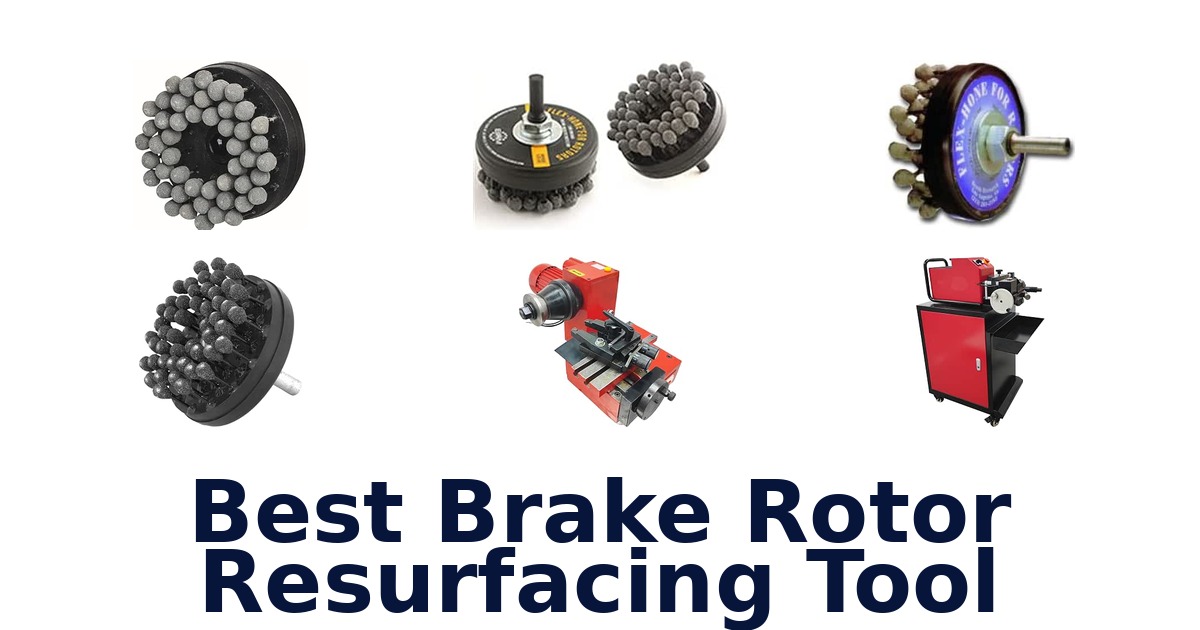
A strong brake rotor resurfacing tool should match the work: a brake lathe for cutting rotor faces, or a hone for creating a crosshatch finish and addressing noise. This roundup suits buyers comparing shop-style machines with simpler rotor-finishing tools, from repair professionals to hands-on automotive and motorcycle owners. The machine listings emphasize dual-side cutting, spindle stability, and stated precision, while the hones differ in grit and intended applications.
Those are not interchangeable jobs, so start by deciding whether you need to remove material or refine a surface. The listings provide useful details, but they do not establish compatibility with every vehicle, rotor condition, or shop setup.
Check machine capacity, power requirements, and the rotor’s condition before choosing a tool or attempting resurfacing.
The LGXEnzhuo E033025 is the leading choice for buyers seeking a dedicated rotor resurfacing machine. It lists dual-cutter machining of both disc sides in one setup, a 90 rpm spindle, a 0.75kW motor, and capacity for discs 180–350mm in diameter and up to 40mm thick. Those concrete operating details make it the most clearly specified lathe in this group.
If you need a crosshatch finishing tool rather than a cutting machine, choose a rotor hone instead.
Our Top Picks
 Best Overall
Its dual-cutter design machines both sides in one setup, with a 90 rpm spindle, 0.75kW motor, and stated 180–350mm disc capacity.
View on Amazon Dual-Side Cutting
The machine turns both disc faces simultaneously in one setup, and its listing describes a taper sleeve and auto-feed cutting system.
View on Amazon Two-Knife Design
Two knives work simultaneously, and the listing says it handles four kinds of brake discs with one-click starting.
View on Amazon- 38mm Spindle Banfluxion CB-033177
- Medium-Grit Hone Brush Research 120G Flex-Hone
Compare These Rotor Resurfacing Tools
| # | Product | Weight | Buy |
|---|---|---|---|
| 1 | 1. LGXEnzhuo E033025Best Overall | 235.9 lb | View on Amazon |
| 2 | 2. Banfluxion CB-033025Dual-Side Cutting | 236 lb | View on Amazon |
| 3 | 3. Banfluxion CB-033178Two-Knife Design | 306 lb | View on Amazon |
| 4 |  4. Banfluxion CB-03317738mm Spindle | 316 lb | View on Amazon |
| 5 |  5. HayWHNKN DL-718LPrecision repair with defined capacity | 319 lb | View on Amazon |
| 6 |  6. Brush Research 120G Flex-HoneMedium-Grit Hone | 4.8 oz | View on Amazon |
| 7 |  7. Flex-Hone RMFHFFine finish for light-duty rotors | 0.27 g | View on Amazon |
| 8 |  8. Performance Tool W80629Crosshatch finishing for mixed vehicles | 0.27 g | View on Amazon |
| 9 |  9. Brush Research Flex-HoneRotor hone for noise reduction | — | View on Amazon |
Detailed Reviews: Best Brake Rotor Resurfacing Tool
#1 · Best Overall
1. LGXEnzhuo E033025
- Weight: 235.9 lb
Best for: Simultaneous two-face machining.
Why it ranks #1: Its dual-cutter design machines both sides in one setup, with a 90 rpm spindle, 0.75kW motor, and stated 180–350mm disc capacity.
Its dual-cutter design machines both disc faces in one setup, enabling parallel resurfacing rather than separate face-by-face cutting. The 0.75kW motor runs at a stated 90rpm spindle speed, and the listed 180–350mm disc diameter range helps define the vehicles and rotors this 220V machine can serve.
Cutting both faces simultaneously in one setup is intended to maintain parallelism while reducing setup steps. The stated 180–350mm diameter range and 40mm maximum thickness provide concrete boundaries for selecting work, while the 85mm working stroke describes cutter travel. A 90rpm spindle and 0.75kW motor specify the machine’s operating configuration, and the 0.11mm feeding rate provides a feed reference. Its 220V electrical requirement and 235.9-pound weight call for planned shop placement.
- Dual cutters machine both disc sides in one setup
- Listed disc diameter range is 180–350mm
- Maximum disc thickness listed as 40mm
- 90rpm spindle and 0.75kW motor are specified
- Requires a 220V power supply.
Skip it if you only have a different supply available; this machine is specified for 220V operation.
This suits a 220V workshop seeking simultaneous two-face cutting on discs within the stated 180–350mm diameter and 40mm thickness limits. Check those capacity boundaries and plan for its 235.9-pound machine weight.
Full product details
| Brand | LGXEnzhuo |
|---|---|
| Included Components | Machine |
| Item Weight | 235.9 pounds |
| Manufacturer | LGXEnzhuo |
| Part Number | E033025 |
| Manufacturer Warranty Description | 6 Month Manufacturer |
| Model Number | E033025 |
Listed on Amazon as: 220V 0.75kW Brake Disc Repair Lathe Rotor Resurfacing Machine
View on Amazon#2 · Dual-Side Cutting
2. Banfluxion CB-033025
- Weight: 236 lb
Best for: Dual-side cutting with automatic feed.
Why it ranks #2: The machine turns both disc faces simultaneously in one setup, and its listing describes a taper sleeve and auto-feed cutting system.
This Banfluxion lathe turns both brake-disc faces simultaneously in one setup, enabling aligned resurfacing with a single mounting workflow. Its special taper sleeve is specified to support turning precision, while the integrated automatic-feed cutting system helps make the machine a fit for repeatable shop resurfacing tasks.
Simultaneous turning of both faces is intended to produce parallel surfaces and reduce setup steps compared with machining each side separately. The special taper sleeve supports the stated turning precision, while the automatic-feed cutting system provides a consistent feed workflow during resurfacing. Banfluxion positions the machine for worn or grooved discs associated with vibration, noise, and uneven braking force. At 236 pounds, it is a substantial shop machine, so installation space and stable placement deserve consideration.
- Machines both disc faces simultaneously in one setup
- Special taper sleeve supports turning precision
- Automatic-feed cutting system
- Targets worn or grooved discs associated with vibration and noise
- Its 236-pound weight limits practical portability.
Skip it if you need to carry the resurfacing tool between jobs; this 236-pound machine is better suited to a fixed shop.
Choose this for workshop resurfacing where simultaneous two-side cutting and automatic feed suit the workflow. Its 236-pound weight makes it a fixed-location choice, and the listing does not state a disc capacity range.
Full product details
| Brand | Banfluxion |
|---|---|
| Item Weight | 236 pounds |
| Item model number | CB-033025 |
| Manufacturer | Banfluxion |
| Part Number | CB-033025 |
| Model | CB-033025 |
| Dimensions | 27.9 x 5.9 x 12.2 inches |
Listed on Amazon as: Brake Disc Repair Machine 220V Brake Lathe Resurfacing Tool
View on Amazon#3 · Two-Knife Design
3. Banfluxion CB-033178
- Weight: 306 lb
Best for: Dual-blade shop resurfacing.
Why it ranks #3: Two knives work simultaneously, and the listing says it handles four kinds of brake discs with one-click starting.
Two knives work simultaneously on this Banfluxion machine, enabling faster cutting during brake-disc resurfacing than a single-blade workflow. The listing also states compatibility with four kinds of brake discs and one-click starting, pairing vehicle application range with a simple stated start procedure for shop use.
The dual-blade arrangement is intended to finish a job in less time by cutting with both knives at once. Compatibility with four kinds of brake discs broadens its stated application scope, which can help a shop handle varied disc types. One-click start simplifies the stated operation, while the positive-arc moving knife, guide-rail oil-free self-lubrication wear-resistant sleeve, and professional reducer support the machine’s cutting and motion system. Its 306-pound weight calls for a fixed work area.
- Two knives work simultaneously for cutting efficiency
- Compatible with four kinds of brake discs
- One-click start supports straightforward operation
- Positive-arc moving knife and professional reducer are specified
- Its 306-pound weight makes it unsuitable for portable, on-the-go work.
Skip it if you need a portable resurfacing tool; this 306-pound machine is better suited to a fixed shop location.
Consider this for a shop resurfacing several stated kinds of brake discs and prioritizing simultaneous two-knife cutting. Its 306-pound machine weight and 22-by-19.7-by-34.6-inch dimensions make workspace planning important.
Full product details
| Brand | Banfluxion |
|---|---|
| Item Weight | 306 pounds |
| Item model number | CB-033178 |
| Manufacturer | Banfluxion |
| Part Number | CB-033178 |
| Model | CB-033178 |
| Dimensions | 22 x 19.7 x 34.6 inches |
Listed on Amazon as: Brake Disc Repair Machine 220V Brake Disc Lathe Resurfacing Tool
View on Amazon#4 · 38mm Spindle
4. Banfluxion CB-033177
- Weight: 316 lb
Best for: Precision lathe for controlled cutting.
Why it ranks #4: Its 38mm spindle is intended to stabilize cutting, and the listing states 220V-to-12V drive and repair accuracy within 0.00–0.005mm.
A 38mm spindle is the defining feature of Banfluxion’s 220V brake disc lathe, supporting stable cutting intended to limit disc vibration. The machine’s stated 0.00–0.005mm repair accuracy gives workshops a precision-focused resurfacing option, while its 220V-to-12V drive system supplies a lower-voltage operating circuit.
The 38mm spindle is specified to stabilize the disc during cutting, a practical consideration when aiming for a smooth, flat repaired surface. Banfluxion lists repair accuracy within 0.00–0.005mm, positioning the unit for precision resurfacing rather than hand honing. Its 220V-to-12V safe-voltage drive system is intended to reduce electric-shock risk even with cutter contact. At 316 pounds and 26.3 by 17.7 by 46 inches, this is a substantial stationary-shop machine, not a compact hand tool.
- 38mm spindle supports stable cutting
- Listed repair accuracy is within 0.00–0.005mm
- 220V-to-12V drive system is specified as a safety measure
- Machine format supports disc resurfacing by cutting
- At 316 pounds, it requires a substantial stationary workspace.
Skip it if you need a light hand tool or a readily portable setup; this 316-pound lathe is a stationary machine.
This suits a workshop seeking controlled disc cutting, a 38mm spindle, and a 220V-to-12V drive arrangement. Account for its 316-pound weight and large listed dimensions when planning installation and workspace.
Full product details
| Brand | Banfluxion |
|---|---|
| Item Weight | 316 pounds |
| Item model number | CB-033177 |
| Manufacturer | Banfluxion |
| Part Number | CB-033177 |
| Model | CB-033177 |
| Dimensions | 26.3 x 17.7 x 46 inches |
Listed on Amazon as: 220V Brake Disc Lathe Resurfacing Tool
View on Amazon#5
5. HayWHNKN DL-718L
- Weight: 319 lb
Best for: Precision repair with defined capacity.
Why it ranks #5: This dedicated machine lists 0.002–0.005mm turning accuracy, Ra 1.5–2.0μm surface roughness, and a 42mm maximum disc thickness.
Its stated 0.002–0.005mm turning accuracy and Ra 1.5–2.0μm surface roughness target make this HayWHNKN lathe a precision-focused resurfacing system. A 38mm spindle is specified to stabilize cutting, while the listed 42mm maximum disc thickness helps buyers assess whether its capacity fits their rotor work.
The 38mm spindle is intended to minimize vibration during cutting, supporting a more uniform finish. HayWHNKN lists turning accuracy of 0.002–0.005mm and surface roughness of Ra 1.5–2.0μm, giving workshops concrete precision targets for resurfacing. The maximum brake-disc thickness is 42mm, a useful capacity limit to check against the discs being serviced. The machine’s listed electrical specification is DC12V/1.5A; its substantial 319-pound item weight makes installation and placement a major part of setup planning.
- 38mm spindle specified to minimize cutting vibration
- Turning accuracy listed at 0.002–0.005mm
- Surface roughness specification of Ra 1.5–2.0μm
- Maximum brake-disc thickness listed as 42mm
- Its 319-pound listed weight demands a permanent, sturdy installation location.
Skip it if you need a portable tool or cannot accommodate a 319-pound machine; this lathe calls for a fixed installation.
Choose this machine for a workshop that values stated precision targets and needs to process discs up to its listed 42mm thickness. Plan for its 319-pound weight and verify capacity against the job.
Full product details
| Brand | HayWHNKN |
|---|---|
| Item Weight | 319 pounds |
| Manufacturer | HayWHNKN |
| Part Number | JHSFY-033177 |
| Package Dimensions | 33.86 x 18.11 x 17.72 inches |
Listed on Amazon as: Brake Disc Lathe Machine 0.002-0.005mm Precision Brake Resurfacing Machine with 38mm Spindle for Repairing Warped Rotors and Vibration 220V to 12V Safe Voltage
View on Amazon#6 · Medium-Grit Hone
6. Brush Research 120G Flex-Hone
- Weight: 4.8 oz
Best for: Medium-grit noise-focused honing.
Why it ranks #6: The 120-grit hone is intended for brake rotors and aims to reduce noise from rough turned finishes while producing a non-directional finish.
The medium-grit Flex-Hone targets rough turned rotor finishes that can contribute to high-pitched squeal and groan, making noise-conscious surface conditioning its central role. Its non-directional finish is also listed for new rotors, while the maker says each hone handles more rotors than abrasive pads.
For rotors with a peaky, rough turned finish, the hone is intended to reduce high-pitched squeal and groan by conditioning the braking surface. Its non-directional finish addresses spiral grooves identified as a cause of friction-induced noise, so it is also listed as suitable for new rotors. The manufacturer says it lasts through more rotors than abrasive pads, a practical advantage for repeated shop use. This is a surface hone, not a machine for cutting rotor thickness or correcting flatness.
- Medium-grit rotor Flex-Hone
- Targets squeal and groan associated with rough turned finishes
- Non-directional finish addresses spiral grooves
- Listed to last longer across more rotors than abrasive pads
- It conditions the rotor surface but does not perform lathe cutting.
Skip it if you need a machine to cut discs or correct flatness; this Flex-Hone is for surface conditioning.
This fits technicians addressing noise linked to rough turned finishes or spiral grooves, including work on new rotors. Choose it for honing and conditioning; it is not a substitute for a lathe when cutting is required.
Full product details
| Brand | Brush Research |
|---|---|
| Item Weight | 4.8 ounces |
| Item model number | RMFH120Z25 |
| Manufacturer | Brush Research |
| Part Number | RMFH120Z25 |
| Model | Brush Research FLEX-HONE BRAKE ROTOR 120G MEDIUM |
| Dimensions | 7.5 x 3.88 x 3.13 inches |
Listed on Amazon as: Brush Research Mfg BRMRMFH120Z25 Flex-Hone for Brake Rotors- Medium Grit by Brush Research
View on Amazon#7
7. Flex-Hone RMFHF
- Weight: 0.27 g
Best for: Fine finish for light-duty rotors.
Why it ranks #7: Its 240-grit finish is specified for light-duty vehicles and motorcycles, especially where appearance matters on visible rotors.
Its 240-grit fine abrasive is aimed at light-duty vehicles and applications where rotor appearance matters, including motorcycles and exposed rotors. The Flex-Hone creates a non-directional crosshatch finish in seconds, helping address brake noise while supporting instant pad seating on new and turned rotor surfaces.
The 240-grit grade makes this hone a specific choice for light-duty work and visible rotor faces, rather than a general-purpose cutting lathe. Its non-directional finish is intended to lower harmonic vibration, and the product description says the surface finish supports instant brake-pad seating. Listed applications also include new and re-turned rotors, flywheels, and clutch plates, giving it uses beyond rotor finishing. Its compact 4-by-3-by-3-inch dimensions suit tool storage, while the task remains surface honing.
- 240-grit fine finish for light-duty vehicles
- Non-directional crosshatch finish helps lower harmonic vibration
- Suitable for new and re-turned rotors
- Also listed for flywheels and clutch plates
- Fine grit is specified for light-duty applications, not heavy-duty rotor finishing.
Skip it if you handle heavy-duty rotor finishing; the listed 240-grit grade is recommended for light-duty vehicles and motorcycles.
Pick this Flex-Hone for light-duty vehicles, motorcycles, or exposed rotors where a fine, non-directional finish matters. Its 240-grit specification is the key fit boundary, and it hones surfaces rather than machining discs.
Full product details
| Brand | Flex-Hone |
|---|---|
| Compatible Material | Cast Iron |
| Grit Material | Z-Grain #1525 |
| Grit Material Type | Z-Grain #1525 |
| Included Components | FLEX-HONE® for Rotors 240Z #1525 Fine Grit |
| Item Dimensions | 4 x 3 x 3 inches |
| Item Weight | 0.27 g |
| Dimensions | 4 x 3 x 3 inches |
| Manufacturer | Brush Research Manufacturing |
| Material | Z-Grain #1525 |
| Model | RMFHF |
Listed on Amazon as: Brush Research Flex-Hone For Rotors, Fine Grit (Pack of 1)
View on Amazon#8
8. Performance Tool W80629
- Weight: 0.27 g
Best for: Crosshatch finishing for mixed vehicles.
Why it ranks #8: This 120-grit, 2-1/2-inch rotor hone scores a crosshatch on automotive and motorcycle rotors and flywheels, and includes three wire brushes.
Its 2-1/2-inch, 120-grit flexible ball stones score a crosshatch pattern on brake rotors, giving automotive and motorcycle users a focused way to finish rotor surfaces. The same hone also works on flywheels, while three included wire brushes add cleanup options for varied shop tasks.
The flexible ball-stone head targets rotor surface honing rather than lathe cutting, so it suits work where the aim is to score a crosshatch finish. Its stated compatibility with automotive and motorcycle rotors gives it a broad vehicle scope, and flywheel use extends the tool to another mating surface. The 120-grit specification identifies the abrasive grade, while the included three wire brushes provide additional brushes for varied uses. It is a compact, 5-by-1-by-1-inch tool.
- 2-1/2-inch diameter with 120-grit flexible ball stones
- Scores a crosshatch pattern on rotor surfaces
- Works on automotive and motorcycle rotors and flywheels
- Includes three wire brushes for varied uses
- Hones surface finish rather than cutting a rotor flat on a lathe.
Skip it if you need a lathe to correct rotor flatness; this hone scores a surface pattern rather than cutting the disc.
Choose it if your work centers on crosshatch honing automotive or motorcycle rotors, with flywheels as an additional application. Its 2-1/2-inch head and 120-grit stones define the task; it is not a rotor-cutting lathe.
Full product details
| Brand | Performance Tool |
|---|---|
| Compatible Material | Cast Iron |
| Grit Material | Rubber |
| Grit Material Type | Rubber |
| Included Components | 2-1/2 in. Brake Rotor Hone |
| Item Dimensions | 5 x 1 x 1 inches |
| Item Weight | 0.27 g |
| Dimensions | 5 x 1 x 1 inches |
| Manufacturer | Performance Tool |
| Material | Cast Iron |
| Model | W80629 |
| Warranty Description | Limited Manufacturer |
| Additional Information | Important Information Proposition 65 Warning for California Consumers WARNING: Cancer and Reproductive Harm – www.P65Warnings.ca.gov |
Listed on Amazon as: Performance Tool W80629 2-1/2 in. Brake Rotor Hone
View on Amazon#9
9. Brush Research Flex-Hone
Best for: Rotor hone for noise reduction.
Why it ranks #9: It is described as a rotor hone for reducing harmonic vibration, but the supplied listing gives no grit, dimensions, or specific model.
This Brush Research Flex-Hone focuses on reducing harmonic vibration at the pad-rotor interface, a stated source of friction-induced brake noise. It is described as reducing high-pitched squeal and whine from a peaked, rough lathe finish, making it a surface-conditioning option for rotor noise concerns.
The stated purpose is to reduce harmonic vibration where the brake pad meets the rotor, connecting surface conditioning with a quieter braking interface. The description specifically identifies high-pitched squeal and whine associated with a peaked, rough lathe finish. Brush Research also says the hone lasts through more rotors than abrasive pads, which matters when conditioning multiple surfaces. The listing identifies it as a rotor hone, so buyers should treat it as a finishing tool rather than a machine that cuts discs to restore flatness.
- Targets harmonic vibration at the pad-rotor interface
- Addresses squeal and whine from rough lathe finishes
- Intended to reduce friction-induced brake noise
- Stated to last through more rotors than abrasive pads
- It is a honing tool, not a rotor-cutting lathe.
Skip it if you need to machine a disc flat or change its thickness; this product is a rotor hone for surface conditioning.
This fits a technician seeking to condition rotor surfaces associated with squeal, whine, or harmonic vibration. It is a hone for finishing work, so choose a lathe instead when the job requires disc cutting.
Full product details
| Brand | Brush Research |
|---|---|
| Manufacturer | Brush Research |
Listed on Amazon as: Flex Hone for Rotors Automotive, tool & industrial
View on AmazonA rotor hone is not a substitute for a brake lathe
A rotor hone refines a surface; a brake lathe cuts the rotor, so the tools address different stages of brake work. The hone listings describe scoring or producing a non-directional crosshatch finish, with noise reduction as a stated aim. By contrast, the machine listings describe cutting, resurfacing, or restoring flatness.
Choosing a hone when a rotor needs material removed will not perform the lathe’s stated job. Choosing a lathe solely to create a finishing pattern may also be more machine than the task calls for.
The product data does not specify how much material can safely be removed from any particular rotor, or whether a damaged rotor remains serviceable. Inspect the rotor and follow vehicle and tool instructions before deciding. If the goal is simply a finish treatment, compare the grit and application guidance of the hones; if the goal is machining, compare lathe capacity and cutting setup.
Check machine fit before ordering a brake lathe
A brake lathe’s stated capacity and electrical requirements can determine whether it fits your work area and the rotors you service. The LGXEnzhuo listing gives a 180–350mm disc diameter range and maximum thickness of 40mm, while the HayWHNKN parameters list a maximum thickness of 42mm. The Banfluxion CB-033178 instead describes compatibility with four kinds of discs without naming their dimensions in the supplied details.
Those claims are not enough to assume every model fits every vehicle or rotor. Also verify power: multiple lathe listings specify 220V, while the HayWHNKN description includes a 12V/1.5A electrical specification for its DL-718L disc resurfacing machine.
The HayWHNKN listing also gives conflicting package and parameter information, so confirm the exact configuration with the seller or manufacturer before relying on it. Match the actual rotor dimensions and available power to the machine’s documented limits.
How to Choose a Brake Rotor Resurfacing Tool
Cutting machine or finishing hone
First decide whether you need a lathe to cut the rotor or a hone to refine its surface. The LGXEnzhuo, Banfluxion, and HayWHNKN listings describe brake-disc repair or resurfacing machines; the Performance Tool and Brush Research options describe rotor hones. The hones are associated with a crosshatch or non-directional finish, not the lathe’s dual-side cutting function.
For a shop doing rotor machining, the lathe group is the relevant end of the range. For a finishing task on an otherwise suitable rotor, a hone may fit better.
Do not treat the tools as substitutes: the supplied information does not establish that honing can correct a rotor needing cutting or repair damage.
Machine capacity and operating details
Look for stated capacity and operating specifications that match the rotors and workspace you handle. The LGXEnzhuo lists 180–350mm disc diameter, up to 40mm thickness, a 90 rpm spindle, and a 0.75kW motor. HayWHNKN lists a 42mm maximum thickness and 0.002–0.005mm turning accuracy, though its description contains mixed configuration details.
Banfluxion CB-033177 highlights a 38mm spindle, while CB-033178 emphasizes two knives and four disc types. Buyers who need clearly stated dimensions may favor the LGXEnzhuo details; those comparing machining features may focus on spindle or cutter design.
Confirm electrical requirements and model-specific limits before purchase, particularly for machines listing 220V.
Hone grit and intended application
For a rotor hone, match the listed grit and application to the finish you want. The Performance Tool W80629 specifies 120-grit flexible ball stones and a 2-1/2-inch diameter; Brush Research offers a 120-grit medium hone and a 240-grit fine option. The fine-grit Flex-Hone is described for light-duty vehicles and motorcycles, especially when visible rotor appearance matters.
The medium-grit listing emphasizes reducing noise from rough turned finishes. Buyers seeking a stated fine finish for light vehicles or exposed rotors can consider the 240-grit model, while those comparing a medium option can consider the 120-grit Brush Research hone.
These listings do not establish vehicle-specific compatibility, so confirm that the tool suits the rotor and follow its instructions.
Which Brake Rotor Resurfacing Tool Should I Choose?
For a dedicated lathe with clearly stated disc dimensions, choose the LGXEnzhuo E033025: it lists dual-side cutting, 180–350mm disc diameter, and up to 40mm thickness. If simultaneous two-face cutting and auto feed are priorities, compare the Banfluxion CB-033025; for a two-knife design and stated compatibility with four disc types, consider the Banfluxion CB-The HayWHNKN DL-718L lists tight turning accuracy and 42mm maximum thickness, but its supplied details include mixed configuration information that should be verified.
If you need a finishing hone rather than a cutting machine, choose the Brush Research 120G Flex-Hone for its stated medium grit, or the Flex-Hone RMFHF for the 240-grit fine option. The Performance Tool W80629 offers 120-grit stones and three included wire brushes.
Frequently Asked Questions
How can I tell whether a rotor should be resurfaced or replaced?
Resurface only when the rotor can be machined to a smooth, usable surface while remaining within the vehicle maker’s minimum thickness and other service limits. Replace it if it is below those limits, cracked, or too damaged to machine safely. Check the service specifications and inspect the rotor before deciding.
Does resurfacing a rotor require removing it from the vehicle?
It depends on the equipment and procedure. Some brake lathes are designed to machine a rotor while it remains mounted on the vehicle; other setups require the rotor to be removed and secured on the machine. Follow the lathe instructions and the vehicle service procedure, and confirm the tool suits your intended setup.
What safety precautions should I follow when using a brake lathe or rotor hone?
Secure the rotor or vehicle as required by the tool instructions, and keep hands, clothing, and hair clear of moving parts. Wear eye protection and any other specified protective equipment, manage metal dust and debris, and do not exceed the tool’s operating limits. Stop if the setup vibrates or behaves unexpectedly.
How do I choose between a rotor hone and a brake lathe?
Choose a lathe when you need a cutting machine to remove material and machine the rotor surface; choose a hone when you need a finishing tool rather than a cutting machine. Compare the tool’s stated rotor compatibility and operating details with your job. The products here include both dedicated lathes and honing tools.
What should I check before buying a brake disc lathe?
Check that the stated disc diameter and thickness capacity cover the rotors you need to service, and review the cutting arrangement and operating details. Verify compatibility with your intended setup, especially when product information lists mixed configurations. The LGXEnzhuo E033025 gives clearly stated dimensions; verify the HayWHNKN DL-718L configuration details.
Final Words
For a dedicated rotor-cutting machine, the LGXEnzhuo E033025 is the clearest choice here: its listing specifies dual-side cutting and disc dimensions. Compare the Banfluxion options if simultaneous two-face cutting, auto feed, or a two-knife design matters. Verify the HayWHNKN configuration before choosing it.
If you need finishing rather than cutting, select a hone by grit: the Brush Research 120G is medium, while the RMFHF is fine.