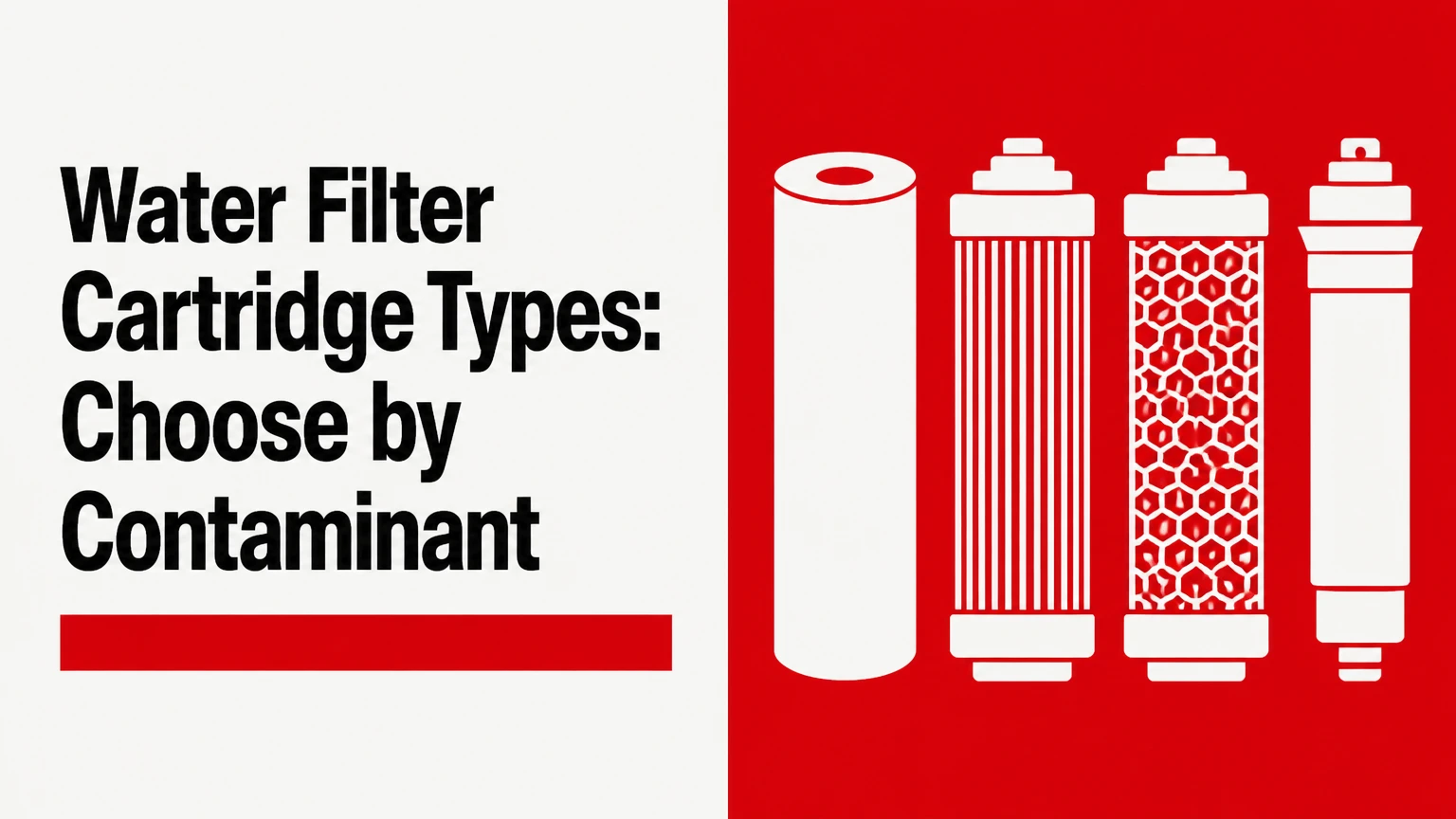
Water filter cartridge types differ by the contaminant they target and the mechanism they use. Sediment cartridges remove suspended particles, activated carbon adsorbs chlorine and organic chemicals, reverse osmosis membranes reduce dissolved solids, ultrafiltration blocks many microorganisms, and ion exchange resin targets hardness or selected charged contaminants. The correct cartridge depends on tested water quality, flow demand, pressure, and housing compatibility.
Key facts at a glance
A sediment cartridge removes particles, not dissolved minerals, chlorine, or most microorganisms.
Activated carbon improves taste and odor, but carbon performance depends on media volume, flow rate, and contaminant certification.
Reverse osmosis can reduce many dissolved contaminants, but it needs pressure, pretreatment, and a drain connection.
Ultrafiltration retains minerals and produces no reject stream, but it does not remove dissolved salts or most chemicals.
Ion exchange softens water by exchanging calcium and magnesium for other ions; it does not function as a universal drinking-water filter.
Nominal and absolute micron ratings are not interchangeable. Certification and capacity matter as much as the advertised pore size.
What Is a Water Filter Cartridge?
A water filter cartridge is a replaceable treatment element installed inside a housing, appliance, pitcher, inline assembly, or reverse osmosis system. The cartridge contains a medium such as polypropylene fiber, activated carbon, ceramic, membrane material, or ion exchange resin.
The housing determines fit and sealing. The media determines treatment. A cartridge can therefore fit physically while being unsuitable for the contaminant or flow rate.
Cartridges use four main mechanisms:
- Mechanical filtration: A porous structure traps suspended particles.
- Adsorption: Activated carbon holds some chemicals on its internal pore surfaces.
- Ion exchange: Resin exchanges charged ions, such as calcium for sodium.
- Membrane separation: Pressure drives water through a selective membrane while larger or differently charged substances remain behind.
A cartridge does not automatically make unsafe water safe. For example, a 5-micron sediment filter can remove visible sand while allowing dissolved arsenic, nitrate, and many bacteria to pass. Treatment claims must match a tested contaminant and a validated product claim.
How Do Cartridge Filtration Mechanisms Differ?
Mechanical cartridges capture particles by size and depth. Carbon cartridges rely mainly on adsorption, although dense carbon blocks also provide particle reduction. Membranes separate contaminants through selective transport, while resin changes the ionic composition of the water.
Mechanical filtration
Depth filters, including melt-blown polypropylene, capture particles throughout a fibrous matrix. Pleated filters collect particles mainly on the outer surface, giving them more usable surface area at comparable dimensions.
Micron ratings require careful interpretation. A nominal rating indicates an approximate reduction for particles of a stated size under defined conditions. An absolute rating is a tighter performance claim, but the test method and efficiency percentage still matter. A product marked “1 micron” without a test basis cannot be compared reliably with a certified 1-micron filter.
Adsorption
Activated carbon has a porous structure that attracts chlorine, taste compounds, and some organic chemicals. Carbon does not remove every chemical, and adsorption capacity falls when water flows too quickly or the media becomes saturated.
Carbon performance also differs by contaminant. A cartridge certified for chlorine reduction may not be certified for lead, PFAS, pesticides, or chloramine. Check the specific claim rather than treating “carbon” as a complete specification.
Membrane separation
UF and RO are membrane processes, but their separation ranges differ substantially. UF generally blocks larger particles, bacteria, and cysts while allowing dissolved salts through. RO uses a much tighter membrane and reduces many dissolved ions, although rejection varies by contaminant, pressure, temperature, pH, and membrane condition.
Ion exchange
Ion exchange resin contains fixed charged sites. Softening resin preferentially captures calcium and magnesium, then releases sodium or hydrogen ions. Specialty resins can target nitrate, iron, copper, lead, or other ions, but each resin has a finite capacity and operating range.
What Are the Main Water Filter Cartridge Types?
The principal water filter cartridge types are sediment, activated carbon, reverse osmosis, ultrafiltration, ceramic, ion exchange, specialty media, and remineralization cartridges. The table below compares their primary function rather than implying that every cartridge within a category has identical performance.
| Cartridge type | Main medium | Primary target | Typical service interval |
|---|---|---|---|
| Melt-blown sediment | Polypropylene fibers | Sand, rust, silt, clay | 1-6 months |
| Pleated sediment | Polyester or polypropylene fabric | Suspended solids | 3-12 months |
| GAC carbon | Loose activated carbon | Chlorine, taste, odor, some VOCs | 3-12 months |
| Carbon block | Compressed activated carbon | Chlorine, particles, selected chemicals | 6-12 months |
| RO membrane | Thin-film composite | Dissolved salts, metals, many ions | 2-5 years |
| UF hollow fiber | Polymer membrane fibers | Bacteria, cysts, fine particles | 1-3 years |
| Ceramic | Microporous ceramic shell | Bacteria and particulates | 6-24 months |
| Softening resin | Ion exchange beads | Calcium and magnesium | Capacity dependent |
| Specialty media | Selective resin or adsorbent | Iron, nitrate, fluoride, or PFAS | Test and capacity dependent |
| Remineralization | Calcite or blended minerals | Adds calcium and alkalinity | 6-24 months |
Sediment filter cartridges
Sediment cartridges are the first-stage choice for visible dirt, rust flakes, sand, silt, and construction debris. They protect carbon beds, pumps, valves, and RO membranes from premature loading.
Melt-blown cartridges provide depth filtration and are inexpensive, but they usually have limited dirt-holding capacity compared with a large pleated cartridge. Pleated cartridges offer more surface area and may be washable when the manufacturer specifically permits cleaning.
| Sediment design | Typical ratings | Strength | Limitation |
|---|---|---|---|
| Melt-blown polypropylene | 1, 5, 10, 20, 50 microns | Low purchase cost | Loads quickly in dirty well water |
| Pleated polypropylene | 1-50 microns | High surface area | Surface dirt can blind the folds |
| Pleated polyester | 5-100 microns | Often washable | May not provide fine absolute removal |
| String-wound | 1-100 microns | Depth capture for varied particles | Fiber shedding is possible |
| Spin-down screen | 60-500 microns | Reusable coarse protection | Does not replace fine cartridge filtration |
A 5-micron sediment filter does not remove dissolved iron, hardness, nitrate, or chlorine. If iron is present as visible particulate, sediment filtration may help; dissolved or bacterial iron needs a different treatment strategy.
Granular activated carbon and carbon block
GAC cartridges contain loose carbon granules. Carbon blocks compress carbon particles into a dense element, increasing contact with the media and usually improving fine-particle reduction.
Carbon block is often the better drinking-water choice when the housing can tolerate its pressure drop. GAC can provide higher flow at lower resistance, but channeling can let water bypass much of the media, especially when the cartridge is poorly packed or installed vertically in an unsuitable configuration.
Activated carbon commonly reduces chlorine, taste, odor, and selected volatile organic compounds. Chloramine is more persistent than free chlorine and may require catalytic carbon, greater carbon volume, or a slower rated flow.
| Carbon option | Typical particle rating | Best use | Main constraint |
|---|---|---|---|
| Standard GAC | 5-20 microns | Taste and chlorine at moderate flow | Channeling risk |
| Carbon block | 0.5-5 microns | Point-of-use drinking water | Higher pressure drop |
| Catalytic carbon | 0.5-10 microns | Chloramine and selected organics | Higher media cost |
| Carbon plus lead claim | Manufacturer-specific | Certified lead reduction | Requires exact certification |
| Carbon plus PFAS claim | Manufacturer-specific | Selected PFAS compounds | Capacity and test conditions vary |
NSF/ANSI 42 generally covers aesthetic effects such as chlorine, taste, and odor. NSF/ANSI 53 covers specific health-effect contaminants, such as lead, when the product carries the applicable claim. NSF/ANSI 401 addresses certain emerging contaminants. Certification does not mean every certified cartridge removes every contaminant.
Reverse osmosis membrane cartridges
An RO membrane reduces dissolved solids by forcing pressurized water through a thin-film composite membrane. The permeate passes to the clean-water side, while concentrated reject water leaves through the drain line.
The often-quoted 0.0001-micron figure is a simplified marketing description, not a complete performance specification. RO performance is better evaluated through contaminant-specific rejection data, operating pressure, recovery ratio, and certification.
| RO attribute | Typical residential value | Why it matters |
|---|---|---|
| Membrane type | Thin-film composite | High rejection for many dissolved ions |
| Nominal capacity | 50-100 gallons per day | Output under specified test conditions |
| Feed pressure | 40-80 psi | Low pressure reduces production |
| TDS reduction | Often 90-99% | Depends on feed chemistry and membrane age |
| Reject ratio | About 1:1 to 4:1 | Product and pressure determine wastewater |
| Replacement interval | 2-5 years | Pretreatment and water quality control life |
RO is useful for high TDS, salinity, fluoride, arsenic, and selected heavy metals, but the exact contaminant claim must be verified. RO does not remove all contaminants equally, and a damaged or poorly maintained system can permit microbial growth in tanks and tubing.
Carbon pretreatment is mandatory for many TFC membranes because chlorine can damage the membrane material. Sediment pretreatment prevents particulate fouling. A remineralization cartridge can add calcium and alkalinity after RO, but it does not restore the original water chemistry exactly.
Ultrafiltration, hollow fiber, and ceramic cartridges
UF cartridges use hollow fibers with small pores that physically retain many bacteria, cysts, colloids, and suspended particles. UF generally operates at ordinary household pressure and produces no intentional reject stream.
UF does not reliably reduce hardness, sodium, nitrate, fluoride, TDS, or most dissolved organic chemicals. A UF cartridge also cannot compensate for an unsafe source if its microbiological claim does not cover the relevant organism or if the housing becomes contaminated.
Ceramic cartridges use a rigid microporous shell. Some include carbon cores or silver-based treatments, but those additions do not create a universal disinfection system. For microbiologically unsafe private wells, laboratory testing and a validated disinfection stage remain necessary.
Ion exchange and water-softening cartridges
Softening cartridges reduce calcium and magnesium, the ions responsible for much scale formation. Sodium-cycle resin releases sodium during operation, while hydrogen-cycle deionization resin releases hydrogen and can remove a wider range of ions when paired with suitable anion resin.
| Ion exchange application | Target | Common indication | Important limitation |
|---|---|---|---|
| Sodium softener | Calcium and magnesium | Scale on fixtures and heaters | Adds sodium and does not disinfect |
| Hydrogen cation resin | Cations | Demineralization systems | Requires downstream treatment |
| Nitrate-selective resin | Nitrate | Tested nitrate contamination | Capacity depends on sulfate and flow |
| Iron-selective resin | Dissolved iron | Staining and metallic taste | Oxidation state affects performance |
| Mixed-bed deionizer | Dissolved ions | Laboratory or process water | Not generally economical for whole-house drinking |
A small inline softening cartridge can exhaust quickly in hard water. Capacity is usually expressed in grains or liters at a specified hardness, flow, and influent chemistry. Replace the cartridge when capacity is reached, not simply when six months have elapsed.
Specialty, remineralization, and alkaline cartridges
Specialty cartridges target a named contaminant or water property. Examples include phosphate media, KDF media, arsenic-selective adsorbents, fluoride media, nitrate resin, and iron treatment media.
Remineralization cartridges usually contain calcite, magnesium media, or a blend. They raise mineral content after RO, which can improve taste and alkalinity, but they do not make untreated water safe and they do not remove contaminants.
Which Cartridge Should You Choose for Each Water Problem?
Choose a cartridge by testing the water first, then match the contaminant, flow rate, pressure, and certified capacity. A taste complaint alone may justify carbon, while scale requires hardness treatment and high TDS requires a membrane process.
| Water problem | First choice | Useful second stage | Do not assume |
|---|---|---|---|
| Sand, rust, or silt | 5-20 micron sediment | Finer sediment or carbon | Sediment removes dissolved iron |
| Chlorine taste | Certified carbon block | Catalytic carbon for chloramine | All carbon removes chloramine |
| Hardness and scale | Ion exchange softener | Sediment prefilter | Carbon removes hardness |
| High TDS or salty taste | RO system | Remineralization | UF lowers dissolved salts |
| Bacteria in tested well water | Validated UV, UF, or disinfection system | Sediment pretreatment | A generic cartridge guarantees safety |
| Lead concern | Certified carbon or RO claim | Sediment protection | A micron rating proves lead removal |
| PFAS concern | Certified adsorption or RO claim | Carbon pretreatment | Generic activated carbon has a universal PFAS claim |
| Nitrate concern | Certified nitrate resin or RO | Sediment and carbon protection | Boiling removes nitrate |
| Sulfur odor | Oxidation or specialty media | Carbon polishing | A small carbon cartridge may exhaust quickly |
Municipal tap water
Municipal water commonly needs chlorine or chloramine reduction, taste improvement, and occasional sediment protection. A practical point-of-use sequence is a 5-micron sediment cartridge followed by a certified carbon block, provided the utility report and household testing support that choice.
Private well water
Private well owners should test for coliform bacteria, nitrate, pH, hardness, iron, manganese, arsenic, and other locally relevant contaminants. The CDC recommends testing private well water at least annually and after flooding, repairs, or changes in taste, color, or odor.
A typical well sequence may include a washable coarse screen, 5-20 micron sediment filtration, iron or hardness treatment, and a validated microbiological barrier. The exact order depends on whether iron is dissolved, particulate, or bacteria-associated.
High-TDS or brackish water
High TDS, salty taste, fluoride, and many dissolved metals point toward RO rather than sediment, carbon, or UF. RO requires adequate pressure, a drain, membrane-compatible pretreatment, and a replacement plan for sediment and carbon stages.
What Specifications Matter When Buying a Cartridge?
The most important specifications are contaminant claim, certification, flow rate, capacity, micron test basis, dimensions, pressure limits, temperature range, and replacement interval. A cartridge with a smaller advertised pore size can perform worse in practice if it clogs rapidly or lacks the required chemical certification.
Physical compatibility
Common residential housings use nominal 10-inch or 20-inch cartridges, but diameter varies. “Slim” and “Big Blue” style housings are not interchangeable, and proprietary refrigerator, pitcher, and appliance cartridges may use keyed fittings.
Check the following before ordering:
- Length and outside diameter
- Open-end configuration
- Gasket or O-ring location
- Maximum flow rate
- Maximum operating pressure
- Water temperature limit
- Food-contact material approval
- Manufacturer replacement code
A cartridge that does not seat fully can allow bypass around the media. That failure can look like poor filtration even when the cartridge itself is effective.
Certification and performance claims
NSF International, the Water Quality Association, and comparable certification bodies provide useful verification, but the exact standard and contaminant claim must appear in the product documentation. EPA registration is not the same as NSF certification, and a manufacturer statement is not equivalent to independent certification.
Performance depends on flow. A carbon cartridge rated for chlorine reduction at 0.5 gallons per minute may provide inadequate contact time at 2 gallons per minute. Whole-house flow demands often require a larger carbon bed rather than a tighter drinking-water cartridge.
How Long Do Cartridges Last and What Do They Cost?
Typical residential replacement costs range from about $5 for a basic sediment cartridge to $100 or more for proprietary multistage or specialty elements. Service life ranges from weeks in heavily contaminated well water to several years for a protected RO membrane.
| Cartridge | Typical replacement cost | Typical life | Primary replacement trigger |
|---|---|---|---|
| Melt-blown sediment | $3-$15 | 1-6 months | Pressure drop or visible loading |
| Pleated sediment | $8-$40 | 3-12 months | Pressure drop or damaged media |
| GAC | $10-$40 | 3-12 months | Capacity or taste breakthrough |
| Carbon block | $15-$80 | 6-12 months | Certified gallon limit or breakthrough |
| UF membrane | $30-$150 | 1-3 years | Flow decline or manufacturer interval |
| RO membrane | $30-$150 | 2-5 years | Rejection decline or low production |
| Softening cartridge | $20-$100 | Capacity dependent | Hardness breakthrough |
| Specialty resin | $30-$200 | Capacity dependent | Contaminant breakthrough |
Manufacturers often publish gallon capacity, but real life can be shorter when sediment, temperature, high flow, or unusual chemistry differs from the test conditions. A pressure gauge before and after whole-house filtration provides a better maintenance signal than a calendar alone.
How Do You Replace a Water Filter Cartridge Safely?
Most residential cartridges can be replaced in 10-20 minutes, provided the correct element, housing wrench, shutoff valve, bucket, clean cloth, and food-grade silicone lubricant are available. The decisive factors are depressurizing the housing, preserving the seal, installing the correct orientation, and flushing the new media.
Step 1: Shut off water and release pressure
Close the inlet valve and open the filtered faucet until flow stops. Place a bucket beneath the housing before loosening the bowl.
Success checkpoint: The housing opens without sustained spray or pressure.
Common mistake: Removing the bowl while the inlet remains pressurized.
Step 2: Remove and inspect the old cartridge
Unscrew the housing, remove the used element, and check for damaged gaskets, unusual slime, cracks, or heavy discoloration. Do not wash and reuse a disposable melt-blown cartridge.
Success checkpoint: The old cartridge and any loose carbon dust are removed.
Common mistake: Leaving the old O-ring beneath a new gasket.
Step 3: Clean the housing and seal
Wash the housing with mild dish soap and warm water, rinse thoroughly, and inspect the O-ring groove. Apply a thin film of food-grade silicone lubricant to the O-ring, not petroleum jelly.
Success checkpoint: The O-ring sits flat without twisting.
Common mistake: Using excess lubricant, which can attract debris.
Step 4: Install the new cartridge
Match the cartridge orientation to the manufacturer’s diagram. Some depth cartridges have an open center that must align with the housing outlet; others use a closed or spring-loaded end.
Success checkpoint: The cartridge is centered and the bowl threads engage smoothly.
Common mistake: Forcing a cartridge that is the wrong length or diameter.
Step 5: Restore flow and flush
Open the inlet valve slowly, inspect for leaks, and flush carbon cartridges until water runs clear and the specified volume has passed. Five to ten minutes is common for small carbon cartridges, but the product instructions control.
Success checkpoint: No leaks remain and carbon fines or cloudy air have cleared.
Common mistake: Sending unflushed carbon dust into an RO membrane or faucet aerator.
What Problems Do Filter Cartridges Commonly Cause?
Sudden pressure loss usually indicates a loaded sediment cartridge, clogged carbon block, closed valve, or undersized cartridge. Replace the sediment stage first, then check pressure before and after each housing.
| Symptom | Likely cause | Corrective action |
|---|---|---|
| Sudden low flow | Clogged sediment or carbon | Replace the loaded stage and inspect pressure |
| Black particles | Carbon fines | Flush longer and check cartridge integrity |
| Cloudy new-filter water | Entrained air | Run water until bubbles disappear |
| Chemical taste | Saturated or unflushed carbon | Flush, then replace if taste persists |
| Water around housing | Twisted O-ring or cross-threading | Depressurize, reseat seal, inspect threads |
| Scale remains | Wrong cartridge type | Test hardness and install softening treatment |
| RO TDS remains high | Membrane failure or bypass | Check pretreatment, seals, pressure, and rejection |
| Short cartridge life | Excess sediment or excessive flow | Add pretreatment or increase cartridge size |
A carbon cartridge does not normally “dump” all captured contaminants at once, but breakthrough can occur when adsorption capacity is exhausted or flow conditions change. Replacement before the certified capacity is a safer practice than relying on taste, which may not reveal health-related contaminant breakthrough.
Which Alternatives Are Better Than a Cartridge?
A cartridge is appropriate for modular, point-of-use, or moderate-flow treatment, but larger problems may require another system. A backwashing media tank handles high sediment or iron loads more economically than small disposable elements, while UV provides validated microbial inactivation without reducing dissolved salts.
| Treatment approach | Best application | Waste stream | Typical maintenance |
|---|---|---|---|
| Cartridge filtration | Point-of-use sediment or carbon | 0 gallons | Replace element |
| Backwashing media tank | Whole-house iron or sediment | Periodic backwash | Media and valve service |
| Water softener | Whole-house hardness | Brine discharge | Salt and resin maintenance |
| UV disinfection | Bacteria and viruses in clear water | 0 gallons | Annual lamp and sleeve service |
| RO system | Drinking water with high TDS | Yes | Prefilters, membrane, sanitation |
| Distillation | Small-volume dissolved contaminant reduction | Concentrate and heat loss | Descaling and cleaning |
A cartridge system is not a substitute for source protection. Leaking wells, failing septic systems, untreated surface water, and contaminated storage tanks require corrective action before filtration is considered adequate.
FAQ
Can one cartridge remove every water contaminant?
No. Sediment, carbon, membranes, resin, and disinfection technologies target different contaminant classes. A carbon block may reduce chlorine and lead under a certified claim, but it will not generally soften water or remove nitrate. Water testing identifies the treatment combination instead of encouraging unnecessary stages.
Is a 1-micron filter better than a 5-micron filter?
A 1-micron filter is finer, but it is not automatically better. The tighter element can reduce flow and clog sooner, while a 5-micron prefilter may protect a carbon or RO stage more effectively. Compare nominal or absolute rating, tested efficiency, pressure drop, capacity, and the contaminant being targeted.
Does boiling replace a water filter cartridge?
No. Boiling can inactivate many pathogens when performed correctly, but it does not remove dissolved salts, nitrate, lead, arsenic, PFAS, or sediment. Boiling can also concentrate nonvolatile contaminants as water evaporates. Use a validated treatment method for the specific risk identified by testing.
Should a whole-house filter use carbon or reverse osmosis?
Whole-house carbon is usually practical for chlorine, taste, and selected organic compounds because it can supply higher flow without creating reject water. Whole-house RO is more complex, costly, and waste-producing, so it is usually reserved for specific high-TDS or contaminant problems rather than general taste improvement.
How can you tell when a carbon cartridge is exhausted?
Use the manufacturer’s gallon or time limit and monitor changes in taste, odor, chlorine test results, or certified performance indicators. Taste alone is not a reliable health-safety test. High flow, chloramine, warm water, and heavy organic loading can exhaust carbon earlier than the published typical interval.
Are reusable sediment cartridges safe to wash?
Reusable pleated cartridges can be washed only when the manufacturer labels them washable and the material remains intact. Melt-blown polypropylene is generally disposable because cleaning cannot reliably restore its internal capture structure. Replace any cartridge with torn media, permanent deformation, microbial growth, or an uncertain cleaning history.
The Bottom Line
The best water filter cartridge types are selected by contaminant, not by the smallest micron number or the longest marketing list. Use sediment filtration for particles, certified carbon for chlorine and selected chemicals, RO for many dissolved contaminants, UF or validated disinfection for specified microbiological risks, and ion exchange for hardness or other tested ions. Test the water, verify the claim, size the cartridge for the required flow, and replace it according to capacity and performance.