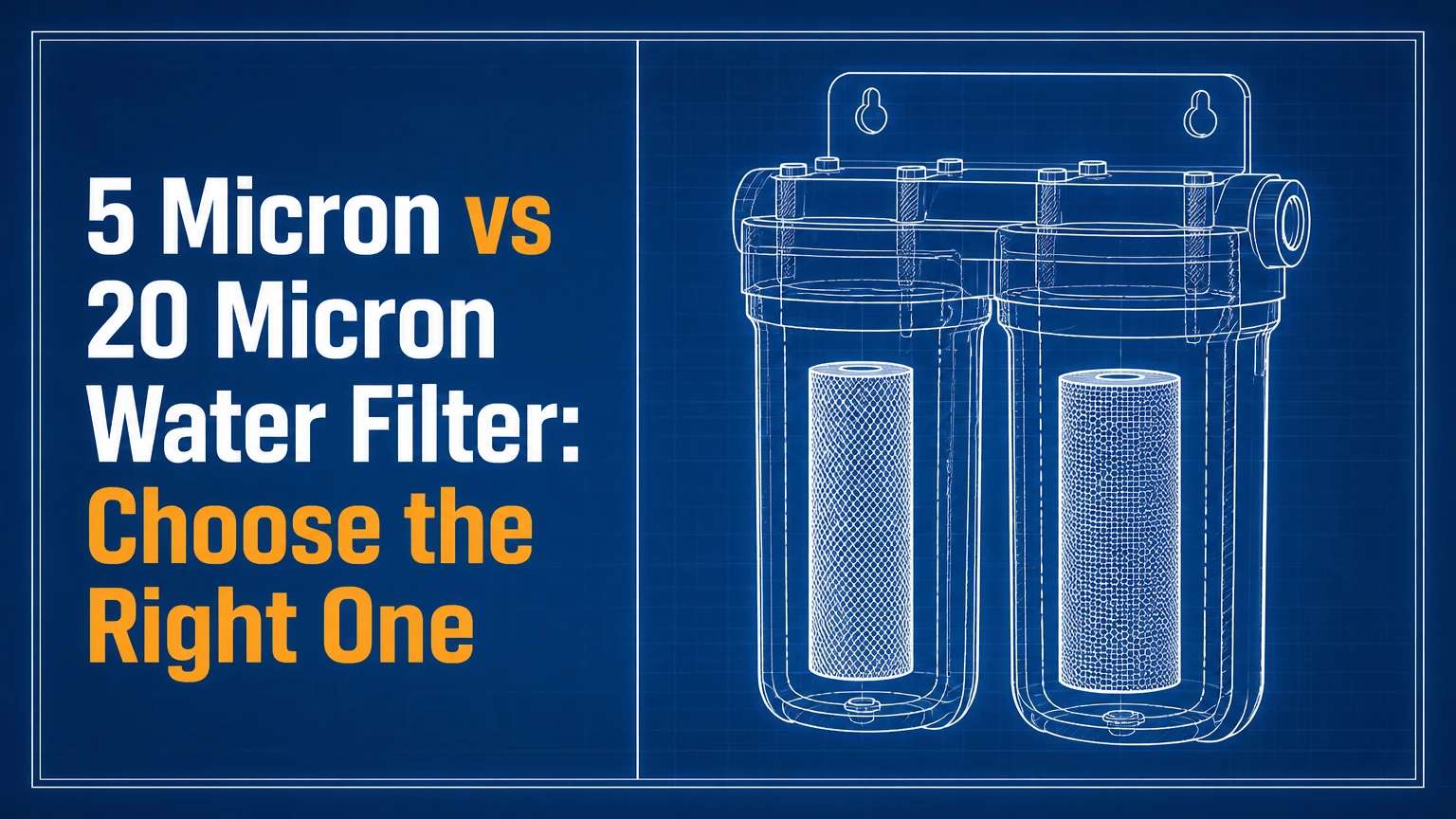
A 5 micron vs 20 micron water filter comparison comes down to capture size, flow, and clogging rate. A 5-micron sediment filter captures finer suspended particles, while a 20-micron filter passes more fine silt but usually delivers higher flow and longer service life. Choose 20 micron for coarse sediment and 5 micron for finer particles or downstream equipment protection.
Key Facts at a Glance
- A 5-micron filter is rated to capture smaller suspended sediment than a 20-micron filter.
- A 20-micron cartridge usually creates less initial pressure loss and handles heavier coarse sediment loads.
- A micron rating describes particle-removal performance, not automatically the cartridge’s exact pore diameter.
- Nominal and absolute ratings are different: a nominal 5-micron cartridge may allow some particles larger than 5 microns through.
- Neither sediment rating removes dissolved chlorine, lead, PFAS, pesticides, bad taste, or odor without another treatment medium.
- A 20-micron prefilter followed by a 5-micron polishing filter often protects equipment better than one restrictive cartridge alone.
What Is the Difference Between 5 and 20 Microns?
A 5-micron filter targets particles approximately 5 micrometers and larger under its stated test conditions, whereas a 20-micron filter targets particles approximately 20 micrometers and larger. Because 5 microns is one-quarter of 20 microns, the 5-micron rating is finer, but the actual result depends on the media design and whether the rating is nominal or absolute.
One micron equals one-millionth of a meter, or 0.001 millimeter. A human hair is commonly around 50-100 microns wide, so both ratings address particles smaller than unaided vision can reliably identify.
| Attribute | 5-micron cartridge | 20-micron cartridge | Practical consequence |
|---|---|---|---|
| Rated particle size | 5 µm | 20 µm | 5 µm captures finer sediment |
| Millimeter equivalent | 0.005 mm | 0.020 mm | 20 µm is four times larger |
| Typical target | Fine silt, micro-sand, rust dust | Coarse sand, scale flakes, grit | Match rating to incoming sediment |
| Initial restriction | Higher | Lower | 20 µm usually preserves pressure |
| Clogging tendency | Faster in muddy water | Slower with coarse debris | Staging can extend service life |
The rating is not a promise that every particle above the number disappears. Manufacturers test cartridges at specified flow, pressure, contaminant concentration, and efficiency. A cartridge rated “5 micron nominal” can perform very differently from one rated “5 micron absolute.”
How Do Sediment Filters Trap Particles?
Sediment filters remove suspended solids through mechanical separation. Water travels through a porous material, and particles are intercepted on the surface, inside the media, or by a combination of both mechanisms.
Surface filters use a relatively thin barrier, commonly pleated polyester or polypropylene. Particles collect on the outer face, which gives the cartridge a high usable area and often a low initial pressure drop. Once the surface becomes covered, pressure can fall quickly because the flow path has narrowed.
Depth filters use thick layers of fibers, such as spun polypropylene or string-wound yarn. Water follows a winding path through the cartridge, and particles become trapped at different depths. Depth media can hold substantial dirt, but the inner structure may become saturated before the outside looks completely blocked.
What Do Nominal and Absolute Ratings Mean?
A nominal rating indicates that a cartridge removes a stated percentage of particles at or above its rated size, while an absolute rating indicates a much tighter maximum-particle claim under controlled test conditions. Buyers should verify the manufacturer’s efficiency percentage and test standard instead of comparing the number alone.
For example, two 5-micron cartridges may differ in performance because one is a low-cost nominal depth filter and another is an absolute-rated membrane cartridge. The absolute cartridge generally provides more predictable protection, but it can cost more and clog sooner when sediment loads are high.
What Does Each Rating Remove?
A 5-micron filter is better suited to fine silt, small rust particles, fine grit, and sediment that leaves a sandy or dusty residue. A 20-micron filter is better suited to visible sand, pipe scale, larger rust fragments, and coarse debris entering from a well, storage tank, or aging plumbing.
Neither cartridge changes the chemical composition of water. Mechanical sediment media do not reliably remove dissolved minerals, chlorine, chloramine, lead ions, volatile organic compounds, PFAS, microorganisms, or unpleasant taste.
| Contaminant or material | Approximate behavior | 5 micron | 20 micron | Treatment needed if not removed |
|---|---|---|---|---|
| Coarse sand | 100-1,000 µm | Captures | Captures | None for particles |
| Visible rust flakes | 50-500 µm | Captures | Captures | Inspect plumbing source |
| Fine silt | 2-50 µm | Partial to strong capture | Variable | Finer sediment stage |
| Colloidal clay | Often below 1-2 µm | Usually passes | Passes | Coagulation or specialized membrane |
| Chlorine | Dissolved chemical | Does not remove | Does not remove | Activated carbon |
| Bacteria | Commonly 0.5-5 µm | Not a disinfection guarantee | Does not remove reliably | Certified disinfection system |
A cloudy appearance does not identify particle size by itself. Cloudiness can come from air, clay, iron, microbial growth, or mineral precipitation, so water testing is more reliable than selecting a cartridge from appearance alone.
Which Filter Gives Better Water Flow?
A 20-micron filter generally gives better flow because its larger openings create less resistance, especially when the water contains substantial sediment. A 5-micron cartridge usually produces more pressure drop, and the difference becomes more noticeable in a small 10-inch housing or a high-demand whole-house installation.
Filter flow depends on more than micron size. Cartridge length, cartridge diameter, media type, water temperature, inlet pressure, fitting size, and dirt loading all affect delivered flow. A 20-micron cartridge in a narrow housing can flow worse than a 5-micron cartridge in an oversized high-flow housing.
| Installation condition | Typical pressure effect | Better starting choice | Reason |
|---|---|---|---|
| One drinking-water faucet | 0.5-5 psi clean | 5 µm | Low flow demand makes fine filtration practical |
| Shower and faucet together | 2-10 psi clean | 20 µm or large 5 µm | Demand can exceed a small housing |
| Whole-house 10-inch housing | 5-15 psi loaded | 20 µm | Small area loads quickly |
| Whole-house 20-inch Big Blue housing | 2-8 psi clean | 5 µm or staged pair | Larger area supports higher flow |
| RO sediment prefilter | 2-8 psi typical | 5 µm | Protects the membrane from fine particles |
Use a pressure gauge before and after a whole-house housing when possible. A rising differential pressure provides a better replacement signal than a calendar estimate because it measures actual loading.
Which Filter Construction Fits the Job?
Spun polypropylene is usually the practical low-cost choice for disposable depth filtration. Pleated polyester is often preferable when flow, surface area, or cleaning matters. String-wound cartridges suit coarse sediment and some industrial applications, but cartridge quality varies significantly between manufacturers.
| Construction | Filtration mechanism | Typical service strength | Main limitation | Common application |
|---|---|---|---|---|
| Spun polypropylene | Depth filtration | Broad particle loading | Pressure rises as fibers load | City water, RO prefilter |
| Pleated polyester | Surface filtration | High area and flow | Surface can blind quickly | Well water, whole-house prefilter |
| String-wound polypropylene | Depth filtration | Coarse and mixed sediment | Variable rating consistency | Well water, process water |
| Pleated polypropylene | Surface filtration | Chemical resistance and area | Usually disposable | High-flow sediment control |
Washable pleated cartridges can reduce replacement waste, but washing does not restore the original capture performance perfectly. Cleaning may also redistribute trapped organisms and sediment, so use clean water, follow the manufacturer’s procedure, and avoid reusing a damaged or permanently stained cartridge.
How Long Will Each Filter Last?
A 20-micron cartridge often lasts longer than a 5-micron cartridge in the same housing because it intercepts fewer fine particles and offers a less restrictive flow path. Typical household replacement intervals range from several weeks to six months, but sediment concentration and water volume matter more than the printed micron number.
The AI Overview’s two-to-four-month estimate for 5-micron cartridges and three-to-six-month estimate for 20-micron cartridges can be reasonable household planning ranges, not guarantees. A sandy well may exhaust a 20-micron cartridge in days, while treated city water may allow a 5-micron cartridge to run for six months.
| Water condition | 5-micron service range | 20-micron service range | Preferred monitoring method |
|---|---|---|---|
| Low-sediment municipal water | 3-6 months | 4-6 months | Pressure and visual inspection |
| Aging city plumbing | 1-4 months | 2-6 months | Pressure gauge and rust observation |
| Moderate well sediment | 2-8 weeks | 1-4 months | Differential pressure |
| Heavy sand or storm turbidity | 1-14 days | 1-8 weeks | Frequent inspection |
| RO point-of-use system | 3-12 months | 3-12 months | Manufacturer schedule and pressure |
Replace a cartridge when flow drops noticeably, pressure falls at fixtures, the cartridge reaches the manufacturer’s capacity, or the water quality changes. A six-month maximum is a useful conservative rule for many household housings, but it does not justify leaving a heavily loaded cartridge in service.
Should You Use Both Filters Before RO?
A 20-micron prefilter followed by a 5-micron filter is usually the better arrangement for sediment-heavy water entering a reverse osmosis system. The first stage removes coarse material, while the second stage protects the RO sediment screen and membrane from finer particles.
A step-down sequence prevents the fine cartridge from receiving the entire sediment load. Install the 20-micron stage first, then the 5-micron stage, and place carbon treatment after sediment removal when chlorine or chloramine is present.
For many residential RO systems, a certified 5-micron sediment cartridge is the manufacturer’s normal minimum prefilter. Do not substitute a 20-micron cartridge alone when the RO manufacturer specifies 5 microns, because finer particles can reach the membrane and increase fouling.
Which Should You Choose for Well Water?
Choose a 20-micron pleated or depth cartridge first when well water contains visible sand, grit, or large rust fragments. Choose a 5-micron stage after it when the water still carries fine silt, the RO system needs protection, or fixtures show a fine abrasive residue.
A well system should also address the source problem. A failed well screen, damaged pressure tank, disturbed aquifer, or inadequate settling tank can overwhelm any cartridge. Sediment filtration treats the symptom at the inlet, not the cause underground.
Which Should You Choose for City Water?
Choose a 5-micron cartridge for municipal water when the main problem is fine rust or pipe scale and household flow remains adequate. Choose 20 micron when pressure is already marginal, the water contains occasional visible grit, or a small cartridge housing clogs too quickly.
Municipal water can contain disinfectant and dissolved contaminants that sediment media cannot remove. Check the local water quality report, and test for lead after plumbing work or in homes with older service lines.
| User profile | Main symptom | Recommended first stage | Recommended second stage |
|---|---|---|---|
| City apartment | Fine rust particles | 5 µm spun PP | Carbon block |
| Sandy private well | Visible sand | 20 µm pleated | 5 µm depth cartridge |
| RO drinking system | Membrane fouling | 5 µm certified sediment | Carbon block |
| Low-pressure home | Weak shower flow | 20 µm large-format | Optional 5 µm point of use |
| Rainwater tank | Leaf grit and tank sediment | 20 µm washable pleated | 5 µm cartridge and disinfection |
How Does Housing Size Change the Choice?
A larger cartridge housing usually reduces pressure loss and extends service life because it provides more media area. A 20-inch by 4.5-inch “Big Blue” cartridge has substantially more usable area than a 10-inch by 2.5-inch cartridge of the same rating, although the exact flow capacity remains manufacturer-specific.
Do not judge a cartridge by its micron number alone. A small 5-micron cartridge may be unsuitable for simultaneous showers, toilets, and appliances, while a large-format 5-micron cartridge can handle the same home more comfortably.
| Housing format | Typical cartridge length | Typical outside diameter | Suitable demand |
|---|---|---|---|
| Standard slimline | 10 inches | 2.5 inches | 1-3 gallons per minute |
| Standard slimline | 20 inches | 2.5 inches | 2-5 gallons per minute |
| Big Blue | 10 inches | 4.5 inches | 5-10 gallons per minute |
| Big Blue | 20 inches | 4.5 inches | 8-20 gallons per minute |
The flow figures are typical planning ranges, not universal ratings. Confirm the manufacturer’s pressure-drop chart before sizing a whole-house system.
What Can’t Either Filter Remove?
Neither a 5-micron nor a 20-micron sediment filter reliably removes dissolved chemicals, disinfectants, heavy-metal ions, dissolved salts, or microorganisms. Mechanical filtration only addresses suspended particles that the media can intercept.
Use activated carbon for chlorine, chloramine, taste, and odor when the cartridge is certified for the specific contaminant. Use reverse osmosis for many dissolved contaminants, and use ultraviolet treatment or another validated disinfection process for microbial control.
| Water concern | 5 or 20 micron sediment filter | More appropriate treatment |
|---|---|---|
| Chlorine | No reliable removal | Activated carbon |
| Lead dissolved in water | No reliable removal | Certified carbon or RO |
| Hardness minerals | No removal | Softener or RO |
| PFAS | No reliable removal | Certified carbon or RO |
| Bacteria and viruses | No disinfection guarantee | UV, chlorination, or validated membrane |
| Fine sand and rust | Yes, rating-dependent | Sediment cartridge |
A “5-micron filter” label does not mean the water is safe to drink. Safety depends on the source, test results, certified treatment claims, and hygienic installation.
Why Is Water Still Cloudy After Filtration?
Water that remains cloudy after a 20-micron filter may contain smaller silt or clay, but cloudiness can also result from dissolved iron, air bubbles, microbial growth, or mineral precipitation. A 5-micron cartridge may improve suspended sediment, yet it cannot solve every cause of turbidity.
Diagnose the cloudiness before installing a finer cartridge. Fill a clear glass and observe it for 10 minutes. If the cloudiness clears from the bottom upward, sediment is likely; if it clears from the top downward, trapped air is more likely.
Troubleshooting Sediment Filter Problems
- Pressure drops suddenly. Replace the cartridge, then inspect the source for a recent well disturbance or plumbing repair.
- Water is cloudy after a 20-micron stage. Test turbidity and install a 5-micron stage only if fine suspended sediment is confirmed.
- A new housing leaks. Shut off water, depressurize the vessel, inspect the O-ring, lubricate it with food-grade silicone grease, and reseat it.
- Flow remains weak with a new cartridge. Check the arrow direction, shutoff valve, bypass position, clogged screen, and undersized fittings.
- The cartridge collapses. Check for excessive differential pressure, an incorrectly fitted core, or a cartridge that does not match the housing.
- Sediment appears after replacement. Flush the housing and downstream plumbing, then verify that the cartridge is fully seated.
A pressure gauge is the most useful upgrade for a whole-house filter. Set a replacement threshold from the clean pressure baseline, commonly a 10-15 psi differential when the housing or manufacturer allows that limit.
Can You Clean or Reuse These Filters?
Pleated polyester filters may be washable when the manufacturer labels them reusable, but spun polypropylene and most string-wound cartridges are disposable. Cleaning a disposable depth cartridge can leave embedded sediment, damage fibers, and reduce predictable filtration performance.
Rinse a reusable pleated cartridge from the clean side outward, use potable water, and inspect the pleats for tears or permanent discoloration. Replace the cartridge if the media remains blocked, smells abnormal, or has been exposed to contaminated water.
What Is the Best Selection Rule?
Use the coarsest rating that solves the sediment problem while preserving adequate pressure. Start at 20 microns when coarse sediment or high flow is the main issue, then step down to 5 microns when testing confirms finer particles or equipment protection requires it.
That rule reduces premature clogging. A 1-micron cartridge is not automatically better because its tighter media can create excessive pressure loss and maintenance when a 5-micron cartridge already achieves the required result.
| Selection priority | Best rating to test first | Reason | Warning |
|---|---|---|---|
| Maximum household flow | 20 µm | Lower resistance | Fine silt may pass |
| Fine rust removal | 5 µm | Smaller target rating | Monitor pressure |
| Heavy well sand | 20 µm | Greater coarse loading | Add a settling stage if needed |
| RO membrane protection | 5 µm | Common manufacturer requirement | Verify certification |
| Lowest replacement frequency | 20 µm large format | More area and less loading | Water may remain hazy |
FAQ
Is a 5-micron filter better than a 20-micron filter for drinking water?
A 5-micron filter is better for removing fine suspended sediment, but it is not automatically safer for drinking water. Neither rating removes every health contaminant. Use laboratory testing and certified carbon, RO, or disinfection equipment when the water contains chemicals, pathogens, or dissolved metals.
Will a 20-micron filter remove sand?
A 20-micron filter will usually remove coarse sand and visible grit, but capture depends on the cartridge rating, construction, and particle shape. Very fine sand can pass through, especially with a nominal cartridge. Use a pressure gauge and a 5-micron polishing stage if residue remains.
Is 1 micron better than 5 micron?
A 1-micron filter captures finer particles than a 5-micron filter, but the tighter rating usually increases pressure loss and shortens service life. Choose 1 micron only when testing or downstream equipment specifications require it; otherwise, 5 micron often provides a more practical balance.
How often should a whole-house sediment filter be replaced?
Whole-house sediment filters commonly last from one week to six months, depending on sediment concentration, water volume, cartridge area, and flow demand. Replace the cartridge when pressure drops materially, flow falls at fixtures, the cartridge reaches its rated capacity, or the manufacturer’s maximum service interval arrives.
Can a sediment filter remove lead?
A 5-micron or 20-micron sediment filter can capture some particulate lead attached to rust or dust, but it does not reliably remove dissolved lead. Use a product certified for lead reduction, such as an appropriate carbon or reverse osmosis system, and test water at the tap.
Should the 5-micron filter go before or after the 20-micron filter?
The 20-micron filter should normally go first, followed by the 5-micron filter. The coarse stage removes larger sediment and protects the finer stage from rapid loading. Install carbon or other chemical treatment after sediment removal unless the equipment manufacturer specifies another sequence.
The Bottom Line
The best 5 micron vs 20 micron water filter depends on the sediment size, required flow, housing capacity, and downstream equipment. Choose 20 micron for coarse well sediment and pressure-sensitive whole-house systems, or choose 5 micron for fine rust, silt, and RO protection. When both problems exist, install 20 micron first and 5 micron second, then add carbon or disinfection for contaminants sediment media cannot remove.