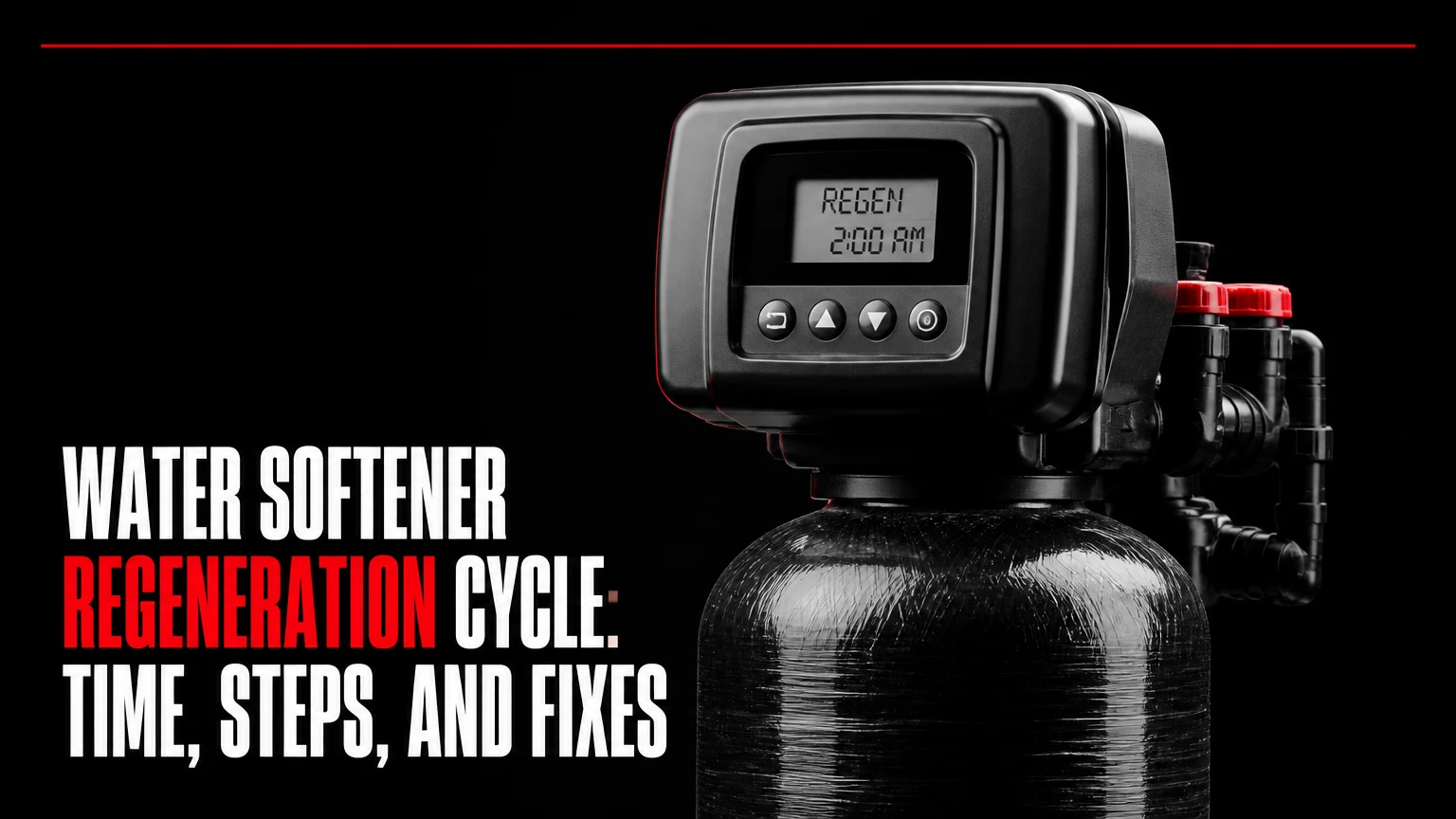
A water softener regeneration cycle restores exhausted ion-exchange resin so the softener can remove calcium and magnesium again. The control valve washes the resin, draws concentrated brine through the tank, rinses away displaced hardness and salt, then returns the system to service, usually in 60-120 minutes.
Key Facts at a Glance
- A residential softener regeneration cycle typically lasts 60-120 minutes, although manufacturer programming can produce shorter or longer cycles.
- Cation-exchange resin removes positively charged calcium and magnesium by exchanging them for sodium or potassium ions.
- A normal cycle commonly uses about 6-12 pounds of salt and 20-70 gallons of water, with high-efficiency models often using less.
- Metered systems regenerate according to measured water use; timer systems regenerate on a calendar schedule.
- Brine regeneration does not disinfect a water supply or reliably remove sediment, bacteria, nitrates, or most dissolved contaminants.
- Water that remains hard after regeneration usually indicates a settings, brine-draw, bypass, resin, or water-quality problem.
What Is a Water Softener Regeneration Cycle?
A water softener regeneration cycle is the controlled cleaning and recharging sequence that renews cation-exchange resin after the resin has captured its working load of hardness minerals. Concentrated sodium chloride or potassium chloride brine supplies replacement ions, while rinse water carries calcium, magnesium, chloride, and waste brine to a drain.
The resin tank contains millions of small, porous beads with negatively charged exchange sites. During normal service, hard water passes through the bed, and calcium and magnesium attach to those sites. Sodium or potassium occupies the sites after regeneration, allowing the exchange process to continue.
University of Nebraska-Lincoln Extension describes the operating principle directly: “The softener is regenerated by flushing the resin bed with a concentrated brine solution.” That statement captures the chemistry, but the complete residential sequence also includes backwashing, slow rinsing, rapid rinsing, and a refill or return-to-service action.
Regeneration is not the same as ordinary backwashing. Backwashing loosens and cleans the resin bed with water; brining restores exchange capacity by replacing hardness ions. A softener can backwash correctly and still fail to regenerate if the brine tank cannot make or deliver adequate brine.
How Does a Water Softener Regenerate?
A typical single-tank water softener regenerates through five operating stages: brine-tank fill, backwash, brine draw with slow rinse, fast rinse, and return to service. Some valves use post-fill programming, placing the refill at the end of the cycle so the salt dissolves before the next regeneration.
Five regeneration stages
| Stage | Typical duration | Flow or action | Main purpose |
|---|---|---|---|
| Brine fill or pre-fill | 5-20 minutes | Fresh water enters brine tank | Dissolves salt into brine |
| Backwash | 8-15 minutes | Water flows upward through resin | Removes sediment and expands bed |
| Brine draw and slow rinse | 30-60 minutes | Brine moves through resin slowly | Exchanges sodium or potassium for hardness |
| Fast rinse | 5-15 minutes | Water flows rapidly downward | Removes residual brine and settles resin |
| Return to service | 1-5 minutes | Valve restores service position | Sends treated water to the home |
Stage 1: Brine tank fill
The control valve sends a measured volume of water into the salt tank. The water dissolves salt, producing a concentrated sodium chloride solution. Brine strength depends on salt chemistry, water volume, temperature, and how long the solution sits.
In a pre-fill design, the tank fills before backwash. In a post-fill design, the tank fills near the end of regeneration and remains ready for the next cycle. Neither arrangement is automatically superior because the valve’s salt dosage and flow rates determine performance.
Stage 2: Backwash
During backwash, the valve reverses flow through the resin tank. Water travels upward, expands the resin bed, and carries trapped sediment, iron particles, and resin fines toward the drain. A restricted drain line can prevent adequate bed expansion and leave contaminants inside the tank.
Backwash is also why a softener requires a drain connection with suitable air-gap protection. Local plumbing rules determine the permitted drain arrangement, but the discharge must not create a cross-connection with wastewater.
Stage 3: Brine draw and slow rinse
An injector creates suction that pulls brine from the salt tank into the resin vessel. The brine passes slowly through the resin, allowing sodium or potassium ions to displace calcium and magnesium from exchange sites.
The displaced hardness flows to the drain. After the brine is removed, the valve continues a slow rinse with fresh water, which pushes remaining hardness and chloride out of the bed without disturbing the resin structure.
Stage 4: Fast rinse
Fast rinse sends water through the resin at a higher rate. The flow removes residual brine and compacts the resin into a stable bed for normal service. A failed fast rinse can produce salty-tasting water, but salty water can also result from incomplete brine draw, excessive salt dosage, or a valve programming fault.
Stage 5: Return to service
The control valve restores the normal service path. Untreated water enters the top or bottom of the resin tank, depending on the equipment design, and softened water exits toward the home. A twin-tank softener can place one tank into regeneration while the second tank supplies treated water.
How Long Does Regeneration Take?
Most residential regeneration cycles take 60-120 minutes, with brine draw and slow rinse usually occupying the largest portion. Exact duration depends on resin volume, programmed salt dose, injector size, water pressure, drain flow, valve model, and whether the system uses pre-fill or post-fill.
| System condition | Typical cycle time | Primary reason for variation |
|---|---|---|
| Compact cabinet softener | 60-90 minutes | Smaller resin bed and lower rinse volume |
| Standard single-tank unit | 90-120 minutes | Longer brining and rinsing sequence |
| High-efficiency upflow model | 45-90 minutes | Lower rinse demand and optimized brine path |
| Large household or commercial valve | 120-180 minutes | Larger resin volume and higher cleaning load |
A softener commonly begins regeneration at 2:00 a.m. because household demand is lower then. The clock time is a scheduling convention, not a chemistry requirement. A properly programmed system can regenerate at another low-use period, provided the household avoids substantial water consumption during the cycle.
The control display may show “regeneration,” “backwash,” “brine,” or a countdown. Those labels describe valve positions, not necessarily separate failures. Consult the model manual before changing stage durations because an incorrect rinse setting can leave salt in the resin or waste water.
How Often Should a Softener Regenerate?
A metered softener should regenerate when calculated resin capacity is nearly exhausted, while a timer softener regenerates at fixed intervals. Many homes regenerate every 3-7 days, but actual frequency depends on hardness, household water use, iron loading, resin capacity, and the programmed reserve.
Capacity calculation
A simplified capacity estimate is:
Daily hardness load = gallons used per day × hardness in grains per gallon
For example, a four-person household using 60 gallons per person each day with 15 grains per gallon creates an estimated load of 3,600 grains per day:
240 gallons × 15 grains per gallon = 3,600 grains
A reserve prevents hard water when actual use exceeds the estimate. Metered controls calculate this reserve differently, commonly using a percentage or a fixed number of days. Iron can consume exchange capacity, so well-water settings may require an iron compensation value specified by the manufacturer.
A system that regenerates every day may be undersized, incorrectly programmed, leaking, or receiving an inflated hardness setting. A system that never regenerates may have a failed meter, an overlarge capacity setting, a bypass condition, or a power interruption.
What Does One Cycle Consume?
A typical residential cycle uses approximately 6-12 pounds of salt and 20-70 gallons of water. These are practical ranges rather than universal specifications; the valve manual, resin volume, salt dose, and efficiency setting determine actual consumption.
| Softener configuration | Salt per cycle | Water per cycle | Typical household effect |
|---|---|---|---|
| Small cabinet unit | 4-8 lb | 15-35 gal | Lower capacity and lower demand |
| Standard 32,000-grain unit | 6-10 lb | 25-50 gal | Common small-family range |
| Standard 48,000-grain unit | 8-15 lb | 40-70 gal | Higher capacity and longer rinse |
| Efficient upflow model | 3-8 lb | 15-35 gal | Reduced waste at matched settings |
Salt cost depends on local pricing and cycle frequency. At $7-$10 per 40-pound bag, a home using 8 pounds per regeneration spends roughly $1.40-$2.00 in salt per cycle, before water, wastewater, electricity, and maintenance costs.
Salt efficiency should be judged by grains removed per pound of salt, not by the lowest advertised salt dose. A severely reduced dose can cause hardness leakage or more frequent regeneration. The best setting is the lowest manufacturer-approved dose that meets the household’s treated-water target.
Which Triggering System Is Better?
Demand-initiated metered control is usually the better choice for households with changing water use, while a timer control can suit a predictable, low-cost installation. Metered control measures gallons through a turbine or electronic meter and schedules regeneration after the programmed capacity is consumed.
| Feature | Timer control | Metered control | Practical consequence |
|---|---|---|---|
| Trigger | Fixed days | Measured gallons | Metered control follows real demand |
| Travel behavior | May regenerate while vacant | Usually delays regeneration | Less waste during holidays |
| Guest behavior | May run short on capacity | Adjusts to higher use | Better protection during occupancy changes |
| Purchase complexity | Mechanical or basic electronic | Electronic sensor and display | Metered units cost more and need power |
| Safety override | Often fixed interval | Usually programmable | Prevents excessive time without regeneration |
Timer systems are not inherently unreliable. Their weakness is that calendar time does not equal water demand. A timer set for every three days may regenerate too often in a vacant home and too rarely during a large family gathering.
Metered controls also need correct hardness, capacity, and reserve settings. A sophisticated controller with bad inputs still produces bad regeneration decisions.
How Does Brine Direction Affect Efficiency?
Co-current downflow regeneration sends brine in the same general direction as service water, while counter-current upflow regeneration sends brine against the service direction. Upflow designs can use less salt and rinse water at matched performance, but downflow designs remain common because they are simpler and can tolerate certain loading conditions better.
| Flow design | Brine direction | Typical salt behavior | Typical application |
|---|---|---|---|
| Co-current downflow | Top to bottom | 6-15 lb per cycle | Conventional residential systems |
| Counter-current upflow | Bottom to top | 3-10 lb per cycle | Efficiency-focused installations |
| Twin alternating | One tank regenerates | Depends on valve design | Continuous soft-water demand |
| High-capacity commercial | Configured by valve | 10-100+ lb per cycle | Larger flow and resin volumes |
Upflow regeneration can preserve the most active resin near the service outlet, which may reduce hardness leakage. However, performance depends on flow distribution, resin type, pressure, and correct installation. The direction alone does not guarantee a 40-50% saving.
For iron-bearing well water, pretreatment is often more important than choosing a flow direction. Oxidized iron, sediment, and organic fouling can restrict resin performance regardless of the brining pattern.
What Should You Check Before Starting a Manual Regeneration?
Before pressing a manual regeneration button, verify salt level, bypass position, hardness setting, drain connection, and household water demand. Manual regeneration is appropriate after adding salt or servicing the system, but it cannot correct a blocked injector, failed meter, damaged resin, or incorrect plumbing.
Pre-cycle checklist
- Confirm the bypass valve is in service, not bypass.
- Check that salt covers the tank’s water level without forming a hard bridge.
- Confirm the brine line and drain line are connected and unobstructed.
- Avoid laundry, showers, dishwasher use, and drinking-water demand during the cycle.
- Record the current time and observe whether each valve stage advances.
- Test hardness at a cold-water tap after the cycle finishes.
Never dismantle a pressurized control valve. Shut off water and follow the manufacturer’s service instructions before cleaning an injector or replacing seals.
What Problems Can Occur During Regeneration?
Regeneration failures usually involve brine production, water flow, valve movement, settings, or resin condition. The symptom provides useful direction, but a single symptom can have several causes, so check the simple hydraulic causes before replacing the control head.
| Symptom | Likely causes | Safe first checks | Escalation point |
|---|---|---|---|
| Hard water after regeneration | Bypass open, wrong setting, exhausted resin | Check bypass and test hardness | Service valve or resin if unresolved |
| Salty taste afterward | Incomplete rinse, excess salt, low drain flow | Inspect drain and run a rinse | Clean injector or service valve |
| Brine tank stays full | Blocked brine line, injector fault, float issue | Inspect tubing and float movement | Technician diagnosis |
| No automatic cycles | Power loss, failed meter, bad schedule | Check display and clock | Replace sensor or controller |
| Salt level never falls | Salt bridge, no water entering tank | Break bridge carefully and inspect fill | Verify brine valve and injector |
| Loud continuous drain | Valve stuck in a position | Check display and water shutoff | Control-head service |
Why is water still hard after regeneration?
Water remains hard after regeneration when the softener did not receive enough brine, the bypass allowed untreated water through, or the programmed capacity does not match the water’s hardness load. Iron fouling, channeling, damaged resin, and a leaking internal valve can produce the same result.
Test hardness before and after the softener using a suitable kit. If raw water measures 15 grains per gallon and treated water remains near 15, suspect bypass or valve flow. If treated water improves but gradually becomes hard before the next cycle, suspect capacity, reserve, hardness settings, or excessive water use.
Why does softened water taste salty?
Salty water after regeneration usually means the resin bed did not receive enough fresh rinse water or the brine draw did not complete. A restricted drain, low pressure, clogged injector, incorrect cycle time, or excessive salt dose can leave chloride in the treated-water path.
Do not drink the water merely because the softener eventually returns to service. Run the manufacturer’s manual regeneration or rinse procedure, then test taste and, where appropriate, chloride or conductivity. Persistent salt taste requires valve and drain diagnosis.
Why is there water in the salt tank?
A small amount of water is normal because the brine tank must dissolve salt. A tank that remains nearly full indicates a filling or draining problem, such as a blocked injector, kinked brine line, stuck float, restricted drain, or control-valve fault.
The water level should be judged against the model’s design, not a universal visual mark. Some cabinet units conceal the brine tank, and some systems leave water after post-fill. Avoid adding random buckets of warm water, which can dilute the programmed brine dose and create overflow.
What Does Regeneration Cost Over a Year?
Annual operating cost commonly includes $40-$180 for salt, a small electricity charge, water and sewer discharge, and occasional cleaning or service. A home regenerating twice weekly at 8 pounds per cycle uses about 832 pounds of salt annually, or approximately 21 standard 40-pound bags.
| Operating pattern | Cycles per year | Salt at 8 lb/cycle | Salt bags at 40 lb |
|---|---|---|---|
| Weekly regeneration | 52 | 416 lb | 11 bags |
| Twice weekly | 104 | 832 lb | 21 bags |
| Every 5 days | 73 | 584 lb | 15 bags |
| Every 3 days | 122 | 976 lb | 25 bags |
A meter-controlled system can reduce unnecessary cycles when occupancy changes, but savings depend on correct programming. Oversizing a softener can reduce regeneration frequency while increasing the salt dose per cycle, so larger capacity does not automatically mean lower ownership cost.
The wastewater volume is also site-specific. A 50-gallon discharge can matter where sewer charges are high or where a private septic system has limited hydraulic capacity. Confirm local requirements before routing discharge to a septic system or outdoor area.
What Can Regeneration Not Fix?
Regeneration cannot remove bacteria, viruses, nitrates, most organic chemicals, or sediment that a separate filter should capture. A water softener also does not reliably solve high iron, manganese, hydrogen sulfide, or low pH unless the equipment and pretreatment were specifically designed for those conditions.
| Water issue | Softener response | More suitable treatment |
|---|---|---|
| Calcium and magnesium hardness | Removes through ion exchange | Water softener |
| Sand and sediment | Limited, damaging to resin | Sediment filter |
| Iron above equipment limit | May foul resin | Oxidation and filtration |
| Bacteria or viruses | Does not disinfect | Certified disinfection system |
| Nitrate | Does not reliably remove | Anion exchange or reverse osmosis |
| Acidic, corrosive water | Does not neutralize adequately | Neutralizing filter or chemical feed |
This limitation matters most on private wells. Test hardness, iron, manganese, pH, nitrate, and bacteria before selecting a treatment sequence. A softener placed ahead of heavy sediment or iron without pretreatment may regenerate normally while its resin capacity declines.
Which Softener Setup Fits Different Homes?
A metered single-tank softener fits most ordinary homes with stable water quality and moderate demand. A twin-tank system fits homes that cannot tolerate a temporary hard-water period, while well owners may need filtration before the softener rather than a more aggressive regeneration schedule.
| Household situation | Preferred configuration | Reason | Important condition |
|---|---|---|---|
| Two to five occupants, city water | Metered single tank | Matches changing daily use | Set hardness from a current test |
| Vacation home | Metered control with override | Avoids calendar waste | Use a 10-14 day maximum override |
| Large family or continuous demand | Twin alternating tanks | Maintains soft water during regeneration | Size both tanks for peak flow |
| Iron-bearing private well | Pretreatment plus softener | Protects resin from fouling | Test iron and pH first |
A days-override feature is useful when low use could leave resin idle for a long period. The correct interval is manufacturer-dependent; 10-14 days is a common programming range, not a universal biological rule.
Expert operating rules
- Treat hardness settings as measured inputs, not guesses. A change in municipal blending, well chemistry, or iron concentration can alter the real load without any change in household water use.
- Inspect the drain during regeneration. Strong, continuous discharge during backwash and rinse confirms flow that a silent controller display cannot prove.
- Use salt efficiency as a performance ratio. Compare grains removed per pound of salt, then verify treated hardness, rather than choosing the lowest advertised salt setting.
- A full brine tank is a hydraulic clue, not proof of a salt shortage. Adding more salt before checking the injector can conceal the actual fault and worsen bridging.
How Should You Maintain the Regeneration System?
Maintain a softener by keeping the salt clean and loose, checking the brine tank and drain several times per year, testing treated hardness, and reviewing the controller after power outages. Use the salt form recommended by the manufacturer, usually high-purity pellets or solar salt, and avoid mixing products without checking compatibility.
Do not allow salt to form a hardened crust. A bridge can leave an empty cavity above the water, making the salt tank appear full while producing little usable brine. Break the crust gently with a nonmetallic handle, remove loose debris, and let the normal fill cycle establish the correct water level.
Clean the brine tank only when sludge, mush, or contamination is present and the manufacturer permits it. Keep the drain termination protected from backflow, and replace a damaged brine-line air check or float assembly rather than bypassing it.
After a power outage, verify the clock, programmed regeneration time, hardness, capacity, and reserve. Older controls may lose time or settings, causing an unintended daytime cycle or an incorrect regeneration interval.
FAQ
Can I use water while the softener regenerates?
You can use water, but substantial use can send untreated or partially rinsed water into the home and may disrupt brine concentration or rinse performance. Avoid showers, laundry, dishwashers, and high-flow fixtures until the controller returns to service. Twin-tank systems usually continue supplying softened water from the active tank.
Should I add salt during regeneration?
Add salt before or after regeneration, not while the brine tank is actively drawing, unless the manufacturer explicitly permits it. Keep the salt above the minimum operating level, but do not fill the tank completely because excessive weight can compact salt and hide a bridge.
Why does my softener regenerate every night?
Nightly regeneration usually indicates a low programmed capacity, an incorrect hardness or iron setting, a water leak, a failed meter, or unusually high water use. Check the meter reading and household water consumption first. If the display counts gallons while every fixture is off, investigate a plumbing leak or meter fault.
Can a water softener regenerate without salt?
A softener can run through its mechanical stages without salt, but it cannot restore exhausted cation-exchange capacity effectively. Repeated salt-free cycles waste water and may leave the resin unable to remove hardness. Potassium chloride can replace sodium chloride only when the controller and manufacturer support that salt type.
How do I know whether regeneration worked?
A successful cycle advances through its programmed stages, sends water to the drain during wash and rinse, leaves the valve in service, and produces a substantial reduction in hardness at a cold-water tap. Compare a raw-water sample with treated water after the cycle rather than relying on taste alone.
The Bottom Line
The water softener regeneration cycle cleans and chemically recharges exhausted resin through brine draw, rinsing, and controlled valve movement. A normal cycle lasts about 60-120 minutes and commonly uses 6-12 pounds of salt, but correct hardness settings, adequate brine flow, a clear drain, and suitable pretreatment determine whether regeneration actually produces soft water. Test the water, inspect the hydraulic path, and follow the valve manufacturer’s programmed limits before changing cycle settings.