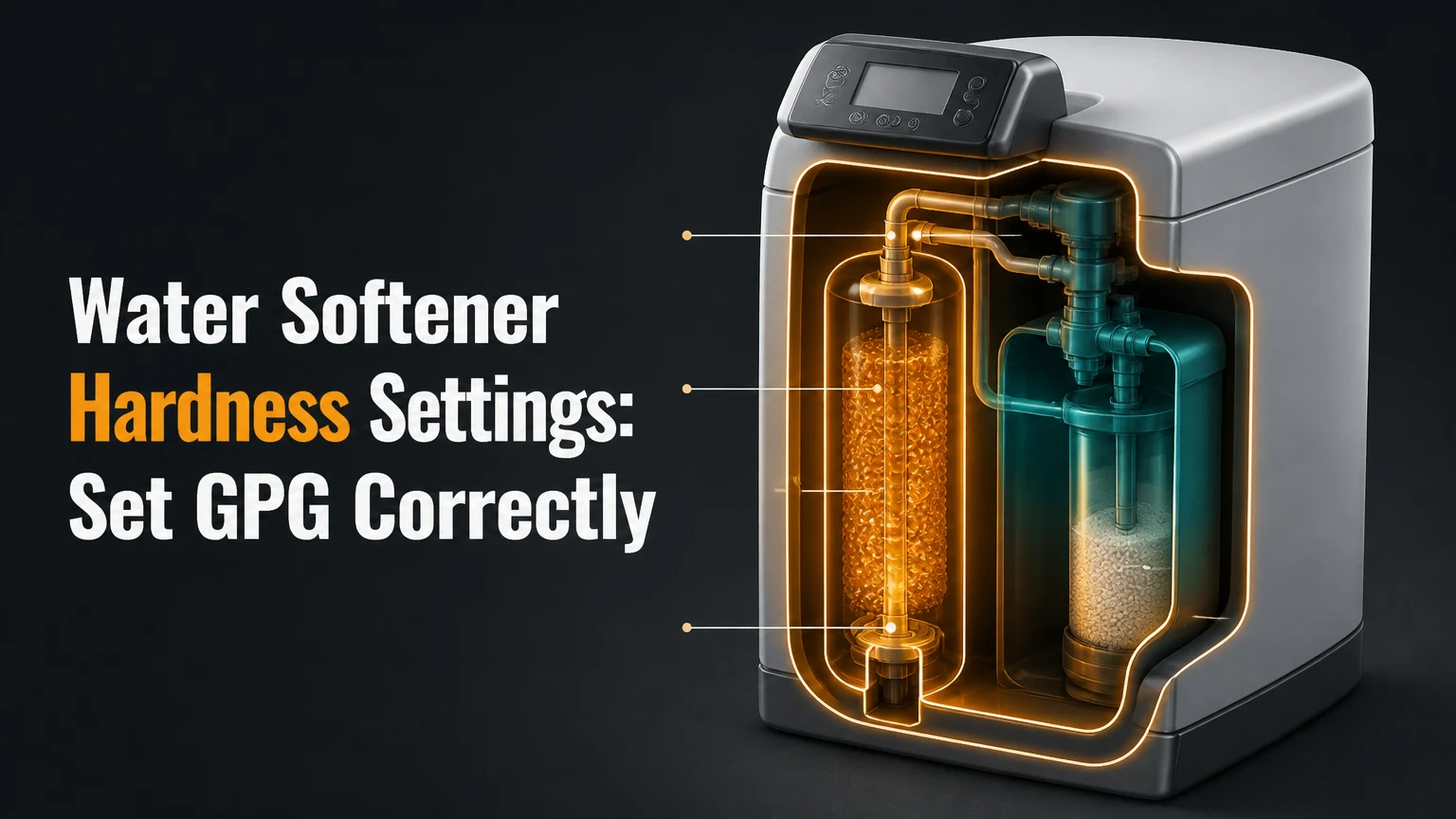
Water softener hardness settings tell a control valve how many grains of hardness the system must remove from each gallon of incoming water. Enter the raw hardness in grains per gallon, add appropriate iron compensation, and confirm the valve’s capacity and reserve settings. The correct value prevents scale while avoiding unnecessary regeneration and salt use.
Key Facts at a Glance
One grain per gallon equals 17.1 milligrams per liter, also written as parts per million for water.
A common iron adjustment is 3 grains per gallon for each 1 milligram per liter of clear-water iron.
A hardness setting describes incoming water; a grain-capacity setting describes the resin’s treatment volume.
Metered-demand valves regenerate according to measured water use, while time-clock valves regenerate on a schedule.
A hardness entry of 150 is usually wrong when a control asks for grains per gallon, because 150 mg/L equals about 8.8 GPG.
Salty water after regeneration is usually a brine, drain, or rinse problem, not a reason to raise hardness.
What Do Water Softener Hardness Settings Mean?
A water softener hardness setting is the programmed hardness concentration used to estimate when the resin bed has treated its available capacity. The setting normally appears in grains per gallon, or GPG, and represents calcium and magnesium in the untreated supply. Some control heads also ask for iron compensation, capacity, people, or reserve information.
Hardness is not the same as the softener’s grain rating. A 32,000-grain label describes nominal exchange capacity under specified salt conditions; a setting of 15 GPG describes the incoming water concentration. The control valve combines those values with water use to estimate regeneration demand.
The U.S. Geological Survey commonly classifies water below 60 mg/L as soft, 61-120 mg/L as moderately hard, 121-180 mg/L as hard, and above 180 mg/L as very hard. Those categories describe water quality, not the correct control-panel entry.
How Do You Convert PPM to GPG?
Divide hardness in PPM or mg/L by 17.1 to convert it to GPG. Multiply GPG by 17.1 to convert in the opposite direction. Water-treatment control valves vary, so follow the unit printed in the programming menu rather than assuming the test report and valve use the same measurement.
| Test result | Conversion | Control entry before compensation |
|---|---|---|
| 85 mg/L | 85 ÷ 17.1 | 5.0 GPG |
| 150 mg/L | 150 ÷ 17.1 | 8.8 GPG |
| 250 mg/L | 250 ÷ 17.1 | 14.6 GPG |
| 342 mg/L | 342 ÷ 17.1 | 20.0 GPG |
| 25 GPG | 25 × 17.1 | 427.5 mg/L |
A lab may report total hardness as calcium carbonate, while a home kit may use German degrees, French degrees, or drops per test. Convert the result before programming. Rounding upward to the next whole GPG is usually safer than rounding downward, provided the valve accepts whole numbers.
How Does a Softener Use the Hardness Setting?
A conventional ion-exchange softener sends hard water through resin beads that exchange calcium and magnesium ions for sodium or potassium ions. During regeneration, a brine solution restores the exchange sites, and the valve then rinses the resin before returning the unit to service.
A metered valve estimates treated gallons from the hardness setting and usable capacity. A simplified calculation is:
Estimated gallons between regenerations = usable grain capacity ÷ compensated hardness
A 24,000-grain usable capacity at 18 GPG supports approximately 1,333 gallons before reserve capacity is considered. Actual results vary because manufacturers publish capacity at particular salt doses, and many systems use a programmed reserve rather than the full nominal rating.
What Is Total Compensated Hardness?
Total compensated hardness is the raw hardness plus the equivalent hardness assigned to iron and, in some programming systems, manganese. For example, 15 GPG hardness with 1 mg/L soluble iron becomes 18 GPG when the common 3-to-1 iron adjustment is used.
The 3 GPG per 1 mg/L iron convention is widely used in residential softener sizing, but it is not a universal chemistry law. Iron fouls resin, and the correct adjustment depends on iron form, pH, flow, resin condition, and the valve manufacturer. An oxidizing iron filter may be more appropriate when iron concentration is high.
| Water constituent | Typical programming treatment | Example impact | Caution |
|---|---|---|---|
| Calcium and magnesium hardness | Enter measured GPG | 15 GPG remains 15 GPG | Use the report’s hardness unit |
| Soluble iron | Add about 3 GPG per 1 mg/L | 1 mg/L adds 3 GPG | Confirm with the manufacturer |
| Manganese | Add a manufacturer-specific equivalent | 0.5 mg/L may require separate treatment | Softener compensation is not universal |
| Ferric iron particles | Filter before softening | Sediment filter removes particles | Test after filtration |
| Hydrogen sulfide odor | Do not treat as hardness | 0 GPG compensation | Use oxidation or specialized filtration |
How to Calculate Water Softener Hardness Settings
Calculate the setting in five steps: obtain a reliable raw-water result, convert it to GPG, compensate for iron when appropriate, verify the control unit, and enter the final number. Most residential programming takes 5-15 minutes once the test result and model information are available.
Step 1: Test the Untreated Water
Collect a sample before the softener, preferably from a cold-water tap supplied directly by the well or municipal line. Do not test a softened tap because the resin has already removed much of the hardness.
A liquid titration kit typically costs $15-$30 and provides a field estimate in about five minutes. A certified laboratory panel commonly costs $50-$150 and may take 3-7 business days. Use laboratory testing when well water contains iron, manganese, nitrate, unusual odor, or changing color.
Step 2: Convert the Result to GPG
Use the conversion formula rather than copying a number from a water report. A report showing 250 mg/L hardness corresponds to 14.6 GPG, which many homeowners would enter as 15 GPG.
Step 3: Add Iron Compensation
Test soluble iron separately. If the result is 1 mg/L and the manufacturer uses the common 3 GPG rule, add 3 GPG to the converted hardness.
Example: 15 GPG hardness + 3 GPG iron compensation = 18 GPG setting
Do not add the adjustment automatically when iron is already removed by an upstream filter. Test the water at the softener inlet, because that is the water the resin actually receives.
Step 4: Confirm Capacity and Valve Units
Find the model number, resin volume, rated grain capacity, and programming manual. A tank marketed as “32,000 grain” may have a lower usable capacity at an efficient salt dose, so do not replace the capacity value with the hardness value.
Some valves ask for hardness only. Others ask for hardness, capacity, salt dose, reserve percentage, day override, and regeneration time. Changing master settings without the manual can reduce rinse performance or cause premature regeneration.
Step 5: Enter the Final Setting and Record It
Enter 18 GPG in the example above, then record the date, test result, iron result, capacity, and salt dose. A written record makes seasonal well-water changes easier to diagnose.
Practitioner rule: Never raise hardness by guesswork before testing. A two-minute bypass check or inlet-water test often identifies a plumbing or resin problem faster than changing the programming value.
How Much Capacity Does a Household Need?
Household sizing depends on compensated hardness, daily water use, and the desired regeneration interval. A practical planning estimate is 60-75 gallons per person per day, although actual use can be lower in an efficient home and much higher during irrigation, bathing, or guest periods.
Use this basic sizing method:
Daily grains = people × gallons per person × compensated GPG
For four people using 75 gallons each per day at 18 GPG, daily demand is 5,400 grains. A system should usually regenerate no more often than every few days, while a day-override limit prevents excessive time between cycles.
| Household | Planning use | Hardness | Daily demand | Approximate usable capacity for 5 days |
|---|---|---|---|---|
| 1 person | 75 gal/day | 10 GPG | 750 grains | 3,750 grains |
| 2 people | 150 gal/day | 15 GPG | 2,250 grains | 11,250 grains |
| 4 people | 300 gal/day | 18 GPG | 5,400 grains | 27,000 grains |
| 5 people | 375 gal/day | 25 GPG | 9,375 grains | 46,875 grains |
The table is a planning illustration, not a prescription for a particular tank. A dealer or manufacturer should match resin volume, salt dose, peak flow, and well-pump output. Oversizing can cause long idle periods, while undersizing can produce frequent regeneration and hard-water leakage.
Which Control Type Uses the Setting Best?
Metered-demand control is usually the best residential choice because the valve measures actual water use instead of regenerating on a fixed calendar. Time-clock controls cost less but waste capacity when occupancy changes. Smart controls add alerts and remote monitoring, but they do not replace accurate water testing.
| Control type | Trigger | Typical residential cost | Main advantage | Main limitation |
|---|---|---|---|---|
| Metered demand | Measured gallons | $600-$1,500 installed | Matches regeneration to use | Turbine can clog with sediment |
| Time clock | Fixed days | $500-$1,200 installed | Simple calendar operation | Regenerates during low use |
| Dual-tank demand | Metered exhaustion | $1,200-$3,000 installed | Continuous soft water | Higher equipment cost |
| Smart connected | Meter plus software | $1,000-$3,500 installed | Alerts and usage history | Requires power and connectivity |
The control valve should also have a day override, often set around 7-14 days depending on the manufacturer and water quality. The override is a hygiene and performance safeguard, not a substitute for correct capacity programming.
How Often Should a Softener Regenerate?
A properly sized metered softener often regenerates every 3-14 days, but household demand and water hardness determine the actual interval. Regeneration every day indicates a capacity, leak, iron, water-use, or programming issue unless the installation has unusually high demand.
A time-clock unit may be scheduled every 3-7 days, but fixed schedules are less efficient when the home is vacant or occupancy changes. Regeneration at night reduces inconvenience, but the valve still needs adequate drain flow and electrical power.
How Do You Verify the Setting After Programming?
Verify softened water with a hardness test at a treated tap after regeneration has completed. The treated result should be near zero or within the manufacturer’s stated leakage tolerance, while the untreated inlet sample should match the value used for programming.
Check these items in order:
- Confirm the bypass handle is fully in service.
- Confirm the valve displays the correct time.
- Confirm the brine tank contains salt but no hard salt bridge.
- Run a manual regeneration if the resin has been exhausted.
- Test cold water after the final rinse.
- Inspect the drain line for kinks, submersion, or restricted flow.
- Compare the result with the inlet-water test.
A water softener does not remove every dissolved contaminant. Hardness may be near zero while iron, nitrate, sodium, chloride, or microbial contamination remains. The treatment objective must match the lab report.
What Are the Most Common Programming Mistakes?
The most damaging mistakes are unit confusion, incorrect capacity, unrecognized iron, and diagnosing plumbing problems as hardness errors. Each mistake changes regeneration frequency differently, so the remedy must match the failure mechanism.
| Mistake | Typical symptom | Likely consequence | Correct response |
|---|---|---|---|
| Entering 150 as GPG instead of mg/L | Regeneration occurs very often | High salt and water use | Convert 150 mg/L to 8.8 GPG |
| Using nominal capacity as usable capacity | Hardness appears before expected | Resin exhausts early | Follow the manufacturer’s salt-dose table |
| Ignoring 1 mg/L iron | Orange stains and shorter capacity | Resin fouling | Test inlet iron and apply approved compensation |
| Leaving the bypass partly closed | Hardness remains after regeneration | Untreated water blends in | Set the bypass fully to service |
| Salt bridge in brine tank | Unit regenerates but water stays hard | Brine cannot dissolve correctly | Break the bridge and inspect the tank |
| Incorrect drain installation | Salty taste or poor rinse | Brine remains in resin | Check drain flow and air gap |
Factory defaults are not reliable evidence of local water conditions. A default value such as 20 GPG may be suitable for one region and excessive for another, while a private well can change substantially after drought, flooding, or pump work.
Why Is Softened Water Still Hard?
Softened water remains hard when the resin is exhausted, the bypass is open, the brine cycle fails, or the programmed capacity does not match actual demand. Increasing the hardness entry by 2-4 GPG can help only when a new water test proves that the incoming supply has become harder.
Start with diagnosis rather than adjustment. Test untreated and treated water, inspect the bypass, confirm salt and brine draw, and check the regeneration history. A resin bed damaged by chlorine, iron, or age may fail even when the hardness setting is accurate.
Municipal hardness can change when a utility changes wells or blends sources. Private-well water can shift more quickly. Retest after plumbing work, a new well pump, visible staining, or a sustained change in taste.
Why Is the Softener Regenerating Too Often?
Frequent regeneration usually results from low usable capacity, excessive water use, a leaking toilet, incorrect hardness units, or iron loading. Lowering the hardness setting without a test can create hard-water leakage and conceal the real problem.
Check the valve’s capacity, hardness, people, meter reading, and day override. Then inspect toilets, outdoor hose connections, and reverse-osmosis equipment for continuous flow. A stuck toilet can consume enough water to trigger a demand meter repeatedly.
Typical residential salt use varies widely, often from 20-80 pounds per month, depending on hardness, household demand, capacity, salt dose, and iron. The $5-$25 monthly range sometimes quoted for salt assumes relatively low local prices and moderate consumption.
Why Does Water Taste Salty After Regeneration?
Salty water after regeneration indicates incomplete brine draw or rinsing, a blocked drain, low drain flow, a malfunctioning injector, or an incorrectly assembled brine line. Do not increase the hardness setting to solve a salty taste, because that increases calculated demand and does not remove residual brine.
Place the softener in bypass and avoid drinking the affected water until the cause is corrected. Check the drain line, injector screen, brine valve, and water pressure according to the manual. A qualified technician should inspect the valve when the unit repeatedly leaves salt in the treated line.
What Settings Work for City Water and Well Water?
City-water programming usually requires the utility’s current hardness report plus a household water test when the report is old or expressed in unfamiliar units. Well-water programming requires a broader analysis because iron, manganese, sediment, pH, and sulfur can alter softener performance.
| Situation | Initial testing | Setting approach | Additional equipment |
|---|---|---|---|
| Municipal water, stable report | Hardness in mg/L or GPG | Convert and round appropriately | Sediment filter if needed |
| Municipal water, blended sources | Hardness test plus utility report | Retest after source changes | None unless contaminants occur |
| Private well, no staining | Hardness, iron, manganese, pH | Use measured compensation | Sediment prefilter |
| Private well, orange staining | Hardness and soluble iron | Follow resin manufacturer’s rule | Iron filtration may be better |
| Well with sulfur odor | Full laboratory panel | Do not treat odor as hardness | Oxidation or specialty filter |
A softener is not a complete well-water treatment system. High iron, manganese, tannins, or suspended particles can require pretreatment, and annual testing is a sensible minimum for many private wells.
Should You Choose a Softener or an Alternative?
An ion-exchange softener is the appropriate option when the goal is to remove calcium and magnesium and produce low-hardness water. Scale-inhibiting cartridges, template-assisted crystallization media, and electronic descalers may reduce deposits or alter crystal formation, but they do not provide equivalent hardness removal.
| Option | Removes hardness ions | Salt required | Typical purpose | Key limitation |
|---|---|---|---|---|
| Ion-exchange softener | Yes | Usually yes | Low-hardness household water | Drain discharge and maintenance |
| Salt-free scale conditioner | No | No | Scale reduction | Hardness remains in water |
| Reverse osmosis | Partly, at one tap | No | Drinking-water polishing | Low flow and wastewater |
| Polyphosphate feeder | No | No | Scale control in selected systems | Consumable media and compatibility |
| Electromagnetic device | No demonstrated universal removal | No | Experimental scale approach | Results vary by water chemistry |
The honest limitation is important: a softener increases sodium in treated water and requires regeneration discharge. People restricting sodium should ask a clinician whether softened water matters for their intake and may use an unsoftened drinking tap or reverse-osmosis system.
What Does Testing and Maintenance Cost?
A homeowner can usually establish a preliminary setting with a $15-$30 titration kit, while a broader certified test commonly costs $50-$150. Professional programming may take 30-90 minutes, and installed residential softener prices commonly range from approximately $500 to $3,500 depending on capacity, plumbing, controls, and pretreatment.
| Item | Typical price or interval | What it covers | Decision point |
|---|---|---|---|
| Liquid hardness kit | $15-$30 | Hardness field test | Routine confirmation |
| Certified laboratory panel | $50-$150 | Hardness and contaminants | Well-water diagnosis |
| Salt supply | $5-$25 monthly, often quoted | Sodium or potassium chloride | Varies with demand |
| Resin replacement | 10-15 years typical | Exchange media | Earlier with iron or chlorine damage |
| Control valve | 7-10 years typical | Meter and regeneration control | Depends on water quality and service |
These are typical planning ranges, not guaranteed prices. Local labor, tank size, access, water chemistry, and pretreatment can move the total substantially.
Frequently Asked Questions
Can I Set Hardness Higher Than My Test Result?
Set hardness higher only when the manufacturer specifies an adjustment for iron, manganese, or another resin-loading factor. Do not add an arbitrary safety margin, because an inflated entry causes earlier regeneration, greater salt use, and more wastewater without improving already soft water.
What Is the Correct Setting for 25 GPG Water?
Enter 25 GPG when the untreated water measures 25 GPG and no additional compensation applies. Add the approved iron adjustment if soluble iron is present. Confirm the softener’s usable capacity separately, because 25 GPG does not mean the system has 25,000 grains of capacity.
Does a Water Softener Need a Hardness Setting for Salt-Free Operation?
A salt-free scale conditioner generally does not need a hardness setting because it does not exchange or remove hardness ions. A metered ion-exchange softener does need hardness programming, even when the household uses potassium chloride instead of sodium chloride.
How Long Does It Take for a New Setting to Work?
A new hardness entry affects the valve’s regeneration calculation immediately, but it does not restore exhausted resin until regeneration occurs. A manual regeneration followed by the complete rinse cycle can return treated water within several hours, depending on the valve and water pressure.
Should Drinking Water Go Through the Softener?
Drinking water may pass through a properly maintained softener, but treated water contains more sodium than the source water. A separate unsoftened cold-water tap or point-of-use reverse-osmosis system may be preferable for people following medical sodium restrictions.
What Happens if the Softener Is Set Too Low?
A hardness value set too low makes the valve overestimate remaining resin capacity. The resin can exhaust before regeneration, allowing calcium and magnesium into the treated supply and causing scale, spotting, and reduced soap performance.
The Bottom Line
Correct water softener hardness settings begin with measured inlet hardness, not a factory default or a visual guess. Convert the result to GPG, add only documented iron compensation, program usable capacity separately, and verify treated water after regeneration. For city water, check the utility report; for well water, test iron, manganese, pH, and sediment before choosing the final setting.