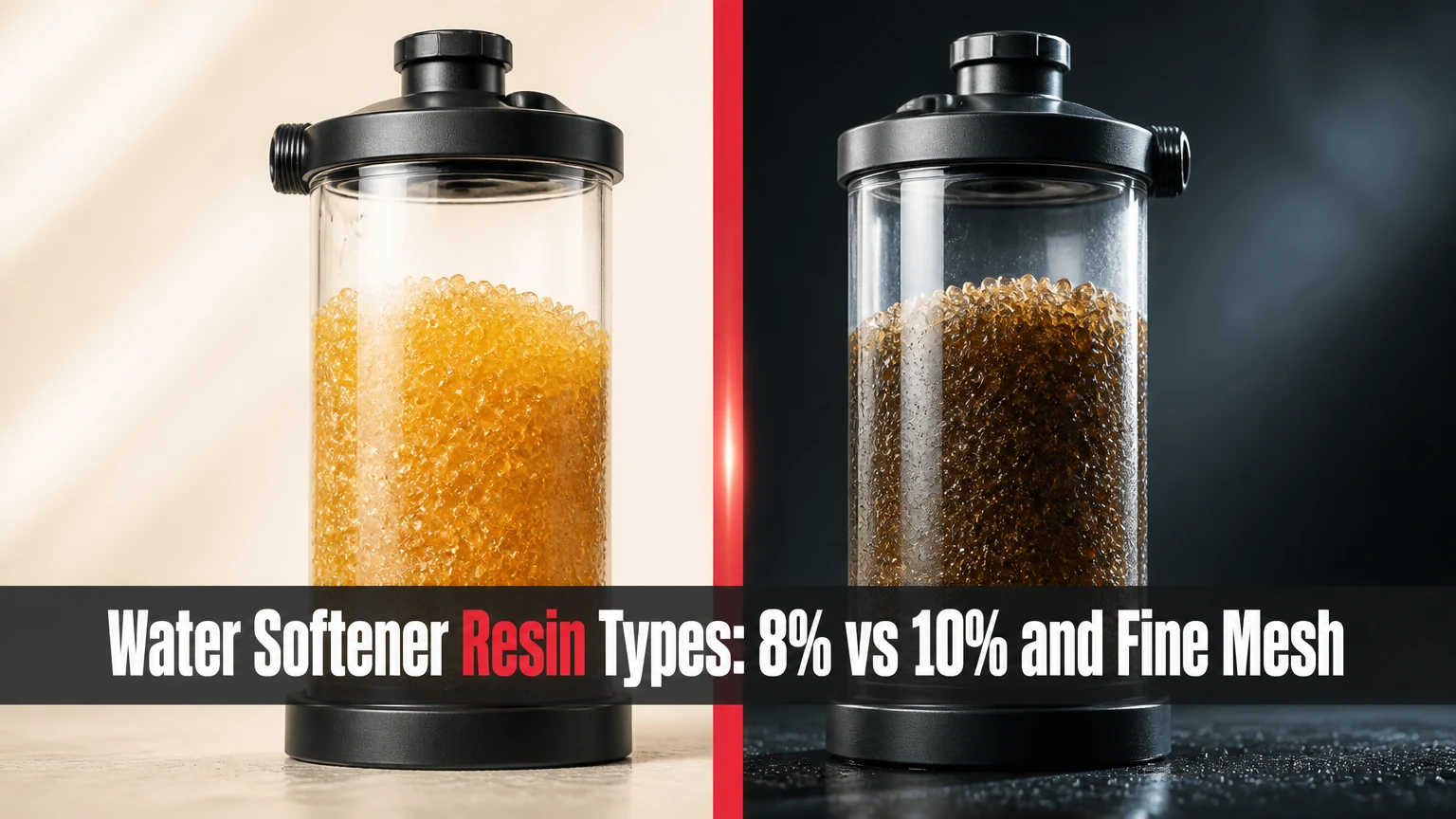
Water softener resin types are ion-exchange media selected according to water hardness, iron, oxidant exposure, flow rate, salt setting, and treatment goals. Standard gel cation resin is the usual choice for hardness, while 10% cross-link, fine mesh, shallow-shell, macroporous, and specialty resins solve narrower problems with different costs and limitations.
Key Facts at a Glance
- Standard water softeners use strong-acid cation resin made from a styrene-divinylbenzene polymer.
- The 8% and 10% labels describe approximate divinylbenzene cross-linking, not a universal capacity or quality grade.
- Fine mesh resin can exchange ions efficiently, but smaller beads create greater pressure-drop and plugging risks.
- Iron, manganese, chlorine, chloramine, sediment, tannin, and nitrate may require pretreatment or a different resin class.
- A typical residential softener contains 0.75-2.5 cubic feet of resin, depending on household demand and tank size.
- Resin life commonly ranges from 8-15 years, but chlorine, chloramine, iron fouling, heat, and poor regeneration can shorten it substantially.
What Is Water Softener Resin?
Water softener resin is the replaceable ion-exchange media inside a mineral tank. The media consists of small, porous polymer beads with fixed negatively charged sites that attract positively charged ions, especially calcium, magnesium, sodium, and potassium.
Most residential softeners use strong-acid cation resin in the sodium form. During service, calcium and magnesium attach to the resin and release sodium or potassium into the treated water. The process reduces scale-forming hardness, but it does not disinfect water or remove every dissolved contaminant.
What does the 8% or 10% label mean?
The cross-link percentage describes the approximate amount of DVB used to connect the styrene polymer chains. Higher cross-linking generally makes a bead more resistant to swelling, osmotic shock, and chemical attack, although the final performance also depends on bead porosity, manufacturing quality, bead size, functional groups, and operating conditions.
The 8% and 10% figures are therefore useful shorthand, not complete specifications. A well-made 8% resin may outperform a poorly manufactured 10% resin under a particular salt dose or water chemistry.
What does resin remove?
| Water constituent | Ordinary cation softener resin | Typical better solution |
|---|---|---|
| Calcium hardness | Removes by ion exchange | Standard softener |
| Magnesium hardness | Removes by ion exchange | Standard softener |
| Ferrous iron | May remove limited amounts | Iron filter or specialty resin |
| Ferric iron particles | Does not reliably remove | Sediment or oxidizing filter |
| Chlorine | Does not remove as a treatment target | Activated carbon |
| Chloramine | Does not remove reliably | Catalytic carbon |
| Nitrate | Does not remove | Anion exchange or reverse osmosis |
| Tannin | Does not remove | Tannin-selective anion resin |
Water softener resin is not a substitute for carbon filtration, iron treatment, microbial disinfection, or nitrate treatment. A laboratory water test should determine whether hardness is the only problem.
How Does Ion Exchange Work?
Strong-acid cation resin softens water because divalent calcium and magnesium ions have a stronger attraction to exchange sites than monovalent sodium or potassium ions. Water passes through the resin bed, hardness ions occupy the exchange sites, and sodium or potassium moves into the treated water.
The exchange is reversible. A concentrated sodium chloride or potassium chloride solution restores the resin to its working form during regeneration. Resin capacity is measured in grains of hardness, but actual usable capacity depends on resin volume, salt dosage, water quality, contact time, and the control valve’s programming.
What happens during service?
- Raw water enters the mineral tank.
- The distributor spreads water across the resin bed.
- Calcium and magnesium attach to negatively charged exchange sites.
- Sodium or potassium enters the outlet stream.
- The lower distributor collects softened water and sends it to the plumbing.
The resin does not function like a simple sieve. Hardness ions diffuse into the bead and exchange at chemically active sites. Excessive flow can reduce contact time and cause hardness leakage, even when the resin has not reached its theoretical capacity.
What happens during regeneration?
| Regeneration stage | Typical residential duration | Main purpose | Drain discharge |
|---|---|---|---|
| Backwash | 8-15 minutes | Loosen bed and remove sediment | Sediment and rinse water |
| Brine draw and slow rinse | 30-60 minutes | Replace calcium with sodium | Calcium, magnesium, and brine |
| Fast rinse | 5-15 minutes | Remove residual brine and settle bed | Dilute saltwater |
| Brine refill | 5-15 minutes | Prepare the next brine dose | Water into brine tank |
The control valve initiates regeneration by meter volume, schedule, or both. Backwash requires a drain flow rate sufficient to expand the bed without carrying resin out of the tank. Brine concentration, injector size, salt dose, and rinse time determine whether the bed regenerates completely.
Which Resin Types Are Available?
The main categories are standard gel cation, higher-cross-link cation, fine mesh, shallow-shell, macroporous, and specialty anion resins. These categories overlap in commercial descriptions, so the product data sheet matters more than a label alone.
| Resin type | Typical bead or structure | Best application | Main limitation |
|---|---|---|---|
| 8% cross-link gel | About 0.3-1.2 mm beads | Clean municipal water | Lower oxidant resistance |
| 10% cross-link gel | About 0.3-1.2 mm beads | Chlorinated water or moderate well conditions | Higher purchase cost |
| Fine mesh cation | About 0.2-0.5 mm beads | Limited ferrous iron and high exchange kinetics | Greater plugging and pressure-drop risk |
| Shallow-shell cation | Functional outer shell over a core | Lower salt and rinse consumption | Product-specific behavior and price |
| Macroporous cation | Larger internal pore network | Fouling-prone or chemically demanding water | Capacity and chlorine claims vary |
| Anion resin | Positively charged functional sites | Nitrate or tannin removal | Requires different regeneration chemistry |
1. Standard 8% cross-link resin
Standard 8% gel resin is the economical default for municipal water with moderate hardness and controlled chlorine exposure. A typical 1-cubic-foot charge may be marketed around 30,000-32,000 grains, although the usable capacity at efficient salt settings is lower than the maximum advertised rating.
Typical media cost is about $90-$140 per cubic foot before labor. On relatively clean water, service life often falls in the 8-15-year range. Chlorine exposure, sediment, iron, heat, and repeated mechanical stress can reduce that period.
Standard resin is a poor choice when a well contains significant iron or when the water supplier uses substantial chloramine and no carbon pretreatment exists. It remains the sensible choice when the water test shows hardness with little iron and the price difference matters.
2. 10% cross-link resin
10% cross-link resin generally provides greater resistance to oxidation and bead degradation than comparable 8% gel resin. It does not automatically provide a 10% capacity increase, and higher DVB content can reduce swelling and alter diffusion behavior.
Typical cost is about $130-$200 per cubic foot. A common residential rating remains approximately 30,000-32,000 grains per cubic foot at a specified salt dose, so buyers should compare capacity curves rather than marketing numbers alone.
10% resin is appropriate for chlorinated municipal supplies, moderate well-water stress, and owners who plan to keep a tank in service for many years. It will not remove chloramine adequately by itself, and it will not replace an iron filter when iron exceeds the resin manufacturer’s limit.
3. Fine mesh resin
Fine mesh resin uses smaller beads that provide a large external surface area and short diffusion distances. The design can improve exchange kinetics and may capture some clear-water ferrous iron, but it is more sensitive to suspended solids, bed fouling, and hydraulic design.
Typical pricing falls around $150-$240 per cubic foot. Claims of 5-10 parts per million iron removal are application-specific, not a universal operating limit. Iron form, pH, oxygen exposure, regeneration frequency, resin cleaner, and contact time determine actual performance.
Fine mesh resin needs a compatible distributor and backwash rate. A smaller bead can be lost through damaged or improperly selected screens, but a “special” top screen is not automatically required for every product. Always follow the resin manufacturer’s bead-size and distributor specifications.
4. Shallow-shell resin
Shallow-shell resin places most functional exchange sites near the bead surface, reducing the distance ions must travel. Products such as Purolite SST-type media are engineered for faster kinetics and potentially lower salt and rinse requirements under controlled settings.
Manufacturers may report salt savings of roughly 20%-50% compared with conventional operating settings, but those results depend on the valve, resin volume, hardness, reserve capacity, and programmed salt dose. The resin does not create savings if the softener remains programmed at an unnecessarily high salt setting.
Prices commonly range from $220-$350 per cubic foot. Shallow-shell media suits high water use, restricted discharge systems, and owners willing to pay more upfront for operating efficiency. It is not a universal cure for iron, chlorine, or poor softener sizing.
5. Macroporous cation resin
Macroporous resin contains a more open internal structure than ordinary gel resin. The structure can improve resistance to fouling from larger organic molecules and certain contaminants, but macroporosity alone does not guarantee high chlorine or chloramine resistance.
Typical pricing is about $250-$400 per cubic foot. Capacity, moisture content, pore volume, and oxidant stability differ by product. Some macroporous resins are designed for organic fouling, while others target demanding industrial chemistry.
Households should not select macroporous resin solely because a listing says “high chlorine.” The technical data sheet should state chlorine or oxidant compatibility, operating pH, maximum temperature, recommended regeneration, and capacity at the intended salt dose.
6. Anion, tannin, and nitrate resin
Anion resin uses positively charged functional groups to exchange negatively charged ions. Nitrate-selective resin targets nitrate, while tannin-selective resin targets dissolved organic compounds that can produce tea-colored water and staining.
These are not interchangeable with ordinary sodium-cycle softener resin. They use different selectivity, capacity, regeneration behavior, and monitoring requirements. A nitrate system also requires careful sizing because nitrate leakage can rise as the bed approaches exhaustion.
How Do Resin Types Compare?
The best resin depends first on the contaminant profile, then on oxidant exposure, flow rate, salt efficiency, and budget. A high-priced media is wasteful when standard resin already matches the water chemistry, while inexpensive resin can become costly when iron or chlorine rapidly shortens its life.
| Decision factor | 8% gel | 10% gel | Fine mesh | Shallow-shell |
|---|---|---|---|---|
| Typical media cost per cubic foot | $90-$140 | $130-$200 | $150-$240 | $220-$350 |
| Typical residential capacity range | 30,000-32,000 grains | 30,000-32,000 grains | 28,000-32,000 grains | 30,000-40,000 grains |
| Typical clean-water life | 8-15 years | 10-15 years | 5-10 years | 10-15 years |
| Clear-water iron suitability | Often below 1-3 ppm | Often below 3-5 ppm | Product-specific, sometimes higher | Product-specific |
| Chlorine tolerance | Lower | Higher | Variable | Variable |
| Pressure-drop risk | Low to moderate | Low to moderate | Moderate to high | Low to moderate |
The figures in the table are typical purchasing ranges, not guarantees. Resin manufacturers publish different capacity and oxidant tests, so a comparison is valid only when salt dose, flow rate, temperature, and influent chemistry are comparable.
Which resin is best for city water?
10% cross-link resin is usually the safer upgrade for chlorinated city water, while 8% resin is adequate for clean water with modest oxidant exposure. If the supply contains chloramine, install catalytic carbon upstream rather than assuming 10% resin solves the problem.
Which resin is best for well water?
10% resin is suitable for well water with hardness and limited dissolved iron after testing. Fine mesh resin can help with certain clear-water ferrous iron applications, but an iron filter is more dependable when iron is high, oxidized, or accompanied by manganese and sediment.
Which resin uses the least salt?
Shallow-shell resin can use less salt at a properly optimized setting, but valve programming determines much of the result. A correctly sized standard resin operating at 6-8 pounds of salt per cubic foot may outperform an oversized premium bed programmed at 15 pounds per cubic foot.
How Much Resin Does a Softener Need?
A residential softener commonly needs 0.75-2.5 cubic feet of resin, and the correct volume depends on daily hardness load, peak flow, reserve capacity, and tank dimensions. Resin volume must leave enough freeboard for backwash expansion, so filling a tank completely is unsafe.
| Mineral tank size | Typical resin volume | Approximate nominal capacity | Common household use |
|---|---|---|---|
| 9 x 48 inches | 0.75 cubic feet | 24,000 grains | 1-2 occupants |
| 10 x 54 inches | 1.0 cubic foot | 30,000-32,000 grains | 2-4 occupants |
| 12 x 48 inches | 1.5 cubic feet | 45,000-48,000 grains | 3-5 occupants |
| 13 x 54 inches | 2.0 cubic feet | 60,000-64,000 grains | 4-6 occupants |
| 14 x 65 inches | 2.5 cubic feet | 75,000-80,000 grains | High demand or large home |
Calculate daily hardness demand by multiplying people, gallons per person per day, and hardness in grains per gallon. For example, four people using 60 gallons each at 20 grains per gallon create 4,800 grains per day before reserve capacity and unusual peak use.
A 1-cubic-foot bed rated at 32,000 grains may deliver considerably less at an efficient salt dose. Oversizing can reduce regeneration frequency, but extreme oversizing can cause long idle periods, channeling, and stale water in the bed.
What Shortens Resin Life?
Chlorine, chloramine, iron, manganese, sediment, oil, bacterial growth, excessive heat, and poor backwash conditions shorten resin life. Resin damage often appears first as hardness leakage, pressure loss, or colored beads in fixtures.
| Failure condition | Typical symptom | Likely cause | Corrective action |
|---|---|---|---|
| Hard water after regeneration | Hardness test remains positive | Exhausted or fouled resin | Test brine draw and clean or replace media |
| Orange or black beads | Beads appear in aerators | Broken distributor or riser | Bypass system and inspect internals |
| Rising pressure loss | Flow weakens at several fixtures | Fouling, bed compaction, or degraded resin | Check sediment, backwash, and media condition |
| Salt remains in brine tank | Brine level does not change | Blocked injector or pickup tube | Clean injector and verify brine draw |
| Frequent regeneration | Valve regenerates too often | Incorrect hardness or capacity setting | Reprogram using test results and meter data |
| Salty water after regeneration | Sodium chloride taste | Incomplete rinse or excessive brine | Verify drain flow, rinse time, and injector |
A resin cleaner may remove some iron and organic fouling, but it cannot restore beads that have chemically degraded or physically collapsed. If resin has become soft, slimy, or clay-like, replacement is normally more practical than repeated cleaning.
What Should You Install Before the Resin?
Pretreatment should address the contaminant that damages or overwhelms the resin. Sediment filtration protects the distributor and bed, carbon reduces chlorine, catalytic carbon targets chloramine, and dedicated iron treatment reduces oxidation and fouling.
- Test hardness, iron, manganese, pH, tannin, nitrate, chlorine, and total dissolved solids.
- Install sediment filtration when visible particles or well sediment exceed the softener’s specification.
- Use activated carbon for free chlorine and catalytic carbon for chloramine.
- Treat high iron before the softener when the resin manufacturer’s limit is exceeded.
- Set the control valve using measured hardness, resin volume, salt dose, and household demand.
- Confirm drain flow and backwash capacity before loading fine mesh or specialty media.
A softener is often installed in the wrong position because homeowners treat hardness as the only water problem. For example, oxidized iron can enter as particles, bypass resin exchange sites, and accumulate in the bed even when a laboratory report lists only a modest total iron value.
What Does Resin Replacement Cost?
Typical replacement media costs about $90-$400 per cubic foot, while professional removal and reloading commonly adds several hundred dollars. A complete residential replacement may therefore cost approximately $300-$1,200, depending on resin volume, access, tank condition, valve compatibility, and disposal.
| Replacement scope | Typical media quantity | Typical total cost | Typical labor time |
|---|---|---|---|
| Small 0.75-cubic-foot bed | 0.75 cubic feet | $300-$550 | 1.5-3 hours |
| Standard 1-cubic-foot bed | 1.0 cubic foot | $400-$700 | 2-4 hours |
| Large 2-cubic-foot bed | 2.0 cubic feet | $650-$1,100 | 3-5 hours |
| Specialty shallow-shell bed | 1.0-2.0 cubic feet | $650-$1,200 | 2-5 hours |
These are typical North American planning ranges, not fixed quotes. Replacing resin is poor value when the control valve, bypass, brine system, or tank distributor is also failing.
How is resin replaced?
The tank is depressurized and disconnected, the old media is removed, the distributor is protected during loading, and the new resin is added with the correct freeboard. After reassembly, the system is slowly filled, backwashed, rinsed, and tested for hardness before returning to service.
Never pour dry resin directly onto an exposed distributor tube. A damaged lateral or riser can release thousands of beads into household plumbing during the first regeneration.
Common Selection Mistakes
Mistake 1: Choosing fine mesh solely for iron
Fine mesh resin may reduce some clear-water ferrous iron, but it does not reliably handle ferric particles, bacterial iron, manganese, or severe oxidation. Use an iron-treatment stage when the test result, pH, and iron form exceed the resin’s documented operating range.
Mistake 2: Assuming 10% resin doubles capacity
The 10% cross-link designation describes polymer structure, not a guaranteed doubling of grain capacity. Compare manufacturer capacity curves at the same salt dose and flow rate.
Mistake 3: Treating chloramine like chlorine
Chloramine is more persistent and often requires catalytic carbon. A stronger cation resin may tolerate some oxidant exposure, but the resin remains a hardness medium rather than a chloramine filter.
Mistake 4: Ignoring flow rate
A resin bed can have enough total grain capacity yet fail during simultaneous showers, washing machines, and fixtures. Size the control valve and bed for peak gallons per minute, not only daily grain demand.
Mistake 5: Filling the mineral tank too high
Freeboard is needed for bed expansion during backwash. Overfilling raises the risk of resin loss through the drain and prevents proper removal of sediment.
Which Resin Should You Choose?
| User situation | Recommended starting point | Add or verify | Avoid |
|---|---|---|---|
| Municipal water, hardness only | 8% gel cation | Chlorine report and metered valve | Paying for specialty media without a need |
| Municipal water with chlorine | 10% gel cation | Carbon pretreatment if exposure is high | Assuming resin removes chlorine |
| Municipal water with chloramine | 10% resin plus catalytic carbon | Chloramine concentration and carbon contact time | Using resin alone |
| Well water, iron below about 3 ppm | 10% gel cation | Iron form, pH, and cleaning routine | Unverified high-iron claims |
| Well water, ferrous iron near 3-10 ppm | Fine mesh only when documented | Iron filter comparison and backwash rate | Fine mesh with heavy sediment |
| Low-salt operating priority | Shallow-shell resin | Capacity curve and valve settings | Expecting automatic savings |
| Nitrate or tannin problem | Selective anion resin | Laboratory testing and leakage monitoring | Ordinary softener resin |
The practical rule is simple: use standard cation resin for hardness, stronger or engineered cation resin for documented stress, and another treatment process for contaminants that are not cations. Water softener resin types should be chosen from a water analysis and operating profile, not from the highest advertised grain number.
Frequently Asked Questions
Can different resin types be mixed in one tank?
Mixing resin types is usually discouraged because different beads can have different density, size, swelling, and regeneration requirements. The lighter or smaller media may stratify unpredictably, while one resin may regenerate before another. Use a blended bed only when the manufacturer specifies the blend and loading sequence.
Does water softener resin remove bacteria?
Ordinary softener resin is not a disinfectant and should not be relied on for bacteria, viruses, or parasites. Private wells require microbiological testing, and a positive result may require shock chlorination, ultraviolet treatment, continuous disinfection, or another system designed for the identified organism.
Is potassium chloride better than sodium chloride?
Potassium chloride can reduce sodium addition to treated water, but it usually costs more and may require a different control setting because potassium regeneration is less efficient by weight. Follow the valve and resin manufacturer’s instructions rather than changing salt type without reprogramming.
How can you tell whether resin is exhausted or damaged?
Test treated water hardness immediately after regeneration and again near the expected capacity point. Exhausted resin regenerates normally when brine strength, draw time, and rinse are correct; damaged or fouled resin continues leaking hardness, loses pressure, or produces abnormal bead texture and color.
Can resin remove lead or other heavy metals?
Some ion-exchange resins can target specific metals, but ordinary sodium-cycle softener resin is not a certified universal lead-removal device. Lead treatment should use a process certified for the contaminant and verified by laboratory testing, particularly when drinking-water exposure is possible.
How often should softener resin be replaced?
Many residential beds last 8-15 years on suitable water, but no calendar interval guarantees replacement. Test performance, inspect for pressure loss and bead leakage, and investigate chlorine, chloramine, iron, heat, and distributor damage before purchasing new media.
The Bottom Line
Water softener resin types differ mainly in cross-linking, bead size, pore structure, exchange kinetics, oxidant resistance, and regeneration efficiency. Choose 8% resin for clean hardness-only water, 10% resin for greater chemical durability, fine mesh for carefully documented ferrous-iron conditions, shallow-shell media for optimized low-salt operation, and anion resin for nitrate or tannin.
The correct water softener resin types decision begins with a water test and ends with capacity, flow, pretreatment, and valve settings that match the home. Resin cannot compensate for untreated chloramine, heavy sediment, excessive iron, undersized equipment, or an incorrectly programmed regeneration cycle.