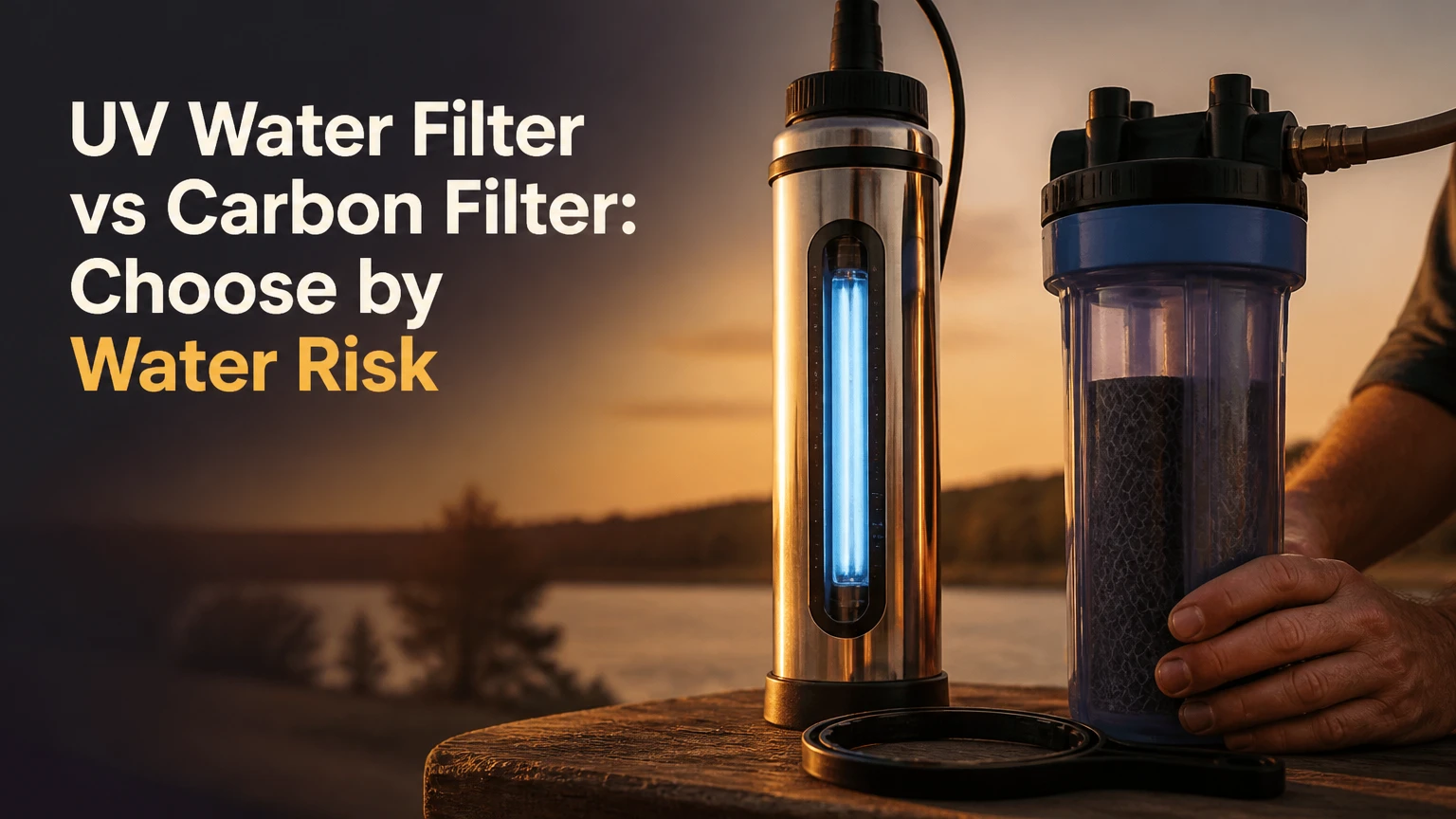
A UV water filter vs carbon filter decision depends on the contaminant you need to control: ultraviolet treatment inactivates bacteria, viruses, and protozoa, while activated carbon reduces selected chemicals, chlorine, taste, odor, and some organic compounds. UV does not remove dissolved chemicals, and carbon does not reliably disinfect water, so many well-water systems use both.
Key Facts at a Glance
- A UV purifier disinfects by delivering a measured UV-C dose; it does not remove sediment, hardness, metals, chlorine, or PFAS.
- An activated carbon filter adsorbs selected contaminants, but performance depends on carbon type, contact time, cartridge capacity, and certification.
- UV requires electricity, clear water, correct flow sizing, lamp monitoring, and periodic quartz-sleeve cleaning.
- Carbon filters require replacement by gallon capacity or time, even when water still tastes acceptable.
- NSF/ANSI certification identifies specific contaminant-reduction claims; a generic “carbon filter” label does not prove PFAS or lead removal.
- A typical well-water arrangement is sediment filtration, optional iron or hardness treatment, activated carbon when needed, then UV disinfection.
UV Water Filter vs Carbon Filter: What Is the Difference?
UV and carbon filters solve different water-quality problems. A UV system is a physical disinfection process that exposes flowing water to ultraviolet-C energy, while activated carbon is a porous treatment medium that captures certain molecules on its internal surface.
| Decision factor | UV purifier | Activated carbon filter | Practical consequence |
|---|---|---|---|
| Main function | Microbial inactivation | Chemical adsorption and particle reduction | Choose by contaminant class |
| Electricity | Typically 15-80 watts | None | UV needs continuous power |
| Typical residential flow | 5-20 gallons per minute | 0.5-10 gallons per minute | Peak demand affects sizing |
| Chemical reduction | None | Chlorine, VOCs, selected PFAS | Carbon needs a specific claim |
| Microbial protection | Bacteria, viruses, protozoa at rated dose | Limited and unreliable | Carbon is not a disinfectant |
| Typical replacement | Lamp about yearly | Cartridge every 3-12 months | Both require scheduled service |
| Typical equipment cost | About $400-$1,500 installed | About $100-$800 installed | Water complexity changes totals |
The decisive distinction is treatment purpose. UV is the stronger choice for a verified microbial risk; carbon is the stronger choice for chlorine, taste, odor, and certified chemical reduction. A carbon filter can make unsafe water taste clean, while UV-treated water can remain chemically unpleasant.
Which option is better for most homes?
For chlorinated municipal water with no known microbial concern, a certified carbon block usually provides more noticeable value. For untreated private-well water with positive coliform results, UV is generally the relevant barrier after adequate pretreatment. A combined system is appropriate when the source has both microbial and chemical concerns.
The answer should follow a laboratory water report, not a product category. The U.S. Environmental Protection Agency recommends testing private wells at least annually for total coliform bacteria and nitrate, with additional testing based on local risks such as flooding, nearby agriculture, or fuel storage.
How Do UV Purifiers Work?
UV water purifiers inactivate microorganisms by exposing water to germicidal UV-C energy, commonly near 254 nanometers in low-pressure mercury systems. The energy damages microbial DNA or RNA so organisms cannot reproduce or cause infection, but UV does not physically remove the disabled organism from the water.
A UV reactor contains a lamp inside a quartz sleeve. Water passes around the sleeve at a controlled flow rate, and the system must deliver enough UV dose across the reactor, commonly specified in millijoules per square centimeter. Faster flow, cloudy water, lamp aging, or a dirty sleeve can reduce delivered dose.
UV performance depends on more than lamp wattage. UV transmittance, measured as a percentage, indicates how easily light travels through the water; dissolved iron, manganese, tannins, turbidity, and suspended particles can absorb or scatter UV energy. The National Sanitation Foundation’s NSF/ANSI 55 standard covers UV microbiological water treatment systems, including Class A systems intended for contaminated water and Class B systems intended for supplemental treatment of already potable water.
What does UV remove from water?
UV controls susceptible microorganisms, not dissolved substances. A correctly sized and maintained system can address bacteria such as E. coli, many viruses, and protozoan cysts such as Giardia and Cryptosporidium, but the exact claim must match the system’s certification and dose.
| Water issue | UV result | Required condition | Better or additional treatment |
|---|---|---|---|
| E. coli bacteria | Inactivates at rated dose | Clear water and correct flow | Sediment pretreatment |
| Giardia cysts | Inactivates at rated dose | Adequate UV transmittance | Turbidity control |
| Cryptosporidium | Inactivates at rated dose | Certified reactor and dose | Fine filtration may assist |
| Chlorine taste | No reduction | UV has no adsorption media | Carbon block |
| Lead or arsenic | No reduction | Dissolved metals pass through | Certified media or reverse osmosis |
| Hardness minerals | No reduction | Calcium remains dissolved | Water softener |
| PFAS | No reduction | UV does not capture PFAS | Certified carbon or reverse osmosis |
UV is not a substitute for filtration. A sediment cartridge protects the reactor from particles, but iron, manganese, hardness, and tannins may require dedicated treatment before the lamp.
How Does Activated Carbon Work?
Activated carbon filters remove contaminants through adsorption, where dissolved molecules attach to the carbon surface, rather than absorption into the entire material. Carbon’s microscopic pores provide extensive surface area, but each cartridge has a finite capacity that depends on contaminant concentration, water temperature, flow, pH, and contact time.
Granular activated carbon allows water to pass through loose particles with relatively low pressure loss. Carbon block media compresses carbon into a denser cartridge, which generally improves particle reduction and limits channeling, although the denser structure can restrict flow sooner.
Catalytic carbon is modified to improve reactions involving chloramine or hydrogen sulfide. Standard coconut-shell GAC may perform well against chlorine and many taste-and-odor compounds, but buyers should not assume that one carbon type removes every chemical.
What does activated carbon remove?
Activated carbon can reduce chlorine, many volatile organic compounds, pesticides, unpleasant odors, and selected PFAS when the product carries a contaminant-specific certification. Carbon performance is not universal because adsorption chemistry varies by molecule and the cartridge can reach breakthrough before its calendar replacement date.
| Contaminant or symptom | Typical carbon result | Media or certification issue | Buyer check |
|---|---|---|---|
| Free chlorine | Usually effective | Standard GAC or block commonly used | NSF/ANSI 42 claim |
| Chloramine | Variable | Catalytic carbon often preferred | Rated chloramine capacity |
| Taste and odor | Often effective | Contact time affects result | Flow limit and gallon rating |
| VOCs and pesticides | Often effective for selected compounds | Carbon grade matters | Named contaminant claim |
| PFAS | Product-specific | High-capacity carbon and long contact time | NSF/ANSI 53 or 58 claim |
| Lead | Product-specific | Special adsorption or block formulation | NSF/ANSI 53 claim |
| Fluoride | Usually ineffective | Carbon is not the normal solution | Reverse osmosis or activated alumina |
| Bacteria and viruses | Not reliable | Carbon is not a disinfectant | Use UV or another validated barrier |
NSF/ANSI 42 generally covers aesthetic effects such as chlorine, taste, and odor. NSF/ANSI 53 addresses health-effect contaminants, while NSF/ANSI 401 covers certain emerging compounds. Certification applies to the tested contaminant, model, flow, and capacity, not to every cartridge sold under a similar brand name.
Which Technology Handles the Most Important Water Problems?
UV wins for microbiological safety, while activated carbon wins for chemical taste, odor, and many certified organic contaminant claims. Neither technology is a complete treatment system for mineral hardness, nitrate, salt, fluoride, or every heavy metal.
| User need | Preferred technology | Why | Important limitation |
|---|---|---|---|
| Positive coliform test in a private well | UV after pretreatment | Adds a microbial barrier | Does not correct the source |
| Chlorine taste at a kitchen tap | Carbon block | Adsorbs free chlorine | Cartridge capacity is finite |
| Chloramine smell | Catalytic carbon | Better reaction pathway | Requires adequate contact time |
| PFAS reduction | Certified carbon or RO | Media can capture selected PFAS | Generic carbon claims are insufficient |
| Cloudy well water | Sediment or clarification first | UV needs light transmission | UV alone cannot clarify water |
| Hard water scale | Softener | Exchanges hardness ions | Neither UV nor carbon softens water |
| Nitrate contamination | Reverse osmosis or ion exchange | Targets dissolved nitrate | Requires testing and maintenance |
| Microbial and chemical concerns | Carbon plus UV | Covers different contaminant classes | Sequence and sizing matter |
The most common purchasing mistake is treating a micron rating as proof of chemical or microbial performance. A 0.5-micron carbon block may reduce particles and some cysts, but pore size alone does not establish viral protection, chemical capacity, or certified pathogen inactivation.
What Are the Main Types and Specifications?
UV systems differ by lamp technology, reactor design, monitoring, and rated flow. Carbon systems differ by media form, carbon chemistry, cartridge size, and tested capacity.
| System type | Typical specification | Best application | Main drawback |
|---|---|---|---|
| Low-pressure mercury UV | 254 nm, 15-80 W | Whole-house well treatment | Lamp replacement and electricity |
| Amalgam UV | Higher-intensity single lamp | Larger flow demand | Higher purchase cost |
| UV-C LED | Instant start, low-flow design | Point-of-use or compact systems | Residential whole-house options remain limited |
| GAC cartridge | 5-10 micron nominal range | Taste and chlorine reduction | Channeling can reduce contact |
| Carbon block | About 0.5-5 micron rating | Kitchen and drinking-water taps | Greater pressure drop |
| Catalytic carbon | Chloramine or sulfur-focused media | Municipal chloramine or odor problems | Media selection must match chemistry |
A UV lamp rated for 12 gallons per minute cannot automatically protect a home drawing 18 gallons per minute. Oversizing the reactor is safer than relying on a lamp’s maximum marketing flow, especially when water has low UV transmittance.
Activated carbon requires the opposite kind of sizing discipline. A cartridge that treats 1,000 gallons at a low contaminant concentration may have a different capacity at higher chlorine, chloramine, or PFAS concentrations. Use the manufacturer’s gallon limit and flow specification, then replace the cartridge at the earlier of its time or capacity limit.
How Much Do UV and Carbon Systems Cost to Own?
Typical residential equipment costs range from $400-$1,500 installed for a UV system and $100-$800 installed for a carbon system, excluding major plumbing, electrical work, well repairs, softeners, or reverse-osmosis equipment. Annual consumables commonly cost $80-$250 for UV and $60-$300 for carbon, depending on flow and water quality.
| Ownership item | UV system | Carbon system | Typical timing |
|---|---|---|---|
| Equipment purchase | $300-$1,200 | $50-$500 | Once |
| Professional installation | $200-$800 | $50-$300 | Once |
| Lamp or cartridge | $60-$180 | $20-$200 | 6-12 months |
| Quartz sleeve | $40-$150 | Not applicable | Replace when damaged |
| Electricity | $15-$80 per year | $0 | Continuous UV operation |
| Unplanned service | Ballast, sensor, leak | Housing, pressure loss | Water-dependent |
These figures are typical retail and installation ranges, not guaranteed quotes. A UV system can cost less than an elaborate carbon installation when the goal is only microbial treatment, while a carbon cartridge can become expensive when high flow, chloramine, PFAS, or frequent replacement is involved.
Can You Use Carbon and UV Together?
Carbon and UV can be used together, and the usual whole-house sequence is sediment filtration, contaminant-specific pretreatment, carbon when needed, then UV. The sequence removes particles and improves UV transmission before the final disinfection barrier.
A practical arrangement is:
- Sediment filter: Remove sand, rust, and suspended particles.
- Iron, manganese, or hardness treatment: Add only when testing identifies the problem.
- Carbon media: Reduce chlorine, chloramine, sulfur odor, or certified organic contaminants.
- UV reactor: Disinfect the clear, treated water immediately before distribution.
Carbon before UV is often appropriate for municipal water because carbon removes disinfectant residuals and improves taste. However, removing chlorine can allow microbial regrowth in downstream plumbing, so the UV reactor should sit near the point where treated water enters the building or at the drinking-water outlet.
For a private well, test the raw source and treated water. A UV lamp cannot repair a cracked well casing, a contaminated storage tank, or a plumbing cross-connection.
Which Should You Choose?
Private well with bacteria
Choose a certified UV system with sediment pretreatment when a laboratory test identifies coliform bacteria or the well has a credible contamination risk. Correct the source where possible, because UV treats water leaving the reactor but does not make a defective well sanitary.
Municipal water with chlorine taste
Choose a certified carbon block at the kitchen tap or point of entry. A whole-house carbon tank may be justified when showers, laundry, and household odor matter, but a point-of-use cartridge usually costs less and preserves municipal disinfectant in unused plumbing.
Rainwater or storage-tank supply
Use staged filtration and UV only after controlling turbidity and maintaining the tank. Rainwater systems often need leaf screening, sediment removal, and testing because organic debris can rapidly consume carbon capacity and shield microorganisms from UV.
RV, cabin, or off-grid use
Choose treatment based on power reliability and flow. A small carbon cartridge can improve taste, while a UV-C LED unit may suit intermittent, low-flow use, but battery capacity, startup controls, stagnation, and source testing matter more than the label “portable.”
Known PFAS, nitrate, or arsenic
Do not select UV alone or a generic carbon cartridge. Use a treatment certified for the named contaminant, such as high-capacity carbon or reverse osmosis for selected PFAS, and follow local health-department guidance for nitrate or arsenic.
What Maintenance and Failure Modes Matter Most?
UV systems need continuous operation, lamp replacement according to the manufacturer’s schedule, sensor and alarm checks, and quartz-sleeve cleaning. Carbon systems need cartridge replacement before capacity is exhausted, flushing after installation, and inspection for leaks or pressure loss.
| Symptom | Likely cause | Immediate action | Prevention |
|---|---|---|---|
| UV alarm sounds | Lamp, ballast, sensor, or power fault | Stop relying on treated water | Keep a spare lamp |
| UV output falls | Dirty sleeve or cloudy water | Clean sleeve and test pretreatment | Monitor turbidity and iron |
| Carbon flow drops | Sediment loading or exhausted block | Replace cartridge and prefilter | Install staged sediment control |
| Black particles appear | Carbon fines from new cartridge | Flush to manufacturer direction | Flush every replacement |
| Taste returns | Carbon breakthrough | Replace by capacity | Track gallons and date |
| Warm water near UV chamber | Long stagnant dwell time | Flush before drinking | Use bypass or flush routine |
Practitioner rule: do not wait for taste, odor, or pressure to signal carbon replacement. Many health-related contaminants have no detectable taste, and a cartridge can exceed capacity while water still appears normal.
A second rule concerns outages. If a UV unit loses power, treat downstream water as untreated until the system confirms full operation; keep an alternative safe-water supply rather than assuming the lamp resumes at full dose instantly.
The common claim that saturated carbon suddenly releases every trapped contaminant is overstated. Breakthrough is usually progressive and contaminant-specific, although poor flow control, media disturbance, chemical changes, or severe exhaustion can cause a noticeable deterioration. Replacement schedules remain essential.
What Should You Test Before Buying?
Test the source before choosing treatment. Municipal users can obtain a water-quality report and test at the tap when plumbing materials or local advisories raise concerns; private-well owners should use an accredited laboratory for total coliform, nitrate, pH, hardness, iron, manganese, turbidity, and locally relevant contaminants.
The test result should answer four questions:
- Is the hazard biological, chemical, physical, or mineral?
- Does the water need point-of-use or whole-house treatment?
- What peak flow must the system handle?
- Which independent certification covers the named contaminant?
A filter’s brand, micron number, and lamp wattage do not answer those questions by themselves. Water chemistry determines media selection, and hydraulic design determines whether the treatment receives enough contact time or UV dose.
FAQ
Does UV make water safe to drink?
A properly sized, certified UV system can inactivate microorganisms when water clarity, UV transmittance, flow, lamp condition, and dose meet the manufacturer’s requirements. UV does not remove chemicals, metals, nitrate, hardness, or particles, so safe drinking water may require additional treatment and laboratory verification.
Can a carbon filter remove viruses?
A standard activated carbon filter cannot reliably remove or inactivate viruses. Some specialized membrane systems combine very fine filtration with other barriers, but a carbon label alone is not evidence of viral protection. Use validated UV, reverse osmosis, or another certified disinfection process for a microbiological risk.
Does a UV filter remove chlorine?
UV does not remove chlorine because ultraviolet energy does not adsorb dissolved disinfectant. Activated carbon is the normal choice for free-chlorine reduction, while catalytic carbon is often selected for chloramine. Check the product’s NSF/ANSI 42 claim and rated capacity rather than relying on the media name.
Is a carbon block better than granular activated carbon?
A carbon block generally provides more consistent particle reduction and less channeling, while GAC usually offers higher flow with lower pressure loss. Carbon block is often preferable for a drinking-water tap; GAC or carbon tanks may suit higher-flow applications when the contaminant claim and contact time are adequate.
Should UV go before or after carbon?
UV usually goes after sediment and carbon treatment so the reactor receives clear water and provides the final microbial barrier. Carbon can remove chlorine residual, so placing UV near the building entry or treated-water outlet reduces the chance of downstream microbial regrowth.
How often should a UV lamp and carbon cartridge be replaced?
Many residential UV lamps are replaced every 9,000 hours, approximately once per year, even when the lamp still glows. Carbon cartridges commonly last 3-12 months, but gallon capacity, contaminant load, flow, and water quality determine the actual interval. Follow the earlier of the rated time or capacity limit.
Conclusion
The UV water filter vs carbon filter choice is a contaminant decision, not a universal product ranking. Choose UV for a verified microbial risk, choose certified activated carbon for chlorine, taste, odor, and selected chemicals, and combine sediment pretreatment, carbon, and UV when testing shows both biological and chemical concerns.