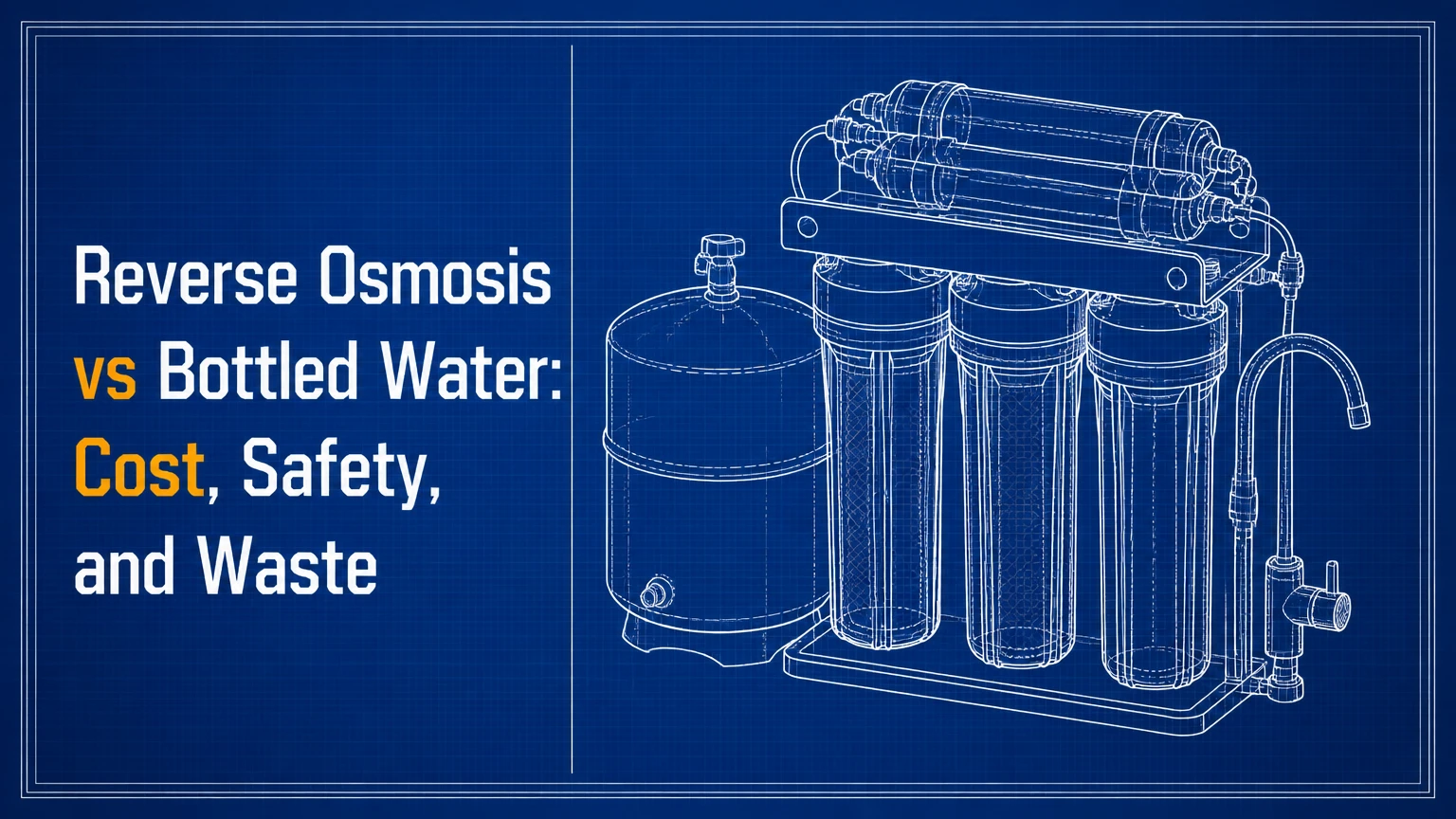
Reverse osmosis usually offers the better long-term household supply because a certified, maintained system can reduce many dissolved contaminants at a far lower cost and with less packaging waste. Bottled water remains better for portability, immediate access, and short-term emergencies, but its safety depends on the source, treatment, container, storage, and handling.
Key Facts at a Glance
- Reverse osmosis is a treatment process; bottled water is a packaged product that may use reverse osmosis.
- A residential RO system commonly costs $150-$600 before installation and produces drinking water for roughly $0.02-$0.10 per gallon after purchase and maintenance.
- Retail bottled water commonly costs $0.25-$2.00 per gallon for large cases and substantially more for small bottles or delivery service.
- Typical residential RO systems reject 1-4 gallons of concentrated water for each gallon of treated water, although efficient models can approach a 1:1 ratio.
- RO reduces many dissolved salts, lead, arsenic, fluoride, nitrate, and PFAS when the specific system is certified for those contaminants.
- Bottled water is the more practical choice for travel and outages, while RO is usually the more economical choice for daily drinking and cooking.
Reverse Osmosis vs Bottled Water: What Is the Difference?
Reverse osmosis and bottled water are not equivalent technologies. Reverse osmosis describes how water is treated, while bottled water describes how treated or untreated potable water is packaged and sold.
An RO system uses feed pressure to push water across a semipermeable membrane. The membrane allows water molecules to pass more readily than many dissolved ions, organic compounds, microorganisms, and suspended particles. Carbon and sediment stages protect the membrane and improve taste, but the final result depends on membrane condition, pressure, pretreatment, and certification.
Bottled water can be purified municipal water, spring water, mineral water, or another regulated packaged-water product. The U.S. Food and Drug Administration regulates bottled water as a packaged food, while the U.S. Environmental Protection Agency regulates public drinking-water systems under the Safe Drinking Water Act. Those regulatory systems address different points in the supply chain.
What types of bottled water are sold?
| Label category | Typical source | Common treatment | Defining U.S. requirement |
|---|---|---|---|
| Purified water | Municipal or groundwater | RO, distillation, deionization, carbon | Must meet purified-water quality standard |
| Spring water | Underground formation | Filtration, disinfection, limited treatment | Must flow naturally to the surface |
| Mineral water | Protected underground source | Limited treatment | At least 250 mg/L total dissolved solids |
| Sparkling bottled water | Spring, mineral, or purified source | Carbon dioxide added | Carbonation must remain at bottling and sale |
| Alkaline water | Municipal or groundwater | Mineral addition or electrochemical treatment | pH claim does not prove contaminant removal |
“Alkaline” describes pH, not comprehensive purification. “Natural” describes source or processing rules, not a guarantee that a bottle removes lead, nitrate, PFAS, or microorganisms.
How Does an RO System Work?
A residential reverse osmosis system normally uses sediment filtration, activated carbon, a membrane, a storage or direct-flow stage, and a final polishing filter. The RO membrane performs the main dissolved-contaminant reduction, but the supporting stages determine whether the membrane remains functional and whether the water tastes acceptable.
The sequence matters. Sediment filters remove particles that could foul the membrane, carbon filters reduce chlorine and many taste compounds, and feed pressure drives water through the membrane. Treated water, called permeate, moves to a tank or faucet; concentrated reject water carries a portion of the retained contaminants to the drain.
A nominal membrane pore-size figure such as 0.0001 micron is often used in consumer explanations, but pore size alone is not a valid performance guarantee. Rejection varies by contaminant, pH, temperature, pressure, membrane age, and system design. NSF/ANSI 58 certification provides a more useful purchasing signal because it identifies tested reduction claims for specific contaminants.
| RO stage | Primary job | Typical replacement interval | Failure consequence |
|---|---|---|---|
| Sediment prefilter | Removes sand, rust, silt, and particles | 6-12 months | Pressure loss and membrane fouling |
| Carbon prefilter | Reduces chlorine, VOCs, tastes, and odors | 6-12 months | Chlorine damage to some membranes |
| RO membrane | Reduces dissolved ions and selected contaminants | 2-5 years | High TDS, slow production, poor rejection |
| Storage tank or direct-flow module | Holds or delivers treated water | 5-12 years for tank | Low volume or intermittent supply |
| Post-carbon filter | Polishes taste after storage | 6-12 months | Flat, stale, or plastic-like taste |
| Remineralization cartridge | Adds limited calcium or magnesium | 6-12 months | Taste and pH drift |
The U.S. Environmental Protection Agency’s household-treatment guidance emphasizes a point often missed in product marketing: treatment devices should be selected for the contaminants present in a particular water supply, not for a generic “purity” claim. A laboratory water report or current utility consumer confidence report should guide the specification.
Which Contaminants Does Each Option Remove?
Certified RO generally has the broader dissolved-contaminant reduction capability, but bottled water does not have one uniform treatment profile. A purified bottle may use RO or distillation, whereas spring water may retain much of its original mineral content and use only limited filtration and disinfection.
| Contaminant or attribute | Certified residential RO | Purified bottled water | Spring or mineral bottled water |
|---|---|---|---|
| Lead | Often reduced, certification required | Often reduced if RO or distillation is used | Source-dependent |
| Arsenic | Often reduced, species and certification matter | Treatment-dependent | Source-dependent |
| Fluoride | Commonly reduced | Often reduced by RO or distillation | Usually retained unless treated |
| Nitrate | Often reduced, certification required | Treatment-dependent | Source-dependent |
| PFAS | Some systems certified for reduction | Treatment-dependent | Source-dependent |
| Bacteria and viruses | Physical reduction varies; disinfection may be needed | Bottling treatment and sanitary controls apply | Disinfection and source controls apply |
| Chlorine taste | Carbon stages reduce it | Usually absent or low after treatment | Source and treatment dependent |
| Calcium and magnesium | Substantially reduced | Low in purified water, higher in mineral water | Commonly retained |
| Total dissolved solids | Commonly reduced 90% or more | Varies by label and process | Often moderate or high |
RO does not automatically make unsafe well water safe. Bacteria, hydrogen sulfide, iron, manganese, hardness, and sediment may require pretreatment, ultraviolet disinfection, oxidation, softening, or a whole-house design. A UV lamp can inactivate microorganisms, but it does not remove dissolved chemicals.
Bottled water also has limits. FDA bottled-water standards generally align with EPA public-water standards for many contaminants, but consumers cannot infer a contaminant-specific result from the word “bottled.” The brand’s water-quality report and treatment description provide better evidence.
Is RO Water Healthier Than Bottled Water?
Neither label alone proves that one water is healthier. Certified RO is usually the stronger choice when a household has a documented dissolved-contaminant concern, while bottled water is reasonable when portability, temporary access, or emergency storage matters more than recurring cost and packaging.
RO reduces minerals that contribute to hardness and taste, including calcium and magnesium. That does not make RO water nutritionally deficient for most people because drinking water is not the main source of dietary minerals; foods provide the majority of calcium and magnesium in a typical diet. Some users prefer a remineralization cartridge for taste, but remineralization does not recreate every property of mineral water.
A practical health assessment has four variables: the original water, the target contaminant, the verified reduction claim, and maintenance. An expired carbon filter, damaged membrane, contaminated storage tank, or poorly sanitized faucet can undermine a technically capable system.
Bottled water can be preferable for a person with no reliable potable supply, during a boil-water advisory, or when a medical professional has specified a low-mineral or low-sodium product. Infant-feeding decisions should follow local public-health and pediatric guidance rather than a marketing claim about alkalinity or “purity.”
Is alkaline or mineral bottled water better than RO?
Mineral water may supply small amounts of calcium and magnesium, but its mineral profile does not make it universally healthier than RO water. Alkaline water has limited evidence for broad health advantages, and a higher pH does not indicate removal of PFAS, lead, nitrate, or pathogens.
Which Option Costs Less Over Five Years?
RO usually costs less for households that drink several gallons weekly, even after filter replacement and reject-water charges. Bottled water can be cheaper initially because no equipment or installation is required, but recurring retail, delivery, transport, and disposal costs quickly dominate.
The following model uses typical U.S. household figures rather than a universal price. It assumes a $350 under-sink RO system, $100 installation, $100 annual consumables, and 600 gallons of drinking and cooking water per year.
| Five-year cost item | Under-sink RO | 5-gallon delivery | Retail 1-gallon containers | Retail 16.9-ounce bottles |
|---|---|---|---|---|
| Equipment or deposit | $450 initial | $50-$150 deposit | $0 | $0 |
| Water purchase | $15-$40 | $3,000-$6,000 | $750-$2,400 | $1,500-$4,500 |
| Filters and service | $400-$650 | Included or delivery fee | Included in price | Included in price |
| Electricity | $10-$40 | $0 at home | $0 at home | $0 at home |
| Five-year total | $875-$1,180 | $3,050-$6,150 | $750-$2,400 | $1,500-$4,500 |
| Typical treated-water cost | $0.29-$0.39/gal | $1.00-$2.00/gal | $1.25-$4.00/gal | $2.00-$6.00/gal |
The RO total includes the purchase price but excludes unusual plumbing repairs. Municipal water charges also vary, although the added water and sewer cost from reject water is usually modest compared with bottled-water purchases.
A family using 2 gallons daily would consume about 3,650 gallons over five years. At $0.30 per gallon for RO, that volume costs roughly $1,095 after equipment and maintenance assumptions; at $1.50 per gallon for delivered or retail bottled water, it costs about $5,475.
Does RO Waste More Water Than Bottled Water?
RO wastes water during membrane separation, while bottled water shifts most of its environmental burden to plastic production, filling, refrigeration, and transport. Neither option has zero impact, but an efficient point-of-use RO system usually has a lower packaging footprint for routine household use.
Typical older residential systems produce 1-4 gallons of reject water per gallon of permeate. Efficiency depends on feed pressure, temperature, membrane area, flow restrictor, recovery setting, and whether the system uses a pump. EPA WaterSense labeling is useful where available because certified systems meet defined efficiency and performance criteria.
Reject water is not automatically toxic. It contains a higher concentration of the substances already present in the feed water, so households sometimes reuse it for toilet flushing, cleaning, or landscaping when local plumbing and chemical conditions make that appropriate. Do not use it on salt-sensitive plants or for drinking.
Bottled water creates a different resource demand. The International Bottled Water Association notes that bottled water is regulated as a food product, but regulatory compliance does not eliminate the energy used to manufacture containers or move water long distances. A refillable bottle supplied by RO, filtered tap water, or a dispenser avoids most single-use packaging.
Is Bottled Water Safer During an Outage?
Sealed bottled water is usually safer and more practical during a power outage, pressure loss, boil-water advisory, flood, or major plumbing failure. A standard under-sink RO unit needs pressurized feed water and may need electricity if it uses a booster pump, so it should not be the only emergency supply.
The U.S. Federal Emergency Management Agency recommends storing at least 1 gallon of water per person per day for several days, with additional water for heat, illness, pets, and sanitation. Bottles are portable and immediately usable, while a large emergency container reduces packaging but requires rotation, cleaning, and a reliable dispensing method.
RO is useful after an outage only when the source remains safe, pressure is adequate, and the system has been protected from contamination. Never assume a stored RO tank is safe indefinitely. Replace stagnant water according to the manufacturer’s instructions and sanitize the system when required.
| Situation | Better primary option | Reason | Backup requirement |
|---|---|---|---|
| Daily home drinking | Certified under-sink RO | Low recurring cost and broad reduction | Keep several sealed gallons |
| Apartment rental | Countertop RO or bottled water | No permanent plumbing changes | Confirm electrical and refill access |
| Boil-water advisory | Sealed bottled water | Immediate verified package barrier | Follow local health department notice |
| Well with bacteria risk | Pretreatment, UV, and RO | RO alone is not a disinfection plan | Test well water at least annually |
| Travel or evacuation | Bottled water | Portable and ready to use | Rotate stored cases |
| Low-pressure rural supply | Pump-assisted RO or alternative | Feed pressure controls production | Install pressure monitoring |
How Should an RO System Be Maintained?
RO maintenance requires scheduled filter changes, periodic sanitation, leak inspection, and performance testing. Carbon and sediment filters commonly change every 6-12 months, while membranes often last 2-5 years, but actual intervals depend on water quality and usage.
Use a TDS meter as a trend tool, not as a complete safety test. A low TDS reading does not prove removal of every contaminant, and some hazardous substances do not raise TDS substantially. For a documented concern, use a laboratory test or a certified reduction claim.
Practitioner rules prevent many avoidable failures:
- Replace carbon prefilters before their rated capacity is exhausted, especially when the membrane is chlorine-sensitive.
- Measure feed and product flow after installation, then repeat when taste, pressure, or production changes.
- Check for leaks after every cartridge change, because a slow fitting leak can damage cabinets before it becomes visible.
- Sanitize tanks, housings, and tubing according to the manufacturer’s procedure rather than pouring unapproved chemicals through the membrane.
- Confirm that the automatic shutoff valve stops drain flow when the tank is full.
| Symptom | Likely cause | First check | Corrective action |
|---|---|---|---|
| Slow faucet flow | Empty or waterlogged tank, clogged filters | Tank pressure and filter age | Replace filters or set empty-tank pressure to manufacturer range |
| Constant drain flow | Faulty shutoff or check valve | Tank-full behavior | Replace valve or restrictor |
| Bad taste after replacement | Insufficient flushing or old postfilter | Flush volume and cartridge date | Flush and replace postfilter if needed |
| High product TDS | Worn membrane, low pressure, bypass leak | Feed pressure and TDS trend | Correct pressure or replace membrane |
| Leaking housing | Cross-threaded or damaged seal | O-ring seating | Reseat seal and hand-tighten correctly |
| Empty storage tank | Low pressure or blocked feed | Feed valve and pressure | Restore pressure, then inspect filters |
Which Should You Choose?
The best decision depends on volume, water chemistry, mobility, and resilience rather than on a universal claim that one option is safer. For most homeowners drinking at least 1 gallon daily, a certified under-sink RO system with appropriate pretreatment is the practical winner; bottled water wins for transport and short-term continuity.
Homeowners and families
Choose an under-sink RO system when the household drinks 5-15 gallons weekly, owns the property, and wants lower long-term cost. Select NSF/ANSI 58 certification for the contaminants of concern, add remineralization only for taste, and retain several sealed bottles for outages.
Renters and students
Choose a countertop RO system when manual filling and electricity are acceptable. Bottled water may be simpler for a short lease, but a renter who consumes multiple cases monthly can recover a countertop system’s cost quickly.
Well-water households
Test the well first. RO should follow sediment, hardness, iron, sulfur, or microbial pretreatment when those conditions exist. UV may be necessary for biological control, because the RO membrane is not a substitute for a complete well-water treatment design.
Travelers and emergency planners
Choose bottled water for vehicles, evacuation bags, workplaces without reliable taps, and active advisories. Store water away from direct sunlight and excessive heat, rotate older stock, and avoid relying on a plumbed appliance during a grid or pressure failure.
People who prefer mineral taste
Choose spring or mineral bottled water if taste and mineral profile outweigh cost and packaging concerns. A remineralizing RO stage can improve taste, but it will not necessarily match the exact calcium, magnesium, bicarbonate, or sodium profile of a named mineral-water source.
What Are the Main Alternatives?
Activated-carbon filtration is often the simplest lower-cost alternative when the primary problems are chlorine taste, odor, and some organic compounds. Carbon does not reliably remove dissolved salts, nitrate, fluoride, or every PFAS compound unless the specific cartridge is certified for that claim.
Distillation removes many dissolved solids and microorganisms through evaporation and condensation, but it uses more energy and can produce flat-tasting water. UV disinfection targets microorganisms without reducing dissolved chemicals. A whole-house sediment or carbon filter protects plumbing and improves bathing water, but point-of-use RO remains more appropriate for broad drinking-water treatment.
The best system can combine methods. For example, a private well may need sediment filtration, iron treatment, softening, UV, and point-of-use RO, while treated municipal water may need only carbon filtration or RO for a documented contaminant.
FAQ
Does reverse osmosis remove microplastics?
Reverse osmosis can physically reduce many suspended particles, including microplastics, because the membrane barrier is much finer than those particles. Certification and system condition still matter, and plastic tubing, fittings, storage tanks, and bottles can introduce particles downstream, so replace damaged components and maintain the postfilter.
Can bottled water be made with reverse osmosis?
Yes. Purified bottled water may be produced with reverse osmosis, distillation, deionization, carbon filtration, or a combination of processes. A bottle labeled spring or mineral water follows a different source definition, so the word “bottled” does not identify the treatment method.
Does RO remove beneficial minerals?
RO removes much of the calcium, magnesium, sodium, bicarbonate, and other dissolved material that contributes to total dissolved solids. Most dietary minerals come from food, not water. A remineralization cartridge can change taste and add limited minerals, but it is optional for most healthy adults.
Is bottled water safer than tap water?
Bottled water is not automatically safer than compliant municipal tap water. Bottled water and public water are regulated under different frameworks, and quality depends on source protection, treatment, distribution, container storage, and testing. During an advisory or infrastructure failure, sealed bottled water is usually the safer immediate option.
How often should an RO membrane be replaced?
A residential RO membrane commonly lasts 2-5 years, although high sediment, chlorine exposure, low pressure, scaling, and heavy use can shorten that period. Replace it when rejection performance declines, not solely by calendar date. Compare feed and product readings and follow the manufacturer’s replacement criteria.
Can RO water be used for cooking?
Yes. RO water is suitable for drinking, cooking, coffee, ice, and infant formula only when the system is properly maintained and the source water is appropriate. For infant feeding, follow local health guidance and formula instructions, because safe preparation depends on more than the water-treatment label.
The Bottom Line
Reverse osmosis vs bottled water is primarily a choice between an on-site treatment system and a packaged distribution method. Choose certified, maintained RO for routine household volume, documented dissolved-contaminant reduction, lower five-year cost, and less single-use plastic. Choose sealed bottled water for portability, advisories, outages, and emergency reserves. The most reliable household plan uses RO for daily supply and keeps a modest bottled-water reserve for situations when plumbing, pressure, or electricity fails.