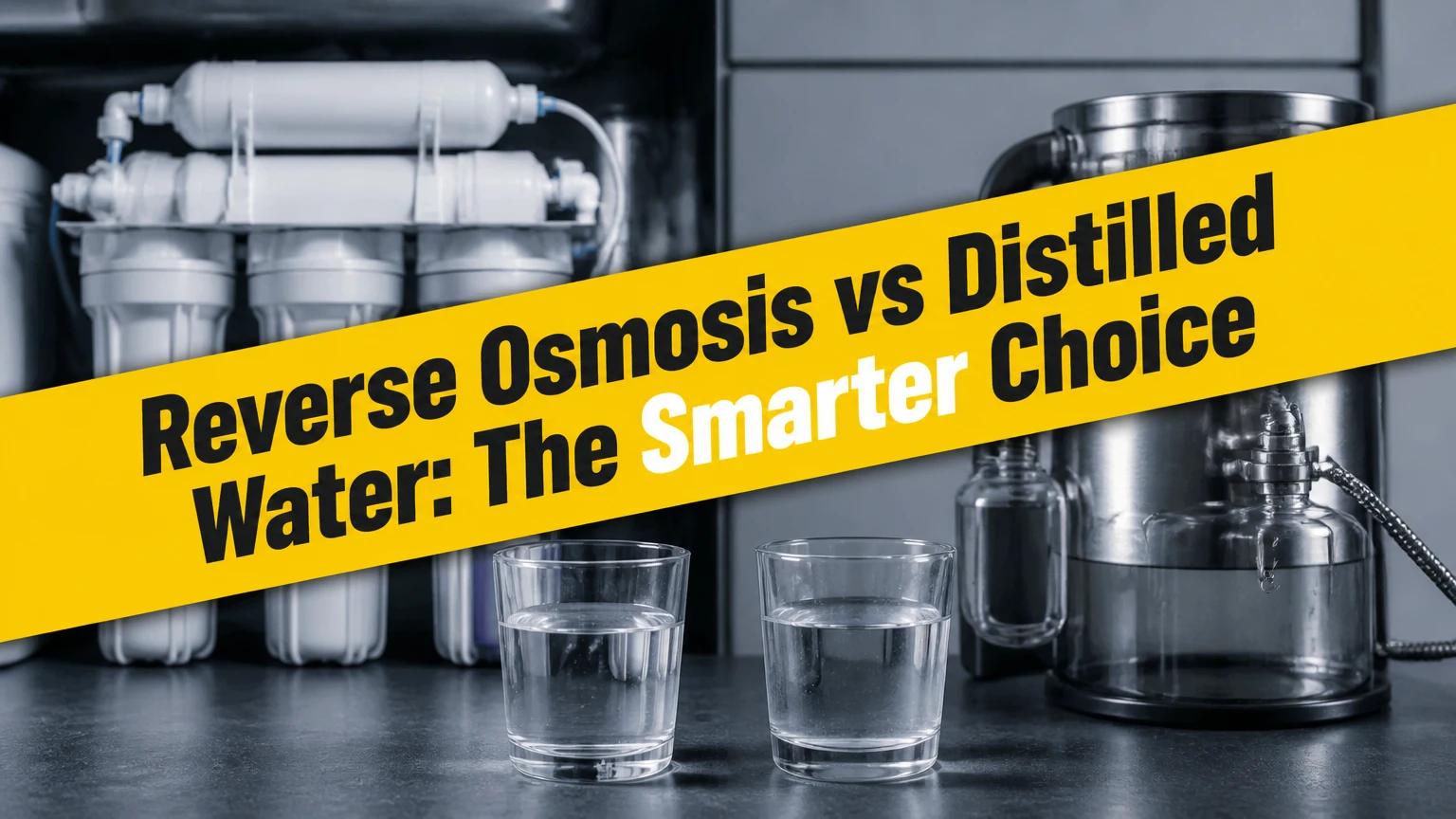
Reverse osmosis and distilled water both reduce dissolved contaminants, but they do so differently. Reverse osmosis is usually the better household choice for frequent drinking because it produces water efficiently at the tap, while distillation is preferable when near-total mineral removal matters more than speed, electricity use, or operating cost.
Key facts at a glance
Reverse osmosis pushes pressurized water through a semipermeable membrane and sends a concentrated reject stream to the drain.
Distillation boils water, condenses the vapor, and leaves most nonvolatile minerals and metals in the boiling chamber.
A typical residential RO system produces about 1 gallon of treated water for every 1-4 gallons sent to waste, depending on design and pressure.
A countertop distiller commonly needs 4-6 hours to produce 1 gallon and uses roughly 3-4 kilowatt-hours per gallon.
Neither method removes every contaminant automatically: volatile compounds can pass through a distiller, while RO performance depends on membrane condition, pressure, and pretreatment.
Drinking-water safety depends on contaminant testing and certified performance, not on a low TDS reading alone.
Reverse Osmosis vs Distilled Water: What Is the Difference?
Reverse osmosis is a pressure-driven membrane process. A pump or household water pressure forces feed water through a thin-film composite membrane, while salts, metals, microorganisms, and other rejected substances remain in the concentrate stream.
Distillation is a thermal separation process. A distiller heats water until it vaporizes, moves the steam through a condenser, and collects the liquid after it returns to water. Most dissolved solids do not vaporize with water, so they remain behind with the boiler residue.
The central distinction is selective membrane separation versus phase change. Reverse osmosis is continuous and relatively economical for drinking water; distillation is batch-based and often achieves lower mineral content, but it consumes substantially more energy.
The two outputs can look identical. A laboratory TDS meter cannot, by itself, prove that either product is free from volatile organic compounds, pathogens, or every regulated contaminant.
How Do RO and Distillation Work?
Reverse osmosis process
A household RO system normally uses several treatment stages:
| Stage | Main function | Typical replacement or condition | Important limitation |
|---|---|---|---|
| Sediment cartridge | Removes sand, rust, and silt | 6-12 months | Does not remove dissolved salts |
| Activated carbon block | Reduces chlorine, taste, odor, and some VOCs | 6-12 months | Capacity depends on carbon mass and flow |
| Thin-film composite membrane | Reduces dissolved ions, metals, microbes, and TDS | 2-5 years | Needs adequate pressure and chlorine protection |
| Post-carbon cartridge | Polishes taste after storage | 6-12 months | Does not substitute for membrane treatment |
| Remineralization cartridge | Adds limited calcium and magnesium | 6-12 months | Changes taste, but does not restore original water chemistry |
A residential membrane often has a manufacturer-rated rejection percentage rather than a universal purity guarantee. A membrane may reject approximately 95-99% of many dissolved solids under specified test conditions, but actual results change with feed-water temperature, pressure, pH, age, and concentration.
The common 0.0001-micron figure describes an approximate effective separation scale. It should not be treated as a complete certification statement because membranes reject contaminants through size exclusion, diffusion, charge effects, and operating conditions.
Distillation process
A countertop distiller follows a shorter physical sequence:
| Production step | What happens | Typical household detail | Failure risk |
|---|---|---|---|
| Filling | Feed water enters the boiling chamber | 1 gallon batch | Overfilling can cause carryover |
| Heating | Water reaches approximately 100°C at sea level | 3-5 hours per batch | Scale insulates the heating element |
| Vapor movement | Steam travels toward the condenser | Fan-cooled or water-cooled design | Volatile compounds may travel with vapor |
| Condensation | Steam becomes liquid water | Stainless steel or glass contact surfaces | Poor seals can cause leaks |
| Carbon polishing | Activated carbon captures some residual vapors | Cartridge or sachet replacement varies | Saturated carbon loses effectiveness |
| Collection | Condensed water enters a clean container | Often 1 gallon per cycle | Dirty storage can recontaminate water |
Distillation removes minerals, hardness, many metals, and nonvolatile dissolved solids effectively. It does not guarantee removal of volatile compounds with boiling behavior near or below water unless the distiller uses suitable venting and activated carbon.
The U.S. Environmental Protection Agency describes distillation as a treatment process that “involves boiling water and then condensing the steam into a container.” That mechanism explains both its strong mineral removal and its need for vapor-control measures.
Which Produces Purer Water?
Distilled water generally has the lower mineral content, but reverse osmosis can deliver comparable practical purity for many household contaminants. Purity depends on the target contaminant, the equipment design, and whether the finished water has passed through a remineralization stage.
| Contaminant or property | Reverse osmosis | Distillation | Decision implication |
|---|---|---|---|
| Calcium and magnesium | Usually reduces 90-99% | Usually removes nearly all nonvolatile mineral content | Distillation wins for mineral-free water |
| Sodium and chloride | Usually reduces 90-99% | Remains in boiler residue | Both work well |
| Fluoride | Often reduces substantially, commonly 90% or more with suitable membrane | Usually remains behind | Verify product certification |
| Nitrate | Can reduce substantially, but model-specific | Generally remains behind | Test well water and verify equipment |
| Volatile organic compounds | Carbon pretreatment may reduce some | Can carry into condensate without venting and carbon | Neither is automatic protection |
| Bacteria and protozoa | Membrane condition and system hygiene matter | Heat inactivates organisms during a valid cycle | Distillation has a strong thermal barrier |
| Viruses | Membrane and validated system design matter | Heat inactivates organisms during a valid cycle | Follow manufacturer and public-health guidance |
| TDS | Often reaches approximately 5-50 ppm | Often reaches approximately 0-10 ppm | TDS is a screening value, not a safety test |
A low TDS result does not prove that water is safe. TDS measures the combined conductivity of dissolved ions; it does not identify individual compounds, detect many organic chemicals, or confirm microbiological quality.
For a drinking-water decision, look for certification against the contaminant of concern. NSF/ANSI 58 applies to reverse-osmosis drinking-water treatment systems, while NSF/ANSI 62 applies to distillation systems. Certification scope matters more than a product label claiming “99.9% pure.”
Which Uses Less Water and Energy?
Reverse osmosis usually uses less electricity, while distillation usually wastes less water. Standard tank-based RO systems discharge reject water during production, whereas distillers return nearly all nonvolatile residue to the boiler and produce no drain stream.
| Operating factor | Typical residential RO | Countertop distiller | Practical result |
|---|---|---|---|
| Production pattern | Continuous or tank-fed | Batch cycle | RO is faster for repeated glasses |
| Treated output | 10-100 gallons per day rated capacity | 1 gallon per 4-6 hours | Distillation needs advance planning |
| Water discharge | 1-4 gallons per gallon produced | Approximately 0 gallons to drain | Distiller wins water efficiency |
| Electricity | Often 0.05-0.5 kWh per gallon, pump-dependent | Approximately 3-4 kWh per gallon | RO usually wins operating energy |
| Feed-pressure requirement | Commonly 40-80 psi | No plumbing pressure required | Distiller suits low-pressure locations |
| Recovery ratio | Approximately 20-75% | Approximately 80-95% liquid recovery | Efficient RO designs narrow the gap |
A 4:1 reject ratio means an RO system sends four gallons to the drain for each gallon collected. High-efficiency units can approach 1:1 under favorable pressure and flow conditions, but the advertised ratio may come from controlled test conditions rather than every installation.
To estimate distillation electricity cost, multiply gallons produced by kilowatt-hours per gallon and then by the local electricity price. At $0.15 per kWh, a 3.5-kWh gallon costs about $0.53 in electricity before cleaning, carbon cartridges, and equipment depreciation.
RO reject water can often be reused for toilet flushing, cleaning, or outdoor plants that tolerate the increased salt concentration. Do not assume it is suitable for every plant or appliance.
Which Costs Less Over Time?
Reverse osmosis usually costs less for a household that produces several gallons every day. Distillation can be cheaper when the required volume is small, plumbing is unavailable, or the user already owns the appliance and values water recovery over electricity consumption.
| Cost category | Residential RO | Countertop distiller | Main price driver |
|---|---|---|---|
| Typical equipment purchase | $150-$600 | $100-$400 | Capacity, automation, certification |
| Replacement consumables | $40-$150 annually | $30-$120 annually | Cartridges, carbon, descaling supplies |
| Electricity for 300 gallons | About 15-150 kWh annually | About 900-1,200 kWh annually | Pump and heating efficiency |
| Plumbing requirement | Usually faucet and drain connection | None for countertop units | Rental or permanent installation |
| Production time for 1 gallon | Often 15-60 minutes of effective filling | About 4-6 hours | Storage tank and flow rate |
| Major service interval | Membrane commonly 2-5 years | Heating element and fan vary by model | Feed-water hardness and cleaning |
These are typical planning ranges, not universal retail prices. Local labor, electricity, replacement-part availability, feed-water quality, and daily volume can change the ownership result.
A whole-house RO system is a different economic category from a drinking-water unit. Whole-house treatment may require pretreatment, pumps, storage, and large membranes, while a countertop distiller treats only the batch placed in its chamber.
Does RO or Distilled Water Taste Better?
Reverse osmosis water usually tastes better to people who prefer a light mineral character, especially when a controlled remineralization cartridge adds calcium and magnesium. Distilled water has very low mineral content and often tastes flat, although taste preference is subjective.
Taste problems frequently indicate equipment or storage issues rather than a fundamental weakness of the method. An exhausted carbon cartridge can create odors, a stagnant RO tank can impart a stale taste, and a dirty distiller collection vessel can contaminate otherwise low-mineral water.
RO remineralization should be treated as a taste adjustment, not a nutritional strategy. Drinking water contributes some minerals, but a varied diet supplies most dietary calcium and magnesium for most people.
Neither process makes unsafe source water automatically safe without maintenance. A neglected RO system can develop hygienic problems in housings and storage tanks, while a neglected distiller can accumulate scale and carry residue into the product stream.
Is Either Water Healthier to Drink?
Neither reverse osmosis water nor distilled water is inherently healthier for every person. Both can be appropriate when the system is correctly selected, maintained, and used with water that has been tested or characterized.
The World Health Organization states that drinking water is not generally a major source of essential minerals compared with food, but water chemistry still matters for taste, corrosion, and local exposure patterns. People with medically prescribed mineral or electrolyte restrictions should follow their clinician’s advice rather than choosing water from internet claims.
A low-mineral product can also be chemically aggressive in some plumbing and appliance conditions. Water that has been treated to near-zero TDS may absorb metals from poorly maintained fixtures, so clean storage and compatible materials remain important.
Do not use either method to manage a medical condition without professional advice. Water purification is not a substitute for treatment, nutrition, or clinical monitoring.
Which Contaminants Require Special Attention?
Reverse osmosis and distillation should be matched to a laboratory result or a documented source-water risk. The following table identifies situations where a generic “pure water” claim is inadequate.
| Source-water concern | Better first action | RO consideration | Distillation consideration |
|---|---|---|---|
| Nitrate in private well water | Laboratory nitrate test | Verify nitrate reduction claim | Often reduces nitrate if vapor carryover is controlled |
| PFAS | Use certified treatment or validated carbon and RO combination | Model-specific performance required | Do not assume removal without data |
| Arsenic | Test arsenic species and concentration | Performance varies by chemistry and pH | Nonvolatile arsenic generally remains in residue |
| Radium or other radionuclides | Use a certified treatment plan | Some forms can be reduced | Nonvolatile forms generally remain behind |
| Chlorine or chloramine | Measure disinfectant and use carbon | Chlorine can damage thin-film composite membranes | Carbon polishing may be needed for taste and VOCs |
| Microbial contamination | Fix the source and consider disinfection | Sanitation and membrane integrity matter | A valid heat cycle inactivates organisms |
| High hardness | Test hardness and protect equipment | Pretreatment extends membrane life | Descaling is mandatory |
| Unknown industrial contamination | Obtain a broad laboratory panel | Do not rely on TDS alone | Volatile compounds remain a concern |
PFAS performance is especially important because treatment results vary by compound, concentration, contact time, membrane condition, and certification. A seller’s general contaminant list cannot replace a product-specific performance sheet.
Which Should You Choose?
Urban household drinking water
Choose a certified under-sink RO system when the goal is several gallons of drinking and cooking water each day. A unit with sediment filtration, carbon protection, an automatic shutoff, and a leak detector offers a practical balance of flow, taste, and contaminant reduction.
Choose a distiller when daily demand is low, plumbing changes are impossible, or mineral-free water is needed for a specific appliance. One gallon every few hours becomes inconvenient for a family that fills bottles, cooks, and makes hot drinks throughout the day.
Private well water
Test private well water before selecting either system. A typical panel may include coliform bacteria, nitrate, arsenic, lead, manganese, iron, hardness, pH, total dissolved solids, and locally relevant volatile compounds.
High hardness can shorten RO membrane life and force frequent cleaning in a distiller. Pretreatment may be more important than the final polishing method.
CPAP, humidifiers, and laboratory work
Distilled water is the usual practical choice when equipment instructions specify distilled water. The low mineral content reduces scale in humidifiers, steam equipment, and some laboratory applications.
RO water may be acceptable for certain devices when the manufacturer permits it, but “RO” does not automatically mean zero mineral content. Follow the equipment manual, because some devices require distilled, deionized, or laboratory-grade water for different reasons.
Aquarium and plant use
Use water chemistry rather than the treatment label. Sensitive freshwater species and carnivorous plants may require low-mineral water, but the correct remineralization or nutrient plan depends on the organism.
RO water is often chosen as a controllable base for aquarium preparation. Distilled water can perform the same role, but its slower production and higher energy use may matter at larger volumes.
Travel, rentals, and emergency use
Choose a countertop distiller when installation is unavailable and electricity is reliable. Choose a portable, certified filtration method when electricity is unavailable, because a distiller cannot operate without a power source.
Neither countertop method should be treated as an emergency microbiological plan unless the equipment and process are validated for that purpose. Boiling, chemical disinfection, or a certified point-of-use device may be more appropriate during a public-health event.
What Maintenance Problems Matter Most?
RO systems need timely cartridge changes and periodic sanitation. Replace carbon prefilters before their rated capacity is exhausted, because chlorine breakthrough can damage a thin-film composite membrane.
A slow RO faucet often results from low feed pressure, a clogged prefilter, a blocked membrane, an incorrectly pressurized tank, or a fouled postfilter. A tank that feels heavy but delivers little water may have lost air charge; confirm the manufacturer’s pressure specification with the tank empty before adding air.
Continuous drain flow after the storage tank fills usually indicates a failing automatic shutoff valve, check valve, incorrect pressure, or a restriction in the system. Replacing parts without checking pressure and tubing can leave the original fault unresolved.
Distillers need descaling on a schedule determined by hardness and usage. Mineral crust insulates the heating element, extends the batch cycle, raises energy use, and can cause premature failure.
Use clean glass or certified food-contact containers for either product. Low-mineral water can extract compounds from unsuitable materials, but the larger practical risk is often dirty storage, prolonged room-temperature holding, or an exhausted carbon cartridge.
What Are the Best Alternatives?
Activated carbon is often the best first step when the main problem is chlorine, odor, or taste. Carbon does not remove most dissolved salts, nitrate, or hardness, so it cannot replace RO or distillation for those goals.
Ultrafiltration can reduce suspended solids, bacteria, and protozoa while preserving minerals, but many dissolved ions pass through. Ultraviolet treatment can inactivate microorganisms in clear water, yet it does not remove metals, salts, chemicals, or particles that shield organisms from light.
Deionization can produce very low-conductivity water by exchanging ions, but resin exhaustion and microbial control require attention. Deionized water is not automatically equivalent to distilled water because the processes and contaminant behavior differ.
Bottled distilled water may be sensible for occasional equipment use. For daily household consumption, packaging cost, transport, storage, and source-water transparency can make an installed treatment system more practical.
Common Questions
Can reverse osmosis replace distilled water?
Reverse osmosis can replace distilled water for some household, cooking, aquarium, and appliance uses when the equipment accepts low-TDS RO water. It cannot be assumed equivalent where a manufacturer specifically requires distilled or deionized water, because residual ions and contaminant-specific performance vary among RO systems.
Is distilled water safe for daily drinking?
Distilled water is generally suitable for daily drinking when it is produced, stored, and handled hygienically. Distilled water does not remove the need for a balanced diet, and people with kidney, electrolyte, or other medical conditions should follow individualized clinical guidance.
Does reverse osmosis remove fluoride and lead?
Reverse osmosis can substantially reduce fluoride and lead when the system is correctly designed and maintained, but performance is model-specific. Check NSF/ANSI 58 certification or the manufacturer’s contaminant-reduction data, and test source water when lead exposure is possible.
Why does distilled water taste flat?
Distilled water tastes flat because boiling and condensation remove nearly all calcium, magnesium, sodium, and other dissolved ions that influence flavor. A clean container and fresh carbon post-filter can improve odor, but adding minerals changes the product from plain distilled water.
How often should an RO membrane be replaced?
An RO membrane commonly lasts 2-5 years in residential use, but high sediment, chlorine breakthrough, scaling, low pressure, and heavy daily demand can shorten that range. Compare feed and product TDS, monitor flow, and follow the membrane manufacturer’s replacement criteria.
The Bottom Line
Reverse osmosis vs distilled water is primarily a choice between efficient continuous treatment and slower near-total mineral separation. Choose certified reverse osmosis for most daily household drinking needs, especially when water use, electricity, taste, and convenience matter. Choose distillation for low-mineral equipment water, low-volume use, or situations where batch production and electricity are acceptable.
Test uncertain source water first. Then compare contaminant certification, production volume, wastewater, energy cost, maintenance access, and the requirements of the appliance or person using the water.