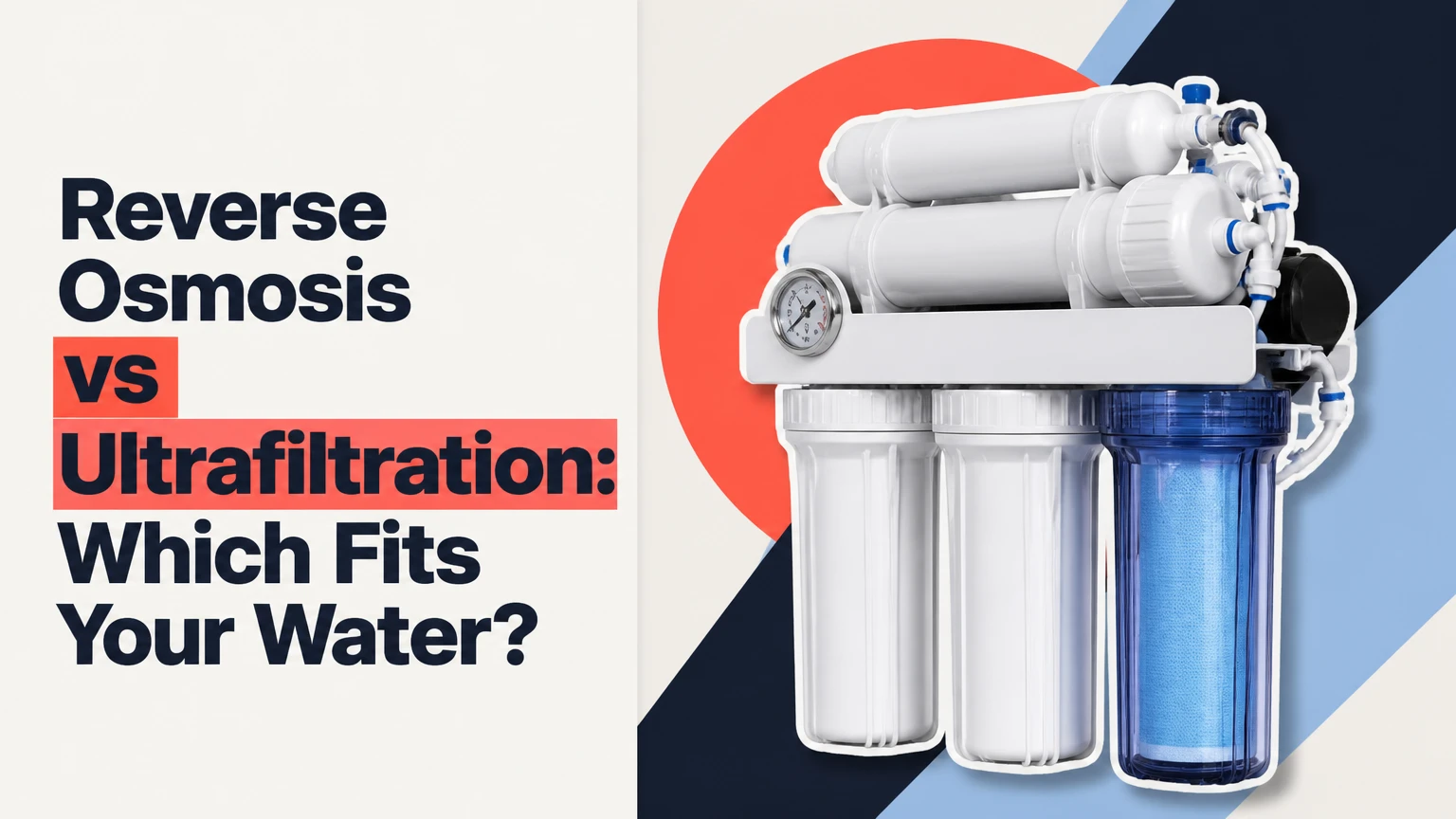
Reverse osmosis vs ultrafiltration is primarily a choice between dissolved-contaminant reduction and particle removal. Reverse osmosis removes many dissolved salts, metals, and ions, while ultrafiltration retains minerals and targets sediment, bacteria, cysts, and larger organic matter. The right system depends on laboratory results, pressure, water usage, and tolerance for wastewater.
Key Facts at a Glance
Reverse osmosis typically reduces total dissolved solids by ัก95-99% when correctly installed and maintained.
Ultrafiltration typically removes suspended particles and many microorganisms, but it does not lower dissolved TDS.
RO needs adequate feed pressure, commonly around 40-80 psi for residential units, while UF often operates at lower pressure.
RO produces a concentrate stream; UF usually has no continuous reject stream but may discharge water during flushing.
Neither membrane should be selected from TDS alone, because TDS does not identify individual contaminants.
Certified performance claims matter, especially for lead, arsenic, nitrate, fluoride, PFAS, and pathogen reduction.
What Are Reverse Osmosis and Ultrafiltration?
Reverse osmosis is a pressure-driven membrane process that pushes water through a dense semipermeable layer while retaining many dissolved ions and molecules. Ultrafiltration is a pressure-driven size-exclusion process that passes water through porous hollow fibers while retaining suspended solids, colloids, bacteria, cysts, and some large organic molecules.
The two technologies sit at different points on the membrane-filtration spectrum. Residential RO membranes have an effective separation scale commonly described around 0.0001 microns, although manufacturers may specify membrane performance differently. UF pores commonly fall around 0.01-0.1 microns. Pore size alone is not a complete performance specification, because membrane chemistry, pressure, temperature, fouling, and test conditions change actual rejection.
The most important distinction is dissolved versus particulate contamination. A metal ion dissolved in water can pass through UF, while a bacterium is physically larger and can be retained. RO can reject many ions, but the percentage depends on the compound, membrane, pH, pressure, and system condition.
How Does Each Membrane Separate Contaminants?
RO uses hydraulic pressure to overcome osmotic pressure and create two streams: permeate, the treated water, and concentrate, the water carrying rejected contaminants. UF normally uses lower pressure and retains contaminants at or near the membrane surface or inside hollow-fiber channels.
| Attribute | Reverse osmosis | Ultrafiltration | Practical meaning |
|---|---|---|---|
| Separation principle | Solution diffusion and membrane rejection | Size exclusion | RO targets dissolved material; UF targets larger particles |
| Typical membrane scale | About 0.0001 microns | About 0.01-0.1 microns | RO has a much denser barrier |
| Typical pressure | 40-80 psi residential feed | About 10-40 psi | UF tolerates lower-pressure plumbing |
| Main output | Permeate plus concentrate | Filtered water plus periodic flush | RO has ongoing reject water |
| Mineral behavior | Removes much calcium and magnesium | Retains dissolved minerals | UF preserves original mineral content |
| Storage requirement | Often uses a tank unless direct-flow | Usually direct-flow | UF generally delivers faster at the faucet |
A useful practitioner rule is simple: if the contaminant is dissolved, UF is usually the wrong membrane; if the problem is sediment or microorganisms, RO may be unnecessary unless dissolved contaminants also exist.
Which Contaminants Do RO and UF Remove?
Reverse osmosis generally provides broader contaminant reduction, but no membrane should be treated as a universal guarantee. Ultrafiltration is effective against larger suspended contaminants and many microorganisms, yet it does not remove dissolved salts, nitrate, fluoride, or most dissolved metals.
| Contaminant or property | RO result | UF result | Selection note |
|---|---|---|---|
| Sediment and rust | Usually removes after prefiltration | Removes effectively | UF is often sufficient for visible particles |
| Bacteria | High reduction when intact and disinfected | High reduction when membrane integrity is maintained | Verify certification and maintenance |
| Protozoan cysts | High reduction | High reduction | UF is commonly suitable for cyst-sized organisms |
| Viruses | Variable, often high rejection | Unreliable for many viruses | Use certified RO, UV, or disinfection as appropriate |
| Lead and arsenic | Often reduces, compound-dependent | Does not reliably remove dissolved forms | Test well water and verify certification |
| Nitrate and fluoride | Often reduces, system-dependent | Does not remove reliably | RO or a dedicated treatment process is needed |
| Hardness minerals | Reduces calcium and magnesium | Does not reduce them | A softener may be better for whole-house scale |
| PFAS | Requires certified, compound-specific performance | Usually not reliable | Check the exact contaminant and certification |
| TDS and salinity | Usually reduces 95-99% | Little or no reduction | TDS is a screening measure, not a contaminant diagnosis |
| Chlorine and odor | Carbon stage usually handles these | Carbon stage is normally required | The membrane alone is not an odor filter |
The U.S. Environmental Protection Agency treats private-well owners differently from municipal customers: private wells are not regulated under the Safe Drinking Water Act, so owners must arrange testing and treatment themselves. That makes UF a risky choice for an untested well, even when the water looks clear.
RO also requires qualification. A product listing that says “removes heavy metals” does not prove reduction for a particular arsenic species, nitrate concentration, or PFAS compound. Look for a current performance data sheet and certification from organizations such as NSF or the Water Quality Association, where applicable.
Does TDS Tell You Which System to Buy?
A high TDS reading points toward RO more strongly than UF, but TDS cannot identify what the dissolved material is. A meter measures electrical conductivity and estimates total dissolved solids; it does not distinguish sodium from nitrate, calcium from arsenic, or harmless minerals from regulated contaminants.
For example, water with 700 mg/L TDS may contain mostly calcium and bicarbonate, while water with 150 mg/L may contain an undesirable concentration of a specific contaminant. A laboratory report is therefore more useful than a TDS meter when health or compliance matters.
How Do RO and UF Systems Work at Home?
A residential RO system normally uses sediment filtration, activated carbon, the RO membrane, a storage tank or pump, and sometimes a post-carbon or remineralization cartridge. A UF system generally uses sediment protection, a hollow-fiber module, a flush valve or automatic flushing cycle, and optional carbon filtration.
Reverse Osmosis Process
- Sediment filtration: A 1-5 micron filter captures sand, rust, and larger particles.
- Carbon pretreatment: Carbon reduces chlorine and selected organic chemicals that can damage thin-film composite membranes.
- Membrane separation: Pressurized feed water enters the RO membrane and divides into permeate and concentrate.
- Storage or direct flow: Permeate fills a bladder tank or passes through a pump-driven tankless system.
- Final polishing: A post-carbon cartridge can reduce taste and odor.
- Optional remineralization: Calcite or blended media adds calcium and magnesium, changing taste and pH.
A common installation error is omitting carbon before a thin-film composite membrane on chlorinated municipal water. Chlorine can oxidize the membrane and reduce rejection. Some systems use chlorine-tolerant membrane materials, so the manufacturer’s specification should control.
Ultrafiltration Process
- Sediment protection: A prefilter reduces abrasive particles and the load on hollow fibers.
- Hollow-fiber filtration: Feed water passes through porous polymer fiber walls or through the fiber channels, depending on design.
- Permeate delivery: Filtered water moves directly to the faucet without a pressure tank in most installations.
- Forward or backflush: A flush cycle removes accumulated solids and restores flow.
- Carbon treatment: An activated-carbon stage handles chlorine, taste, and odor that UF cannot remove.
UF is often described as producing zero wastewater, but that statement needs precision. A direct-flow UF cartridge may discharge no water during ordinary filtration, while automatic flushing uses a small volume at intervals. The quantity is typically far lower than an inefficient RO system, but it is not always literally zero.
Which System Uses Less Water and Energy?
UF generally uses less water and energy because it can operate from normal line pressure and sends nearly all feed water to the faucet. RO uses pressure to drive permeation and discharges concentrate, although modern high-efficiency systems can reduce the reject ratio substantially.
| Operating factor | Typical RO range | Typical UF range | Household consequence |
|---|---|---|---|
| Feed pressure | 40-80 psi | 10-40 psi | Low pressure favors UF or an RO booster pump |
| Product flow | 0.03-0.1 gallons per minute at membrane stage | 0.5-1.5 gallons per minute | UF usually feels faster at the faucet |
| Waste ratio | About 1:1 to 4:1, system-dependent | Flush-only discharge | RO may use several gallons per gallon produced |
| Electricity | Optional pump, common in tankless units | Usually none | UF can operate during power interruptions |
| Storage | Common in tank units | Usually unnecessary | RO tanks occupy cabinet space |
| Temperature limit | Commonly around 100°F, product-specific | Commonly around 100°F, product-specific | Never connect either membrane to hot water |
RO performance falls when feed pressure is low, water is cold, or the membrane is fouled. A booster pump can improve production and reduce waste, but it adds electrical consumption, noise, cost, and another service component.
How Much Do RO and UF Systems Cost?
Typical residential purchase prices are approximately $150-$600 for RO and $80-$250 for UF, before unusual plumbing work. Annual consumables commonly cost $60-$150 for RO and $35-$80 for UF, but local cartridge pricing, water quality, and replacement frequency create substantial variation.
| Ownership item | Reverse osmosis | Ultrafiltration | Cost driver |
|---|---|---|---|
| Entry system price | $150-$300 | $80-$150 | Number of stages and included faucet |
| Higher-specification system | $300-$600+ | $150-$250 | Pump, sensors, certification, flow rate |
| Sediment or carbon replacement | Every 6-12 months | Every 6-12 months | Chlorine and sediment loading |
| Membrane replacement | Commonly 2-3 years | Commonly 1-2 years | Feed quality and maintenance |
| Typical annual consumables | $60-$150 | $35-$80 | Brand and water chemistry |
| Installation labor | $100-$300 typical | $75-$250 typical | Shutoff access, drilling, cabinet layout |
The cheapest system is not necessarily the cheapest treatment. RO concentrate can increase water use, while UF cartridges can clog rapidly when untreated well water carries fine silt. Calculate annual filter cost, membrane cost, installation, and water use together.
Which System Is Better for Your Water Situation?
The best choice is determined by the contaminant and the treatment location, not by the membrane label. RO fits dissolved-contaminant problems at a drinking-water faucet; UF fits microbiological and particulate problems when dissolved chemistry is already acceptable.
Municipal Water With Normal TDS
Choose UF with carbon when the municipal supply is compliant, tastes acceptable after carbon treatment, and the main complaints are sediment, rust, or occasional particulate contamination. Choose RO when a laboratory report or utility report identifies elevated nitrate, fluoride, salinity, or another dissolved contaminant.
Private Well Water
Choose RO for a drinking-water point of use when testing identifies dissolved arsenic, nitrate, fluoride, or high salinity and the system is certified for that contaminant. UF can reduce bacteria and turbidity, but UF cannot protect against invisible dissolved metals or salts.
Private wells often need a treatment train rather than one cartridge. A typical design may include sediment filtration, iron treatment, carbon, UV for microbial control, and RO for dissolved contaminants. The sequence must follow the water analysis.
Hard Water and Limescale
RO reduces dissolved calcium and magnesium at one faucet, so it can protect a kettle, espresso machine, or humidifier from scale. UF does not soften water and will not correct white deposits, high hardness, or a mineral taste.
For whole-house hardness, a water softener or another point-of-entry process is usually more practical than whole-house RO. Whole-house RO requires large capacity, storage, pumps, concentrate management, and significant capital.
Low Water Pressure or No Electricity
UF is usually the better fit for low-pressure plumbing because it often works at 10-40 psi and can deliver water continuously. RO may need a booster pump when pressure drops below the manufacturer’s minimum, commonly around 40 psi.
Neither system should be connected to hot water. Heat can deform membrane components and shorten seal life. Follow the product’s maximum temperature specification rather than relying on a generic number.
Can You Combine RO, UF, Carbon, and UV?
RO and UF can be combined, but combining membranes does not automatically improve safety. A common point-of-use sequence is sediment filtration, carbon, RO, optional remineralization, and final carbon; UF and UV may be added when microbial risk or flow requirements justify them.
| Treatment stage | Main target | Best placement | Important limitation |
|---|---|---|---|
| Sediment filter | Sand, rust, silt | Before membrane | Does not remove dissolved contaminants |
| Activated carbon | Chlorine, taste, odor, some organics | Before RO or after UF | Capacity depends on contact time and cartridge size |
| UF membrane | Bacteria, cysts, turbidity | Point of use or whole house | Does not reduce TDS or dissolved metals |
| RO membrane | Ions, salts, many dissolved contaminants | Usually point of use | Produces concentrate and needs pretreatment |
| UV reactor | Microorganisms | After clear pretreatment | Does not remove chemicals or particles |
| Remineralization cartridge | Calcium, magnesium, taste | After RO | Does not restore every original mineral |
The counterintuitive design rule is that a UV lamp cannot disinfect cloudy water reliably because particles can shield organisms. Sediment and turbidity control must come first. Likewise, carbon does not replace RO when nitrate or salinity is the problem.
How Do You Maintain Each Membrane?
Replace sediment and carbon cartridges every 6-12 months as a typical interval, then replace the RO membrane around every 2-3 years or the UF module around every 1-2 years. Actual timing should follow pressure drop, flow decline, chlorine exposure, turbidity, and performance testing.
RO Maintenance Checklist
- Replace sediment and carbon filters on schedule.
- Confirm feed pressure and tank pressure using the manufacturer’s procedure.
- Sanitize the storage tank and housing during scheduled membrane service.
- Test permeate TDS against feed TDS to calculate rejection.
- Inspect tubing, shutoff valves, air gaps, and drain connections.
- Flush new cartridges and membranes for the specified time.
A practical RO rejection calculation is: (feed TDS - permeate TDS) / feed TDS x 100. If feed water measures 400 mg/L and permeate measures 20 mg/L, apparent rejection is 95%. Temperature and instrument error affect the reading, so use the result as a trend rather than a laboratory certification.
UF Maintenance Checklist
- Flush the membrane according to the product schedule.
- Replace or clean the sediment prefilter before severe fouling develops.
- Monitor flow at the faucet and pressure before and after the module.
- Replace the UF membrane when flushing no longer restores flow.
- Disinfect the system after prolonged stagnation or contamination events.
- Keep carbon cartridges within their rated capacity.
A UF membrane can retain particles while still allowing contaminated water through if fibers are damaged. Sudden unexplained flow with a failed integrity test is a replacement event, not a reason to keep flushing.
What Problems Should You Expect?
Slow RO flow usually comes from low pressure, an empty or waterlogged tank, clogged prefilters, cold water, or a fouled membrane. Slow UF flow usually comes from sediment loading, inadequate flushing, biofouling, or a spent module.
| Symptom | Likely RO cause | Likely UF cause | First action |
|---|---|---|---|
| Very slow faucet flow | Low tank pressure or clogged postfilter | Fouled hollow fibers | Check pressure and replace the final restriction |
| High treated-water TDS | Damaged membrane or bypass valve | Expected UF behavior | Test RO rejection; do not use UF for TDS |
| Chlorine taste | Spent carbon prefilter | Spent carbon cartridge | Replace carbon and flush |
| Drain runs continuously | Faulty shutoff or flow restrictor | Flush valve malfunction | Inspect valves and drain line |
| Bitter or acidic taste | Stale tank or exhausted postfilter | Carbon exhaustion or source chemistry | Sanitize, replace carbon, test water |
| Sudden microbial concern | Poor sanitation or tank biofilm | Fiber breach or stagnant housing | Stop use and disinfect or replace |
Do not assume a fixed tank pressure applies to every RO model. Many residential tanks specify about 5-8 psi when empty, but the manufacturer’s value overrides generic advice. Measuring a full tank gives misleading results.
Which Should You Choose?
Choose RO for Dissolved Contaminants
Select RO when a report identifies nitrate, fluoride, arsenic, salinity, or high TDS, or when scale protection is needed at a drinking-water appliance. Use carbon pretreatment, confirm minimum pressure, and verify the exact contaminant claim through certification.
Choose UF for Particles and Microorganisms
Select UF when water already has acceptable dissolved chemistry and the problem is turbidity, sediment, bacteria, or cysts. Add carbon for chlorine and odors, because UF alone does not adsorb most dissolved chemicals.
Choose a Multi-Stage System for Untested Well Water
Do not choose UF or RO from taste and appearance alone when water comes from a private well. Test for coliform bacteria, nitrate, arsenic, lead, manganese, iron, hardness, pH, and TDS, then match each result to a treatment process.
| User profile | Recommended starting point | Reason | Required check |
|---|---|---|---|
| Apartment with sediment and low pressure | UF plus carbon | Low pressure and continuous flow | Confirm municipal water chemistry |
| Home with high TDS and scale | Point-of-use RO | Dissolved mineral reduction | Check pressure and drain capacity |
| Private well with nitrate | Certified RO | UF cannot remove nitrate reliably | Laboratory test and certification |
| Rural home with bacteria and turbidity | UF or UV train | Particle and microbial control | Test for dissolved contaminants |
| Espresso machine owner | RO or blended RO water | Reduces scale-forming minerals | Avoid excessively low-mineral water if equipment requires alkalinity |
FAQ
Does ultrafiltration remove salt from water?
Ultrafiltration does not reliably remove dissolved salt because sodium and chloride ions are far smaller than UF membrane pores. A UF system can improve clarity and reduce microorganisms while leaving salinity and TDS substantially unchanged. Reverse osmosis, distillation, or a suitable ion-exchange process is needed for salt reduction.
Is RO water healthier than UF water?
Neither RO water nor UF water is automatically healthier without knowing the source-water chemistry. RO can reduce harmful dissolved contaminants but also removes calcium and magnesium, while UF preserves minerals but cannot address nitrate, arsenic, or salinity. Safety depends on tested water, certified performance, and correct maintenance.
Does reverse osmosis remove all bacteria and viruses?
A properly maintained RO membrane can provide strong reduction of many bacteria and viruses, but performance varies by organism, membrane integrity, pressure, and system design. Choose a product with a verified microbiological claim, and consider UV or disinfection when the source has a documented pathogen risk.
Can UF replace a water softener?
UF cannot replace a water softener because UF does not remove dissolved calcium and magnesium hardness. UF can reduce sediment that makes water look cloudy, but it will not prevent limescale on fixtures, kettles, boilers, or shower doors. Use softening or RO for the specific scale problem.
Does an RO system waste more water than a UF system?
Yes, a conventional RO system usually sends some feed water to drain as concentrate, while UF normally discharges water only during flushing. Typical residential RO ratios range from about 1:1 to 4:1, although high-efficiency designs can perform better. UF has lower routine water use but still may need periodic flushing.
Can RO and UF be installed together?
RO and UF can be installed together when each has a defined role, but most homes do not need both at the same point of use. UF can protect an RO membrane from particles, while RO handles dissolved contaminants. For microbial protection, carbon, UV, and sanitation may be more useful than adding a second membrane.
The Bottom Line
Reverse osmosis vs ultrafiltration is a contaminant-matching decision. Choose RO for dissolved salts, high TDS, hardness at one faucet, nitrate, fluoride, or certified reduction of specific dissolved pollutants. Choose UF for sediment, turbidity, bacteria, and cysts when the water’s dissolved chemistry is already acceptable. Test private-well water before selecting either system, and judge the final design by verified performance, pressure, maintenance, and water use rather than pore size alone.