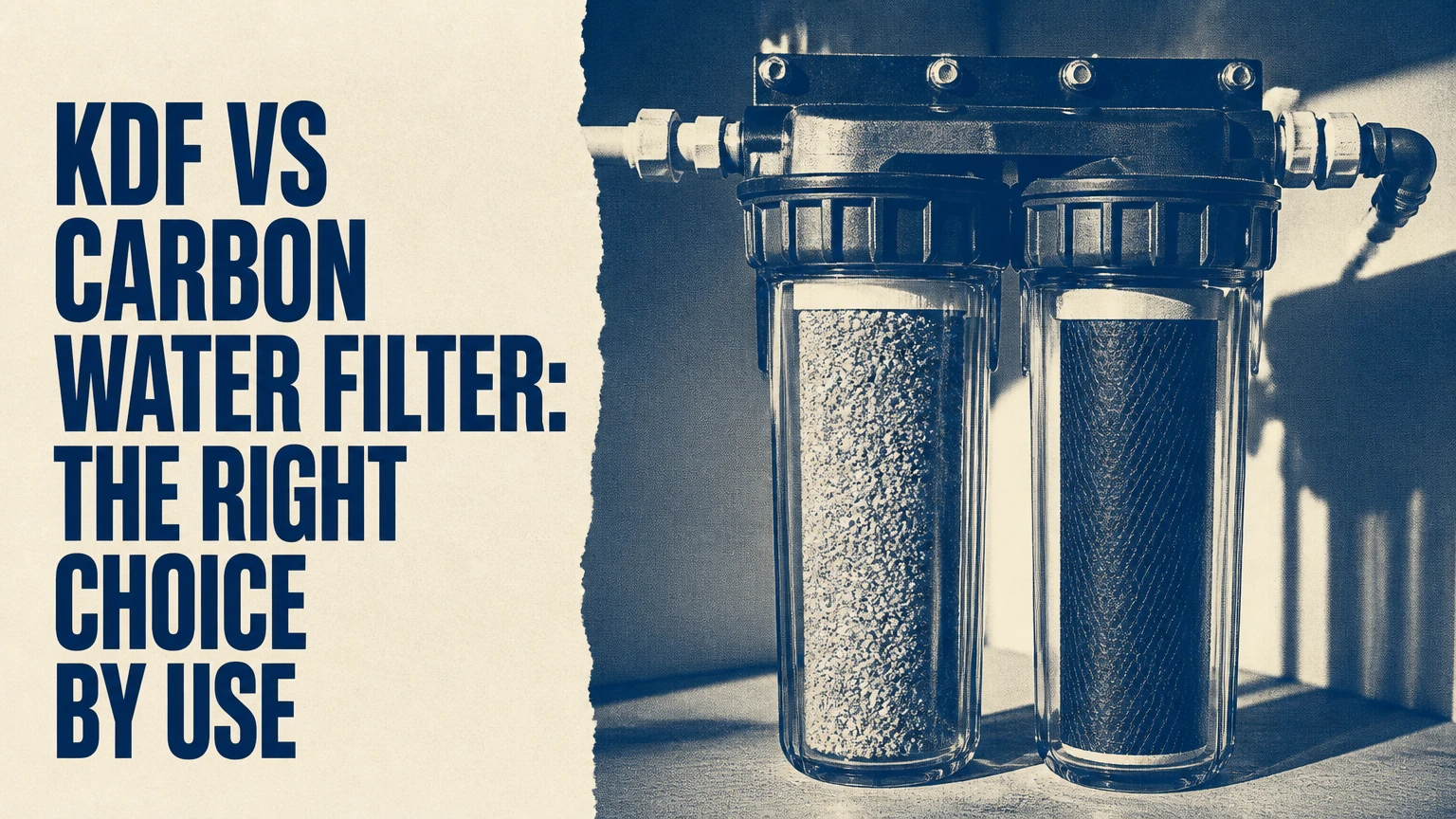
KDF is usually better for hot-water chlorine treatment, some dissolved metals, and microbial control inside a filter, while activated carbon is usually better for taste, odor, VOCs, pesticides, and chloramine when catalytic carbon is specified. For many homes, KDF followed by carbon is the strongest design, but neither medium reliably removes every contaminant.
Key Facts at a Glance
- KDF media uses a copper-zinc alloy and redox reactions; activated carbon uses adsorption inside a porous carbon structure.
- KDF 55 primarily targets free chlorine and some dissolved metals; KDF 85 is selected for certain iron and hydrogen sulfide applications.
- Activated carbon removes many organic compounds, chlorine-related taste, and odor, but ordinary carbon is less effective against chloramine.
- KDF is not a sediment filter and has no meaningful micron rating; carbon block can provide particulate reduction when its product specification supports it.
- Standard activated carbon should not be assumed suitable for hot water because temperature, flow, and contact time change performance.
- NSF/ANSI certification for a specific contaminant is more useful than a media name or a percentage printed on packaging.
What Is the Difference Between KDF and Activated Carbon?
KDF is a granular copper-zinc alloy that changes certain dissolved contaminants through oxidation-reduction reactions. Activated carbon is a high-surface-area material that captures many chemicals by adsorption, with performance determined by carbon type, pore structure, flow rate, contact time, and contaminant concentration.
The difference is chemical rather than cosmetic. KDF media is electrically active: zinc commonly acts as the more readily oxidized metal while copper participates in the electrochemical surface reaction. Activated carbon does not work like a magnet and does not generally destroy every contaminant; many compounds remain held within its pores until the media loses capacity or operating conditions change.
KDF media is dense and requires appropriate bed design and backwashing in larger systems. Carbon media is lighter, but loose granular carbon can develop preferential channels if the vessel is poorly sized or inadequately maintained. A carbon block adds a physical barrier because compressed carbon has a defined particulate rating, although the exact rating belongs to the cartridge, not to activated carbon as a category.
How Does KDF Work?
KDF works when water contacts copper-zinc granules and dissolved substances participate in surface redox reactions, adsorption, or cementation. The exact result depends on the contaminant, pH, oxidation state, temperature, flow, bed depth, and media formulation.
KDF can reduce free chlorine and help control some dissolved metals, while KDF 85 is marketed for particular iron and hydrogen sulfide conditions. A KDF bed does not literally “zap” every microorganism or guarantee sterile water. Its bacteriostatic behavior can suppress microbial growth on the media, but that is different from disinfection.
KDF also does not remove sediment in the same way as a 5-micron filter. Install a sediment prefilter when sand, rust, or suspended particles could clog valves or foul downstream media. The system must be sized for the required service flow and, for backwashing vessels, the manufacturer’s minimum backwash flow.
How Does Activated Carbon Work?
Activated carbon works mainly through adsorption, in which dissolved molecules attach to internal pore surfaces. Carbon type, empty-bed contact time, water temperature, pH, competing compounds, and flow rate determine how long a contaminant remains captured.
Granular activated carbon has larger spaces between granules and can provide lower pressure loss, but channeling can let water bypass much of the media. Carbon block compresses carbon particles into a dense cartridge, improving physical filtration and often reducing channeling, though pressure loss rises as the cartridge loads with sediment.
Catalytic carbon has a modified surface that improves treatment of chloramine and some sulfur compounds. Ordinary GAC should not be treated as interchangeable with catalytic carbon. The American Water Works Association identifies chloramine as a more persistent disinfectant than free chlorine, which explains why a carbon specification for chlorine does not automatically establish chloramine performance.
Which Contaminants Does Each Medium Remove?
Activated carbon is generally the stronger choice for many organic chemicals and aesthetic problems, while KDF is more useful for selected redox-sensitive inorganic contaminants and hot-water installations. Performance must be verified against the product’s certified claims because neither medium has a universal removal list.
| Water problem | KDF suitability | Activated carbon suitability | Better starting point |
|---|---|---|---|
| Free chlorine taste | Strong in suitable contact conditions | Strong for many cartridges | Carbon for drinking, KDF for hot water |
| Chloramine disinfectant | Usually limited | Catalytic carbon preferred | Catalytic carbon |
| Lead | Possible reduction in specified products | Some certified cartridges reduce lead | NSF/ANSI 53-certified product |
| Mercury | Product-dependent | Product-dependent | Test water and verify certification |
| VOCs and solvents | Poor | Stronger adsorption medium | Activated carbon |
| Pesticides | Poor | Often effective, compound-dependent | Certified activated carbon |
| Iron | KDF 85 may help selected dissolved iron | Standard carbon is not an iron solution | Test first, then specialized treatment |
| Hydrogen sulfide odor | KDF 85 may help lower loads | Catalytic carbon may help | Water analysis and matched media |
| Bacteria | Bacteriostatic effect, not sterilization | Can support biofilm if neglected | UV or disinfection for pathogens |
| Sediment | Not a sediment rating | Carbon block may reduce particles | Dedicated sediment filter |
The table describes treatment categories, not guarantees. A private well with 8 milligrams per liter of iron, low pH, or bacterial contamination needs a design based on laboratory results rather than a generic KDF cartridge.
Does KDF Remove Lead Better Than Carbon?
Neither KDF nor activated carbon should be called the better lead filter without a product-specific test claim. Some KDF-containing cartridges reduce dissolved lead, while some carbon blocks carry NSF/ANSI 53 certification for lead reduction; the certification, rated capacity, and flow rate decide the comparison.
Lead can enter through plumbing, solder, fixtures, or a service line. Municipal water reports may not represent lead at a particular tap because household plumbing changes exposure. For drinking water, use a certified point-of-use product and replace it on schedule. Boiling does not remove lead.
Does Carbon Remove More Chemicals Than KDF?
Activated carbon generally removes a wider range of organic chemicals than KDF because hydrophobic molecules can adsorb to its pore surfaces. Benzene, many pesticides, fuel-related compounds, trihalomethanes, and taste-and-odor compounds are typical carbon targets, but each compound has a different adsorption affinity.
Carbon does not reliably remove nitrate, fluoride, hardness minerals, sodium, or every pharmaceutical. Reverse osmosis, ion exchange, or specialized media may be required. A water test determines whether the apparent problem is organic contamination, dissolved minerals, or microbial contamination.
Which KDF and Carbon Types Should You Buy?
KDF 55 is generally associated with free chlorine and selected dissolved-metal applications, while KDF 85 is selected for certain iron and hydrogen sulfide conditions. GAC, carbon block, and catalytic carbon serve different purposes, so the correct type depends on water chemistry and flow.
| Media type | Typical form | Main application | Main limitation |
|---|---|---|---|
| KDF 55 | Granular copper-zinc alloy | Free chlorine and selected metals | Requires correct contact and backwash design |
| KDF 85 | Granular copper-zinc alloy | Selected iron and sulfur odor loads | Performance depends strongly on pH and concentration |
| KDF-F | Fine alloy blended into cartridges | Compact cartridge enhancement | Cartridge claims vary widely |
| GAC | Loose activated carbon | Taste, odor, chlorine, some organics | Channeling and lower physical filtration |
| Carbon block | Compressed carbon cartridge | Drinking-water polishing and particles | Higher pressure loss and sediment loading |
| Catalytic carbon | Modified granular or block carbon | Chloramine and difficult odor compounds | Costs more and needs adequate contact time |
Product names do not replace test data. “KDF 55” identifies a media formulation, not a guaranteed whole-house removal percentage. Cartridge construction, bed depth, flow rate, and contaminant load can change the result substantially.
How Much Do KDF and Carbon Filters Cost?
Typical replacement cartridges cost about $15-$50 for activated carbon and $35-$100 for cartridges containing KDF or multiple media layers. Whole-house systems commonly range from roughly $1,000-$3,500 installed, excluding unusual plumbing, electrical work, or difficult well-water pretreatment.
| System type | Typical purchase range | Replacement interval | Main cost variable |
|---|---|---|---|
| 10-inch carbon cartridge | $10-$35 | 3-12 months | Gallons and chlorine load |
| 20-inch carbon block | $25-$80 | 6-18 months | Flow and sediment burden |
| KDF shower cartridge | $25-$90 | 6-12 months | Hot-water volume and media mass |
| GAC whole-house tank | $900-$2,200 | 2-5 years | Tank size and backwash valve |
| Catalytic carbon tank | $1,200-$3,500 | 2-5 years | Chloramine load and contact time |
| KDF-containing backwash tank | $1,500-$4,000 | 3-7 years | Water chemistry and backwash capacity |
These are typical market ranges, not guarantees. A low purchase price can become expensive if a cartridge has a short capacity or causes unacceptable pressure loss. Compare annualized cost, replacement labor, water used for backwashing, and certified contaminant capacity.
Is KDF or Carbon Better for a Shower?
KDF is usually the better starting medium for a hot shower filter because many standard activated-carbon cartridges are designed for cool or ambient water. A shower filter still cannot be assumed to remove all chlorine, chloramine, metals, or hardness unless the manufacturer provides a relevant test method and capacity.
Hot water reduces dissolved-gas behavior and changes adsorption kinetics. Shower filters also have short contact times because flow may reach 2-2.5 gallons per minute. Calcium sulfite is another common shower medium for free chlorine, but it is not equivalent to a certified carbon or KDF system and has limited relevance to hardness.
A practical shower setup uses a sediment screen, a correctly sized KDF or calcium sulfite cartridge, and replacement based on gallons and household use. Hair or skin improvement is not proof of contaminant removal. Measure chlorine at the outlet if performance matters.
Should KDF Go Before or After Carbon?
KDF usually belongs before activated carbon when both media are installed in series, because pretreatment can reduce chlorine or selected metal loads reaching the carbon bed. The correct order is normally sediment filtration, KDF or other pretreatment, then carbon polishing, although a manufacturer may specify a different arrangement.
Use a dedicated sediment filter first when particulate loading is present. Carbon then handles taste, odor, and organic compounds under a lower competing load. A carbon stage before KDF is not automatically wrong, but it can be inefficient if the carbon is exposed to high chlorine, iron, or sediment concentrations without need.
The often-repeated claim that KDF extends carbon life by exactly 15 times is not a universal engineering value. Extension depends on influent concentration, bed volume, contact time, water temperature, and the carbon’s rated capacity. Treat any percentage as product-specific unless independently documented.
KDF vs Carbon Water Filter: Which Should You Choose?
The right choice depends on water source, contaminant, temperature, flow, and certification rather than on the media label alone. Carbon is the default for drinking-water taste and many organic chemicals; KDF is more useful for selected hot-water, chlorine, metal, iron, and sulfur applications.
| User situation | Recommended first medium | Add or consider | Avoid assuming |
|---|---|---|---|
| City water, chlorine taste | Carbon block | KDF prefilter for selected metals | Chloramine removal from ordinary GAC |
| City water, chloramine odor | Catalytic carbon | Adequate bed depth and contact time | Standard carbon capacity |
| Apartment shower | KDF or calcium sulfite | Sediment screen | Hardness removal from shower media |
| Private well, sulfur odor | KDF 85 or catalytic carbon after testing | Oxidation or aeration | Treatment without pH and sulfur data |
| Private well, iron staining | Specialized iron system | KDF 85 for suitable lower loads | Standard carbon alone |
| Lead at kitchen tap | Certified point-of-use cartridge | Plumbing investigation | Uncertified percentage claims |
| VOC concern | Activated carbon | Laboratory testing and replacement plan | KDF as an organic-chemical filter |
| Bacterial contamination | UV or disinfection | Sediment pretreatment | KDF as sterilization |
Which Filter Is Better for City Water?
Carbon is usually better for city-water taste and odor, while catalytic carbon is the more appropriate carbon type when the utility uses chloramine. A KDF stage can provide useful pretreatment for selected metals or free chlorine, but the final choice should follow the utility water report and tap testing.
The EPA’s annual Consumer Confidence Report identifies the public system’s reported contaminants and treatment practices, but it cannot diagnose lead released by interior plumbing. For lead concerns, sample the first-draw kitchen tap and use a product certified for lead reduction.
Which Filter Is Better for Well Water?
Neither KDF nor carbon should be selected for well water before testing for pH, iron, manganese, hydrogen sulfide, hardness, nitrate, arsenic, and coliform bacteria. KDF 85 or catalytic carbon may fit moderate iron or sulfur conditions, but high loads commonly require aeration, oxidation, filtration, or another dedicated process.
The U.S. Environmental Protection Agency recommends private-well owners test at least annually for coliform bacteria and nitrate, with additional tests based on local risks. A sulfur odor can indicate hydrogen sulfide, but odor alone does not quantify concentration or establish safe treatment.
What Alternatives Remove Problems KDF and Carbon Miss?
Reverse osmosis is commonly considered for dissolved nitrate, fluoride, arsenic, and high total dissolved solids when the membrane and pretreatment are correctly selected. Ultraviolet treatment addresses microorganisms but requires clear water and does not remove chemicals. Ion exchange targets hardness, nitrate, or selected metals depending on resin chemistry.
| Target problem | More suitable technology | Typical placement | Reason |
|---|---|---|---|
| Hard water | Water softener | Whole house | Exchanges calcium and magnesium |
| Fluoride | Reverse osmosis or activated alumina | Point of use | Carbon and KDF are unreliable |
| Nitrate | Reverse osmosis or anion exchange | Point of use or whole house | Requires validated capacity |
| Bacteria | UV, chlorination, or ozone | Whole house | Provides disinfection when designed correctly |
| High sediment | Sediment filter or media filtration | Before other media | Protects downstream equipment |
| Arsenic | Certified adsorptive media or RO | Point of use or whole house | Species and pH affect treatment |
What Problems Cause Filter Failure?
Filter failure usually comes from wrong media, excessive flow, missing pretreatment, exhausted capacity, or neglected maintenance. A filter can still pass clear water after its contaminant capacity is exhausted, so appearance and taste are not reliable replacement indicators.
| Symptom | Likely cause | Corrective action | Prevention |
|---|---|---|---|
| Sudden low flow | Loaded carbon block or sediment filter | Replace cartridge and inspect pressure | Install staged sediment filtration |
| Black dust after replacement | Carbon fines | Flush according to cartridge instructions | Pre-rinse and flush fully |
| Chlorine taste returns | Exhausted carbon or channeling | Replace media and verify flow | Track gallons and replacement dates |
| Iron staining continues | Wrong KDF type or excessive iron | Test iron and pH | Use an iron-specific process |
| Rotten-egg odor returns | Saturated sulfur media | Test sulfide and add pretreatment | Size for peak load |
| KDF tank will not backwash | Insufficient flow or fouling | Check valve, drain, and pump capacity | Confirm backwash rate at installation |
| Bacterial growth in housing | Long stagnation or poor sanitation | Sanitize where manufacturer permits | Replace cartridges on schedule |
A carbon cartridge that has been left unused for months should not automatically be returned to service. Stagnation, biofilm, and cartridge age justify replacement or manufacturer-approved sanitation. Do not backwash a disposable carbon block unless its instructions specifically permit it.
What Certifications Should You Check?
NSF/ANSI 42 generally covers aesthetic effects such as chlorine taste and odor, while NSF/ANSI 53 covers specific health-effect contaminants such as lead when the product carries the relevant claim. NSF/ANSI 58 applies to reverse-osmosis systems, and NSF/ANSI 401 addresses certain emerging contaminants.
Certification is claim-specific. A filter certified for chlorine under NSF/ANSI 42 is not automatically certified for chloramine, lead, PFAS, or VOCs. Check the performance data sheet for contaminant, capacity, flow rate, testing conditions, and replacement interval.
A practitioner rule is simple: match the contaminant certificate to the water test. Media branding comes second.
How Do You Install a KDF and Carbon System?
Install a combined system in five stages: test the water, remove sediment, place KDF pretreatment, add the correct carbon stage, and verify flow and outlet quality. The most important variable is contact time at the rated flow, because fast water can reduce removal even when the media volume appears adequate.
- Test the source water. Use the utility report for municipal water and a certified laboratory for well water. Record pH, chlorine or chloramine, iron, manganese, hardness, nitrate, and bacteria where relevant.
- Install sediment protection. Use a 5-micron cartridge when suspended particles are present, unless the system manufacturer specifies another rating.
- Add KDF when the contaminant matches. Use KDF 55 for suitable chlorine or metal applications and KDF 85 only when iron or sulfur chemistry supports its use.
- Add carbon polishing. Choose carbon block for point-of-use polishing, GAC for lower-restriction applications, or catalytic carbon for chloramine.
- Flush and verify. Flush new cartridges until fines disappear, check for leaks, measure pressure before and after the system, and test the treated water when health claims matter.
Do not size a whole-house bed from cartridge capacity alone. Peak flow, empty-bed contact time, backwash flow, drain capacity, and household water demand all affect performance.
FAQ
Can KDF remove fluoride?
KDF is not a dependable fluoride-removal medium. Fluoride usually requires reverse osmosis, activated alumina, or another technology with a validated fluoride claim. Test the treated water because naturally occurring fluoride levels vary, and a chlorine or metal claim says nothing about fluoride performance.
Does activated carbon soften hard water?
Activated carbon does not soften water because it does not remove calcium and magnesium hardness ions at useful household scale. A cation-exchange softener is the conventional whole-house option. Reverse osmosis can reduce some dissolved minerals at a drinking-water tap but is not a practical substitute for whole-house softening.
Can KDF and carbon remove PFAS?
Some specialized activated-carbon systems can reduce particular PFAS compounds when tested and certified for that purpose, but ordinary carbon and KDF should not be assumed to remove PFAS. The U.S. EPA’s 2024 drinking-water rule makes validated treatment and laboratory confirmation more important for affected systems.
How often should a carbon filter be replaced?
A household carbon cartridge commonly lasts 3-12 months, while larger tanks may last 2-5 years. Actual life depends on gallons, chlorine or chloramine concentration, sediment, flow, and carbon mass. Replace by the manufacturer’s capacity or date, whichever arrives first, rather than waiting for taste to return.
Does KDF kill bacteria?
KDF can inhibit microbial growth on filter media under suitable conditions, but KDF is not a complete disinfection barrier. A private well with coliform bacteria requires source investigation and validated treatment such as continuous chlorination or ultraviolet disinfection, with sediment and turbidity controlled first.
The Bottom Line
KDF vs carbon water filter is not a universal winner comparison. Choose activated carbon for drinking-water taste, odor, VOCs, pesticides, and certified contaminant claims; choose KDF for suitable hot-water, free-chlorine, selected metal, iron, and sulfur applications. Combine KDF and carbon when testing supports both stages, and select alternatives when the target is hardness, fluoride, nitrate, high dissolved solids, or bacteria.