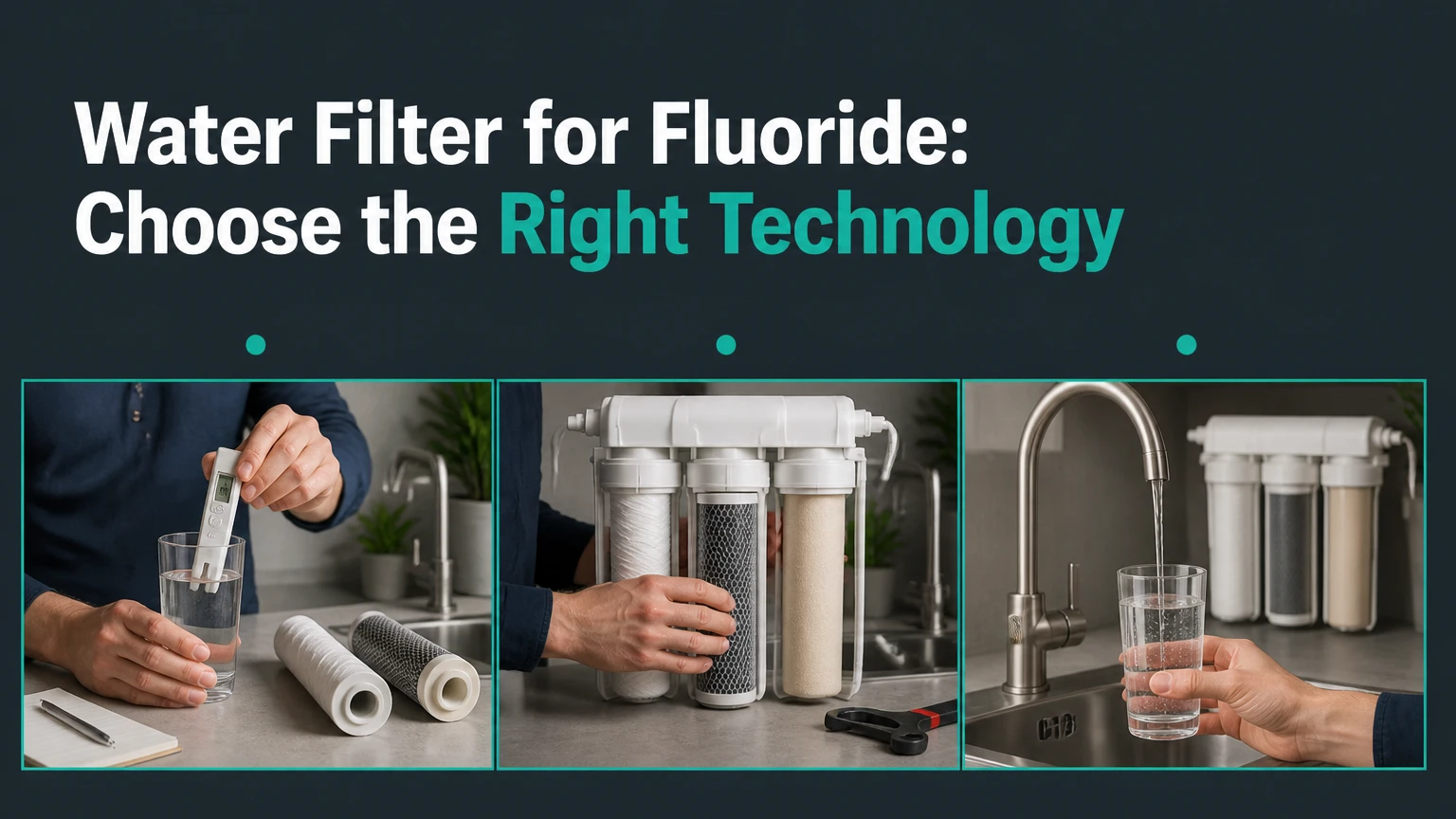
A water filter for fluoride must use reverse osmosis, distillation, activated alumina, bone char, or another media specifically rated for fluoride reduction. Ordinary activated-carbon pitchers and refrigerator filters generally improve chlorine taste but do not reliably reduce dissolved fluoride. For most households, certified under-sink reverse osmosis offers the best balance of verified reduction, output, and convenience.
Key facts at a glance
Reverse osmosis commonly reduces fluoride by approximately 90% or more when the membrane and complete system are properly rated.
Distillation removes fluoride during boiling and condensation, but countertop units usually produce water slowly and consume electricity.
Activated alumina and bone char can reduce fluoride without RO wastewater, but performance depends strongly on pH, flow rate, media capacity, and replacement timing.
NSF/ANSI 58 certification is the most useful independent benchmark for residential reverse-osmosis fluoride-reduction claims.
Standard carbon, sediment, ultraviolet, and water-softener systems are not substitutes for a fluoride-rated treatment stage.
A laboratory test of untreated and treated water is the most dependable way to confirm actual fluoride reduction.
Which Technology Removes Fluoride Best?
For most homes, reverse osmosis is the strongest overall choice because it combines high fluoride reduction with continuous point-of-use production. Distillation can achieve very high reduction, while activated alumina and bone char avoid wastewater, but each requires more careful control of energy, chemistry, flow, or replacement intervals.
The right choice depends on the treated volume. A renter making 1-2 gallons daily may accept a countertop distiller or gravity system. A family using 3-8 gallons daily usually needs an under-sink RO system because a small distiller cannot keep pace. A household that rejects RO reject water should examine an alumina cartridge only after checking pH and the manufacturer’s tested capacity.
| Technology | Typical fluoride reduction | Typical purchase price | Main operating burden |
|---|---|---|---|
| Reverse osmosis | 90-99%, model-dependent | $150-$600 | Filter changes and reject water |
| Activated alumina | 80-95%, chemistry-dependent | $70-$250 | pH control and media replacement |
| Distillation | Often above 95%, unit-dependent | $100-$500 | 3-6 hours per gallon and electricity |
| Bone char | 80-90%, flow-dependent | $60-$200 | Slow flow and frequent media changes |
| Standard activated carbon | Usually negligible for fluoride | $15-$100 | Taste and chlorine reduction only |
No percentage should be treated as universal. Fluoride concentration, pH, alkalinity, temperature, flow, membrane condition, and cartridge age can change the result substantially.
How Does a Fluoride Water Filter Work?
Fluoride filtration separates dissolved fluoride from water through a membrane, adsorption media, or phase change. The mechanism matters because fluoride is a small, highly soluble ion that ordinary carbon pores do not capture effectively.
Reverse osmosis separates ions with pressure
Reverse osmosis pushes water through a semipermeable membrane while concentrated reject water carries many dissolved substances toward the drain. A residential system normally uses sediment filtration first, carbon prefiltration to protect the membrane from chlorine, the RO membrane, and a final carbon polishing filter.
The often-repeated “0.0001-micron pore” description is an approximation, not a literal sieve explanation. RO performance depends on membrane chemistry, pressure, temperature, feed-water composition, recovery, and seal integrity. The U.S. Environmental Protection Agency identifies fluoride at 4.0 mg/L as the federal maximum contaminant level and 2.0 mg/L as the secondary standard related to cosmetic effects, but a filter’s output still requires product-specific validation.
A practical RO sequence is:
- Sediment cartridge removes rust, sand, and suspended particles.
- Carbon block reduces chlorine and protects the membrane.
- The membrane rejects fluoride and other dissolved solids.
- A storage tank or direct-flow module supplies the dedicated faucet.
- A post-carbon cartridge improves taste.
EPA states, “The maximum contaminant level (MCL) for fluoride is 4.0 mg/L.” That regulatory limit addresses excessive exposure in public drinking water; it does not prove that every household needs complete fluoride removal.
Activated alumina adsorbs fluoride onto a mineral surface
Activated alumina uses porous aluminum oxide media that binds fluoride at surface sites. The media generally performs better under acidic conditions, and high pH, alkalinity, competing anions, or insufficient contact time can reduce capacity.
Manufacturers may quote 90-95% reduction under controlled test conditions, but those figures cannot be transferred automatically to alkaline municipal water. A cartridge rated for 500 gallons at pH 6.5 may perform differently at pH 8.2 with high bicarbonate. Ask for influent concentration, effluent concentration, pH range, flow rate, and tested gallon capacity.
Activated alumina normally follows this process:
- Water enters through a sediment stage.
- Fluoride contacts the alumina bed.
- Surface sites bind fluoride.
- The treated water exits until capacity is reached.
- The cartridge is replaced before documented breakthrough.
Activated alumina is not a set-and-forget option. A new cartridge should be flushed according to its instructions, and post-installation testing is sensible where fluoride reduction is medically or legally important.
Distillation removes fluoride through phase change
Distillation boils water, condenses the vapor, and leaves nonvolatile fluoride and minerals in the boiling chamber. A carbon post-filter can improve taste and reduce some volatile compounds, but distillation is not designed to remove every volatile organic contaminant unless the complete unit includes an appropriate treatment stage.
Countertop distillers commonly produce about 1 gallon in 3-6 hours and use roughly 3-4 kilowatt-hours per gallon, although heating efficiency varies. Scale accumulates on the boiling chamber, so cleaning frequency depends on hardness and production volume. Citric-acid descaling is common, but the manufacturer’s concentration and contact-time instructions should control.
Distillation is useful when plumbing is unavailable or the household needs a small volume of very low-mineral water. It is inconvenient for cooking, large families, and continuous drinking-water demand.
What Should You Check Before Buying?
The most important buying check is a complete performance claim for fluoride, not a general label such as “purifies water” or “removes contaminants.” Product literature should identify the exact model, tested influent concentration, reduction percentage, capacity, flow rate, and replacement schedule.
Certification is stronger than a marketing list
NSF/ANSI 58 applies to reverse-osmosis drinking-water treatment systems and can include specific contaminant-reduction claims. NSF/ANSI 42 generally concerns aesthetic effects such as chlorine taste and odor, so NSF 42 alone does not establish fluoride reduction. A product may also use an independent laboratory report rather than a formal NSF certification.
| Label or document | What it can establish | What it cannot establish |
|---|---|---|
| NSF/ANSI 58 fluoride claim | Tested RO fluoride reduction for a named model | Performance after overdue maintenance |
| NSF/ANSI 42 claim | Chlorine, taste, or odor reduction | Reliable fluoride removal |
| Performance data sheet | Test conditions, capacity, and stated reduction | Your exact tap-water result |
| Laboratory water test | Fluoride concentration before and after treatment | Future performance after media exhaustion |
| Generic “multi-stage” label | Number or type of treatment stages | Any specific fluoride percentage |
| Replacement reminder | Suggested service interval | Actual remaining media capacity |
Water chemistry changes filter performance
Test or obtain the following values before selecting adsorption media: fluoride, pH, alkalinity, hardness, total dissolved solids, nitrate, sulfate, and iron. Private-well users should also test for arsenic, bacteria, manganese, and other contaminants relevant to local geology.
High hardness can create RO scale and reduce membrane productivity. High alkalinity can reduce activated-alumina capacity. High iron or sediment can foul cartridges. A water softener may protect an RO membrane from hardness, but it does not remove fluoride, and sodium exchange does not equal fluoride treatment.
How Much Do Fluoride Filters Cost to Own?
Typical first-year ownership ranges from about $100 for a small media cartridge system to more than $800 for a high-capacity RO installation with professional plumbing and replacement parts. Purchase price alone is misleading because electricity, reject water, testing, cartridges, and maintenance determine the long-term cost.
| System format | Equipment cost | Replacement cost | Typical service interval |
|---|---|---|---|
| Under-sink RO | $150-$600 | $60-$180 per year | Prefilters 6-12 months; membrane 2-5 years |
| Countertop distiller | $100-$500 | $10-$40 per year | Carbon cup 2-6 months; descaling as needed |
| Activated-alumina cartridge | $70-$250 | $40-$100 per cartridge | 400-1,000 gallons or 3-12 months |
| Bone-char gravity unit | $60-$200 | $30-$80 per set | 300-1,000 gallons or 3-6 months |
| Whole-house specialty media | $600-$3,000 | $150-$800 per service | Media commonly 1-5 years |
RO reject-water ratios vary by design. Older systems may send 3-4 gallons to drain per gallon produced, while efficient systems may approach 1 gallon of reject water per gallon of treated water under suitable pressure. A permeate pump, pressure regulator, or high-recovery design can improve efficiency, but product specifications should state the tested ratio.
Distillation has no drain reject stream, but its energy cost is measurable. At 3-4 kWh per gallon, a household producing 30 gallons monthly uses approximately 90-120 kWh before considering local electricity rates.
Is Point-of-Use or Whole-House Treatment Better?
Point-of-use treatment is usually better for fluoride because people primarily ingest fluoride through drinking and cooking water, while whole-house treatment must process showers, toilets, laundry, and outdoor use. An under-sink system also reduces the required treatment volume, allowing a smaller membrane or media bed to achieve adequate contact time.
Whole-house fluoride removal can make sense when a private well has unusually high fluoride and the household wants fluoride-reduced water at every fixture. The system requires flow-rate sizing, pretreatment, backwashing or media service, and verification at multiple faucets. Whole-house systems cost more and may create maintenance problems if the installer does not account for pH, hardness, iron, and pressure.
| Household situation | Better starting format | Reason | Main limitation |
|---|---|---|---|
| One adult, rented apartment | Countertop distiller | No plumbing alteration | Slow output |
| Couple using 2-4 gallons daily | Under-sink RO | Adequate output and tested reduction | Storage tank and reject water |
| Family using 5-10 gallons daily | High-capacity direct-flow RO | Faster production and larger demand | Higher purchase cost |
| Alkaline private well | RO after water treatment | Less dependent on adsorption pH | Pretreatment may be required |
| Low-waste household | Alumina or bone char | No RO drain stream | More chemistry and flow sensitivity |
| Entire-property treatment | Engineered whole-house media system | Treats every fixture | Highest installation complexity |
Do Standard Carbon Filters Remove Fluoride?
Standard activated-carbon pitchers, refrigerator cartridges, faucet filters, and carbon blocks generally do not provide dependable fluoride reduction. Activated carbon has strong value for chlorine, taste, odor, and some organic compounds, but dissolved fluoride remains in the water unless the cartridge contains a separately tested fluoride-removal medium.
A “five-stage” or “ten-stage” label does not change that rule. Count the actual fluoride-rated stage, then verify its capacity and test conditions. Some products combine carbon with activated alumina, bone char, ion exchange, or another specialty medium, so the material name and performance sheet matter more than the number of stages.
Boiling water also does not remove fluoride. Evaporation leaves fluoride behind and can slightly increase its concentration if water volume decreases. Ultraviolet treatment disinfects microorganisms but does not remove dissolved ions. A conventional salt-based softener exchanges hardness ions and does not function as a fluoride filter.
How Do You Install and Maintain the System?
Install a point-of-use fluoride system on cold drinking water, flush every new cartridge as directed, and record installation dates, gallons treated, and test results. Maintenance is the main determinant of real-world performance because every adsorption cartridge and RO membrane eventually reaches breakthrough or loses productivity.
Follow this practical installation sequence
- Test the source water. Record fluoride, pH, hardness, TDS, and relevant well contaminants before buying equipment.
- Confirm the treatment claim. Match the exact model number to a fluoride performance data sheet or NSF listing.
- Install sediment and carbon pretreatment. Protect membranes and specialty media from particles and chlorine.
- Set the flow rate. Do not exceed the cartridge’s tested rate, especially with alumina or bone char.
- Flush the new media. Discard the manufacturer-specified volume until fines, taste, and air clear.
- Measure treated water. Send untreated and treated samples to a certified laboratory when confirmation matters.
- Replace components on capacity. Use gallons, time, pressure, taste changes, and test results together.
An inexpensive handheld TDS meter cannot measure fluoride specifically. TDS may fall after RO, but fluoride performance requires a fluoride test. This distinction prevents a common false conclusion: a low TDS reading does not prove a particular contaminant has been removed.
What signals a failing filter?
Fluoride has no dependable odor or taste at typical drinking-water concentrations, so taste is a poor breakthrough alarm. Sudden changes in flow, pressure, treated-water TDS, cartridge age, or laboratory fluoride results are more useful indicators.
| Symptom | Likely cause | Corrective action |
|---|---|---|
| RO faucet slows sharply | Clogged prefilter, low tank pressure, or fouled membrane | Replace prefilters, check pressure, inspect membrane |
| Alumina output rises in fluoride | Media exhaustion or unsuitable pH | Stop relying on cartridge, test water, replace media |
| Distiller production falls | Scale on heating element | Descale with approved product and rinse thoroughly |
| White residue appears | High mineral load or poor cleaning | Clean chamber, inspect condenser, retest output |
| New cartridge tastes sour | Incomplete flushing or media fines | Flush longer and follow installation instructions |
| RO water tastes flat | Low mineral content | Use a compatible remineralization stage if desired |
| No fluoride reduction | Wrong media or bypass leak | Verify plumbing, model claim, and laboratory results |
What Are the Main Limitations and Edge Cases?
No fluoride filter is universally best. Reverse osmosis wastes some feed water and removes minerals that some users prefer to retain. Distillation uses electricity and cannot meet high demand quickly. Activated alumina and bone char can be effective, but their results are more sensitive to water chemistry and flow than many product pages imply.
A remineralization cartridge can add calcium or magnesium after RO, improving taste without restoring every original contaminant. The cartridge must be compatible with the system and maintained properly. Mineral content is not automatically a health requirement in drinking water because dietary intake supplies most essential minerals, but taste and dietary circumstances may justify a remineralization preference.
Aluminum concerns require precision. Activated alumina is aluminum oxide media, but the relevant question is measured aluminum release from a properly operated, certified product, not the mere presence of aluminum in the media. Flush new cartridges, stay within the rated pH and flow range, and test when the manufacturer supplies no convincing leachate data.
Bone char is a calcium-phosphate medium, not ordinary carbon. It may conflict with vegan preferences, has variable product availability, and often needs slower flow to provide adequate contact time. Ask whether the product is made from bovine bone, how it was processed, and what fluoride capacity was tested.
Which Filter Should Different Households Choose?
A family usually does best with a certified under-sink RO system, while a renter often benefits from a countertop distiller or verified gravity unit. A low-waste household should compare alumina and bone char against distillation’s electricity demand, but only after confirming the source-water chemistry and replacement capacity.
Choose RO for regular family use
Select RO when daily demand exceeds several gallons, fluoride reduction must be documented, and the household accepts a dedicated faucet and some reject water. Choose a high-recovery or direct-flow model when storage-tank delays and water waste are important.
Choose distillation for mobility and small volumes
Select distillation when plumbing changes are impossible and output of approximately 1 gallon every 3-6 hours meets demand. Keep a second drinking-water source available if the household needs more water than the machine can produce.
Choose activated alumina for controlled chemistry
Select alumina when the cartridge provides tested fluoride performance at the household’s actual pH, alkalinity, flow rate, and concentration. Do not choose it solely because the unit is inexpensive or claims “natural mineral filtration.”
Choose bone char when material preference matters
Select bone char when no-electricity operation, low wastewater, and a calcium-phosphate medium fit the household’s priorities. Verify sourcing, flow requirements, replacement capacity, and fluoride test data before relying on it.
Frequently Asked Questions
Does bottled water contain fluoride?
Bottled water may contain low, moderate, or higher fluoride concentrations depending on its source and treatment process. The label may identify added fluoride or provide a fluoride statement, but absence of a statement does not prove zero fluoride. Contact the bottler or test the product when concentration matters.
Can a water softener remove fluoride?
A conventional ion-exchange water softener removes calcium and magnesium hardness, not fluoride. Softening can protect an RO membrane from scale, but it should be treated as pretreatment rather than fluoride purification. A fluoride-rated membrane or adsorption cartridge remains necessary.
Is fluoride removal necessary for everyone?
The decision depends on source-water concentration, total exposure, dental-care guidance, and personal circumstances. The CDC and EPA distinguish beneficial fluoridation levels from excessive exposure, while individual medical decisions belong with a dentist or clinician who knows the household’s diet, age, and health history.
How can I test fluoride in tap water?
Use a laboratory accredited for drinking-water fluoride analysis, or use a validated field method with appropriate calibration and quality controls. Test the source water and treated water from the actual faucet. Repeat testing after cartridge replacement and near the stated capacity if verification is important.
Does a refrigerator filter remove fluoride?
Most refrigerator filters use activated carbon and do not reliably reduce fluoride. Check the exact cartridge’s performance data rather than the refrigerator brand or filter-stage count. A refrigerator cartridge with a fluoride-specific medium and documented test result is a different product from a standard carbon cartridge.
Conclusion: Choosing a Water Filter for Fluoride
The best water filter for fluoride is usually a certified under-sink reverse-osmosis system for households needing dependable daily output and documented reduction. Distillation suits smaller, plumbing-free applications; activated alumina and bone char suit low-waste users who can control pH, flow, and replacement timing. Verify the exact fluoride claim, test the treated water, and maintain the system by capacity rather than appearance.