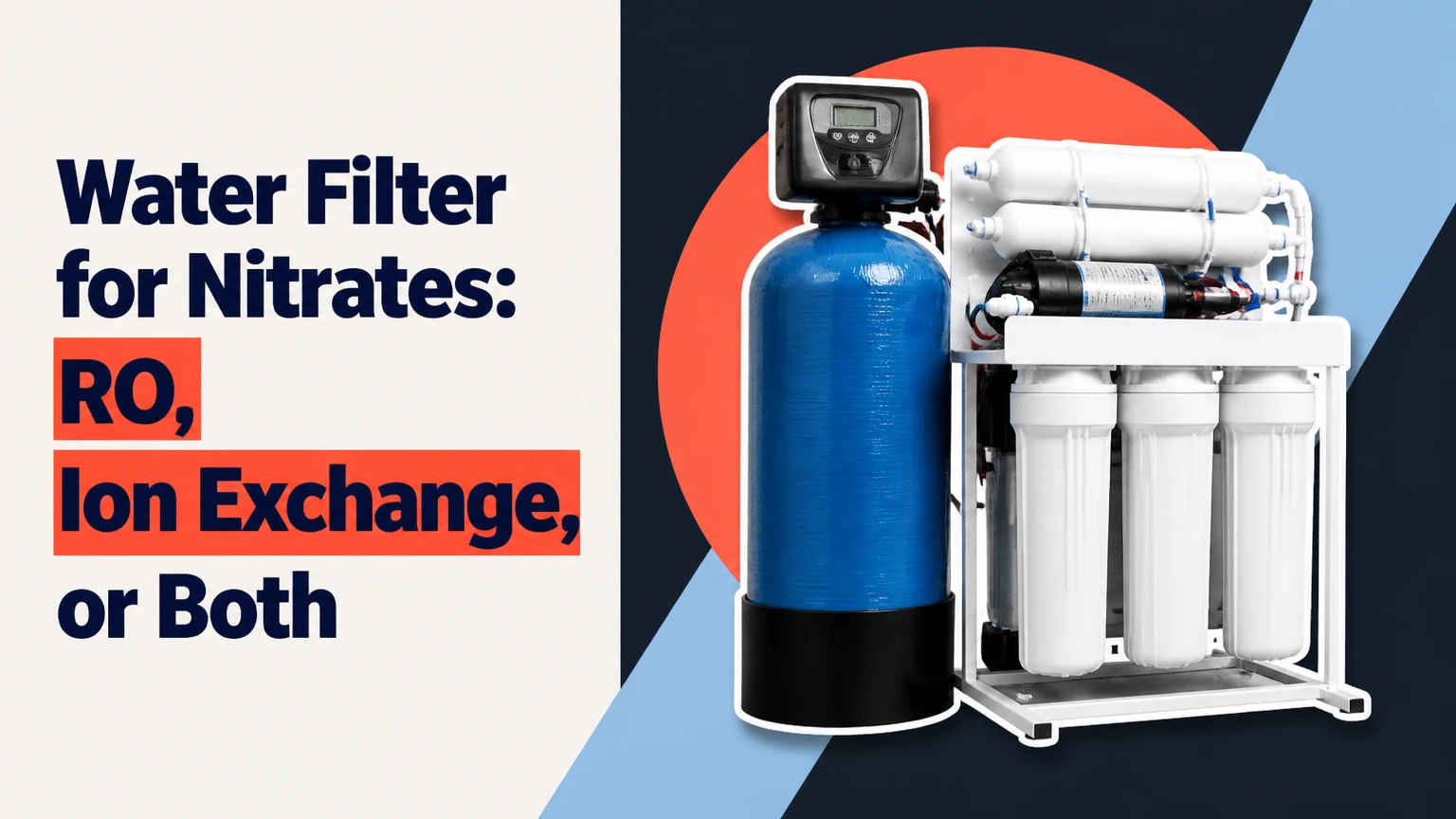
A water filter for nitrates must use reverse osmosis, nitrate-selective anion exchange, or distillation because ordinary carbon cartridges and water softeners do not reliably remove dissolved nitrate. For most households, certified under-sink reverse osmosis is the practical choice for drinking and cooking water; high-flow whole-house treatment usually requires selective anion exchange.
Key Facts at a Glance
- The U.S. EPA maximum contaminant level is 10 mg/L measured as nitrate-nitrogen, equivalent to 45 mg/L measured as nitrate.
- Activated carbon, sediment filters, ultraviolet systems, and standard water softeners are not nitrate-removal technologies.
- Reverse osmosis commonly treats one drinking-water tap and sends part of the feed water to drain.
- Nitrate-selective anion exchange can treat the whole house but requires capacity monitoring, regeneration, and salt management.
- Boiling does not destroy nitrate; evaporation can increase nitrate concentration in the remaining water.
- A product claim matters only when the complete system has a documented nitrate-reduction performance claim, not merely a generic “multi-stage” label.
What Is a Water Filter for Nitrates?
A water filter for nitrates is a treatment device designed to reduce nitrate ions, which are dissolved, negatively charged contaminants that pass through ordinary mechanical and carbon filtration. The three established household technologies are reverse osmosis, nitrate-selective anion exchange, and distillation, although their capacity, waste, flow, and maintenance requirements differ.
Nitrate commonly enters groundwater and surface water through fertilizer, manure, septic systems, wastewater, and naturally occurring nitrogen compounds. Private wells near intensive agriculture or shallow groundwater are especially vulnerable, but a municipal supply can also contain nitrate after seasonal runoff.
Nitrate and nitrate-nitrogen are different reporting units. A result of 10 mg/L as nitrate-nitrogen corresponds approximately to 45 mg/L as nitrate, so a filter decision based on the wrong unit can be seriously inaccurate. The EPA limit applies to public drinking-water systems in the United States; private well owners must arrange their own testing and treatment.
The health concern is greatest for bottle-fed infants because nitrate can interfere with oxygen transport in blood. The Agency for Toxic Substances and Disease Registry describes methemoglobinemia as a condition in which hemoglobin cannot carry oxygen normally. Pregnant people and adults should also follow medical or public-health advice when concentrations exceed the applicable standard.
Test Before Choosing a Nitrate Filter
Test the untreated water at an accredited laboratory before buying a nitrate filter. A laboratory result should identify nitrate, nitrate-nitrogen or both, the reporting unit, the sample date, and any accompanying contaminants that affect treatment selection.
Use a certified laboratory rather than relying on a low-cost strip for a final decision. The EPA recommends that private well owners test for nitrate at least annually, and local health departments may recommend more frequent testing where fertilizer runoff, flooding, or septic contamination is present.
Collect the sample from a cold-water tap according to the laboratory’s instructions. Do not sample after a filter if the purpose is to size treatment. Repeat an unexpected result, especially when a well has recently flooded or undergone construction.
| Water-test result | Interpretation | Immediate decision |
|---|---|---|
| Below 10 mg/L as nitrogen | Below EPA public-water MCL | Continue periodic testing |
| 10 mg/L as nitrogen or higher | At or above EPA MCL | Treat drinking and cooking water |
| 20-50 mg/L as nitrogen | High private-well concentration | Consider RO capacity or selective exchange |
| Above 50 mg/L as nitrogen | Very high concentration | Use alternative water while designing treatment |
| Nitrate reported as ion | Compare against 45 mg/L equivalent | Confirm units before selecting equipment |
| High sulfate, iron, or manganese | Potential treatment interference | Obtain a broader water panel |
A nitrate test alone is insufficient for a well-water design. Test pH, hardness, total dissolved solids, sulfate, chloride, iron, manganese, arsenic, bacteria, and, where relevant, volatile organic compounds. The combination determines whether pretreatment is needed and whether an ion-exchange resin will exhaust prematurely.
How Do Nitrate-Removal Technologies Work?
Reverse osmosis separates dissolved ions with pressure and a semipermeable membrane. Anion exchange captures negatively charged nitrate on resin beads and releases another anion, usually chloride. Distillation separates water vapor from nonvolatile dissolved solids through boiling and condensation.
How Reverse Osmosis Removes Nitrate
Reverse osmosis typically reduces nitrate by forcing water through a thin-film composite membrane at pressure. The membrane rejects much of the nitrate and sends the concentrated reject stream to drain, while permeate enters a storage tank or flows directly to the tap.
A conventional under-sink RO system normally contains a sediment cartridge, carbon prefilter, RO membrane, storage tank, and post-carbon filter. Chlorine removal protects many thin-film composite membranes, while sediment removal prevents premature clogging. Membrane performance depends on pressure, temperature, pH, total dissolved solids, and the feed-water concentration.
Typical household RO recovery ranges from about 20% to 50%, meaning one gallon of treated water may require roughly two to five gallons of feed water, although efficient systems can perform better. “Waste ratio” varies by product and plumbing conditions, so use the manufacturer’s tested figure rather than a generic claim.
NSF/ANSI 58 is the relevant residential RO system standard. A buyer should verify that the exact model and configuration carries a nitrate or nitrate-nitrite reduction claim, because certification for total dissolved solids or taste does not automatically prove nitrate performance.
How Nitrate-Selective Anion Exchange Works
Nitrate-selective anion exchange uses a strong-base resin with exchange sites loaded with chloride. When water passes through the bed, nitrate occupies those sites and chloride enters the treated water. Once the resin approaches capacity, a programmed regeneration cycle uses brine to remove nitrate and reload the resin.
Selective resin matters because sulfate and other anions compete for exchange capacity. A nonselective resin may perform poorly when sulfate is elevated, while a nitrate-selective resin is engineered to favor nitrate under defined conditions. The actual capacity still depends on flow rate, temperature, nitrate concentration, sulfate concentration, and regeneration settings.
Whole-house systems can deliver several gallons per minute and treat showers, toilets, laundry, and drinking taps. They also add chloride and discharge a nitrate-containing brine stream, so the drain and septic or wastewater arrangement must be reviewed before installation.
How Distillation Removes Nitrate
Distillation removes nitrate because nitrate is nonvolatile and remains in the boiling chamber while water vapor condenses elsewhere. Countertop units commonly produce around 0.25-0.5 gallons per hour, depending on heating power and design.
Distillation can reduce dissolved minerals, metals, and microorganisms in the product water, but the boiling chamber accumulates concentrated residue and requires cleaning. Volatile organic compounds may evaporate and condense with the product water, so a carbon postfilter is appropriate when chemical contamination is possible.
Distillation is usually practical for low daily volumes, travel, emergency use, or locations without plumbing. It is less suitable for a family that needs several gallons quickly because heating consumes electricity and production is slow.
Which Nitrate Filter Is Best for Your Water?
Certified reverse osmosis is usually the best nitrate filter for a kitchen tap, while nitrate-selective anion exchange is better for whole-house flow. Distillation is a niche option for small volumes or off-grid use, and the right decision depends on nitrate concentration, water chemistry, daily demand, installation scope, and wastewater constraints.
| Criterion | Reverse osmosis | Selective anion exchange | Distillation | Typical household consequence |
|---|---|---|---|---|
| Main installation | Under-sink POU | Whole-house POE or large POU | Countertop or plumbed appliance | Choose based on treated outlets |
| Typical product flow | 0.1-0.5 gal/min at tap | 5-12 gal/min system flow | 0.25-0.5 gal/hour | RO needs storage for peak demand |
| Nitrate performance | Commonly 80%-95% reduction | Commonly 90%-98% with correct design | Often near-complete dissolved-solids removal | Verify exact product data |
| Typical equipment cost | $200-$800 | $1,500-$4,000 installed | $150-$500 | Local labor changes totals |
| Ongoing expense | $60-$180 per year | Salt, service, and wastewater | Electricity and cleaning | Operating chemistry differs |
| Water waste | About 1-5 gallons per gallon product | Regeneration brine discharge | No membrane reject stream | Drain access affects selection |
| Main limitation | One tap and slower output | Chloride addition and resin exhaustion | Slow, energy-intensive production | No technology solves every need |
What Does Nitrate Treatment Cost?
A realistic installed budget is about $200-$800 for a basic under-sink RO system, $1,500-$4,000 or more for whole-house selective anion exchange, and $150-$500 for a countertop distiller. These are typical U.S. household ranges, not guaranteed quotes, and pretreatment, plumbing changes, electrical work, and laboratory testing can raise the total.
| Treatment expense | Reverse osmosis | Anion exchange | Distillation |
|---|---|---|---|
| Initial equipment | $200-$800 | $1,000-$3,000 | $150-$500 |
| Professional installation | $150-$600 | $500-$2,000 | $0-$200 |
| Replacement media or filters | $60-$180/year | $100-$400/year | $20-$100/year |
| Typical service interval | 6-24 months | 1-12 months checks | Weekly to monthly cleaning |
| Electricity requirement | Low, pump-dependent | Low to moderate | High per gallon |
| Drain requirement | Usually yes | Yes, for regeneration | Usually no |
RO membrane replacement often occurs every two to five years, but fouling, chlorine exposure, low pressure, and poor maintenance can shorten that interval. Anion-exchange resin may last several years, yet its usable capacity can be consumed much sooner when nitrate is high or sulfate competition is severe.
When Should You Choose Reverse Osmosis?
Choose reverse osmosis when nitrate affects drinking or cooking water but whole-house treatment is unnecessary. An under-sink unit limits equipment cost, avoids adding chloride to every household outlet, and can reduce multiple contaminants when the system has verified claims for those contaminants.
RO is a strong fit for renters, small households, municipal water users, and homes with an infant when the product is independently certified for nitrate reduction. A dedicated faucet also prevents untreated water from reaching the drinking-water point.
RO is not a complete well-water solution. Iron, manganese, sediment, hardness, and microbial contamination can damage pretreatment stages or create a separate health hazard. A point-of-use system also does not treat bathroom taps, refrigerator lines unless connected, or water used to prepare infant formula at another outlet.
When Is Anion Exchange Better?
Choose nitrate-selective anion exchange when occupants need treated water throughout a house or when peak demand exceeds practical RO storage capacity. The system can supply showers, kitchen taps, laundry, and other outlets at normal household flow rates.
Anion exchange requires more engineering than a cartridge filter. The installer should calculate resin volume from nitrate load, flow, regeneration frequency, sulfate competition, and reserve capacity. A bypass or exhausted bed can send untreated water into the house, so an automatic shutoff, alarm, or alternating-tank design may be warranted.
The system can increase chloride. That change may affect taste, sodium or chloride loading, and corrosion risk in certain plumbing conditions. Check chloride, sodium, alkalinity, copper, lead, and discharge constraints after installation rather than assuming that nitrate removal alone proves safe water.
Can You Use a Softener, Carbon Filter, or Boiling?
A standard water softener does not remove nitrate because its resin exchanges positively charged calcium and magnesium, while nitrate is negatively charged. Activated carbon, sediment cartridges, ultraviolet lamps, and boiling also do not provide reliable nitrate reduction.
Boiling can raise the nitrate concentration in the remaining water because water leaves as vapor while nitrate stays behind. Ultraviolet treatment can inactivate microorganisms but does not remove dissolved nitrate. A sediment filter can protect downstream equipment, yet it has no meaningful effect on dissolved nitrate.
| Product or method | Nitrate removal | Primary function | Appropriate role |
|---|---|---|---|
| Sediment cartridge | 0% expected | Sand and particulate capture | Protect pretreatment |
| Activated carbon | Not reliable | Chlorine, taste, some chemicals | Protect RO membrane |
| Standard softener | 0% expected | Calcium and magnesium reduction | Treat hardness only |
| UV disinfection | 0% expected | Microbial inactivation | Treat microbes, not nitrate |
| Boiling | 0% removal | Microbial reduction | Avoid as nitrate treatment |
| Certified RO | Product-specific | Dissolved contaminant reduction | Drinking and cooking |
| Selective anion resin | Product-specific | Nitrate exchange | Whole-house or higher flow |
| Distillation | High for nonvolatile solids | Vapor separation | Small-volume treatment |
What Certification and Maintenance Should You Require?
Buyers should match the exact contaminant claim to the exact model, replacement cartridge, and operating conditions. NSF/ANSI 58 certification is a useful starting point for RO, while a whole-house ion-exchange supplier should provide resin specifications, design calculations, regeneration settings, and post-installation test results.
Do not treat a certification logo as proof that every contaminant is reduced. Check the performance data sheet for nitrate or nitrate-nitrite reduction, rated capacity, feed-water limits, replacement part numbers, and whether the claim applies to the complete system or one component.
Maintain an RO system by replacing sediment and carbon filters on schedule, checking for leaks, sanitizing the tank and housings when recommended, and testing product water. Maintain anion exchange by keeping salt available, inspecting the brine tank, checking regeneration, and testing water near the end of the operating cycle.
A practical verification schedule is to test new RO product water after installation, after filter changes, and at least annually. For anion exchange, test before regeneration is expected to occur, because an exhausted system may continue delivering water while the owner assumes the programmed cycle is adequate.
Why Do Nitrate Filters Fail?
Nitrate filters fail most often because the buyer skips a baseline laboratory test, selects a generic cartridge, ignores competing ions, or waits for taste and odor as a warning. Nitrate has no dependable taste or smell at concentrations relevant to drinking-water decisions.
Common failure modes include:
- Wrong reporting unit: A homeowner compares 10 mg/L nitrate with a limit expressed as nitrate-nitrogen. Confirm whether the result is reported as NO3 or NO3-N.
- Exhausted ion-exchange resin: High nitrate, high flow, or sulfate competition consumes capacity earlier than the programming assumes. Test near the end of the service cycle.
- Iron or manganese fouling: Dissolved metals can coat resin or foul RO pretreatment. Remove them before nitrate treatment when the laboratory result warrants it.
- Low RO pressure: Low feed pressure reduces production and can worsen rejection. Check pressure, membrane condition, tank pressure, and clogged prefilters.
- Untreated bypass: A bypass valve, incorrect plumbing, or regeneration cycle can send raw water to a tap. Label the bypass and test each outlet.
- Poor brine discharge design: Anion exchange regeneration produces nitrate-bearing wastewater. Confirm that the drain, septic system, and local rules can accommodate it.
One practitioner rule is to size anion exchange from nitrate mass, not only household flow. A four-person household using 250 gallons daily with 20 mg/L nitrate-nitrogen places a very different load on resin than a one-person cabin using 20 gallons daily at the same concentration.
Which Setup Fits Each Household?
For renters or one kitchen tap
Use a certified under-sink RO system with a dedicated faucet. Confirm that installation is reversible, the drain connection is allowed, and the product water is tested after installation.
For homes with infants
Use a verified nitrate-reduction system for water used in formula and cooking, and use an alternative safe water source until treatment is confirmed. The Centers for Disease Control and Prevention identifies infants under six months as especially vulnerable to nitrate-related methemoglobinemia.
For high-nitrate private wells
Use professional water analysis followed by selective anion exchange, RO, or a staged design. A whole-house system may need iron and manganese removal, sediment control, a disinfected well, a brine tank, and a post-treatment sampling plan.
For remote cabins
Use distillation or a compact RO system when daily volume is modest and power is available. Store treated water safely, maintain the unit, and do not assume that a portable device removes every contaminant found in an untreated source.
FAQ
Is bottled water safer than a nitrate filter?
Bottled water can provide a temporary alternative when untreated water exceeds the applicable limit, but its safety depends on the source, brand, storage, and intended use. A properly certified and maintained nitrate filter offers a repeatable household solution, while laboratory testing confirms whether the filtered water meets the target.
Can nitrate water be used for bathing?
Nitrate is primarily a drinking-water concern because ordinary skin exposure does not provide the same intake route. Bathing water can still contain other hazards, including bacteria or volatile chemicals, so a private-well owner should evaluate the full laboratory report rather than treating nitrate as the only contaminant.
How often should a nitrate filter be tested?
Test the source water at least annually and test treated water after installation, after major maintenance, and near the expected exhaustion point. Test more often after flooding, fertilizer application, well repairs, unusual results, or a change in taste, although nitrate itself may not produce a reliable sensory warning.
Does a refrigerator filter remove nitrate?
Most refrigerator filters use activated carbon and are designed for chlorine taste, odor, sediment, or selected chemicals. Unless the exact refrigerator cartridge has a documented nitrate-reduction claim under an applicable standard, assume that it does not remove nitrate.
Can a nitrate filter remove bacteria too?
Reverse osmosis and distillation can reduce many microorganisms under suitable operating conditions, but nitrate-selective anion exchange is not a disinfection process. A private well with bacterial contamination needs a separate treatment and sanitation plan, commonly involving source correction, disinfection, filtration, or ultraviolet treatment.
Should nitrate treatment cover the whole house?
Whole-house treatment is justified when every outlet needs treated water, when plumbing protection is part of the design, or when household flow exceeds point-of-use capacity. Drinking-water-only treatment is usually less expensive and simpler when bathing and other non-ingestion uses do not require nitrate reduction.
The Bottom Line
The best water filter for nitrates is usually certified reverse osmosis for drinking and cooking, while nitrate-selective anion exchange is the stronger choice for whole-house flow. Test nitrate units and supporting chemistry first, verify the exact reduction claim, maintain the system on schedule, and confirm treated water with a laboratory rather than relying on taste or a product label alone.