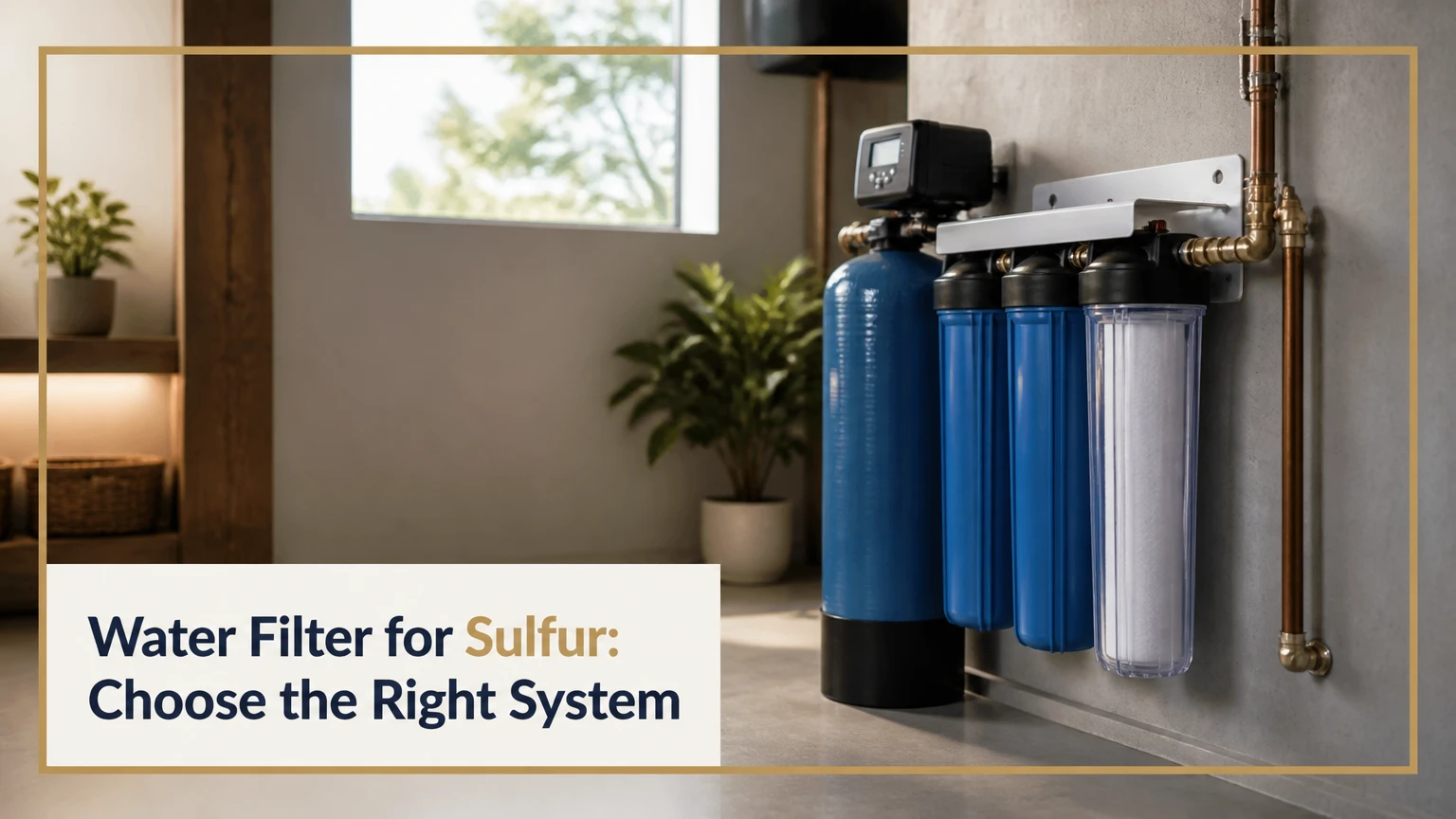
A water filter for sulfur removes dissolved hydrogen sulfide, the gas responsible for rotten-egg odor and taste in well water. The most reliable whole-house systems oxidize hydrogen sulfide into solid sulfur, trap the particles in a backwashing media bed, and discharge the captured material during an automatic cleaning cycle.
Key Facts at a Glance
Hydrogen sulfide odor in both hot and cold water usually requires treatment at the well entry point.
A standard sediment filter, ordinary carbon block, or water softener does not reliably remove dissolved hydrogen sulfide gas.
Air-injection oxidation commonly suits approximately 1-10 ppm hydrogen sulfide when pH, contact time, and backwash flow are adequate.
Hydrogen peroxide or chlorine injection is more appropriate for severe odor, sulfur bacteria, black slime, or highly variable contamination.
Test pH, hydrogen sulfide, iron, manganese, hardness, coliform bacteria, and sulfate before selecting equipment.
A treatment tank must receive the manufacturer’s specified backwash flow, often about 5-10 gallons per minute for residential media beds.
What Does a Water Filter for Sulfur Remove?
A sulfur water filter is a treatment system for hydrogen sulfide, dissolved sulfide compounds, and sometimes related iron or manganese contamination. Hydrogen sulfide creates odor at very low concentrations, so an unpleasant smell does not automatically indicate an extreme concentration or a dangerous condition.
Hydrogen sulfide can enter groundwater through natural geological processes, decomposing organic matter, or activity from sulfur-reducing bacteria. The gas may also appear when sulfate in an oxygen-poor well environment is biologically reduced to sulfide.
The odor is a diagnostic clue, not a complete water analysis. A laboratory test should determine whether the water contains dissolved sulfide, sulfate, iron, manganese, bacteria, acidity, or another odor-producing compound.
Is sulfur water dangerous?
Hydrogen sulfide at household water concentrations is primarily an aesthetic problem, but high concentrations in enclosed spaces can create a serious inhalation hazard. The greatest concern occurs at the well, storage tank, septic area, or poorly ventilated utility room where gas can accumulate after water releases it.
The Pennsylvania State University Extension describes rotten-egg odor as the characteristic sign of hydrogen sulfide in well water and recommends testing the well when the odor is persistent. Do not enter a confined well or tank space to investigate an odor without appropriate professional safety procedures.
Hydrogen sulfide can also accelerate corrosion of copper, brass, steel, and some water-heating components. Sulfur particles and microbial slime can stain fixtures, restrict valves, foul softener resin, and reduce water pressure.
How Does Sulfur Filtration Work?
A whole-house sulfur filter normally uses four linked stages: oxidation, conversion into particles, media filtration, and backwashing. The treatment succeeds only when the oxidant, contact time, media capacity, pH, and hydraulic flow are matched to the water analysis.
- Oxidation: Air, chlorine, or hydrogen peroxide reacts with dissolved hydrogen sulfide.
- Precipitation: The reaction converts dissolved sulfide into elemental sulfur or other filterable sulfur compounds.
- Filtration: A catalytic or oxidizing media bed captures the resulting particles.
- Backwashing: An automatic valve expands the bed and sends accumulated solids to drain.
Air-injection oxidation systems maintain an air pocket or introduce air into the treatment vessel. Chemical systems meter an oxidant into the raw-water line, usually followed by a contact tank and a backwashing carbon or catalytic filter.
The sulfur is not simply “absorbed” like a smell in a room. Successful treatment changes the contaminant’s form, then physically removes the reaction products.
What does catalytic media do?
Catalytic media accelerates oxidation and provides a large reactive surface for trapping precipitated sulfur. Common examples include catalytic carbon, manganese dioxide media, manganese greensand, and proprietary mineral blends such as Katalox Light.
Media names do not determine performance by themselves. A tank with inadequate empty-bed contact time, insufficient backwash flow, unsuitable pH, or excessive iron can fail even when the media is technically compatible.
Which Sulfur Filter Type Fits Your Water?
Air injection is usually the simplest whole-house option for moderate hydrogen sulfide without severe bacterial slime. Peroxide or chlorine injection is the stronger choice for high or unstable sulfide levels, sulfur bacteria, and combined iron problems, while catalytic carbon cartridges suit low-flow point-of-use polishing.
| System type | Typical sulfur range | Consumable | Typical maintenance | Best application |
|---|---|---|---|---|
| Air-injection oxidation | 1-10 ppm | Air and electricity | Backwash every 1-4 days | Moderate whole-house odor |
| Peroxide injection | 5-30+ ppm | Hydrogen peroxide | Refill and pump service | Severe or variable sulfide |
| Chlorine injection | 5-30+ ppm | Sodium hypochlorite | Refill, contact tank, carbon service | Sulfur bacteria and sanitation |
| Greensand or manganese dioxide | 1-6 ppm | Air or regenerant, model dependent | Chemical or frequent backwash | Sulfur with iron and manganese |
| Catalytic carbon cartridge | Under 1 ppm | Replacement cartridge | Replace about every 3-12 months | Low-level, single-fixture odor |
| Reverse osmosis | Polishing only | Membrane and prefilters | Filter and membrane replacement | Drinking-water finishing |
These sulfur ranges are typical design starting points, not universal guarantees. Manufacturers may publish different capacities because media depth, pH, oxidation method, contact time, water temperature, and competing contaminants change results.
When is air-injection oxidation the best choice?
Air-injection oxidation is generally the best first whole-house choice for approximately 1-10 ppm hydrogen sulfide when the water has adequate pH and the well pump can deliver the required backwash rate. It avoids routine chemical handling and typically uses a single treatment tank.
AIO systems can also remove some iron and manganese when correctly configured, but they do not disinfect a well or reliably eliminate living sulfur bacteria. Air systems may produce temporary sputtering or cloudy microbubbles after regeneration, particularly when air enters the service line.
Choose AIO when odor is steady, the water test shows moderate sulfide, and the installation has a suitable drain and electrical outlet. Avoid it as the sole treatment when black slime, strong biological odor, or severe concentration swings indicate active microbial growth.
When should you use peroxide or chlorine injection?
Chemical injection is the more adaptable option for hydrogen sulfide above roughly 10 ppm, strong sulfur bacteria, black slime, and water chemistry that changes substantially during the year. Hydrogen peroxide oxidizes sulfide without adding chlorine residual, while chlorine provides an additional disinfection effect.
A typical train contains a chemical storage tank, metering pump, injection point, contact tank, and downstream catalytic carbon filter. The contact tank provides reaction time, and the carbon bed removes oxidized sulfur plus residual oxidant.
Hydrogen peroxide does not replace laboratory testing or well disinfection. Pump calibration, solution concentration, injection timing, and contact volume determine the actual dose.
Are greensand filters still useful?
Manganese greensand and manganese dioxide media can treat hydrogen sulfide together with iron and manganese, but the correct regeneration method depends on the product. Traditional greensand may require potassium permanganate, whereas some newer manganese dioxide products use air oxidation or another regenerant.
Greensand is a poor choice for an owner who wants no chemical handling and minimal adjustment. It can be effective in a controlled installation, but missed regeneration, excessive iron, or inadequate backwashing can cause rapid pressure loss and media damage.
What Should You Test Before Buying?
A private-well owner should test the raw water before choosing a sulfur filter because odor intensity does not identify concentration, pH, bacterial activity, iron loading, or flow requirements. Collect a properly preserved sample from an untreated tap and test the water near the same time that the odor is present.
| Test parameter | Typical reason for testing | Treatment effect | Useful decision |
|---|---|---|---|
| Hydrogen sulfide | Measures dissolved sulfide | Sets oxidation demand | Select AIO or chemical injection |
| pH | Controls oxidation and media performance | Low pH can reduce treatment efficiency | Add neutralizer if required |
| Iron | Competes for media capacity | Causes fouling and staining | Add iron-capable pretreatment |
| Manganese | Creates dark deposits | Increases oxidation load | Select compatible media |
| Hardness | Causes scale and valve fouling | Blocks injectors and air ports | Consider softening after sulfur removal |
| Coliform bacteria | Indicates sanitary contamination | Requires disinfection and source correction | Evaluate well and UV treatment |
| Sulfate | Identifies sulfur-cycle conditions | Helps interpret sulfide formation | Investigate well chemistry |
| Flow and pressure | Sizes equipment and backwash | Determines cleaning success | Verify pump and drain capacity |
Hydrogen sulfide is volatile, so a delayed or poorly sealed sample can understate the concentration. Ask the laboratory about bottle type, preservation, delivery time, and whether it measures sulfide directly rather than inferring it from sulfate.
What pH does a sulfur filter need?
Many oxidation systems perform best near neutral to mildly alkaline conditions, often around pH 7.0-8.5, but the acceptable range is media-specific. Water below approximately pH 6.8 may require an acid-neutralizing filter before oxidation treatment, especially when the selected media depends on alkaline conditions.
A neutralizer adds calcium carbonate or another alkaline medium and can increase hardness. The downstream water softener, if needed, normally follows the sulfur treatment and neutralizer.
How much backwash flow is required?
Residential sulfur tanks commonly need approximately 5-10 GPM during backwash, although the exact requirement depends on tank diameter, media density, temperature, and the manufacturer’s expansion specification. A well pump that produces adequate pressure at a faucet may still fail to provide enough sustained flow at the treatment valve.
Measure flow while the well system is operating, not only from the pump label. Confirm pressure-switch settings, pressure-tank drawdown, pipe size, drain capacity, and simultaneous household demand.
How Much Does Sulfur Treatment Cost?
Typical residential sulfur treatment costs range from about $250 for a point-of-use cartridge or small reverse-osmosis system to $4,500 for a multi-tank chemical injection installation. The final price depends on pretreatment, electrical work, drain access, plumbing modifications, laboratory testing, and whether a contact tank is required.
| Solution | Typical equipment cost | Typical annual operating cost | Installation time | Main recurring task |
|---|---|---|---|---|
| Catalytic carbon cartridge | $50-$600 | $80-$200 | 1-3 hours | Replace cartridges |
| AIO backwashing filter | $1,200-$2,500 | $50-$200 | 3-6 hours | Inspect valve and backwash |
| Greensand system | $1,000-$2,500 | $100-$300 | 3-6 hours | Regeneration or media service |
| Peroxide injection train | $2,500-$4,500 | $150-$400 | 5-10 hours | Refill, prime, calibrate pump |
| Chlorine injection train | $2,500-$4,500 | $150-$350 | 5-10 hours | Refill solution and service carbon |
| Under-sink RO polisher | $250-$600 | $60-$180 | 2-4 hours | Replace prefilters and membrane |
These are typical market ranges rather than guaranteed quotes. A treatment professional should price the equipment after seeing the laboratory report and measuring the available backwash flow.
AIO media may last approximately 5-10 years under suitable conditions. Catalytic carbon cartridges may last 3-12 months, while a backwashing carbon bed commonly requires replacement after about 3-5 years, depending on oxidant exposure and contaminant load.
How Should the Equipment Be Installed?
The usual installation order is sediment protection, sulfur oxidation and filtration, neutralization if needed, water softening, and point-of-use polishing. Ultraviolet treatment belongs after particulate removal and is useful for biological disinfection, but UV does not remove hydrogen sulfide odor.
Recommended sequence:
- Raw well line
- Sediment prefilter, if sediment is present
- Sulfur treatment tank or chemical injection point
- Contact tank, when the chemical system requires one
- Backwashing catalytic filter
- Acid neutralizer, if the design calls for it
- Water softener
- UV disinfection, if bacteria testing justifies it
- Reverse osmosis at the drinking-water tap
Place a standard softener after sulfur filtration because untreated sulfur particles and biological slime can foul resin and increase pressure loss. Place a cartridge sediment filter before an AIO valve only when its micron rating and flow capacity will not restrict the backwash rate.
The system needs a properly trapped or air-gapped drain, a nearby electrical outlet for automatic valves, bypass valves for service, and enough clearance to remove the control head. Never route a backwash drain where wastewater can return to the well or septic system without professional review.
Why Does the Rotten-Egg Smell Return?
A returning odor usually means the oxidation system is receiving a higher contaminant load, losing contact with air or chemical, failing to backwash, or treating a source problem that has not been corrected. The first diagnostic step is to compare untreated water before the filter with treated water after the filter.
| Symptom | Likely cause | First check | Corrective action |
|---|---|---|---|
| Odor returns gradually | Fouled air injector or exhausted carbon | Inspect injector and media age | Clean injector or replace media |
| Odor appears suddenly | Empty chemical tank or lost pump prime | Check solution level and pump | Refill and reprime |
| Pressure falls during use | Bed fouling or insufficient backwash | Measure backwash GPM | Increase flow or service media |
| Odor only in hot water | Magnesium anode reaction | Compare hot and cold taps | Inspect or replace anode |
| Black slime in toilets | Sulfur or iron bacteria | Test bacteria and inspect tanks | Disinfect well and treat source |
| Milky water after regeneration | Entrained air | Observe timing and clear faucet | Adjust air draw or add air release |
| Filter works in winter only | Seasonal sulfide variation | Test in multiple seasons | Resize or use chemical control |
An air-injection valve can lose effectiveness when a venturi port becomes blocked by scale or iron. A chemical pump can lose prime after an empty tank, stiff diaphragm, clogged foot valve, or air leak in the suction tubing.
A pressure drop is not proof that the media is “full of sulfur” alone. Sediment, iron hydroxide, bacterial slime, undersized plumbing, and a weak well pump can create the same symptom.
Can a water heater cause sulfur odor?
A water heater can cause rotten-egg odor when the smell occurs only in hot water, especially in a tank with a magnesium anode rod. The reaction can involve sulfate-reducing bacteria and the anode, so installing a whole-house sulfur filter will not fix a hot-water-only problem.
Compare cold and hot water from the same fixture, then repeat the comparison at another fixture. A plumber can inspect the anode and evaluate an aluminum-zinc or powered replacement, but removing the anode permanently may reduce tank protection and can affect the manufacturer’s warranty.
What causes black slime?
Black slime commonly indicates biological growth involving sulfur or iron bacteria, but its appearance does not identify the organism with certainty. Slime may develop in toilet tanks, pressure tanks, filters, faucet aerators, and low-flow sections of plumbing.
Source correction may require well inspection, shock chlorination, pressure-tank cleaning, and a treatment system that continuously controls sulfide. Chlorine injection offers a stronger sanitation pathway than chemical-free AIO, but neither system compensates for a damaged well casing or surface-water entry.
Can Reverse Osmosis Remove Sulfur?
Reverse osmosis can polish drinking water after pretreatment, but an under-sink RO unit is not a practical whole-house sulfur filter. Hydrogen sulfide can foul carbon prefilters, create odor at multiple fixtures, and consume membrane capacity before the water reaches the drinking tap.
Use RO when the goal is high-quality drinking water after the main odor problem has been removed. Install adequate sediment and carbon pretreatment, verify membrane compatibility, and maintain the storage tank and drain connection according to the manufacturer’s schedule.
A point-of-use catalytic carbon cartridge may handle mild odor at one tap, but cartridge capacity is limited. A cartridge should not be selected for a whole-house application merely because its first-day water tastes better.
Which System Should You Choose?
| Household situation | Recommended starting point | Avoid as the only solution | Reason |
|---|---|---|---|
| Odor below 1 ppm at one drinking tap | Catalytic carbon or RO | Large chemical train | Point-of-use demand is low |
| Odor at every fixture, 1-10 ppm | AIO oxidation | Ordinary softener | Whole-house oxidation and backwash fit the load |
| Odor above 10 ppm | Peroxide injection and carbon | Small cartridge | High sulfide can exhaust carbon rapidly |
| Black slime or sulfur bacteria | Chlorine or peroxide plus source correction | Chemical-free filter alone | Biological growth needs sanitation planning |
| Sulfur plus iron and manganese | Compatible manganese dioxide or chemical system | Undersized carbon | Multiple contaminants consume capacity |
| Low well-pump flow | Chemical system or pump upgrade | Backwashing tank without testing | Media cannot clean itself properly |
| Hot-water-only odor | Water-heater inspection | Whole-house sulfur filter | The source is downstream of the filter |
The best water filter for sulfur is therefore conditional. Choose AIO for moderate, stable odor with adequate flow; choose peroxide or chlorine injection for severe or biological cases; choose catalytic carbon or RO only for low-load point-of-use polishing.
What Are the Most Common Buying Mistakes?
- Buying by odor strength alone: A powerful smell can occur at low concentration, while a less noticeable odor can accompany a substantial sulfide load.
- Ignoring pump flow: A filter that cannot backwash will become a pressure problem regardless of media quality.
- Using ordinary carbon first: Standard activated carbon may temporarily reduce odor, then exhaust quickly under continuous hydrogen sulfide exposure.
- Putting the softener first: Sulfur solids and slime can foul resin and shorten the softener’s service interval.
- Assuming UV removes sulfur: UV inactivates susceptible microorganisms; it does not oxidize or filter dissolved hydrogen sulfide.
- Treating bacteria without inspecting the well: Shock treatment may be temporary if the well allows contaminated water to enter.
- Selecting potassium permanganate casually: The chemical requires correct storage, dosing, spill control, and regeneration procedures.
A practitioner rule is to size the treatment train from the worst credible raw-water condition, not the best result from a single sample. Seasonal groundwater changes, well pumping depth, and bacterial cycles can produce different sulfide loads several months apart.
Another rule is to test pressure loss across the system before changing media. A dirty prefilter, restricted drain, or weak pump can mimic chemical-treatment failure and lead to an unnecessary equipment replacement.
Sulfur Filter FAQ
Does a water softener remove sulfur smell?
A water softener does not reliably remove dissolved hydrogen sulfide and should not be used as the primary sulfur treatment. Softening resin targets hardness ions such as calcium and magnesium, while sulfur treatment requires oxidation, adsorption, or a specialized chemical process.
How often should a sulfur filter backwash?
Many automatic sulfur filters backwash every 1-4 days, with a cycle lasting roughly 30-60 minutes. The correct interval depends on sulfide concentration, iron loading, water use, media depth, and the manufacturer’s programming.
Can boiling remove hydrogen sulfide?
Boiling can drive volatile hydrogen sulfide from a small quantity of water, but it is not a safe or practical whole-house treatment. Heating may release the gas into indoor air, and boiling does not remove iron, manganese, bacteria, or precipitated sulfur particles.
Does sulfur water damage plumbing?
Hydrogen sulfide can contribute to corrosion, especially in systems containing copper, brass, steel, or vulnerable water-heater components. Damage depends on sulfide concentration, pH, dissolved oxygen, temperature, plumbing materials, and exposure time.
How do I know whether the sulfur is in the well or water heater?
Test cold and hot water from separate fixtures. Odor in both temperatures points toward the well or incoming plumbing, while odor confined to hot water points toward the water heater, anode rod, or hot-water plumbing.
Is sulfur water safe to drink?
Low-level hydrogen sulfide is commonly treated as an aesthetic issue, but a persistent odor warrants laboratory testing before drinking use. Test for coliform bacteria, nitrate, arsenic, iron, manganese, sulfide, and other contaminants relevant to the well’s location.
The Bottom Line
A water filter for sulfur must match hydrogen sulfide concentration, pH, iron and manganese loading, bacterial activity, household flow, and available backwash capacity. Air-injection oxidation is a practical chemical-free choice for moderate stable odor, while peroxide or chlorine injection provides better control for severe sulfide and sulfur bacteria. Test the raw water first, keep sulfur treatment ahead of the softener, and verify the well pump can clean the selected media bed.