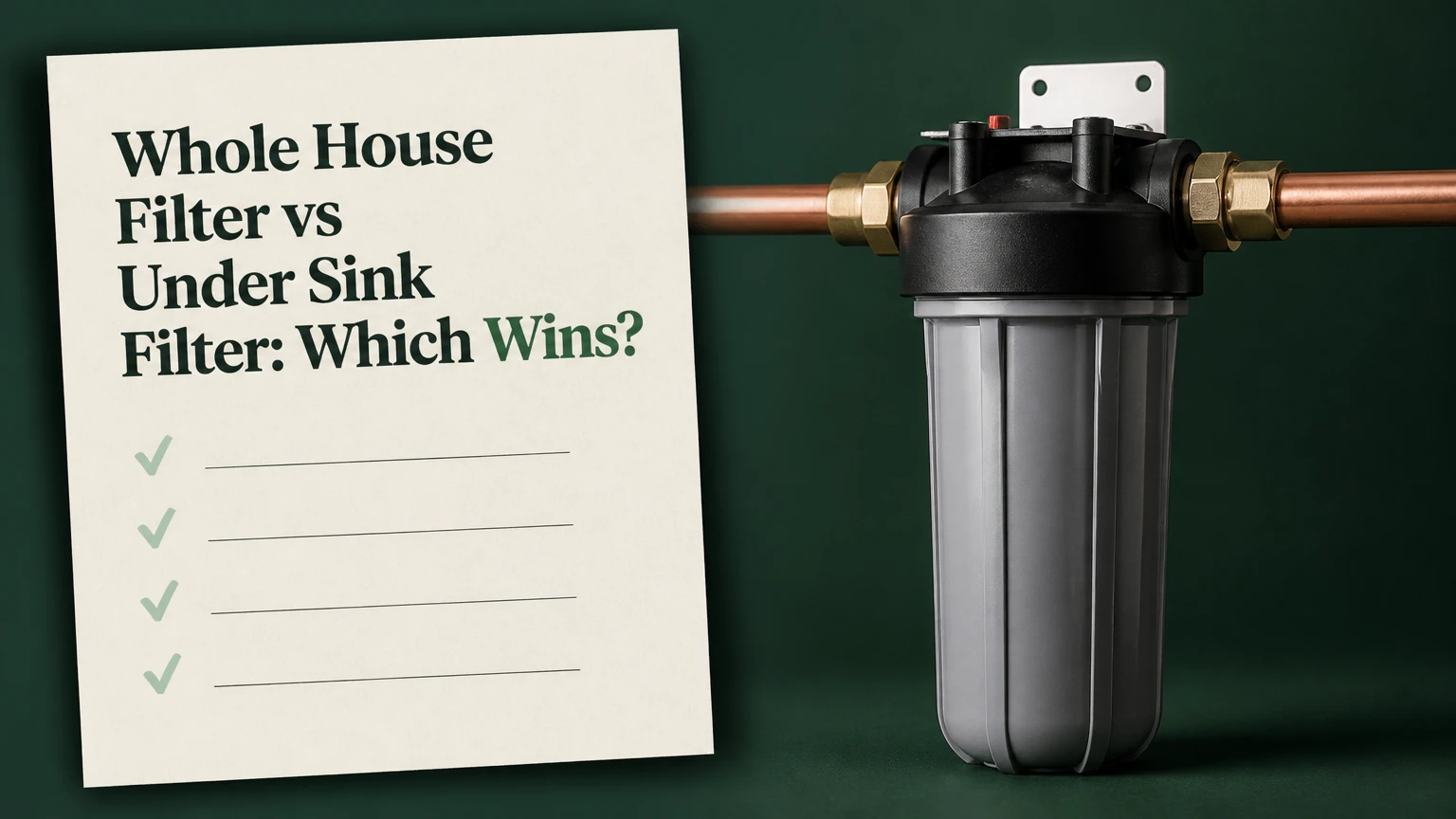
A whole house filter treats water at the main entry point for every fixture, while an under-sink filter treats water at one faucet. Choose whole-house filtration for sediment, chlorine, scale, or well-water problems throughout the property; choose under-sink filtration for targeted drinking-water treatment. A hybrid system often provides the broadest protection.
Key Facts at a Glance
- A whole-house filter operates at the point of entry and supplies filtered water to showers, toilets, appliances, and faucets.
- An under-sink filter operates at the point of use and usually supplies one kitchen faucet.
- Activated carbon improves chlorine, taste, and odor but generally does not reduce hardness or dissolved-solids readings.
- Reverse osmosis removes many dissolved contaminants, but it produces reject water and usually delivers 0.5-1.5 gallons per minute.
- A whole-house cartridge system commonly costs $500-$2,500 before professional installation, while an under-sink system commonly costs $150-$600.
- Water testing should determine the treatment method, because no filter removes every contaminant.
Whole House Filter vs Under Sink Filter: What Is the Difference?
The main difference is treatment location and coverage. A whole-house filter is a point-of-entry system installed on the main cold-water line, whereas an under-sink filter is a point-of-use system installed beneath one counter and connected to one cold-water branch.
Whole-house filtration treats water before distribution through the plumbing network. That arrangement can reduce sediment and chlorine at showers, washing machines, ice makers, bathroom sinks, and kitchen faucets, provided the system has sufficient capacity and the plumbing is correctly configured.
Under-sink filtration concentrates treatment where consumption occurs. A carbon block, ultrafiltration membrane, or reverse-osmosis membrane can deliver more intensive treatment without processing every gallon used for laundry, flushing, or bathing.
The distinction determines the correct purchase. A whole-house carbon unit is a poor substitute for drinking-water RO when dissolved arsenic or fluoride is the concern. An under-sink carbon filter is a poor substitute for a sediment or iron treatment system when orange staining appears at every fixture.
Which System Does What?
The correct system depends on the contaminant, the number of fixtures requiring treatment, and the required water flow. Whole-house systems favor coverage and flow, while under-sink systems favor targeted contaminant reduction and lower purchase cost.
| Decision factor | Whole-house system | Under-sink carbon | Under-sink UF | Under-sink RO |
|---|---|---|---|---|
| Treatment location | Main entry line | Kitchen cabinet | Kitchen cabinet | Kitchen cabinet |
| Typical treated outlets | 10-25 fixtures | 1 faucet | 1 faucet | 1 faucet |
| Typical flow | 10-25 GPM | 0.5-2.0 GPM | 0.5-1.5 GPM | 0.5-1.5 GPM |
| Typical purchase price | $500-$2,500 | $75-$300 | $150-$500 | $200-$600 |
| Dissolved-solids reduction | Usually 0% | Usually 0% | Usually 0% | Often 80%-99% |
| Wastewater | 0 gallons for cartridge units | 0 gallons | 0 gallons | Typically 1-3 gallons per gallon produced |
| Main benefit | Whole-property treatment | Taste and chlorine reduction | Particulate and microbial barrier | Broad dissolved-contaminant reduction |
These figures are typical residential ranges, not performance guarantees. Flow and contaminant reduction vary with inlet pressure, temperature, cartridge size, membrane condition, and the manufacturer’s tested claims.
What Does a Whole-House Filter Remove?
Whole-house filters commonly remove sediment, rust particles, sand, chlorine, and selected volatile organic compounds when the system uses appropriately sized sediment and carbon media. Specialized systems can address iron, manganese, sulfur odor, hardness, or microorganisms, but each requires a different treatment process.
A 5-micron sediment cartridge can capture many visible particles. A carbon bed can adsorb chlorine and improve taste and odor. KDF media can support chlorine and certain metal-reduction applications, although the specific product claim must be verified rather than assumed.
Whole-house filters generally do not reduce hardness minerals, sodium, nitrate, fluoride, or TDS. A water softener uses ion exchange for calcium and magnesium. A whole-house RO system can reduce dissolved solids, but its cost, wastewater volume, storage requirements, and flow limitations make it unsuitable for many ordinary homes.
What Does an Under-Sink Filter Remove?
An under-sink filter can reduce contaminants at the drinking-water faucet, but capability depends on the filter type. Carbon targets taste, odor, chlorine, and some organic chemicals; UF blocks particles and many microorganisms; RO reduces many dissolved ions and compounds.
The phrase “five-stage filter” does not identify performance. A five-stage system may contain three carbon cartridges, a sediment cartridge, and a post-carbon cartridge, or it may include an RO membrane. The performance label and certification matter more than the stage count.
NSF/ANSI 42 commonly relates to aesthetic claims such as chlorine, taste, and odor. NSF/ANSI 53 relates to specific health-effect contaminants, such as lead, when the product has the relevant certification. NSF/ANSI 58 applies to reverse-osmosis systems. Certification must match the contaminant claim.
How Do the Two Systems Work?
A whole-house system filters water before household distribution, while an under-sink system diverts a small cold-water stream through cartridges or membranes. The plumbing sequence affects pressure, maintenance, wastewater, and which fixtures receive treated water.
Whole-House Treatment Sequence
- Water enters through the main shutoff and passes through a correctly sized isolation valve.
- A sediment cartridge or backwashing filter captures sand, rust, silt, or suspended particles.
- Carbon or catalytic carbon reduces chlorine, chloramines, taste, odor, and selected organic compounds.
- A softener, iron filter, air-injection unit, or sulfur treatment addresses a specific water chemistry problem.
- UV treatment disinfects microbiologically unsafe water after upstream sediment removal.
- Treated water continues to the water heater and cold-water branches.
A whole-house filter must be sized for simultaneous demand. A family shower can use 2.0-2.5 GPM, a washing machine commonly uses 2-5 GPM while filling, and multiple fixtures can quickly exceed a restrictive filter housing.
Under-Sink Treatment Sequence
- A tee valve diverts cold water from the sink supply line.
- A sediment cartridge protects carbon blocks and membranes from suspended particles.
- Carbon filtration reduces chlorine and organic compounds.
- An RO membrane separates many dissolved contaminants and sends reject water to the drain.
- A storage tank or electric pump supports delivery, depending on the design.
- A post-carbon cartridge polishes stored water before the dedicated faucet.
Tankless RO systems can save cabinet space, but they usually require electricity and may need higher instantaneous flow. Traditional tank RO systems occupy more space and replenish slowly, yet they can deliver a stronger faucet stream when the storage tank is full.
Which Contaminants Require Which Technology?
The contaminant determines the treatment method more reliably than the system’s location. A whole-house or under-sink label describes placement, not purification strength.
| Water problem | Whole-house response | Under-sink response | Test or verification |
|---|---|---|---|
| Rust, sand, and silt | 5-20 micron sediment filter | 1-5 micron cartridge | Visual inspection and laboratory turbidity |
| Chlorine taste or odor | Carbon tank or cartridge | Certified carbon block | Utility report and chlorine test |
| Chloramine | Catalytic carbon with adequate contact time | Certified catalytic carbon | Utility report |
| Hardness and scale | Ion-exchange softener | Usually ineffective | Hardness test in grains per gallon |
| Lead at the faucet | Certified whole-house or outlet filter | NSF/ANSI 53 certified cartridge or RO | First-draw laboratory sample |
| Arsenic or nitrate | Specialized whole-house treatment | Certified RO or dedicated media | Laboratory analysis |
| Bacteria in well water | Sediment plus UV or disinfection | Certified microbiological barrier for one outlet | Coliform laboratory test |
| Fluoride and high TDS | Whole-house RO, usually expensive | RO membrane | Laboratory analysis and TDS screening |
TDS is a screening measurement, not a safety diagnosis. A low TDS reading does not prove that water is microbiologically safe, and a high TDS reading does not identify which dissolved substances are present.
The U.S. Environmental Protection Agency’s Consumer Confidence Report program gives municipal customers annual information about regulated contaminants detected in public water supplies. Private well owners do not receive that public utility testing, so the Centers for Disease Control and Prevention recommends regular well-water testing through an accredited laboratory, particularly after flooding, repairs, or changes in taste and odor.
What Are the Costs and Maintenance Requirements?
Under-sink filtration usually costs less to purchase and install, while whole-house treatment costs more because it uses larger housings, media tanks, valves, and main-line plumbing. Long-term cost depends on water usage, cartridge capacity, local labor, replacement media, and wastewater.
| Expense category | Whole-house cartridge | Whole-house media tank | Under-sink carbon or UF | Under-sink RO |
|---|---|---|---|---|
| Equipment purchase | $500-$1,500 | $900-$2,500 | $75-$500 | $200-$600 |
| Professional installation | $500-$1,500 | $600-$1,800 | $150-$300 | $200-$450 |
| Filter or media service | $100-$300 per year | $150-$400 per year | $40-$120 per year | $60-$180 per year |
| Main equipment life | 5-10 years | 8-15 years | 3-7 years | 3-7 years |
| Typical replacement event | 3-12 months | 5-10 years for media | 6-12 months | 6-12 months prefilters |
| Membrane replacement | Not applicable | Not applicable | Not applicable | 2-4 years |
Professional prices vary by region and by whether a bypass loop, drain connection, electrical outlet, permits, or a new shutoff valve is needed. A low equipment price can become expensive if the system requires frequent high-capacity cartridges.
RO ownership includes reject water and sanitization. A conventional RO system may send 1-3 gallons to the drain for each gallon of product water, although high-efficiency models can perform better. Check the manufacturer’s tested recovery ratio rather than relying on a generic stage count.
Does Installation Location Affect Water Quality?
Installation location affects which plumbing is protected and whether unfiltered water can bypass the treatment point. A whole-house filter installed after an outdoor hose bib may leave exterior fixtures untreated, while a unit installed before the branch split can treat most indoor outlets.
Whole-house equipment normally needs a level, accessible area near the main shutoff. The installer should provide isolation valves, a bypass valve, pressure gauges where useful, a drain route for backwashing equipment, and protection from freezing.
Under-sink systems need cabinet clearance, a compatible cold-water connection, a faucet hole or direct-connect adapter, and adequate drain plumbing for RO reject water. RO drain saddles should be installed above the trap and positioned according to the manufacturer’s instructions.
Hot-water treatment requires special attention. Many whole-house filters treat only cold water before the water heater, so the water heater receives filtered cold water but an existing tank can still contain sediment. Under-sink filters almost always connect to cold water, because hot water can damage carbon cartridges, membranes, and plastic fittings.
Which Option Fits Each Household?
The best choice changes with the water source and the problem being solved. A household with chlorine odor may need carbon throughout the home, while a household with a verified arsenic concern may need certified drinking-water treatment at one or more consumption points.
Municipal Home With Chlorine and Scale
Choose a whole-house carbon filter plus a properly sized water softener when chlorine affects showers and hardness causes scale on fixtures. Add under-sink RO when the household also wants lower TDS or targeted reduction of lead, fluoride, arsenic, or nitrate.
Carbon does not soften water. A salt-free conditioner may alter scale behavior but does not remove calcium and magnesium in the same way as ion exchange.
Private Well With Sediment or Bacteria
Choose whole-house sediment treatment first, then add iron, manganese, sulfur, or UV equipment according to laboratory results. An under-sink filter can improve drinking water, but it cannot protect every faucet from contaminated well water.
UV systems require relatively clear water and correct flow sizing. Excess sediment, hardness, iron, or manganese can shield microorganisms and foul the UV sleeve.
Apartment Renter
Choose a compact under-sink carbon or UF system with reversible connections and no permanent cabinet modification. A countertop unit or faucet-mounted filter may be more practical when the lease prohibits plumbing changes.
Renters rarely benefit from whole-house equipment because the main water line is inaccessible, the system cannot move easily, and installation may require landlord approval.
Large Home With Pressure Sensitivity
Choose a backwashing media tank or large-diameter cartridge housing rated above the home’s peak demand. Avoid a small 10-inch housing on a property where several showers, appliances, and irrigation fixtures operate at once.
A filter’s advertised maximum flow is not always its best operating flow. Sediment loading increases pressure loss, and carbon requires contact time to perform well.
What Are the Main Advantages and Limitations?
Whole-house filtration provides broad coverage and can protect fixtures, appliances, and bathing water, but it cannot automatically deliver drinking-water purification. Under-sink filtration can provide highly targeted treatment at a lower initial cost, but it leaves most household plumbing exposed.
| Attribute | Whole-house advantage | Whole-house limitation | Under-sink advantage | Under-sink limitation |
|---|---|---|---|---|
| Coverage | Treats showers and appliances | More equipment and plumbing | Focuses treatment at consumption point | One faucet or branch only |
| Flow | Supports 10-25 GPM with correct sizing | Restrictive housings reduce pressure | Efficient for one faucet | Usually below 1.5 GPM |
| Dissolved contaminants | Specialized systems can address them | Whole-house RO is costly | RO can reduce many dissolved compounds | RO creates reject water |
| Maintenance | Media tanks can reduce cartridge changes | Backwashing needs drain and service | Filter changes are accessible | Cabinet space becomes limited |
| Installation | Central treatment point | Main-line cutting is required | Often suitable for DIY installation | Leaks can damage the cabinet |
| Drinking water | Removes aesthetic contaminants throughout home | Carbon may not address arsenic or nitrate | Certified cartridges target named contaminants | Treatment does not reach showers |
A whole-house system is also not a universal health safeguard. It should not be selected to treat a serious contaminant without a laboratory result and a product performance claim that names that contaminant.
What Common Mistakes Cause Poor Results?
Most filtration failures result from incorrect treatment selection, inadequate flow sizing, or neglected maintenance rather than defective filter media. The following practitioner rules prevent the most expensive errors.
- Buying from a TDS reading alone: TDS meters cannot identify lead, nitrate, arsenic, bacteria, or individual chemicals. Use TDS as a screening clue, then order contaminant-specific laboratory testing.
- Using carbon for hardness: Carbon can improve chlorine taste but does not remove calcium and magnesium. Install a softener or another verified scale-control system for hard-water deposits.
- Choosing a filter by micron rating alone: A 0.5-micron rating does not establish lead, cyst, virus, or chemical performance. Confirm the exact certification and rated capacity.
- Ignoring peak flow: Add the expected simultaneous fixture demand before purchasing a whole-house unit. A filter rated for 8 GPM can restrict a home that routinely needs 12 GPM.
- Installing RO without an air gap or correct drain connection: Improper drain plumbing can cause siphoning, noise, or contamination risk. Follow the equipment diagram.
- Leaving cartridges in service too long: A clogged cartridge reduces pressure and can degrade water quality. Replace cartridges by capacity, time, or pressure-drop indication, whichever arrives first.
An experienced installer also leaves a bypass route. A bypass permits water service during cartridge changes and helps isolate whether a pressure problem originates in the treatment equipment.
How Do You Troubleshoot Pressure, Leaks, and RO Noise?
Whole-house pressure loss usually indicates a loaded sediment cartridge, undersized housing, closed valve, or fouled media bed. Under-sink RO slow flow usually indicates low feed pressure, an empty or over-pressurized storage tank, a blocked post-filter, or an exhausted membrane.
| Symptom | Likely cause | First check | Typical corrective action |
|---|---|---|---|
| Low pressure at every fixture | Clogged sediment cartridge | Compare inlet and outlet gauges | Replace cartridge and flush housing |
| Low pressure at one faucet | Under-sink cartridge restriction | Remove aerator and check flow | Replace filter or clean aerator |
| Housing leak | Twisted or dry O-ring | Shut off and depressurize system | Reseat O-ring with food-grade silicone lubricant |
| RO faucet drips slowly | Low tank pressure or blocked filter | Check tank pressure when empty | Set approximately 5-7 PSI or replace filter |
| RO drain runs continuously | Faulty shutoff or check valve | Close feed valve and observe drain | Service valve assembly |
| Carbon taste after replacement | Incomplete flushing | Check manufacturer flush volume | Flush the specified gallons before use |
Never open a pressurized filter housing. Close the inlet valve, open a downstream faucet, and confirm pressure has fallen before removing a cartridge.
RO tank pressure is model-specific, so the manufacturer’s instruction takes priority over a general 5-7 PSI guideline. A tank that is checked while full can give a misleading reading.
Should You Buy Both Systems?
Buy both systems when the household needs whole-property aesthetic or scale treatment and higher-grade drinking-water treatment. A common configuration is sediment filtration and carbon at the main entry, followed by a softener if hardness warrants it, plus certified under-sink RO at the kitchen faucet.
The hybrid approach avoids forcing one technology to perform incompatible jobs. Whole-house carbon handles chlorine in shower water, the softener addresses calcium and magnesium, and under-sink RO treats drinking and cooking water where its slower flow and wastewater are manageable.
A hybrid system costs more and requires coordinated maintenance. The owner must track the main prefilter, carbon media, softener salt or regeneration, RO prefilters, membrane, postfilter, and any UV lamp.
How Should You Decide Before Buying?
Use a water test and a fixture inventory before comparing brands. The decision should follow four steps:
- Obtain the municipal Consumer Confidence Report or order an accredited private-well laboratory test.
- List each confirmed contaminant, its concentration, and the required reduction.
- Calculate peak household flow and identify whether outdoor hose bibs need treatment.
- Compare certified performance, capacity, replacement cost, installation requirements, and bypass access.
A product should make a named claim for the contaminant you need to reduce. “Purifies water” is too broad to evaluate, while “reduces lead from 150 parts per billion to below the certified limit at 1,000 gallons” is a measurable performance statement.
Frequently Asked Questions
Can an under-sink filter remove hard water?
Most under-sink carbon, UF, and standard RO systems are not practical hardness treatments for an entire home. RO can reduce some dissolved calcium and magnesium at one faucet, but the slow flow and membrane scaling make a whole-house softener the better solution for widespread scale.
Does a whole-house carbon filter lower TDS?
A whole-house carbon filter normally does not lower TDS because activated carbon adsorbs many chemicals without removing most dissolved mineral ions. A TDS reduction claim requires a membrane or other treatment process specifically tested for dissolved solids.
Is reverse osmosis necessary for safe drinking water?
Reverse osmosis is not necessary for every household. Certified carbon filtration may be sufficient for chlorine and selected contaminants, while RO becomes more appropriate when laboratory testing or a utility report identifies dissolved contaminants such as nitrate, arsenic, or fluoride.
How often should a whole-house filter be changed?
Whole-house sediment and carbon cartridges commonly require replacement every 3-12 months, depending on water quality, cartridge capacity, and household consumption. Replace sooner when pressure falls, taste changes, or the manufacturer’s rated gallon capacity is reached.
Can a whole-house filter remove bacteria?
A standard sediment or carbon filter should not be assumed to disinfect water. Private wells with confirmed bacterial contamination usually require source correction and a validated disinfection method, such as UV or chemical treatment, selected after laboratory testing and flow analysis.
Is an under-sink RO system wasteful?
An under-sink RO system produces reject water because the membrane separates purified product water from concentrated contaminants. Typical systems send 1-3 gallons to the drain per gallon produced, although efficient models can reduce that ratio and some homes reuse reject water for non-potable tasks.
The Bottom Line
Choose a whole-house filter for property-wide sediment, chlorine, odor, or specialized well-water treatment, and choose an under-sink filter for concentrated drinking-water treatment at lower cost. For many municipal homes with hard water or a specific dissolved contaminant, the best answer to whole house filter vs under sink filter is a correctly sized hybrid system based on laboratory results, certified performance, and required flow.