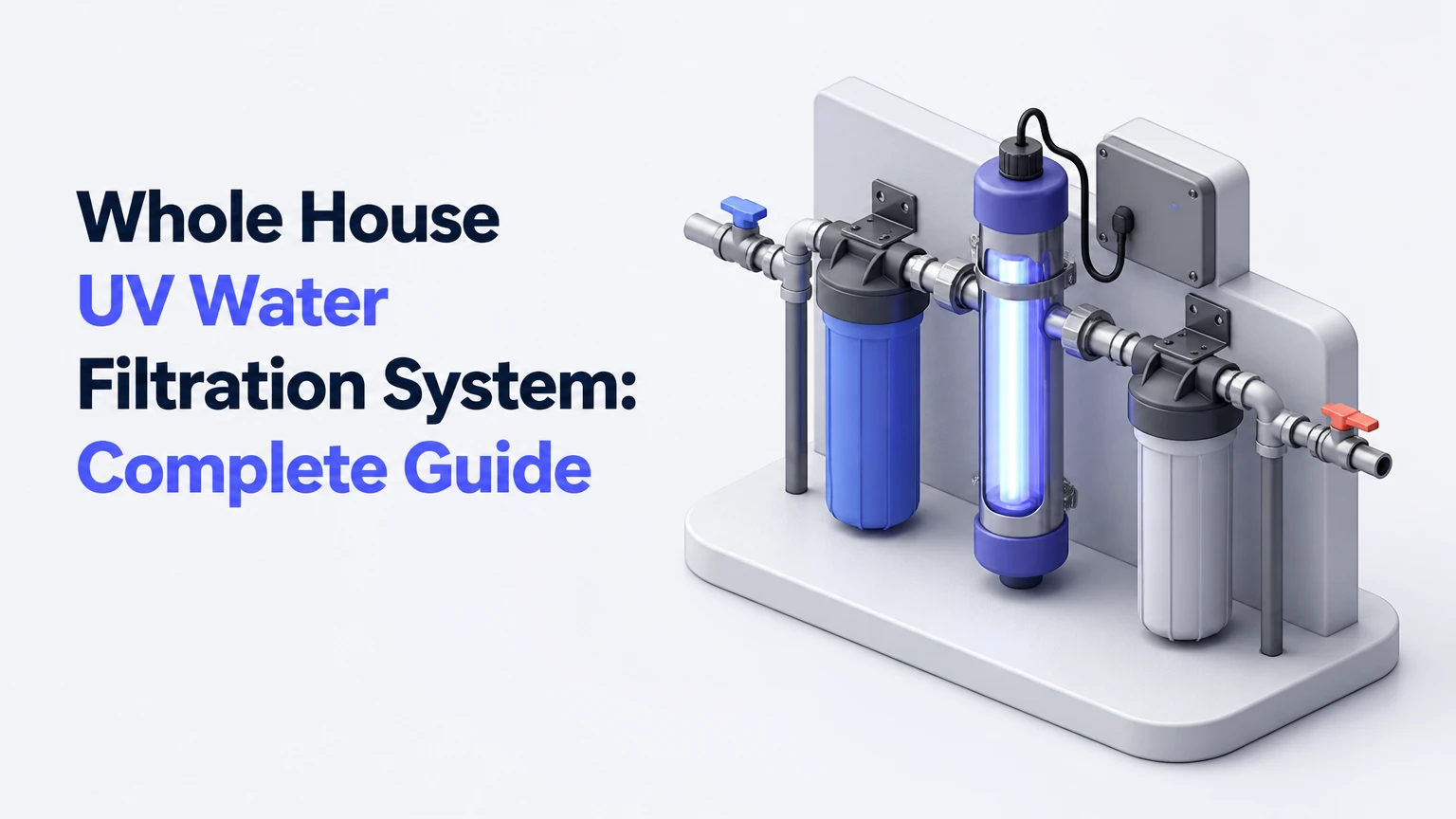
A whole house UV water filtration system is a point-of-entry disinfection unit installed on the main water line, where ultraviolet-C light inactivates bacteria, viruses, and protozoan cysts before water reaches household fixtures. UV does not remove sediment, lead, PFAS, hardness, iron, or chlorine, so successful installations use water testing and properly sized pretreatment.
Key Facts at a Glance
A whole-house UV system treats water for every tap, shower, appliance, and fixture after the treatment point.
Germicidal UV typically operates near the 254-nanometer wavelength and inactivates microorganisms by damaging their DNA or RNA.
UV requires clear water. Sediment, iron, manganese, and scale can shield organisms or block light from reaching them.
A UV chamber disinfects water only while the lamp operates and provides no disinfectant residual inside downstream plumbing.
Typical residential systems cost $500-$1,200 for equipment, with professional installation commonly adding $300-$1,000.
The lamp generally requires replacement every 12 months, even when it still produces visible blue light.
What Is a Whole House UV Water Filtration System?
A whole house UV water filtration system is a point-of-entry treatment device placed after the water enters a home and before the line branches to fixtures. The UV chamber exposes flowing water to germicidal light, while upstream filters prepare the water so the required dose reaches microorganisms.
The term “filtration” can mislead buyers. A UV lamp does not physically strain contaminants from water. The system is more accurately a whole-home ultraviolet disinfection system, usually combined with sediment, carbon, softening, or iron-removal equipment.
A typical installation serves private wells, rural water supplies, shared wells, cabins, and homes affected by microbial contamination. Municipal users may need UV after a boil-water advisory, pipe intrusion, or persistent concern about biological safety, although city water normally already receives centralized disinfection.
Where Does a UV System Go?
Install the UV chamber on the main cold-water line after the pressure tank and pretreatment equipment, but before the line divides toward bathrooms, kitchens, laundry, and water heaters. Keep a bypass loop, isolation valves, drain access, and a nearby electrical receptacle available for service.
Water heaters normally remain downstream of the UV unit. A separate point-of-use filter can treat drinking-water contaminants that UV cannot address, such as nitrate or dissolved metals.
How Does Ultraviolet Disinfection Work?
Ultraviolet disinfection works by delivering a sufficient UV dose to microorganisms as water passes around a quartz sleeve containing the lamp. UV-C energy damages microbial genetic material, preventing affected organisms from reproducing and causing infection.
The important engineering value is dose, measured in millijoules per square centimeter (mJ/cm²). Dose depends on lamp output, exposure time, chamber geometry, water flow, UV transmittance, and sleeve cleanliness. A lamp that glows visibly can still deliver inadequate germicidal output.
The Four-Stage Treatment Sequence
A reliable whole-house setup usually follows this order:
- Sediment filtration: A 5-micron or finer cartridge removes sand, silt, rust flakes, and suspended particles.
- Chemical pretreatment: Activated carbon reduces chlorine, selected organic compounds, tastes, and odors.
- Conditioning: A softener or dedicated iron and manganese filter limits scale and metal deposits when water testing justifies it.
- UV exposure: The polished water enters the stainless-steel chamber and receives the manufacturer’s rated dose.
Carbon is not always mandatory. For untreated well water, sediment control is usually fundamental, while carbon depends on chlorine, odor, organic contamination, and the selected UV manufacturer’s water-quality limits.
What Does UV Kill?
Validated UV systems can inactivate bacteria, viruses, and protozoan cysts, including E. coli, coliform bacteria, Giardia, and Cryptosporidium, when the system receives the specified dose at or below its rated flow. The exact performance depends on the certification, organism, dose, and water clarity.
UV inactivation is not the same as removal. A dead microorganism and its cellular material remain in the water unless a separate membrane or physical filter captures them.
The U.S. Centers for Disease Control and Prevention warns that “no single treatment process can remove all contaminants from drinking water.” That principle applies directly to UV selection: biological treatment and chemical treatment solve different problems.
What Does UV Leave Behind?
UV does not remove lead, arsenic, nitrate, PFAS, VOCs, pesticides, calcium, magnesium, chloride, or dissolved iron. It also does not reduce chlorine, turbidity, or bad taste unless those outcomes come from separate filter stages.
| Water problem | Does UV treat it? | More suitable treatment | Test or measurement |
|---|---|---|---|
| E. coli and coliform | Yes, with rated dose | Certified UV disinfection | Presence or absence test |
| Sand, silt, and rust | No | Sediment cartridge | Turbidity, typically NTU |
| Lead and arsenic | No | Certified adsorption or RO | Laboratory metals panel |
| Hardness and scale | No | Water softener or antiscalant | Grains per gallon |
| Chlorine and odor | No | Activated carbon | Chlorine and sensory assessment |
| PFAS and VOCs | No | Certified carbon or RO | Laboratory contaminant panel |
| Iron and manganese | No | Oxidation, catalytic media, or filtration | Parts per million |
| Nitrate | No | Anion exchange or RO | Laboratory nitrate test |
What Water Quality Does a UV System Require?
A UV system requires water clear enough for light to penetrate and clean enough to prevent deposits on the quartz sleeve. Many residential specifications use turbidity below 1 NTU, UV transmittance near or above 75%, iron below 0.3 mg/L, and manganese below 0.05 mg/L, but the equipment manual controls the actual limits.
Hardness limits vary significantly by design. Some manufacturers recommend pretreatment around 7 grains per gallon, while others permit more hardness if scaling is controlled. Do not treat generic limits as universal engineering rules.
Which Water Tests Should You Order?
Test private well water for total coliform and E. coli, turbidity, pH, hardness, iron, manganese, nitrate, arsenic, lead, and any region-specific contaminants. Test after flooding, well repairs, unexplained illness, a change in taste, or a failed sanitary inspection.
A useful testing sequence is:
- Collect a certified laboratory sample before buying equipment.
- Identify microbial, physical, mineral, and chemical problems separately.
- Select pretreatment from the measured values.
- Test treated water after installation and after any major well or plumbing change.
For municipal water, obtain the supplier’s annual water-quality report, then test at the tap if the home has old service lines, a private connection, or unusual taste and odor.
How Should You Size a Whole-House UV System?
Size a whole-house UV system for the home’s maximum simultaneous flow, not its average daily consumption. A system rated for 6 gallons per minute can be inadequate when two showers, a toilet refill, and a washing machine operate together.
| Home profile | Typical peak flow target | Suggested UV capacity | Sizing caution |
|---|---|---|---|
| One bathroom, low-flow fixtures | 6-8 GPM | 8-10 GPM | Verify fixture flow totals |
| One to two bathrooms | 9-12 GPM | 12-15 GPM | Include outdoor hose demand |
| Three bathrooms | 15-18 GPM | 18-20 GPM | Check well-pump output |
| Four or more bathrooms | 20-25 GPM | 25 GPM or higher | Consider commercial-style chamber |
| Cabin or seasonal home | 6-10 GPM | 10-12 GPM | Account for long idle periods |
Use the manufacturer’s flow rating at the certified dose. A higher nominal GPM rating does not automatically mean adequate disinfection if the rating is based on a lower dose or different UV transmittance.
Does a UV System Reduce Water Pressure?
The UV chamber usually creates a small pressure drop, but clogged pretreatment cartridges create the more noticeable restriction. A pressure gauge before and after the filter bank helps distinguish chamber resistance from cartridge loading.
Oversizing the housing and using adequately sized inlet and outlet ports can reduce pressure loss. A 1-inch main line should not be narrowed unnecessarily to a small cartridge manifold when the home has high simultaneous demand.
Which UV System Features Matter Most?
A monitored, certified system with a UV-intensity sensor is generally safer than a lamp-on indicator alone. A glowing lamp proves that electricity reaches the lamp, but it does not prove that sufficient UV reaches the water.
| Feature | Basic version | Monitored version | Best use |
|---|---|---|---|
| Lamp status | Power LED | Lamp-current and alarm monitoring | All installations |
| UV intensity | Not measured | Sensor with alarm threshold | Private wells and high-risk homes |
| Flow control | Manual bypass | Flow sensor or solenoid shutoff | Off-grid or unattended properties |
| Chamber material | Stainless steel | Stainless steel with polished interior | Residential whole-home use |
| Lamp technology | Low-pressure output | Amalgam high-output lamp | Higher flow or temperature variation |
| Alarm response | Audible fault | Audible and visual fault code | Homes needing fast intervention |
| Power protection | Standard outlet | Surge protector or UPS | Unstable electrical supply |
Low-pressure, high-output lamps are common in residential systems because they provide efficient germicidal output. Amalgam lamps can suit higher-flow installations, but lamp type matters less than certified dose at the required flow.
An automatic shutoff valve can prevent untreated water from entering the home after a lamp failure or severe intensity alarm. It also creates a new maintenance requirement, because a failed valve or sensor can interrupt water service.
What Does a Whole-House UV System Cost?
Typical equipment costs range from $500-$1,200 for a UV chamber with basic pretreatment, while professional installation commonly costs $300-$1,000. A complete well-water installation can cost more when it requires an iron filter, softener, new electrical work, plumbing modifications, or laboratory testing.
| Cost item | Typical range | Replacement interval | Main cost driver |
|---|---|---|---|
| UV chamber and ballast | $400-$900 | 10-15 years | Flow rating and monitoring |
| Sediment and carbon housings | $100-$400 | 5-12 years | Port size and materials |
| Professional installation | $300-$1,000 | One-time | Access and plumbing complexity |
| UV lamp | $70-$200 | 12 months | Brand and output |
| Quartz sleeve | $40-$150 | 2-5 years | Fouling and model |
| Filter cartridges | $60-$240 per year | 3-12 months | Sediment load and cartridge type |
| Water testing | $50-$300 per panel | Annual or event-based | Laboratory scope |
| UPS or surge protection | $50-$300 | 3-10 years | Capacity and battery design |
A typical 10-year ownership budget is about $2,500-$4,500 before major pretreatment replacements. That figure includes recurring lamps, cartridges, occasional sleeves, testing, and service labor, but local prices vary substantially.
Electricity use is usually modest for a residential lamp, often comparable to a small continuously operating appliance. The ballast, solenoid, alarms, and backup power equipment add to consumption.
How Do You Install and Maintain UV Treatment?
Professional installation is preferable when the main line, pressure tank, electrical supply, or pretreatment needs modification. A competent installer should verify flow, pipe size, water chemistry, UV transmittance, drainage, bypass design, and the final disinfected-water test.
Step 1: Test the Source Water
Order laboratory testing before selecting the equipment. Confirm microbial status, turbidity, hardness, iron, manganese, pH, UV transmittance, and chemical contaminants relevant to the property.
Success checkpoint: The test report identifies which contaminants require pretreatment.
Common mistake: Buying a combined UV and carbon package without testing iron or hardness.
Step 2: Install Pretreatment Upstream
Place sediment filtration before carbon and UV. Add an iron filter or softener only when measured contamination and the equipment manual justify it.
Success checkpoint: Water entering the UV chamber meets the manufacturer’s turbidity, iron, manganese, hardness, and UVT limits.
Common mistake: Installing carbon before a heavily sedimented source, which rapidly plugs the carbon bed.
Step 3: Match Flow and Plumbing
Select a UV rating above the calculated peak demand and match the system’s connection size to the home’s main line where practical. Install isolation valves, a bypass, sample taps, pressure gauges, and a drain or safe service area.
Success checkpoint: Several fixtures can run without exceeding the certified UV flow.
Common mistake: Using the well-pump flow as the only sizing value without adding concurrent household demand.
Step 4: Install the Chamber and Electrical Controls
Mount the chamber vertically when required by the manufacturer, protect the ballast from water, and use a grounded receptacle with surge protection. Keep access around the quartz sleeve and lamp connection.
Success checkpoint: The lamp starts reliably, alarms function, and there are no leaks at operating pressure.
Common mistake: Placing the ballast below a leaking filter housing where condensation or drips can damage electronics.
Step 5: Disinfect the Plumbing
Follow the manufacturer’s startup procedure, which may include shock chlorination of a private well and downstream plumbing. Do not assume that a new lamp instantly sanitizes contaminated pipes.
Success checkpoint: Post-installation samples meet the applicable microbial target.
Common mistake: Sampling before the treated water has flushed through the household plumbing.
Step 6: Record the Maintenance Date
Replace the lamp on a 12-month schedule, clean the quartz sleeve according to water conditions, and replace prefilters when pressure loss or cartridge loading requires it.
Success checkpoint: The service log records lamp age, sleeve cleaning, cartridge changes, alarms, and laboratory results.
Common mistake: Waiting for visible lamp failure, because UV-C output declines before the blue glow disappears.
What Are the Main Advantages and Limitations?
UV disinfection adds no chemical taste, creates no treatment wastewater, and can inactivate chlorine-resistant protozoa when the system is properly sized and maintained. It also treats every downstream fixture rather than only one drinking-water tap.
The limitations are equally important. UV requires electricity, has no downstream residual, cannot remove dissolved contaminants, and cannot compensate for poor pretreatment or excessive flow.
Can UV Protect Plumbing After the Chamber?
No. UV disinfects water inside the chamber but leaves no residual disinfectant in downstream pipes. Microorganisms introduced by a storage tank, leaking connection, dead-leg pipe, or unsanitary faucet can grow or contaminate water after treatment.
This limitation matters in long, intermittently used plumbing systems. Flush seldom-used fixtures, clean aerators, maintain storage tanks, and investigate any recurring positive microbial result instead of simply increasing lamp power.
UV Versus Other Whole-Home Treatments
UV is strongest when the primary concern is microbial contamination in clear water. Carbon, reverse osmosis, ultrafiltration, chlorination, and boiling address different risks.
| Treatment | Main target | Whole-home suitability | Power or consumable need |
|---|---|---|---|
| UV disinfection | Bacteria, viruses, protozoa | High, at point of entry | Continuous electricity and annual lamp |
| Activated carbon | Chlorine, odor, selected organics | High, with flow-rated housing | Media replacement or backwashing |
| Reverse osmosis | Dissolved salts, nitrate, metals | Usually point of use | Electricity, membrane, reject water |
| Ultrafiltration | Suspended solids and many microbes | Possible, with pressure | Membrane cleaning or replacement |
| Chlorination | Microbes with residual protection | High, for wells and storage | Chemical feed and monitoring |
| Boiling | Microbial inactivation | Low, temporary emergency use | Fuel or electricity |
A UV system is often the better biological barrier for a clear private well, while a carbon system is the better first purchase for municipal chlorine taste. A well with heavy iron, cloudy water, or recurring contamination needs source correction and pretreatment before UV selection.
What Problems Should You Expect?
A warm first splash usually results from heat transferred by a continuously operating lamp to stagnant water inside the chamber. Flush the cold line briefly, improve ventilation, or use a manufacturer-approved temperature management feature.
An alarm may indicate lamp failure, low UV intensity, a dirty sleeve, a failed sensor, or ballast trouble. Check the display code, isolate water if required, and do not bypass a safety alarm merely to restore normal service.
| Symptom | Likely cause | Immediate action | Long-term correction |
|---|---|---|---|
| Warm water at first draw | Heat in stagnant chamber water | Flush 15-30 seconds | Add approved purge or cooling control |
| Audible alarm | Lamp, sensor, sleeve, or ballast fault | Check code and water status | Replace failed component and test |
| Cloudy treated water | Sediment cartridge exhausted | Change cartridge | Reassess source turbidity |
| Low household pressure | Clogged prefilter or undersized housing | Compare inlet and outlet gauges | Increase housing size or service interval |
| Positive microbial sample | Flow excess, fouling, bypass, or contamination | Stop drinking untreated water | Retest source and treated water |
| Water after power outage | UV inactive during outage | Boil or use safe supply | Add UPS, generator, or shutoff valve |
Never touch a quartz sleeve or lamp with bare hands. Oil from skin can create hot spots and leave residue that reduces light transmission; use clean nitrile or cotton gloves during service.
Which Homes Benefit Most?
Private well owners generally receive the strongest value from UV when testing finds bacterial contamination or when the well is vulnerable to runoff, flooding, shallow groundwater, or poor sanitary protection. A monitored system with automatic shutoff is appropriate when occupants cannot easily check alarms.
Municipal users usually need UV only for a specific biological risk or a high-assurance treatment strategy. Carbon filtration is normally more directly relevant to chlorine taste, while lead, nitrate, PFAS, and arsenic require targeted certified media.
Off-grid owners should treat power reliability as part of water safety. A UPS can maintain short-term operation, but a prolonged outage still requires a safe water plan, such as bottled water, boiling, or a generator.
Seasonal cabins need freeze protection, startup flushing, and microbial testing after long closure. Rental properties need visible alarm instructions and a service record so a lamp does not remain overdue after a tenant change.
Expert Rules That Prevent Expensive Failures
- Size the system from the worst realistic flow. A UV chamber rated at 12 GPM at 40 mJ/cm² is not equivalent to a chamber rated at 12 GPM at a lower dose.
- Treat sleeve fouling as a water-quality signal. Rapid mineral deposits indicate that softening, iron removal, pH correction, or sediment control may be needed upstream.
- Use two sample points. Sampling before and after UV separates source contamination from treatment or downstream plumbing problems.
- Do not confuse a bypass with a solution. A bypass restores water flow during maintenance, but bypass water is untreated and should not be consumed unless separately disinfected.
- Prefer alarms that measure intensity. Lamp-on status cannot identify a dirty sleeve, aging output, blocked sensor, or inadequate UV transmission.
FAQ
Is UV Water Safe to Drink?
UV-treated water can be safe to drink when the source is tested, pretreatment meets the manufacturer’s limits, the chamber delivers its certified dose, and post-treatment samples pass. UV does not remove metals, nitrate, PFAS, salts, or chemicals, so a separate treatment stage may still be necessary.
How Often Should a UV Lamp Be Changed?
Replace a residential UV lamp every 12 months, or at the interval stated by the manufacturer. Continuous operation gradually reduces germicidal output even when the lamp still emits visible light. Record the installation date and replace the lamp before its rated service period ends.
Can a UV System Treat Hard Well Water?
A UV system can disinfect hard well water, but hardness can deposit scale on the quartz sleeve and reduce UV transmission. Test hardness first, then add a softener or other approved conditioning method when the result exceeds the UV manufacturer’s limit.
Does UV Remove E. Coli From Water?
UV inactivates E. coli when the water receives the required dose at the system’s rated flow and has adequate clarity. UV does not physically remove the organism or correct a contaminated well, broken casing, faulty septic system, or downstream plumbing defect.
Will UV Work During a Power Outage?
A UV system will not disinfect flowing water during a power outage unless backup power keeps the lamp and controls operating. Use a UPS for short interruptions, a generator for longer events, or a safe alternative water supply until treatment resumes.
Is a Whole-House UV System Better Than Reverse Osmosis?
Neither treatment is universally better. UV is designed for microbial inactivation across the whole home, while reverse osmosis is designed mainly for dissolved contaminants at a drinking-water tap. Homes with both microbial and chemical concerns may need UV at entry and RO at the kitchen sink.
The Bottom Line
A whole house UV water filtration system is a strong biological safeguard for clear, properly tested water, especially in private-well homes. Select the chamber by certified dose and peak flow, install sediment and contaminant-specific pretreatment, monitor UV intensity, replace the lamp annually, and remember that UV does not remove chemicals, metals, hardness, or downstream contamination. A correctly designed whole house UV water filtration system solves microbial risk, not every water-quality problem.