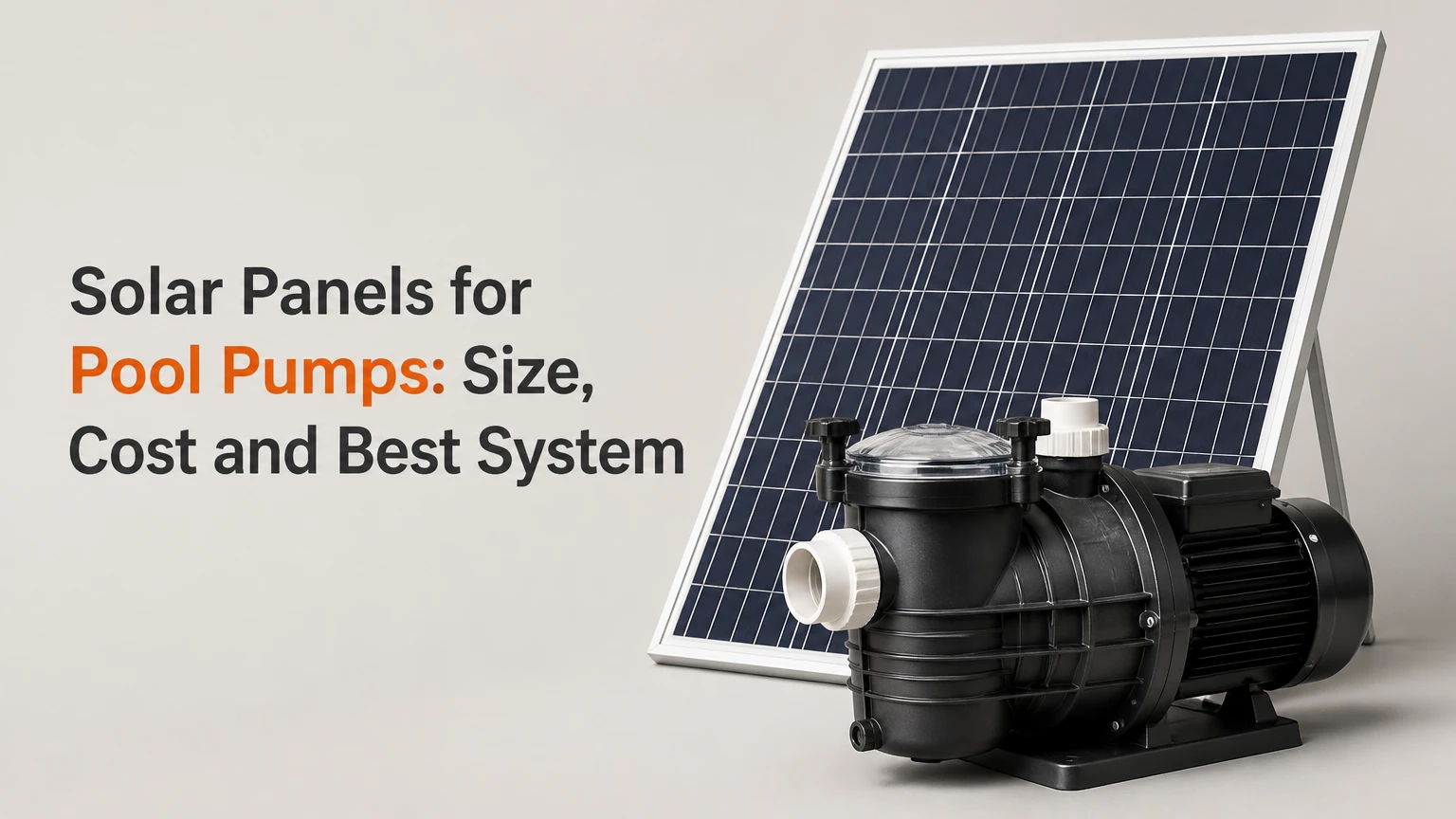
Solar panels for pool pumps convert sunlight into electricity for filtration, circulation, and chlorination. A typical residential installation uses about 1,000-2,400 watts of photovoltaic capacity, but the correct size depends on pump input power, total dynamic head, daily runtime, local sun, and whether the pump must operate after sunset.
Key facts
A solar pool pump needs electrical power and adequate hydraulic flow; pump horsepower alone cannot size the PV array.
A direct DC system runs when solar power is available, while a hybrid system can use grid electricity during weak sunlight or at night.
A 1,200-watt array may run a small efficient pump, but a 2,000-watt array gives more practical margin for clouds, heat, dirt, and startup demand.
Batteries are usually uneconomic for routine pool filtration because a pump needs sustained power for several hours.
A complete residential system commonly costs about $2,000-$6,500 installed, with local labor, equipment, and electrical work creating wide variation.
Photovoltaic panels power a pump; they do not directly heat pool water in the same way as solar thermal collectors.
What Are Solar Panels for Pool Pumps?
A solar pool-pump system combines photovoltaic modules, a controller or inverter, a circulation pump, and the existing filter equipment. The photovoltaic array produces direct-current electricity, the controller regulates that output, and the pump moves pool water through the filter, heater, salt cell, or chemical feeder.
The energy path is:
Sunlight → PV panels → controller or inverter → pump motor → filter and return jets
The pump does not need to operate at full speed for every filtration task. A modern variable-speed motor can circulate water at lower wattage for longer periods, which often reduces the required array size and improves filtration during changing sunlight.
The U.S. Department of Energy’s Energy Saver guidance identifies pool pumps as “one of the largest energy users in a home.” That practical observation explains why solar electricity can have a meaningful effect on operating costs, especially where a single-speed pump runs six to ten hours daily.
Solar pumping is not automatically a good replacement for every grid-connected pump. A shaded roof, high-friction plumbing, winter operation, or a requirement for reliable overnight circulation can make a hybrid or conventional variable-speed system more suitable.
How Does a Solar Pool-Pump System Work?
A solar pool-pump system changes motor speed or operating mode as available sunlight changes. At midday, the array may provide enough power for the pump’s rated flow; during cloud cover, the controller reduces speed, pauses the motor, or transfers the load to the grid, depending on the design.
Main components and their jobs
| Component | Typical specification | Primary function | Replacement timeframe |
|---|---|---|---|
| PV module | 350-450 W, 35-50 V open circuit | Produces DC electricity | 25-30 years |
| Solar controller | 1-3 kW rated input | Matches variable PV output to motor demand | 8-15 years |
| DC brushless pump | 0.5-2 HP equivalent | Converts electricity into water flow | 7-12 years |
| AC variable-speed pump | 0.75-3 HP, 230 V common | Runs from inverter or utility supply | 8-15 years |
| Filter | 300-600 mm residential size | Removes suspended material | 5-15 years |
| Disconnect and protection | DC isolator, breaker, GFCI | Isolates and protects circuits | 10-20 years |
A DC brushless motor can connect to a dedicated solar controller without a separate AC inverter. An AC pump requires an inverter unless the pump is connected directly to utility electricity. Hybrid controllers accept both PV and grid inputs and can select the available source automatically.
The hydraulic side remains just as important as the electrical side. The pump must overcome static lift, pipe friction, elbows, valves, filter resistance, heater resistance, and the pressure required by return fittings. That combined resistance is total dynamic head, usually measured in feet or metres.
How Many Solar Panels Does a Pool Pump Need?
Most residential pool pumps need approximately 1,000-2,400 watts of PV capacity, equal to three to six modern 400-watt panels, but the final count should be based on measured pump input watts and local solar production rather than horsepower labels.
Use this preliminary formula:
Required array watts = pump operating watts × solar runtime adjustment ÷ usable sunlight hours
For example, a pump drawing 1,100 watts for six hours needs 6.6 kilowatt-hours per day. If the site receives five equivalent peak-sun hours and the complete system delivers about 75% of rated output after temperature, wiring, controller, and dirt losses, the preliminary array is:
6,600 Wh ÷ (5 × 0.75) = 1,760 W
That result points to five 400-watt modules, subject to controller voltage limits and the pump’s startup characteristics.
| Pump application | Typical operating input | Typical PV array | 400 W panel count | Practical note |
|---|---|---|---|---|
| Small above-ground pool | 400-700 W | 800-1,200 W | 2-3 | Low head and short plumbing |
| Compact in-ground pool | 700-1,000 W | 1,200-1,600 W | 3-4 | Efficient variable-speed motor preferred |
| Average family pool | 1,000-1,500 W | 1,600-2,400 W | 4-6 | Allow margin for clouds and filter loading |
| Large pool or high-head layout | 1,500-2,400 W | 2,400-3,600 W | 6-9 | Confirm pump curve and head pressure |
| Solar heating circulation loop | 300-900 W | 600-1,500 W | 2-4 | Separate from the heating collector area |
A 2 HP label does not mean a motor continuously consumes 1,492 watts. Electrical input may be higher or lower depending on motor efficiency, speed, and load. Read the pump nameplate, controller display, or utility monitor whenever possible.
Why hydraulic head changes the answer
Two pools with the same volume can require different pump power. A pump moving water through 20 metres of narrow pipe, a heater, and several restrictive valves may need twice the input power of a pump serving a compact equipment pad with large-diameter pipe.
Pool volume determines required turnover. Hydraulic head determines the power required to achieve that turnover. Both belong in the design.
Which Solar Pool-Pump System Should You Choose?
A hybrid AC/DC system is the safest general recommendation for a frequently used family pool because it preserves filtration during cloudy weather and at night. A direct DC system fits a sunny site where daytime-only operation is acceptable, while an AC inverter arrangement fits homeowners who already own compatible solar equipment or want common AC replacement parts.
| System type | Solar-to-pump path | Night operation | Typical installed cost | Best operating condition |
|---|---|---|---|---|
| Direct DC | PV array to DC controller to BLDC pump | No, unless battery added | $2,000-$4,000 | Sunny site with daytime filtration |
| AC/DC hybrid | PV or grid to smart controller to pump | Yes, grid backup | $3,500-$6,500 | Family pool needing reliable circulation |
| AC with inverter | PV to inverter to AC pump | Yes, grid or battery | $3,000-$7,000 | Existing AC equipment and future solar expansion |
| Grid-tied PV plus pump | Home solar inverter to utility pump | Yes, utility supply | $4,000-$10,000 whole array | Whole-home solar project |
| Solar thermal loop | Thermal collector to circulation pump | Usually scheduled | $1,500-$5,000 | Pool heating rather than electrical offset |
Direct DC systems
Direct DC systems use fewer conversion stages and can be efficient at partial sunlight. Their main limitation is continuity: a cloudy afternoon can reduce speed, and a long overcast period can reduce the total filtration achieved.
Direct DC is suitable when the pool can tolerate daylight-only circulation and the owner accepts a separate plan for storms, winter, or extended low-sun periods. It is less suitable for commercial pools or heavily used pools where sanitation depends on predictable daily circulation.
Hybrid AC/DC systems
Hybrid systems prioritize PV energy and use utility power when solar output falls below the required threshold. A controller may also schedule higher-speed circulation during the strongest sunlight and lower-speed filtration in the morning or evening.
The additional switching electronics increase installation complexity. The trade-off is better water-quality resilience, especially after a weekend gathering, a dust storm, or several rainy days.
AC systems with an inverter
An AC inverter system can power a standard variable-speed pump, but every conversion stage creates losses. A separately purchased inverter also adds another component with its own cooling, warranty, and replacement requirements.
This approach makes sense when the property already has a correctly sized solar inverter and electrical distribution system. It is usually inefficient to install a large inverter solely for a small pool pump unless the inverter will support other household loads.
Can Solar Panels Run an Existing Pool Pump?
Solar panels can run an existing pool pump only when the pump’s voltage, phase, frequency, startup demand, and controller compatibility match the solar equipment. A conventional 230-volt single-speed pump cannot connect directly to PV modules because panel voltage and current vary with sunlight.
There are four practical retrofit paths:
- Replace the pump with a solar-rated DC motor. This minimizes conversion equipment but requires plumbing and electrical changes.
- Install a compatible solar pump inverter. The inverter converts variable DC into the AC waveform required by the existing motor.
- Use PV to offset household electricity. A grid-connected solar array supplies energy to the home, while the existing pump remains on its normal circuit.
- Replace a single-speed pump with a variable-speed AC model. Lower-speed filtration may cut energy use enough to make a modest solar array more effective.
The third path is often the simplest for a house already planning rooftop solar. It avoids a dedicated pump controller and preserves normal night operation, although the pump still depends on the grid when household demand exceeds solar production.
What Does a Solar Pool-Pump System Cost?
A typical residential solar pool-pump project costs $2,000-$7,000 installed, excluding major roof repairs, service upgrades, trenching, structural reinforcement, and a whole-home battery. Equipment type and local electrician rates create more variation than panel wattage alone.
| Project element | Typical small system | Typical family-pool system | Higher-complexity system |
|---|---|---|---|
| PV modules | $600-$1,200 | $1,000-$2,400 | $2,000-$4,000 |
| Pump and controller | $700-$1,800 | $1,200-$3,000 | $2,500-$5,000 |
| Mounting and wiring | $300-$900 | $600-$1,500 | $1,200-$3,000 |
| Electrical labor | $400-$1,000 | $700-$1,800 | $1,500-$3,500 |
| Total installed project | $2,000-$4,000 | $3,500-$6,500 | $6,000-$12,000 |
Calculate payback from avoided electricity, not from the panel nameplate. If a pump saves 6 kilowatt-hours per day and electricity costs $0.25 per kilowatt-hour, annual gross savings are about $548 before maintenance, seasonal underproduction, and pump replacement.
A direct system with a $3,500 installed price would therefore have a simple payback near 6.4 years under those assumptions, not automatically two to four years. Higher utility rates, longer runtime, rebates, and an existing pump replacement can shorten payback. Low rates and winter shutdowns extend it.
Solar panels commonly carry 25-30-year performance warranties. Controllers and pumps generally require replacement much sooner, so a sound financial model includes at least one controller or pump replacement during the array’s life.
Is Battery Storage Worth Adding?
Battery storage is usually a poor economic choice for routine pool filtration because the battery must deliver several hours of continuous motor power every night. A 1,200-watt pump operating for six hours requires 7.2 kilowatt-hours before inverter, battery, and wiring losses.
| Night filtration requirement | Usable battery energy | Approximate lithium battery size | Typical added cost |
|---|---|---|---|
| 500 W for 4 hours | 2.0 kWh | 2.5-3.0 kWh | $1,500-$3,000 |
| 800 W for 6 hours | 4.8 kWh | 6.0-7.0 kWh | $3,500-$6,000 |
| 1,200 W for 6 hours | 7.2 kWh | 9.0-10.0 kWh | $5,000-$9,000 |
| 1,500 W for 8 hours | 12.0 kWh | 15.0-17.0 kWh | $8,000-$14,000 |
A hybrid controller using grid backup usually costs less and provides more dependable night operation. Battery storage becomes more defensible when the home already has batteries for outage protection, the pool pump is a critical load, or utility power is unavailable.
Do not use a battery to compensate for an undersized array. First correct panel capacity, pump efficiency, plumbing restriction, and filtration scheduling.
How Is a Solar Pool-Pump System Installed?
Professional installation normally takes one to three days after equipment approval, with design, permits, utility review, and procurement adding two to eight weeks in many jurisdictions. The success factor is matching the pump curve to the plumbing system before mounting panels.
Step 1: Measure the pool and existing equipment
Record pool volume, pipe diameter, filter model, heater resistance, pump nameplate data, and current operating pressure. Note the required turnover time, which many residential designs target at roughly one complete circulation cycle in 8-12 hours rather than assuming one universal eight-hour rule.
Checkpoint: The installer has measured flow or selected a pump curve at the actual head pressure.
Common mistake: Choosing a 1.5 HP motor from pool size alone.
Step 2: Audit the solar site
Map shade from trees, chimneys, parapets, and neighboring buildings at different seasons. A south-facing roof is often productive in the Northern Hemisphere, while north-facing surfaces may be preferable in parts of the Southern Hemisphere; azimuth and tilt should follow local solar conditions.
Checkpoint: The array has a shade analysis for morning, midday, and afternoon.
Common mistake: Checking shade only in summer.
Step 3: Size the array and controller
Calculate daily energy, apply a realistic system-output factor of about 0.70-0.85, then confirm the controller’s maximum open-circuit voltage and current. Series wiring raises voltage; parallel wiring raises current, and both must remain within manufacturer limits.
Checkpoint: Cold-weather voltage remains below the controller limit.
Common mistake: Adding a panel string without recalculating maximum voltage.
Step 4: Mount panels and protection equipment
Use roof attachments connected to structural members or a properly anchored ground rack. Install DC isolators, overcurrent protection, weather-rated conduit, grounding, and labels required by the local electrical code.
Checkpoint: Wiring is protected from abrasion, water entry, and pool splash zones.
Common mistake: Routing exposed PV cable across a wet equipment pad.
Step 5: Connect the pump and controller
Follow the pump manufacturer’s wiring diagram and maintain required separation between electrical equipment and water lines. A licensed electrician should handle grid connections, bonding, disconnects, and ground-fault protection.
Checkpoint: The controller reports acceptable PV voltage, motor current, and fault status.
Common mistake: Treating a low-voltage DC pump as automatically safe in a wet location.
Step 6: Commission flow and schedules
Test priming, suction pressure, return flow, filter pressure, automatic source transfer, and shutdown behavior under strong and weak sunlight. Set a lower-speed filtration schedule and a higher-speed period for skimming or vacuuming when the pump supports variable control.
Checkpoint: The measured flow meets the sanitation and equipment requirements at the intended speed.
Common mistake: Testing only the motor and failing to verify water turnover.
What Problems Occur With Solar Pool Pumps?
The most common failures arise from insufficient solar voltage, excessive hydraulic resistance, air entering the suction line, dirty filters, and incorrect controller programming. Troubleshooting should separate electrical symptoms from water-flow symptoms before replacing any component.
| Symptom | Likely cause | First inspection | Corrective action |
|---|---|---|---|
| Pump will not start | Low PV voltage or open isolator | Controller voltage display | Wait for stronger sun, inspect array and disconnect |
| Pump starts then stops | Controller thermal or overcurrent fault | Fault code and cooling clearance | Reduce load, improve ventilation, verify wiring |
| Motor runs with low flow | Dirty filter or suction restriction | Filter pressure and basket | Clean filter, empty basket, inspect valves |
| Pump loses prime | Air leak or low water level | Lid seal and suction joints | Refill pool, lubricate seal, repair fitting |
| Flow falls in afternoon | Shade or rising filter resistance | Shade map and pressure gauge | Remove obstruction, clean filter, resize array |
| Grid transfer fails | Incorrect hybrid wiring or settings | Controller source menu | Recheck configuration with electrician |
| Controller shows overvoltage | Excessive series-panel voltage | Cold-weather string calculation | Reconfigure modules within controller limit |
A pump that clicks during weak sunlight may be reaching its startup threshold without having enough current to accelerate the motor. Repeated stall attempts can stress electronics, so the controller should manage soft starting and low-voltage shutdown.
Pool water can turn cloudy or develop algae when circulation and sanitizer distribution fall below the required level. Direct solar systems need a weather response, such as temporary grid operation, manual circulation, or reduced bather load during prolonged storms.
What Are the Alternatives to Solar Panels for Pool Pumps?
The main alternatives are a high-efficiency variable-speed pump, grid-connected rooftop solar, and solar thermal heating. These options solve different problems, so replacing a PV pump with a thermal collector will not provide the same electrical function.
A variable-speed AC pump often reduces consumption by operating at lower speed for routine filtration. Grid-connected rooftop PV can offset that pump and other home loads while preserving dependable operation after sunset. Solar thermal collectors heat water through a separate circulation loop and may require a smaller electrical pump, but they do not generate electricity for the house.
Do not select solar thermal equipment when the goal is zero-grid filtration. Do not select a direct DC pump when the pool requires guaranteed overnight circulation and no backup source exists.
Which System Fits Each Pool Owner?
| Owner situation | Recommended system | Reason | Main limitation |
|---|---|---|---|
| Sunny off-grid property | Direct DC pump | Few conversion stages and no utility dependence | No reliable night operation |
| Frequently used family pool | AC/DC hybrid | Grid backup protects filtration | Higher controller cost |
| Existing whole-home PV plan | Grid-connected AC pump | Shares inverter and electrical infrastructure | Pump still uses grid at some times |
| Cloudy coastal climate | Hybrid variable-speed system | Maintains circulation through weak sunlight | Solar fraction may be lower |
| Small above-ground pool | Compact DC kit | Low flow and modest array requirement | Limited upgrade path |
| Commercial or shared pool | AC system with grid backup | Predictable sanitation schedule | Less independence from utility power |
The best choice depends on the required operating schedule, not on the largest available panel array. For most homeowners, a hybrid variable-speed system is the balanced option because it captures daytime solar energy without risking water quality during poor weather.
Solar Panels for Pool Pumps: Final Recommendation
Solar panels for pool pumps are most effective when the design matches PV output, pump input watts, hydraulic head, and the pool’s required filtration schedule. Choose direct DC for sunny daytime-only operation, hybrid AC/DC for reliable family-pool circulation, and AC or grid-tied PV when existing electrical equipment matters more than a dedicated off-grid design.
Before buying, obtain the pump’s measured wattage, filter pressure, flow requirement, local peak-sun data, and a shade assessment. Those five inputs produce a more reliable design than horsepower, panel count, or a generic payback promise.
Frequently Asked Questions
Can a pool pump run directly from one solar panel?
A standard pool pump cannot run reliably from one solar panel because the panel’s voltage and current vary, while the motor needs controlled startup power. A small dedicated DC circulation pump may operate from a single module if its controller, voltage range, flow requirement, and panel output are explicitly matched.
How long should a solar pool pump run each day?
Many residential pools require approximately 6-10 hours of daily circulation, but the correct schedule depends on pool volume, flow rate, sanitizer system, water temperature, debris load, and local health requirements. Variable-speed pumps can run longer at lower power, while high-use pools may need additional circulation after heavy bathing.
Can solar panels heat a swimming pool?
Photovoltaic panels produce electricity for a pump, heater, or heat pump; they do not directly transfer solar heat into pool water. Solar thermal collectors heat water through a separate plumbing circuit and are the relevant alternative when the primary goal is extending the swimming season.
What happens to a direct solar pump during several cloudy days?
A direct solar pump may slow down or stop when available PV power falls below its operating threshold. The pool can then receive inadequate filtration or sanitizer distribution, so owners should use a hybrid controller, temporary grid pump operation, or a weather-based maintenance plan during extended low-sun periods.
Should a single-speed pump be replaced before adding solar panels?
Replacing a single-speed pump with a variable-speed model is often worthwhile before installing solar because lower-speed filtration reduces electrical demand and can improve the match between pump consumption and daytime PV production. The replacement is less attractive when the existing pump is new, lightly used, or already operates at low measured wattage.
How often do solar pool-pump panels need cleaning?
Inspect panels at least twice yearly and after pollen, dust, construction debris, or severe weather. Cleaning frequency depends on rainfall, tilt, dust, and nearby trees. Disconnecting equipment and following the panel manufacturer’s instructions is safer than spraying electrical connectors or walking on roof modules.