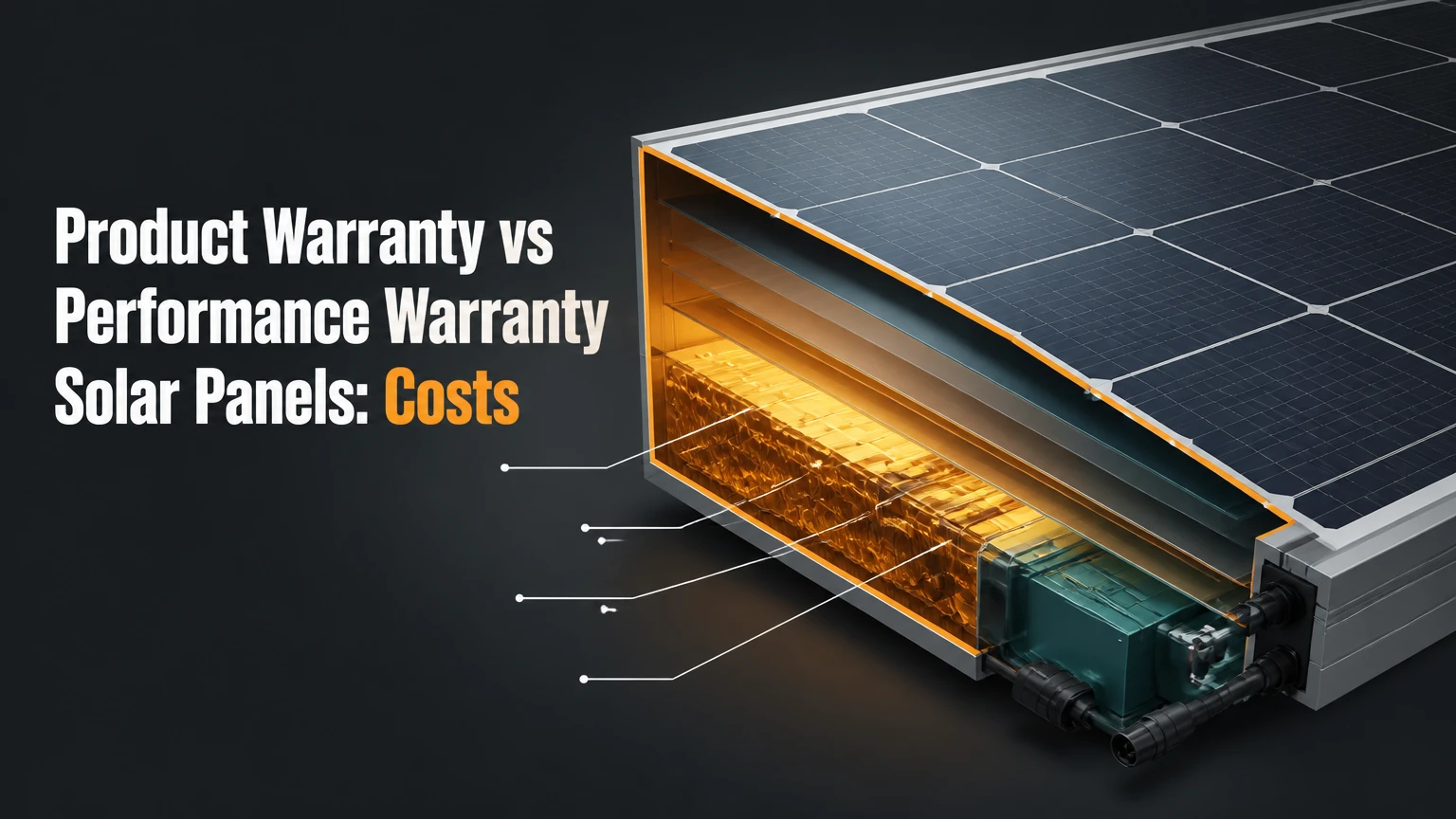
A product warranty protects a solar panel against defects in materials and workmanship, while a performance warranty protects its electrical output against excessive degradation. Product coverage usually lasts 12-25 years; performance coverage commonly lasts 25-30 years. Neither warranty automatically pays every labor, shipping, roof-access, or diagnostic cost.
Key Facts at a Glance
- A solar panel product warranty covers defective hardware, materials, and factory workmanship.
- A solar panel performance warranty guarantees minimum retained power, not a fixed monthly energy bill.
- A 25-year performance warranty commonly guarantees about 80%-90% of initial rated power at year 25.
- Product warranty duration and performance warranty quality are separate purchasing criteria.
- Labor, freight, removal, and reinstallation require separate wording in the contract.
- Low output can result from shade, dirt, wiring, or an inverter rather than a defective module.
What Does Each Warranty Cover?
A product warranty addresses whether the solar module is physically and electrically free from manufacturing defects. A performance warranty addresses whether the module retains a stated percentage of its original nameplate power after exposure to sunlight over time.
The product guarantee applies to faults such as delamination, failed solder connections, premature frame corrosion, junction-box defects, and manufacturing-related moisture intrusion. Exact coverage depends on the manufacturer’s warranty document, because some policies classify glass breakage, discoloration, and cosmetic damage differently.
The performance guarantee does not promise that a 400-watt module will produce 400 watts at every moment. The 400-watt figure is a laboratory nameplate rating under Standard Test Conditions, commonly 1,000 watts per square metre of irradiance, 25°C cell temperature, and an air-mass value of 1.5. Real operating output changes with temperature, irradiance, angle, shading, soiling, and inverter limits.
| Warranty type | Protected attribute | Typical term | Typical claim example |
|---|---|---|---|
| Product warranty | Materials and workmanship | 12-25 years | Delamination in year 8 |
| Performance warranty | Retained DC power | 25-30 years | Module below guaranteed year-20 output |
| Installer workmanship warranty | Installation labor and installation defects | 1-10 years | Roof penetration leaks in year 3 |
| Inverter warranty | Power electronics and controls | 5-25 years | Inverter stops converting DC power |
A product warranty is therefore a defect remedy. A performance warranty is a degradation limit. The warranties may appear in one document, but they answer different questions.
How Do Product and Performance Guarantees Work?
Product warranty coverage normally requires a defect attributable to the manufacturer, while performance warranty coverage requires proof that measured module performance falls below a contractual threshold. The owner usually must establish that installation, shading, wiring, inverter operation, and environmental damage did not cause the shortfall.
Product claims are often simpler to establish. A visible cracked backsheet, failed junction box, or corrosion pattern can support inspection, although the manufacturer may still request photographs, serial numbers, and an installer report.
Performance claims are more technical. Monitoring software may reveal a persistent decline, but whole-system production does not equal individual-panel output. A failed optimizer, disconnected string, tripped breaker, or inverter clipping event can reduce generation without activating a module performance warranty.
The claim threshold also matters. A warranty may require testing at a certified laboratory, a field-flash test, or an authorized technician’s report. The contract may specify who pays for testing when the claim is rejected.
What Does a Performance Percentage Actually Mean?
A performance percentage is the minimum retained nameplate power under the warranty’s stated degradation schedule. For a 400-watt panel with an 80% year-25 guarantee, the contractual minimum is 320 watts under the defined test method, not 80% of the array’s original annual electricity production.
NREL’s degradation research by Dirk Jordan and Sarah Kurtz reported, “The median degradation rate is 0.5% per year.” That figure describes observed module degradation across a broad field and literature dataset; it does not replace the specific warranty schedule for a purchased panel.
| Initial panel rating | Year-1 guarantee | Year-25 guarantee | Minimum year-25 rated power |
|---|---|---|---|
| 400 W | 98.0% | 80.0% | 320 W |
| 400 W | 98.0% | 87.4% | 349.6 W |
| 450 W | 99.0% | 87.4% | 393.3 W |
| 500 W | 98.0% | 90.0% | 450 W |
The output guarantee applies to module power under specified conditions. A household’s annual kilowatt-hours can fall faster because trees grow, panels become dirty, inverter capacity changes, or electricity demand and weather patterns vary.
Which Warranty Has the Better Terms?
Neither warranty is inherently better because product and performance warranties protect different loss events. Buyers should compare product coverage for early hardware failure, performance coverage for long-term degradation, and installer coverage for the labor required to access the roof.
A 25-year product warranty can be valuable when a panel develops a defect in year 18, but it may still exclude the $300-$1,000 typical cost of roof access, diagnosis, removal, and reinstallation. A strong performance schedule can preserve more generation but may require expensive testing before the manufacturer accepts a claim.
| Decision criterion | Product warranty | Performance warranty | Buyer consequence |
|---|---|---|---|
| Primary protection | Physical module defect | Excessive power degradation | Different claim triggers |
| Common term | 12-25 years | 25-30 years | Longer term does not mean broader coverage |
| Typical threshold | Defect confirmed | 80%-90% retained power at year 25 | Test method controls enforceability |
| Common evidence | Photos, serial number, technician report | Monitoring, irradiance data, electrical test | Performance claims need stronger records |
| Labor treatment | Often excluded | Usually excluded | Installer contract matters |
| Damage from hail | Usually excluded | Not applicable | Property insurance often responds |
| Roof leak | Usually excluded | Not applicable | Workmanship warranty may respond |
| Replacement remedy | Repair, replacement, credit, or refund | Replacement, credit, or compensation | Read remedy language carefully |
Winner by criterion: Product warranty wins for discrete factory defects; performance warranty wins for long-term power retention; neither wins on labor unless the contract expressly includes it.
How Do Performance Schedules Calculate Degradation?
Linear performance warranties reduce the guaranteed output by a stated amount each year, while stepped warranties set output floors for separate periods. Linear schedules are easier to model because the buyer can calculate an approximate guaranteed value for any year.
A typical standard schedule might guarantee 98% in year one and reduce the floor by 0.5% annually from year two through year 25. A premium schedule might guarantee 99% in year one and reduce output by 0.25% annually. Actual policies use their own formula, so buyers should not infer a schedule from a brochure.
| Schedule type | Year-1 floor | Annual reduction | Year-25 floor | 400 W year-25 floor |
|---|---|---|---|---|
| Standard linear | 98.0% | 0.50% | 86.0% | 344 W |
| Conservative linear | 98.0% | 0.70% | 81.2% | 324.8 W |
| Premium linear | 99.0% | 0.25% | 93.0% | 372 W |
| Stepped | 97.5% | Period floors | 80.0% | 320 W |
A brochure stating “up to 90% after 25 years” is incomplete without the first-year floor, annual rate, measurement method, and remedy. The contract may define a lower guaranteed value than the headline figure implies.
Why Does First-Year Degradation Matter?
First-year degradation matters because light-induced degradation can cause a larger initial decline than later annual aging. Passivated emitter and rear contact, heterojunction, and other newer cell designs may use different degradation assumptions, but technology labels do not replace the written guarantee.
Buyers should request the exact schedule in percentage and watts. A 1% difference on a 500-panel commercial array can represent 2.5 kilowatts of nameplate capacity, although the financial value depends on irradiance, tariff structure, and system design.
Which Warranty Costs More to Use?
The largest practical warranty expense is often labor rather than the replacement panel. A manufacturer may ship a replacement module while the property owner pays for troubleshooting, freight coordination, roof access, removal, electrical reconnection, disposal, and commissioning.
Typical residential figures vary by roof height, system design, region, and installer availability. The following ranges are planning figures, not contractual prices.
| Claim expense | Typical residential range | Typical commercial range | Contract question |
|---|---|---|---|
| Diagnostic visit | $150-$400 | $500-$2,000 | Who confirms module failure? |
| Roof access and removal | $150-$500 per panel | $300-$1,000 per panel | Is access labor included? |
| Reinstallation and commissioning | $200-$600 per panel | $400-$1,500 per panel | Who restores monitoring? |
| Freight or special handling | $0-$250 | $100-$1,000 | Does the manufacturer prepay freight? |
| Independent electrical test | $300-$1,200 | $1,000-$5,000 | Who pays if testing disproves the claim? |
| Roof-system removal | $1,500-$8,000 | $5,000-$50,000 | Does roof work suspend coverage? |
An installer’s workmanship warranty is separate from the panel manufacturer’s product warranty. A solar contract that says “25-year warranty” may combine a 25-year module performance term with only a 5-year installation labor term.
How Do You File a Solar Panel Warranty Claim?
A successful claim begins with system-level diagnosis, not an immediate demand for panel replacement. Owners should preserve monitoring records, identify the affected equipment, obtain written test results, and submit the manufacturer’s required documents within the stated notice period.
Step 1: Confirm the Production Anomaly
Compare daily and monthly production with the same system’s historical data, weather-adjusted expectations, and neighboring strings. Record the date, inverter alarms, module-level readings, irradiance conditions, and any recent roof or electrical work.
Step 2: Check External Causes
Inspect for new shading from trees, buildings, vents, or satellite equipment. Check visible soiling, bird deposits, snow, disconnected breakers, communication failures, and inverter error codes, but do not open energized equipment without qualified electrical training.
Step 3: Contact the Installer or Service Provider
Request a written diagnostic report identifying whether the fault is in the module, optimizer, microinverter, string inverter, wiring, combiner, or monitoring platform. A whole string at zero output usually points first toward a circuit, inverter, or connection problem rather than simultaneous module degradation.
Step 4: Gather Claim Documents
Prepare the original invoice, warranty certificate, module model, serial numbers, installation date, installer details, monitoring exports, photographs, service reports, and proof of ownership. Some manufacturers require online registration or impose transfer deadlines after a property sale.
Step 5: Submit the Manufacturer Claim
Use the manufacturer’s current RMA or warranty portal. State the defect, affected serial numbers, test results, requested remedy, and requested coverage for freight and labor. Keep the submission number and every response.
Step 6: Complete Required Testing
The manufacturer may require an authorized field test, insulation-resistance measurement, IV-curve test, electroluminescence inspection, or laboratory measurement under STC. Do not ship a panel before receiving written instructions, because unauthorized transport can complicate liability.
Step 7: Confirm the Settlement
Read whether the remedy is an equivalent module, a current substitute, repair, credit, or prorated refund. Confirm wattage, dimensions, electrical characteristics, shipping responsibility, removal labor, disposal, and monitoring reconfiguration before accepting the settlement.
What Voids or Limits Solar Warranty Coverage?
Solar warranty coverage can be limited by improper installation, unauthorized modification, environmental damage, missed registration, poor maintenance, and failure to follow claim procedures. The exact exclusions appear in the legal warranty, not in the product datasheet.
| Risk or exclusion | Common warranty treatment | Evidence to preserve | More suitable protection |
|---|---|---|---|
| Hail above tested rating | Physical damage often excluded | Weather report and photographs | Home or commercial property insurance |
| Fallen tree or debris | Usually excluded | Incident photographs | Property insurance |
| Incorrect installation | Excluded or disputed | Permit and installer records | Installer workmanship warranty |
| Unauthorized repair | May void affected coverage | Service invoices and approvals | Authorized service provider |
| DIY mounting or wiring | Often excluded | Permit and inspection documents | Installer warranty, where available |
| Coastal corrosion or chemicals | Depends on stated environment | Site conditions and maintenance logs | Site-specific product selection |
| Roof replacement | Module warranty may remain, labor usually excluded | Roofing and solar contracts | Roof-removal provision |
A warranty can also exclude indirect losses such as lost electricity revenue, business interruption, consequential property damage, and financing costs. Commercial owners should review those exclusions with counsel or an insurance adviser before relying on a manufacturer promise as a project guarantee.
What Happens If the Manufacturer or Installer Fails?
Manufacturer insolvency can make a long warranty difficult or impossible to enforce, while installer closure can leave labor obligations without a practical service provider. A strong warranty term has limited value if the responsible company cannot process claims or fund replacement logistics.
Buyers should distinguish manufacturer bankability from a “Tier 1” label. BloombergNEF’s Tier 1 classification primarily concerns manufacturers used in financed projects and does not guarantee a particular warranty claim, product quality, or future solvency.
| Protection structure | What it can protect | Limitation | Best use |
|---|---|---|---|
| Manufacturer warranty | Module defect or degradation | Company performance risk | Standard residential purchase |
| Installer workmanship warranty | Installation labor | Installer closure risk | Roof penetrations and wiring |
| Insurer-backed warranty | Defined covered obligations | Policy exclusions and limits | Commercial portfolios |
| Extended service contract | Labor and service visits | Provider terms and fees | Hard-to-access arrays |
| Property insurance | Hail, fire, theft, falling objects | Deductible and policy exclusions | Physical damage events |
For commercial projects, request audited financial information, claim administration details, an assignment provision, parent-company support, and any insurance-backed warranty certificate. For residential projects, retain the installer’s legal entity, license number, permit record, and service contact even after commissioning.
Which Warranty Should Each Buyer Choose?
The best warranty combination depends on ownership duration, roof access, electricity value, installer strength, and the cost of a replacement visit. A buyer staying five years may value transferable product coverage, while a commercial owner may prioritize labor protection and manufacturer financial strength.
Homeowners Selling Within Seven Years
Choose a reputable panel with at least a 12-15-year product warranty and a 25-year performance warranty, then confirm that both warranties transfer to a buyer. Transfer procedures may require notice, registration, or a fee.
A transferable installer workmanship warranty can matter more during resale than a small improvement in year-25 degradation. Buyers should keep the warranty documents with the home’s closing records.
Long-Term Homeowners
Prioritize a product warranty that reaches 25 years, a clearly calculated linear performance schedule, and an installer labor warranty of at least 10 years. A 0.25% annual degradation rate can improve retained output, but the premium should be compared with the system’s expected electricity value.
Do not pay for a premium warranty solely because the number is larger. Verify exclusions, claim testing, replacement labor, and the manufacturer’s service history.
Landlords and Property Managers
Prioritize remote monitoring, serial-number records, transferable coverage, and a service agreement that defines response times. A performance warranty cannot compensate for a monitoring portal that loses data or a contractor who cannot access a locked commercial roof.
Commercial and Industrial Owners
Prioritize bankability, insured or secured warranty obligations, replacement compatibility, labor coverage, and a documented claims process. A 30-year performance promise without a funded service pathway creates a contingent asset rather than dependable protection.
How Can You Tell a Panel Has Failed?
A panel failure is more likely when one module or one optimizer underperforms while comparable modules receive similar sunlight and the inverter, wiring, and monitoring system test normally. A system-wide production decline more often indicates a shared condition such as shading, soiling, inverter clipping, grid curtailment, or weather.
Use module-level monitoring where available, but treat software alerts as screening evidence. Monitoring systems estimate performance and can misidentify communication faults as module faults.
| Observation | More likely cause | First verification | Warranty path |
|---|---|---|---|
| One module reads low | Module, connector, or optimizer | Module-level voltage and IV curve | Product or installer |
| Entire string is offline | Breaker, inverter, wiring, or string fault | DC voltage and inverter logs | Inverter or installer |
| Output falls after tree growth | New shading | Hourly shade inspection | Usually no warranty |
| Gradual uniform decline | Normal degradation or soiling | Cleaning and trend analysis | Performance only if below floor |
| Hotspot or visible burn mark | Electrical or module defect | Qualified thermal inspection | Product, insurance, or installer |
| Water entry at roof | Mounting or roof defect | Roof inspection | Workmanship or roof warranty |
Practitioner Rule: Compare Like With Like
Compare panels with the same orientation, tilt, shading exposure, inverter channel, and cleaning history. Comparing a north-facing module with a south-facing module can create a false warranty claim even when both operate normally.
What Should You Check Before Signing?
Read the legal warranty before comparing brand names or headline years. The most important terms are the warranty start date, covered owner, transfer process, claim deadline, test method, remedy, labor responsibility, freight rules, and exclusions.
Ask the installer for written answers to these questions:
- Does product coverage begin at shipment, sale, installation, or commissioning?
- Does the warranty cover labor, travel, roof access, freight, disposal, and reinstallation?
- Does the performance warranty apply to each panel or only the whole array?
- What test proves a module is below its guaranteed power?
- Is a replacement panel equal in wattage, dimensions, voltage, and appearance?
- Who handles the claim if the installer closes?
- What registration and property-sale deadlines apply?
- Does roof removal suspend or limit any warranty?
- Which damage events belong to home or commercial insurance?
- Is a third-party insurer or parent company backing the promise?
Practitioner Rule: Demand Watts, Not Only Percentages
A percentage without the original rating can hide the practical remedy. A 90% guarantee on a 400-watt panel equals 360 watts, while 90% on a 500-watt panel equals 450 watts, and the system’s module count determines the aggregate difference.
FAQ
Does a 30-year solar warranty mean the panels will last 30 years?
A 30-year performance warranty means the manufacturer defines a minimum retained power level through year 30. It does not guarantee unchanged production, zero repairs, roof integrity, inverter operation, or free labor. Panels can continue operating beyond the warranty term, but output, physical condition, and repair economics vary by site.
Are solar panel warranties transferable to a new homeowner?
Solar panel warranties are often transferable, but the legal process depends on the manufacturer and installer. Some require proof of sale, online registration, written notice within a specified period, or a transfer fee. Obtain confirmation before closing because a missed deadline can reduce practical coverage.
Does home insurance cover broken solar panels?
Home insurance commonly covers certain sudden events such as hail, fire, theft, or falling objects, subject to the policy deductible and exclusions. Home insurance usually does not cover manufacturing defects, normal degradation, poor installation, or gradual wear. Confirm that the policy lists rooftop solar equipment and its replacement value.
Is a performance warranty the same as an electricity-production guarantee?
A performance warranty is not the same as an annual electricity-production guarantee. The performance warranty usually measures module power under specified test conditions, while annual production also depends on sunlight, temperature, shade, dirt, inverter efficiency, system availability, and grid restrictions.
Should buyers prefer a 25-year product warranty over a lower degradation rate?
Buyers should prefer the warranty combination that matches their exposure. A 25-year product warranty protects against late hardware defects, while a lower degradation rate preserves more power. Product warranty duration usually matters more when replacement access is expensive; degradation rate matters more when the array produces high-value electricity for decades.
The Bottom Line
The difference between product warranty vs performance warranty solar panels is straightforward: product coverage addresses defective equipment, and performance coverage addresses excessive loss of rated power. Compare both terms with installer workmanship coverage, labor obligations, test procedures, transfer rules, exclusions, and company financial strength before choosing a module.
For most homeowners, a strong 25-year product warranty, a transparent 25-year linear performance schedule, and written labor coverage provide better protection than an impressive performance percentage alone. For commercial owners, funded claim administration and replacement labor can matter more than extending a performance promise from 25 to 30 years.