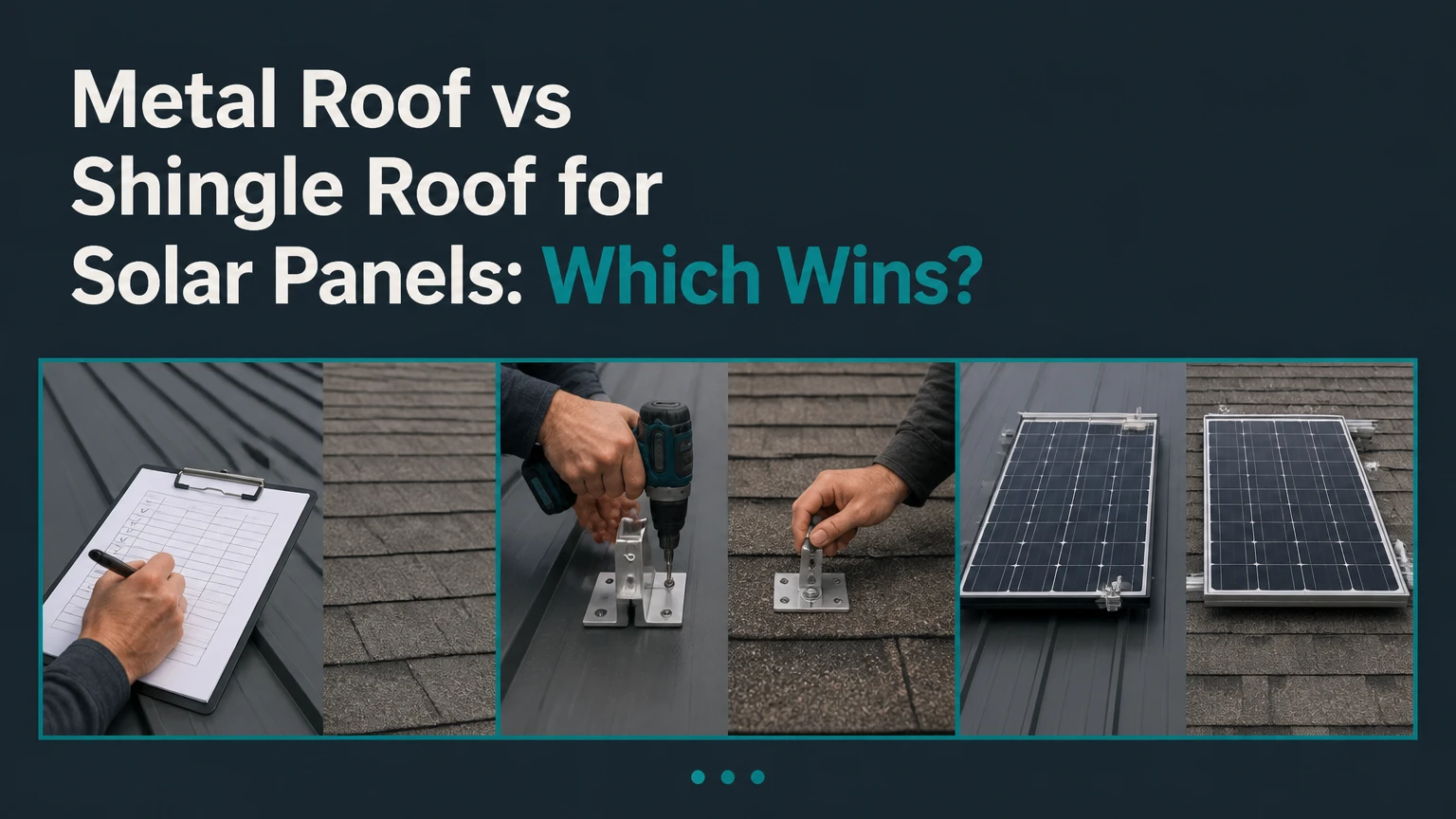
Metal roofs are usually the better long-term solar foundation, especially standing-seam metal, because approved clamps can attach without penetrating the roof covering and the roof can outlast the panels. Asphalt shingles remain the lower-cost choice when the roof is new, structurally sound, and installed by a qualified solar contractor using flashed rafter attachments.
Key facts at a glance
Standing-seam metal commonly permits zero-penetration solar attachments, but only with clamps approved for the exact seam profile.
Asphalt-shingle solar mounts typically use flashed lag attachments connected to structural rafters, not the shingles alone.
A roof with less than about 10 years of reliable service remaining deserves a replacement analysis before solar installation.
Metal roofing does not automatically produce more solar electricity; panel orientation, shading, tilt, and temperature determine energy output.
Exposed-fastener metal roofing is different from standing seam and commonly requires gasketed top-of-rib attachments.
Solar removal and reinstallation during reroofing can add several thousand dollars, depending on system size, access, and local labor.
What Is the Difference Between Metal and Shingle Solar Mounting?
Metal-roof solar mounting usually relies on seam clamps or profile-specific brackets, while asphalt-shingle mounting relies on structural penetrations sealed with metal flashing and elastomeric gaskets. The roof covering, underlying framing, panel layout, wind zone, and manufacturer instructions determine which attachment method is permitted.
On an asphalt roof, an installer locates a rafter, drills through the shingle and underlayment, and installs a lag screw through a flashed attachment. The flashing must extend under the shingle course above the attachment so water drains over the metal plate rather than behind it. Rails attach to L-feet, and mid-clamps or end-clamps secure the photovoltaic modules.
Standing-seam systems use clamps fitted to the seam geometry. The clamp transfers uplift and downward loads to the seam without creating a hole through the roof panel. Rails or rail-less panel attachments then connect to the clamps. A clamp is only suitable when its manufacturer publishes load data for that seam, panel thickness, material, and installation orientation.
The distinction matters because waterproofing and structural load transfer are separate problems. A sealed hole can still be attached to the wrong framing member, while a non-penetrating clamp can still fail if the seam is incompatible or the torque is incorrect.
Master Comparison: Metal Roof vs Shingle Roof for Solar Panels
The best roof depends on whether the comparison concerns an existing roof or a new roof selected before solar. Standing-seam metal leads on durability and reroofing risk, while architectural shingles usually lead on initial roof cost and installer availability.
| Criterion | Architectural asphalt shingles | Standing-seam metal | Exposed-fastener metal |
|---|---|---|---|
| Typical roof service life | 25-30 years | 40-70 years | 20-40 years |
| Typical installed roof cost | $4-$8 per square foot | $8-$16 per square foot | $5-$12 per square foot |
| Common solar attachment | Flashed lag, L-foot, rail | Seam clamp, rail or rail-less | Top-of-rib bracket, gasketed screw |
| New roof penetrations | About 20-50 for a residential array | 0 when clamp-compatible | About 20-50, profile-dependent |
| Typical solar mounting complexity | Standard residential | Profile-specific engineering | Fastener and purlin dependent |
| Roof removal during future reroof | Often required after panel removal | Usually deferred for decades | Possible panel removal if panels obstruct replacement |
| Primary solar risk | Flashing or rafter error | Wrong clamp or torque | Failed gasket, corrosion, or weak substrate |
These figures are typical planning ranges, not universal prices. Roof pitch, geographic labor rates, decking repairs, array size, material gauge, roof access, electrical upgrades, and local code requirements can change the final proposal substantially.
Which Roof Has the Safer Mounting Method?
Standing-seam metal generally has the safer waterproofing method because compatible clamps avoid holes through the roof membrane and metal panel. Asphalt shingles can also support reliable solar installations, but every penetration requires accurate rafter attachment, correctly integrated flashing, gasket compression, and careful roof workmanship.
“Zero penetration” does not mean zero engineering. Standing-seam clamps must be selected for the exact seam width, seam height, panel thickness, steel or aluminum substrate, and design loads. The installer should provide the clamp manufacturer’s installation instructions and the system’s wind-uplift calculations.
Asphalt mounting is reliable when the attachment lands in the structural center of a rafter and the flashing remains flat beneath the upper shingle course. Lag screws installed only into roof decking, screws driven too close to a rafter edge, and sealant used without proper flashing are recurring failure patterns.
Winner: Standing-seam metal for leak-risk reduction, provided the roof and clamp system are compatible.
Does Roof Age Change the Solar Decision?
Roof age can change the economic answer more than roof material. Installing a 25-year solar system on a roof with only 5-8 years of dependable life remaining can create a second project when the roof fails, because contractors generally must remove and reinstall the array before replacing covered roofing.
| Existing roof condition | Remaining roof life estimate | Recommended solar action | Typical consequence |
|---|---|---|---|
| New architectural shingles, no damage | 20-30 years | Install solar after inspection | Lowest combined disruption |
| Shingles aged 10-15 years | 10-18 years | Price reroofing and solar together | Possible future detach and reset |
| Shingles with curling, granule loss, or exposed fasteners | Under 10 years | Replace before solar | Higher initial cost, lower rework risk |
| Standing seam under 20 years old | 25-50 years | Confirm seam and coating condition | Usually favorable for solar |
| Exposed-fastener metal with aged washers | 5-15 years | Repair or replace before solar | Solar can obstruct future screw work |
A roof inspection should assess decking, underlayment, flashing, penetrations, ridge ventilation, attic moisture, and structural framing. A solar sales estimate based only on satellite imagery cannot establish whether shingles are brittle or whether the roof deck can accept the proposed attachments.
The practical rule is simple: align the expected roof life with the solar system’s service period. If roof replacement is likely before the inverter or modules reach their planned service horizon, obtain a reroofing quote before signing the solar contract.
Winner: The newer roof, regardless of material, is usually the better solar roof.
How Do Roof Costs Compare Over the Solar System’s Life?
Asphalt shingles usually cost less on day one, but lifecycle cost can rise when a roof replacement requires solar removal, storage, flashing repair, and reinstallation. Standing-seam metal costs more initially and can reduce the probability of that mid-system disruption.
| Cost item for a typical residential array | Asphalt shingles | Standing-seam metal | Exposed-fastener metal |
|---|---|---|---|
| Roof installation range | $4.50-$8.00 per square foot | $9.00-$18.00 per square foot | $6.00-$12.00 per square foot |
| Solar attachment premium or discount | Baseline | Often $0 to $1,200 lower | Often $200-$600 higher |
| Solar removal and reinstall | $3,000-$8,000 typical | Usually deferred | $3,000-$8,000 if reroofing occurs |
| Roof replacement under array | Common after 15-30 years | Less common within array life | Profile and washer condition determine timing |
| Maintenance access cost | Moderate | Moderate | Higher when fasteners are concealed by modules |
These are broad U.S. planning ranges for residential work, not bids. A detached garage, steep roof, two-story access, battery installation, or service-panel upgrade can add materially to project cost.
Metal also has costs that a simple “no holes” comparison misses. Installers may need profile-specific clamps, engineering review, replacement fasteners, snow-load analysis, or a roofing contractor familiar with the panel manufacturer. A cheaper exposed-fastener roof can become expensive if solar blocks access to deteriorating washers.
Winner: Standing-seam metal over the full lifecycle; asphalt shingles for the lowest initial roof expenditure.
Does Metal Roofing Increase Solar Energy Production?
Metal roofing does not automatically generate more electricity than asphalt shingles. Photovoltaic output depends mainly on solar irradiance, azimuth, tilt, shading, module temperature, inverter behavior, snow, and system losses, although roof surface temperature and rear ventilation can influence module operating temperature.
Solar modules produce less power as cell temperature rises. The exact loss depends on the module’s temperature coefficient, commonly around -0.25% to -0.40% of rated power per degree Celsius above the reference temperature. A well-ventilated array on either roof type can perform effectively.
Metal roofing can support a durable air gap beneath the modules, but asphalt roofs can also use raised rails with ventilation. The roof itself is not a heat sink that guarantees a meaningful annual production advantage. A shaded metal roof remains a poor solar site, while an unshaded shingle roof with strong rear airflow can outperform it.
Roof color has a smaller practical effect than array orientation and shade in most residential designs. A contractor should model production with tools such as PVWatts, account for local weather data, and disclose assumptions for azimuth, tilt, snow cover, soiling, and inverter clipping.
Winner: Neither material by itself. The better solar resource and array design win.
What Changes With Exposed-Fastener Metal?
Exposed-fastener metal roofing is solar-compatible, but it does not offer the same attachment advantages as standing seam. Solar hardware commonly attaches at the high rib with gasketed fasteners, and the installer must verify the metal thickness, purlin or rafter location, washer condition, and bracket approval.
Low valleys carry drainage and should not receive arbitrary penetrations. High-rib attachment reduces exposure to flowing water, but it does not eliminate the need for a compatible seal, correct fastener length, and proper compression. Over-tightening can deform the panel or crush the gasket; under-tightening can permit movement and leakage.
Older exposed-fastener roofs deserve special scrutiny because washers can harden under ultraviolet exposure. Adding solar panels may also make future screw replacement more difficult, particularly where rail layouts cover seams or rows of fasteners.
| Metal roof profile | Attachment approach | Main inspection point | Solar suitability |
|---|---|---|---|
| Standing seam, concealed fastener | Mechanical seam clamps | Seam dimensions and clamp load rating | Excellent when compatible |
| Through-fastened trapezoidal | Top-of-rib brackets | Purlin, screw, washer, and coating condition | Good with approved hardware |
| Corrugated round-rib panel | Rib brackets or adapter plates | Rib geometry and substrate thickness | Good to moderate |
| Metal shingles or tiles | Specialized hooks and brackets | Interlocking layout and breakage risk | Moderate, often costlier |
Winner: Standing seam remains the strongest metal option; exposed-fastener panels require more roof-specific inspection.
Which Roof Performs Better in Wind, Hail, and Snow?
Weather performance depends on the roof assembly, attachment design, building code, and installer workmanship rather than material alone. Standing-seam clamps can perform very well under wind uplift, but the completed solar array still needs project-specific structural calculations and tested hardware.
The International Building Code and local amendments govern many structural and fire requirements, while the National Electrical Code governs photovoltaic wiring and equipment installation in the United States. Snow regions may require stronger rail spacing, lower module edges, and additional load checks.
Metal roofing often resists fire and hail differently from asphalt shingles, but cosmetic denting remains possible, especially with lighter-gauge panels. Class 4 impact-rated shingles and metal products can both improve hail resistance. Homeowners should compare tested roof ratings rather than rely on the word “metal.”
Solar modules can become the weather system’s weakest attachment if rails are spaced too widely or clamps miss the module’s approved clamping zones. A proposal should identify design wind speed, exposure category, snow load, attachment spacing, and module clamp locations.
Winner: The roof and racking system with documented local load calculations, not a material chosen by label alone.
What Should a Solar Quote Include?
A dependable solar quote should identify the roof profile, attachment hardware, structural load path, waterproofing method, equipment warranty, reroofing responsibility, and assumptions behind the energy estimate. Quotes that say only “roof mount” leave too many failure points unresolved.
Use this checklist before comparing prices:
- Confirm the roof age, manufacturer, material, gauge, seam dimensions, and known repairs.
- Request a roof inspection report with photographs of decking, flashing, penetrations, and attic conditions.
- Require the racking brand, model, clamp or flashing type, fastener material, and published installation instructions.
- Ask whether attachments connect to rafters, trusses, purlins, seams, or only decking.
- Check that wind, snow, fire setbacks, conduit routing, and rapid-shutdown equipment appear in the design.
- Obtain written terms for leaks, roof damage, panel removal, storage, and reinstallation during future roofing work.
- Verify that the solar contractor and roofing contractor coordinate warranties rather than shifting responsibility to each other.
A roofing contractor should inspect an existing roof independently when the solar salesperson is not licensed for roofing work. Solar companies frequently subcontract roof work, so the contract should name the responsible company.
Common Failure Modes and Corrective Actions
The most expensive solar roof problems usually begin with a mismatch between roof condition, hardware, and installer assumptions. Prevention is less expensive than leak investigation beneath a completed array.
| Failure mode | Why it happens | Early warning sign | Corrective action |
|---|---|---|---|
| Lag misses the rafter | Layout relies on roof measurements only | Attachment spacing looks irregular | Remove and reinstall into verified framing |
| Flashing sits above shingles | Installer cuts or lifts the wrong course | Exposed metal edge faces uphill | Rework flashing under the upper shingle course |
| Clamp does not match seam | Generic hardware used on a proprietary profile | Clamp rocks before torqueing | Replace with listed profile-specific clamps |
| Washer is over-compressed | Installer uses impact tools carelessly | Panel or rib visibly deforms | Replace damaged fastener and gasket |
| Dissimilar metals contact | Fastener and roof coating were not checked | White corrosion or staining appears | Isolate materials and replace corroded parts |
| Array blocks roof maintenance | Layout ignores fastener rows or valleys | Roof access is impossible around rails | Reconfigure before commissioning |
A sealant bead should not substitute for flashing on a shingle roof. Sealant can age, separate, or conceal an attachment error, while correctly installed metal flashing directs water by geometry.
Galvanic corrosion risk depends on the metals, coatings, moisture, and electrical contact path. Stainless steel, aluminum, galvanized steel, and zinc-coated products should be combined only according to the roof and racking manufacturers’ compatibility guidance.
Which Should You Choose?
The right choice changes with roof age, budget, profile, and expected ownership period. Standing-seam metal is the strongest long-term selection, while new architectural shingles are reasonable when initial cost matters and the homeowner expects to avoid reroofing during the solar system’s life.
Choose standing-seam metal if you own a forever home
Standing seam fits homeowners planning 25 or more years of ownership because roof life and solar life align more closely. Ask for seam-specific clamp engineering, coating compatibility, and a roof warranty that permits the proposed attachments.
Choose new architectural shingles if upfront cost dominates
New architectural shingles can be the practical budget choice when the roof has no deferred maintenance and the solar installation uses listed flashed attachments. Do not select this route when the shingles already show granule loss, curling, exposed nails, or widespread repairs.
Choose metal when reroofing disruption is unacceptable
Standing seam usually reduces the chance that panels must be removed for roof replacement. The result is especially valuable for homes with steep access, limited staging space, or expensive labor markets where solar detach and reset costs are high.
Choose based on the roof profile in severe-weather regions
Wind and snow engineering matter more than a generic metal-versus-shingle label. Compare stamped calculations, attachment spacing, module clamp zones, roof ratings, and local code compliance before accepting claims about a specific wind speed.
Avoid solar until the roof is repaired
A roof with active leaks, soft decking, failed flashing, brittle shingles, or deteriorated exposed-fastener washers is not ready for panels. Fixing the roof first protects the array and prevents the installer from using solar equipment to conceal a roofing defect.
Expert Rules of Thumb for Better Decisions
A zero-penetration roof can still have a high leak risk if drainage is blocked. Rails, clamps, and debris can trap leaves or snow around seams, curbs, valleys, and penetrations. The design must preserve drainage paths and service access.
The roof warranty is not automatically the solar warranty. A roofing manufacturer may limit coverage for unauthorized penetrations, while a solar contractor may exclude leaks caused by existing roofing defects. Obtain written responsibility for both systems.
The cheapest roof can become the most expensive roof when timing is wrong. Replacing a sound shingle roof solely for solar may not produce enough energy savings to justify the added capital, but replacing a failing roof after solar installation often creates avoidable detach and reinstall costs.
Solar installation is also a roof-access project. Leave clearance for gutters, valleys, plumbing vents, attic ventilation, fire pathways, and future fastener maintenance. Maximum panel count is not always the best layout.
Frequently Asked Questions
Can solar panels be installed on a shingle roof without leaks?
Yes, solar panels can be installed on asphalt shingles without leaks when attachments connect to verified structural framing and use approved flashing, gaskets, and fasteners. Leaks usually result from poor flashing integration, misplaced lag screws, damaged shingles, or an existing roof defect rather than from solar modules themselves.
Is a metal roof harder to repair after solar installation?
Standing-seam metal can be easier to preserve because clamps avoid many new holes, but repairs still require access around modules and rails. Exposed-fastener metal can be harder to service when solar equipment covers screw rows or aging washers. The installer should document access paths before finalizing the array.
Do solar panels make metal roofs rust?
Solar panels do not inherently make a metal roof rust. Corrosion can develop when incompatible metals contact, protective coatings are damaged, water is trapped, or cut edges and fasteners are left unprotected. Use manufacturer-approved hardware and inspect roof drainage, fasteners, coatings, and penetrations.
Should I replace my shingle roof before installing solar?
Replace an asphalt-shingle roof before solar when its reliable remaining life is shorter than the period you expect the array to operate, or when inspection finds brittle shingles, leaks, soft decking, or failed flashing. A newer roof avoids the cost and disruption of removing panels for an early reroof.
Are solar panels more efficient on a standing-seam metal roof?
Solar panels are not automatically more efficient on standing-seam metal. Standing seam may support good rear ventilation, and cooler module temperatures can improve output, but annual production depends more on orientation, shade, tilt, weather, module temperature coefficient, and inverter design.
The Bottom Line
For most long-term homeowners, standing-seam metal is the better solar foundation because it combines long roof life with compatible non-penetrating clamps and reduces future reroofing disruption. New architectural shingles remain a sensible lower-cost option when the roof is structurally sound and has enough remaining life. The correct choice in metal roof vs shingle roof for solar panels is determined by roof age, exact profile, mounting hardware, local loads, and lifecycle cost, not material price alone.