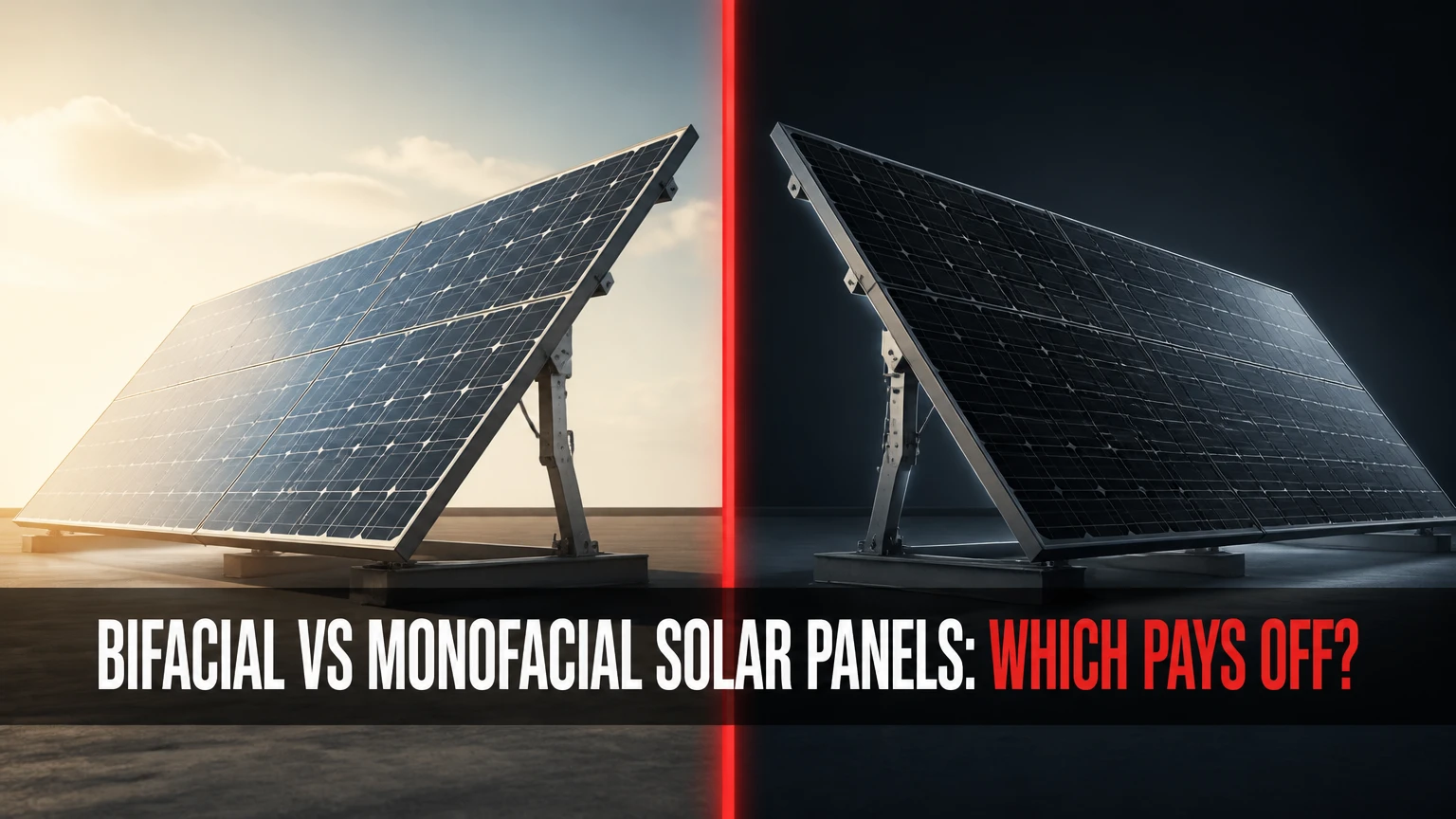
Bifacial solar panels generate electricity from their front and rear surfaces, while monofacial solar panels generate electricity primarily from the front surface. Bifacial modules can deliver roughly 5%-30% more annual energy in suitable open, reflective installations, but monofacial modules usually provide better value on flush-mounted residential roofs where rear light cannot reach the cells.
Key Facts at a Glance
- A monofacial module has photovoltaic cells intended to receive usable light from the front side only.
- A bifacial module has active cells on both sides and uses reflected or diffuse rear-side irradiance.
- A bifaciality factor of 80% means the rear side can produce 80% of the front-side output under equal irradiance, not 80% extra system energy.
- Typical bifacial energy gain ranges from 0%-5% on obstructed roofs, 5%-15% on many open systems, and 15%-30% on high-clearance reflective sites.
- Bifacial systems often need more clearance, wider row spacing, rear-accessible racking, and more careful electrical modeling.
- Monofacial panels remain a practical choice when the module sits close to a dark roof, shaded ground, or opaque surface.
What Is the Difference Between Bifacial and Monofacial Solar Panels?
The primary difference is the number of light-active faces: monofacial solar panels use the front face for photovoltaic conversion, while bifacial solar panels use both front and rear faces. The distinction depends on cell layout and module construction, not simply on whether the back looks transparent.
A monofacial module normally uses an opaque polymer backsheet behind the cells. The backsheet protects the module from moisture and electrical exposure, but it blocks rear irradiance from reaching photovoltaic cells.
A bifacial module exposes the rear cell surface through dual glass or a transparent backsheet. Rear-side electricity comes from ground-reflected sunlight, diffuse sky radiation, and light reflected by nearby surfaces. The rear face does not receive the same light intensity as the front face in most real installations.
| Attribute | Monofacial module | Bifacial module | Practical effect |
|---|---|---|---|
| Active light faces | Front face | Front and rear faces | Rear access determines added yield |
| Typical enclosure | Glass plus opaque backsheet | Glass-glass or glass-transparent backsheet | Weight and durability vary |
| Bifaciality factor | Not applicable | Typically 60%-95% | Describes rear cell response |
| Rear-side gain | Approximately 0% | Typically 0%-30% | Depends on site geometry |
| Flush roof suitability | High | Technically possible, often uneconomic | Little rear irradiance reaches cells |
| Open-ground suitability | High | High when elevated | Ground reflectance can add energy |
The term “bifacial” does not mean a panel automatically produces 30% more electricity. The 30% figure represents a favorable upper range, while a poorly designed bifacial array may produce almost the same energy as a comparable monofacial array.
How Does Bifacial Solar Generation Work?
Bifacial solar generation combines front-side irradiance with rear-side irradiance collected by the same photovoltaic module. The front face receives direct sunlight and diffuse sky light, while the rear face receives a smaller, geometry-dependent amount of reflected and scattered light.
The energy path is straightforward:
- Sunlight reaches the front cells.
- Ground or nearby surfaces reflect part of the incident light toward the rear cells.
- Rear cells convert that additional irradiance into direct current.
- The module combines front and rear current through its cell interconnections.
- The inverter converts the combined DC output into grid-compatible AC power.
What Does Bifaciality Factor Mean?
Bifaciality factor is the ratio of rear-side electrical performance to front-side performance under specified equivalent irradiance. A module with an 80% bifaciality factor does not produce 80% more annual energy; it can produce 80% of its front-side power if the rear receives the same irradiance, which rarely occurs outdoors.
IEC TS 60904-1-2 provides methods for measuring bifacial photovoltaic device performance. Actual annual yield also depends on rear irradiance, module temperature, incidence angle, row shading, cable placement, and inverter limits.
The rear side generally contributes less in a dense array because the ground view is restricted by low mounting height, adjacent rows, support rails, and shadows. Rear-side gain is therefore a system-design result rather than a module-label result.
How Much More Electricity Can Bifacial Panels Produce?
Bifacial panels typically add 5%-15% annual energy in a well-designed open array, while high-clearance systems over white gravel, concrete, or snow can approach 20%-30%. A bifacial module installed directly above dark roofing may add less than 5%, and some flush installations gain effectively nothing.
| Installation condition | Typical rear-side gain | Main reason |
|---|---|---|
| Flush dark shingle roof | 0%-3% | Roof blocks rear irradiance |
| Elevated white commercial roof | 5%-15% | Reflective membrane and open module underside |
| Grass or bare-soil ground mount | 5%-12% | Moderate rear exposure and low albedo |
| White gravel ground mount | 10%-20% | Higher ground reflectance |
| Snow-covered open site | 15%-30% during reflective periods | Snow has high short-term albedo |
| Solar carport or canopy | 8%-20% | Rear face remains exposed to sky and reflected light |
NREL’s bifacial photovoltaic research emphasizes that rear irradiance is controlled by albedo, geometry, and shading rather than by module rating alone. PV performance platforms such as NREL’s System Advisor Model and PVsyst can model these variables, but the result remains sensitive to accurate row spacing, height, and surface assumptions.
A 100 kW front-rated array that gains 12% from the rear face may produce an additional 12 kW-equivalent annual energy contribution under the modeled conditions. That does not mean every hour produces 112 kW, because morning, cloudy, winter, and inverter-limited conditions differ.
Which Bifacial Cell Technology Fits the Project?
TOPCon and HJT modules generally provide stronger rear-side response than older PERC bifacial modules, but cell technology should be selected alongside temperature behavior, price, warranty, availability, and electrical compatibility. A higher bifaciality factor has value only when the project can supply useful rear irradiance.
| Cell technology | Typical bifaciality factor | Typical temperature coefficient | Best-fit project |
|---|---|---|---|
| PERC or PERT bifacial | 60%-75% | About -0.30% to -0.38% per °C | Cost-sensitive open arrays |
| N-type TOPCon | 75%-85% | About -0.29% to -0.34% per °C | Mainstream commercial and utility systems |
| HJT | 85%-95% | About -0.24% to -0.30% per °C | Hot sites and premium high-yield designs |
| Back-contact monofacial | Usually not bifacial | About -0.29% to -0.35% per °C | Space-constrained roofs needing front efficiency |
Temperature coefficients describe power loss as cell temperature rises above the reference condition, usually 25°C. HJT can perform well in hot climates, but the installed price and product availability may outweigh its thermal advantage on a small residential system.
Rear-side cell performance can also vary across manufacturers. Buyers should request the module’s datasheet, bifaciality test conditions, maximum system voltage, maximum series fuse rating, operating current, and warranty rather than comparing technology names alone.
What Construction Differences Matter?
Dual-glass bifacial modules generally offer strong moisture resistance and long-term mechanical protection, while transparent-backsheet bifacial modules can reduce weight. Neither construction automatically eliminates every degradation mechanism, and the manufacturer’s certification and warranty language should control the purchase decision.
| Construction | Typical module weight | Rear transparency | Main advantage | Main limitation |
|---|---|---|---|---|
| Glass-opaque backsheet | 18-23 kg | None | Lower weight and broad compatibility | No rear generation |
| Glass-transparent backsheet | 20-25 kg | High | Lower weight than many dual-glass designs | Polymer aging and underside abrasion |
| Glass-glass bifacial | 23-32 kg | High | Strong moisture and mechanical protection | Higher roof load and handling difficulty |
| Frameless glass-glass | 22-30 kg | High | Fewer frame surfaces for dirt buildup | Requires approved clamps and precise handling |
Glass-glass construction does not make a module completely immune to potential-induced degradation, microcracks, hail damage, or installation stress. “PID-free” claims should be checked against the product warranty, system voltage, humidity testing, and installation requirements.
Roof structure matters more than the panel’s nameplate weight. A 30 kg module can be acceptable on one roof and unsuitable on another after rail, ballast, snow, and wind loads are included.
What Installation Design Does Each Panel Need?
Monofacial panels tolerate close-backed mounting, whereas bifacial panels need an unobstructed rear view, suitable elevation, and low-shadow racking to produce meaningful additional energy. Bifacial design should begin with geometry and irradiance modeling, not with a decision to buy the highest bifaciality factor.
| Design variable | Conventional monofacial design | Bifacial design target | Consequence of ignoring it |
|---|---|---|---|
| Rear clearance | A few centimeters may be adequate | Often 0.5-1.5 m for ground systems | Reduced rear irradiance |
| Ground surface | Dark soil or roof is acceptable | Light gravel, concrete, or reflective membrane helps | Lower energy gain |
| Row spacing | Optimized mainly for front shading | Also protects rear ground view | Inter-row shadow loss |
| Support rails | Rear obstruction is less important | Rails should avoid active rear cells | Local rear-side shading |
| Vegetation | Routine maintenance | Low vegetation beneath and between rows | Rear-side blockage |
| Modeling inputs | Front irradiance and shading | Albedo, height, view factor, rear mismatch | Overstated production forecast |
The AI Overview’s suggested 1-1.5 m minimum elevation is not universal. A lower mounting height can still produce rear gain, while a taller array can underperform if rails, rows, or vegetation block the rear face. The correct clearance depends on module dimensions, tilt, azimuth, row pitch, latitude, and ground reflectance.
Trackers can increase rear irradiance by changing module orientation, but torque tubes and drive components may shade rear cells. Tracker design must account for the exact module layout and back-side active area.
What Do Bifacial and Monofacial Panels Cost?
Bifacial modules commonly cost about $0.02-$0.12 more per watt than comparable monofacial modules, while the total installed premium can range from 0% to 15% because mounting, labor, ballast, land preparation, and modeling dominate project cost. Residential roof installation often has little financial reason to pay for rear-side capability.
| Cost component | Monofacial typical range | Bifacial typical range | Cost driver |
|---|---|---|---|
| Module price | $0.22-$0.35/W | $0.26-$0.42/W | Cell technology and construction |
| Racking and structure | $0.10-$0.30/W | $0.12-$0.38/W | Clearance, ballast, tracker, or canopy |
| Design and modeling | $500-$3,000 | $1,000-$6,000 | Rear irradiance and geometry analysis |
| Ground preparation | $0-$5,000 per acre | $1,000-$10,000 per acre | Gravel, grading, vegetation control |
| Total installed premium | Baseline | 0%-15% typical | Project-specific balance of system |
A simple payback test compares the incremental installed cost with the value of additional annual energy. If bifacial equipment adds $8,000 to a project and produces electricity worth $1,200 more each year, the simple incremental payback is about 6.7 years before financing, maintenance, taxes, and degradation.
Higher annual energy does not guarantee lower levelized cost of energy. The added value depends on electricity rates, export compensation, land cost, tax treatment, snow conditions, and the forecast’s accuracy.
Are Bifacial Panels Worth It on a Roof?
Bifacial panels are usually worthwhile on elevated commercial roofs, carports, and canopy structures, but monofacial panels often win on pitched residential roofs with flush rails and dark shingles. The deciding factor is rear irradiance access, not the nominal wattage printed on the module.
Residential Pitched Roofs
Monofacial panels are usually the safer economic choice when modules sit close to asphalt shingles, tile, or a dark membrane. A bifacial module may still offer a useful warranty, thermal, or glass-construction benefit, but the rear energy premium can be too small to recover its additional price.
Roof loading also matters. Dual-glass bifacial modules may weigh several kilograms more per panel, and local snow and wind loads must be included in the structural review.
Flat Commercial Roofs
Bifacial modules can work well on white TPO, PVC, or coated membrane roofs when the array is elevated or installed with a design that exposes the rear face. Ballasted layouts require an engineer to balance wind uplift, roof penetrations, ballast weight, maintenance paths, and rear-side access.
A white roof can lose reflectance as dirt and weathering accumulate. Financial models should use a maintained, aged albedo assumption rather than a new-roof laboratory value.
Ground Mounts, Carports, and Agrivoltaics
Open ground mounts, solar carports, awnings, and elevated agrivoltaic arrays are the strongest bifacial applications because the rear face remains exposed. White gravel, pale concrete, snow, and dry sand can increase rear irradiance, while tall crops, weeds, dark soil, and nearby rows reduce it.
Carports deserve special attention because their underside may receive reflected pavement light and diffuse sky radiation. The rear gain is not free, however, because the structure may require more steel, drainage, clearance, and wind engineering.
How Do Snow, Shade, and Vegetation Change Results?
Snow can increase bifacial rear irradiance when it covers the ground, but snow sitting on the module front can temporarily reduce total output. Shade, vegetation, and nearby structures can reduce rear-side yield even when the front face receives strong sunlight.
| Site factor | Effect on bifacial rear yield | Inspection or design response |
|---|---|---|
| Fresh snow on ground | High reflectance, often 80%-90% albedo | Model winter gain separately from snow-covered modules |
| Green grass | Often 15%-25% albedo | Maintain short vegetation |
| Asphalt or dark soil | Often 5%-15% albedo | Do not assume meaningful rear gain |
| White gravel | Often 50%-60% albedo | Control dust migration and gravel displacement |
| Nearby parapet | Blocks low-angle reflected light | Include parapet shading in simulation |
| Tall weeds or crops | Blocks rear cells | Set maintenance and crop-height limits |
Snow reflection can help during clear winter hours, but the annual benefit depends on snow depth, duration, panel tilt, cleaning behavior, and whether snow slides off the module. A rear face cannot compensate for a front face covered by snow.
Partial shading is particularly important because bypass-diode behavior and cell-string layout can create mismatch. Racking shadows that cross rear active cells may reduce more output than their narrow visual width suggests.
What Common Design Mistakes Reduce Output?
The most common bifacial mistake is paying for rear-side cells without designing a rear-side optical environment. Other failures include incompatible clamps, excessive rail shading, inaccurate albedo assumptions, and inverter settings that ignore higher operating current.
- Flush mounting over a dark roof: The rear face receives almost no useful light. Choose a well-priced monofacial module unless glass construction or warranty terms justify the premium.
- Using a new-surface albedo forever: White gravel and membranes become dirty. Model an aged or maintained surface and confirm the assumption during operations.
- Ignoring racking shadows: Rails, torque tubes, junction boxes, and cable loops can shade active rear cells. Request the manufacturer’s approved mounting zones.
- Sizing the inverter from front rating alone: Bifacial gain can increase DC input and clipping. Check maximum current, MPPT limits, DC-to-AC ratio, and local interconnection rules.
- Overstating the 30% gain: A favorable value from a high-clearance reflective array is not a residential default. Require a site-specific modeled gain.
- Adding reflective material without maintenance planning: Dust, weeds, snow drift, and drainage can erase the expected benefit. Assign an owner and recurring maintenance budget.
An important practitioner rule is to compare bifacial and monofacial systems using equal land area, equal structural design quality, and equal degradation assumptions. Comparing a premium bifacial array with a low-cost monofacial quote can hide the actual source of the economic difference.
Which Should You Choose?
The correct choice depends on installation geometry, rear irradiance, structural capacity, and the value of additional electricity. The following personas provide a faster decision.
Choose Monofacial for a Flush-Mounted Home Roof
Select monofacial panels when the array sits close to dark shingles or tile, roof space is adequate, and the budget prioritizes the lowest installed cost. Monofacial modules also simplify replacement because standard mounting and electrical expectations are widely available.
Choose Bifacial for an Elevated Ground Mount
Select bifacial panels when modules are elevated above reflective or open ground and a design model predicts at least about 8%-10% annual rear-side gain. White gravel, snow-prone locations, and wide row spacing improve the financial case.
Choose Bifacial for a Solar Carport
Select bifacial modules when the rear face remains exposed beneath a canopy and the structure already justifies elevated mounting. The added module cost may be small compared with steel, foundations, electrical work, and site preparation.
Choose a Premium Bifacial Technology for a Hot Commercial Site
TOPCon or HJT may suit hot commercial sites with high annual irradiance, long operating horizons, and adequate rear access. Confirm that the thermal coefficient, current rating, warranty, and price premium improve the project model rather than relying on the cell label.
How Long Do These Panels Last?
Both module types commonly carry 25-30-year performance warranties, while product warranties often range from 12-25 years depending on the manufacturer and construction. Warranty duration does not prove that a bifacial module will produce enough additional energy to repay its purchase premium.
| Lifecycle attribute | Monofacial typical range | Bifacial typical range | What to verify |
|---|---|---|---|
| Product warranty | 12-20 years | 15-25 years | Exact exclusions and labor coverage |
| Performance warranty | 25-30 years | 25-30 years | First-year and annual degradation terms |
| Annual degradation assumption | About 0.35%-0.50% | About 0.25%-0.40% | Datasheet warranty curve |
| Common construction | Glass-backsheet | Glass-glass or transparent backsheet | Weight, fire rating, moisture testing |
| Replacement planning horizon | 25-30 years | 25-30 years | Availability of matching electrical characteristics |
A longer warranty can be valuable, but it should be priced against roof access, labor, shipping, and the manufacturer’s financial strength. Product warranty coverage may not pay for removing and reinstalling modules.
The Bottom Line
Bifacial vs monofacial solar panels is primarily a question of site geometry, not a contest between old and new technology. Monofacial panels usually deliver the better purchase decision for flush residential roofs, while bifacial panels can produce lower energy cost on elevated ground mounts, reflective commercial roofs, carports, and agrivoltaic structures.
Use bifacial modules when a site-specific model supports meaningful rear-side energy, the structure exposes the back of the module, and the additional cost is recovered within the project’s financial horizon. Use monofacial modules when rear light is blocked, roof loading is restricted, or the bifacial premium produces little measurable output.
Frequently Asked Questions
Do bifacial panels work on dark asphalt shingles?
Yes, bifacial panels still generate from the front on dark asphalt shingles, but their rear-side advantage is usually very small when mounted close to the roof. A monofacial panel often offers comparable annual energy at lower cost, lower weight, and simpler installation.
Do bifacial panels need a special inverter?
Bifacial panels do not require a unique inverter category, but the inverter must accept the array’s combined current and voltage under the modeled rear-side contribution. Installers should check MPPT operating range, maximum input current, clipping assumptions, rapid-shutdown requirements, and local electrical code.
Are glass-glass bifacial panels safer in hail?
Glass-glass bifacial panels can provide strong mechanical and moisture protection, but hail resistance depends on the tested module design, glass thickness, impact certification, installation method, and local hail exposure. Glass-glass construction should not be treated as an unconditional hail guarantee.
Can bifacial panels be installed vertically?
Yes, vertical bifacial panels can work in east-west layouts, agrivoltaic systems, fences, and noise barriers. Vertical orientation changes the daily production profile, rear irradiance pattern, snow behavior, land use, and row-spacing requirements, so annual energy should be modeled rather than inferred from a conventional south-facing array.
Do bifacial panels require more cleaning?
Bifacial panels do not always require more cleaning, but rear-side performance can decline when dust, mud, vegetation, or debris blocks the underside. Ground-mounted systems need an inspection plan for both faces, drainage areas, weeds, gravel movement, and cable placement.
Can monofacial panels outperform bifacial panels?
Yes. A monofacial system can outperform a bifacial system when the bifacial array has poor rear exposure, excessive structure shading, inaccurate albedo assumptions, or a suboptimal orientation. Panel type should be compared using modeled annual AC energy, installed cost, maintenance, and lifetime value rather than nameplate wattage alone.