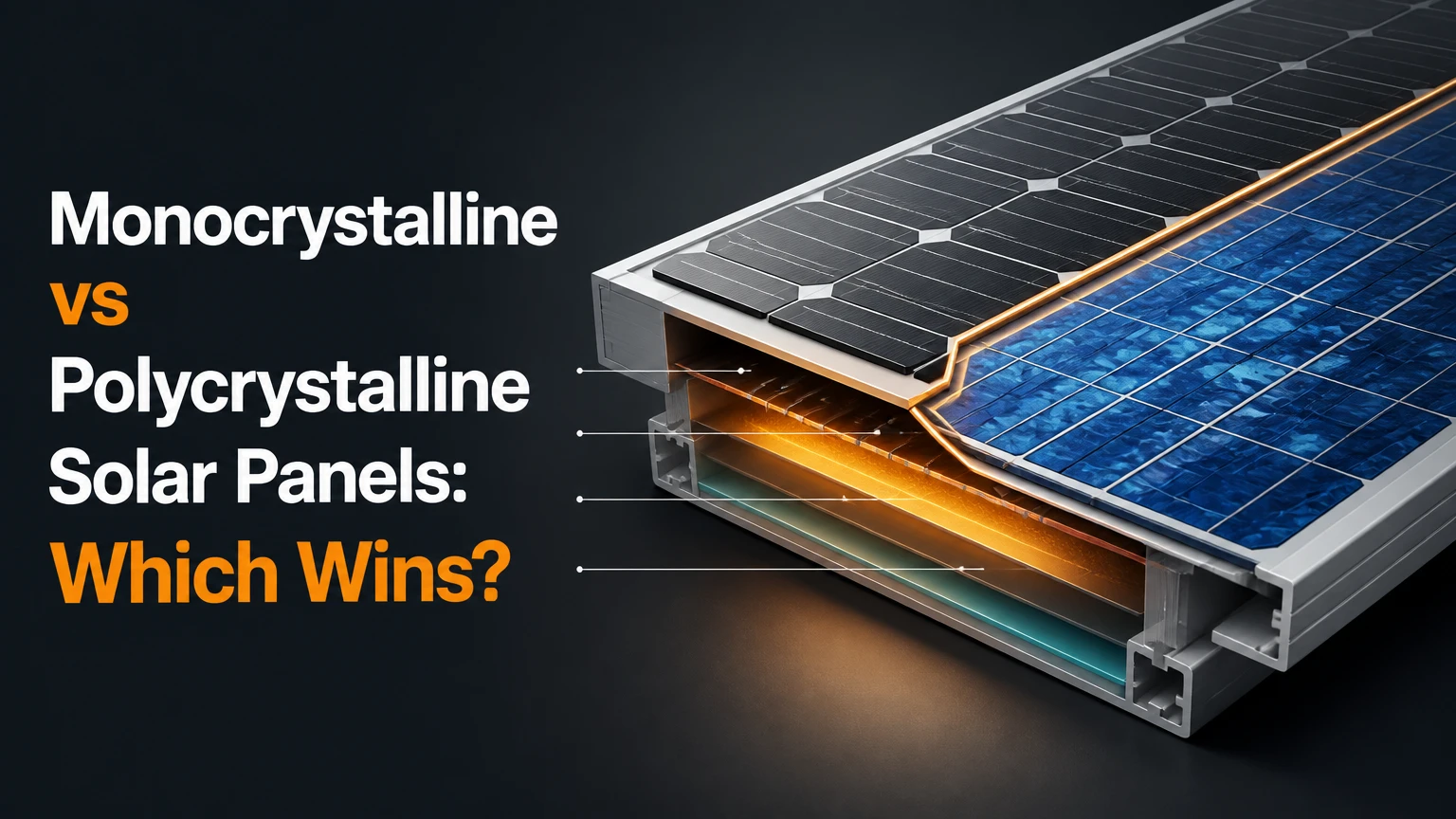
Monocrystalline solar panels usually win for homes because they produce more electricity per square metre, occupy less roof space, and are now more widely available than polycrystalline panels. Polycrystalline panels can still make financial sense for large ground-mounted, off-grid, or clearance projects where space is plentiful and the purchase price is substantially lower.
Key Facts at a Glance
- Monocrystalline cells use one silicon crystal structure, while polycrystalline cells contain many crystal grains.
- Modern commercial monocrystalline modules commonly reach approximately 20% to 24% efficiency, with premium products exceeding 24%.
- Older polycrystalline modules commonly fall around 15% to 18% efficiency.
- A panel’s temperature coefficient, warranty, shading behavior, and electrical design matter more than the mono or poly label alone.
- Polycrystalline panels are largely a legacy product in mainstream residential markets, but used and clearance modules remain available.
- For a 6 kW array, monocrystalline panels commonly require about 25 to 32 square metres, depending on module wattage and layout.
Monocrystalline vs Polycrystalline Solar Panels: Direct Comparison
Monocrystalline solar panels are made from wafers cut from a single silicon ingot, whereas polycrystalline solar panels use wafers solidified from multiple silicon crystals. The difference affects efficiency, appearance, manufacturing cost, and the amount of roof area needed, but it does not determine every aspect of panel quality.
| Decision factor | Monocrystalline | Polycrystalline | Practical consequence |
|---|---|---|---|
| Typical module efficiency | 20%-24% | 15%-18% | Mono produces more power in the same area |
| Typical appearance | Uniform black or dark blue | Speckled blue | Aesthetic preference differs by property |
| Common module power | 400-600 W | 250-ฟ? | Modern mono uses fewer panels |
| Temperature coefficient | About -0.24% to -0.35%/°C | About -0.30% to -0.45%/°C | Datasheet values matter in hot climates |
| Typical product availability | New residential stock | Used or clearance stock | Replacement matching is easier with mono |
| Typical design life | 25-40 years | 20-30 years for older stock | Warranty and condition determine value |
| Space for a 6 kW array | About 25-32 m² | About 32-42 m² | Poly needs more roof or ground area |
| Best economic setting | Limited space, long ownership | Very low-cost, spacious sites | Installed economics can reverse the panel-price ranking |
The table shows why the residential verdict generally favours monocrystalline technology. The table also shows why a blanket statement that mono is always better is incomplete. A sound decision uses module efficiency, degradation warranty, temperature coefficient, inverter compatibility, condition, and installed price together.
Which panel is more efficient?
Monocrystalline panels are more efficient in typical like-for-like comparisons because single-crystal wafers allow manufacturers to reduce some grain-boundary losses and use advanced cell architectures more effectively. Current residential modules commonly provide 400 to 500 watts from roughly 1.7 to 2.1 square metres, while older polycrystalline modules often provide 250 to 370 watts from a similar or larger footprint.
Efficiency means the share of incoming sunlight converted into electricity under laboratory test conditions. It does not mean a 23% panel produces 23% of its rated output throughout the day. Irradiance, cell temperature, orientation, inverter losses, soiling, snow, mismatch, and shading determine annual energy yield.
A 6 kW system illustrates the area difference. Twelve 500 W monocrystalline modules provide 6 kW, while twenty-four 250 W polycrystalline modules provide the same nameplate capacity. Actual panel dimensions vary, but the polycrystalline layout often needs more racking, clamps, cable, and installation labour.
Winner: monocrystalline, when roof area or panel count is constrained.
How Are Mono and Polycrystalline Cells Manufactured?
Monocrystalline silicon is produced by growing a cylindrical ingot around a seed crystal, then slicing that ingot into wafers. Polycrystalline silicon is cast into a block, cooled into many crystal grains, and sliced into square wafers. The manufacturing route explains the visual and efficiency differences, but modern cell design now contributes as much as the original crystal structure.
Monocrystalline manufacturing
- High-purity polysilicon is melted in a crucible.
- A seed crystal enters the melt and rotates as it is slowly withdrawn.
- The process grows a single-crystal cylindrical ingot.
- Wire saws slice the ingot into thin wafers.
- Manufacturers square or chamfer the wafers to improve module packing.
- Cell processing adds doping, passivation, contacts, and anti-reflective coatings.
The cylindrical ingot creates the familiar clipped-corner shape in many older cells. Newer wafer formats and interconnection methods reduce inactive space between cells, so the finished module can use more of its surface for active generation.
Polycrystalline manufacturing
- Silicon fragments are melted together.
- The melt is poured into a square mould.
- Cooling creates many crystal grains with different orientations.
- The solid block is sawn into square wafers.
- Cell processing adds electrical contacts and protective coatings.
Grain boundaries can increase recombination losses, where charge carriers disappear before contributing to current. Improved passivation can reduce those losses, but the polycrystalline manufacturing route generally produces lower efficiency than current monocrystalline designs.
Which Modern Technologies Matter More Than Mono or Poly?
N-type TOPCon, heterojunction, and back-contact designs usually matter more to a new buyer than the basic mono label. Most of these technologies use monocrystalline wafers, but their passivation, contacts, and temperature behavior differ.
| Cell architecture | Typical efficiency | Typical degradation claim | Main advantage | Main limitation |
|---|---|---|---|---|
| P-type PERC mono | 19%-22% | About 0.4%-0.5%/year | Broad historical availability | Older product generation |
| N-type TOPCon | 21%-24% | About 0.3%-0.4%/year | Strong efficiency and mainstream supply | Datasheets vary by manufacturer |
| HJT | 22%-24.5% | About 0.2%-0.3%/year | Low temperature loss and strong bifacial potential | Higher product cost |
| Back-contact, BC or IBC | 22%-25% | About 0.25%-0.35%/year | High efficiency and clean appearance | Premium pricing |
| Polycrystalline PERC | 16%-19% | About 0.5%-0.8%/year | Low clearance cost | Limited new supply and larger footprint |
These are typical market ranges, not guarantees. The exact model datasheet controls the decision. A well-made PERC module with a credible warranty can be a better purchase than an unknown TOPCon module sold through an unreliable channel.
N-type refers to the silicon wafer’s electrical doping type. TOPCon adds a tunnel oxide and passivated contact structure. HJT combines crystalline silicon with thin amorphous silicon layers. Back-contact designs move much of the front electrical metallization to the rear, reducing front shading.
Do Mono Panels Perform Better in Heat and Cloud?
Monocrystalline panels often have a better temperature coefficient than older polycrystalline panels, but heat performance is a cell-design and module-design issue rather than a guaranteed consequence of crystal structure. In cloudy weather, both technologies produce less electricity because irradiance falls, while system orientation, spectral response, shading, and inverter design influence the final difference.
| Condition | Mono response | Poly response | Design response |
|---|---|---|---|
| Cell temperature rises 25°C above test condition | About 6%-9% power reduction | About 7.5%-11% reduction | Select a less-negative coefficient |
| Bright overcast | Reduced output | Reduced output | Use accurate annual-yield modelling |
| Partial shade on one module | Mismatch risk | Mismatch risk | Consider optimizers or module-level electronics |
| Roof with poor ventilation | Higher operating temperature | Higher operating temperature | Maintain a 10-15 cm air gap where practical |
| Snow or reflective ground | Bifacial gain possible | Bifacial gain possible | Choose a bifacial module and suitable rear clearance |
The temperature coefficient is usually listed as a negative percentage per degree Celsius. A coefficient of -0.30%/°C means the module’s power falls by approximately 0.30% for every degree above the reference cell temperature, not necessarily above outdoor air temperature.
The U.S. Department of Energy explains that photovoltaic module output declines as module temperature rises. That principle applies to mono and poly modules alike. A roof-mounted module can become far hotter than the surrounding air under direct sun, so mounting gap, roof colour, wind, and racking design affect yield.
Microinverters do not make a polycrystalline cell inherently better in clouds. Their benefit is electrical independence: one shaded or poorly oriented module has less influence on other modules. That advantage applies to either panel technology.
Winner: modern mono in many hot-climate comparisons, but the datasheet temperature coefficient and installation ventilation decide the result.
How Much Roof Space and Hardware Does Each Need?
A 6 kW monocrystalline array commonly uses 12 to 15 modern modules and about 25 to 32 square metres of module surface. A 6 kW polycrystalline array may use 17 to 24 older modules and approximately 32 to 42 square metres, before adding access pathways, setbacks, and irregular roof margins.
| Example system | Module specification | Panel count | Approximate module area |
|---|---|---|---|
| 6 kW modern mono | 12 × 500 W, 2.0 m² each | 12 | 24 m² |
| 6 kW modern mono | 15 × 400 W, 1.8 m² each | 15 | 27 m² |
| 6 kW older poly | 17 × 350 W, 1.9 m² each | 17 | 32.3 m² |
| 6 kW older poly | 24 × 250 W, 1.7 m² each | 24 | 40.8 m² |
| 10 kW modern mono | 20 × 500 W, 2.0 m² each | 20 | 40 m² |
Roof measurements must include fire access paths, ridge and edge setbacks, vents, skylights, dormers, and structural obstructions. A rectangular roof with 30 square metres of total surface may not offer 30 square metres of usable solar area.
Fewer high-wattage panels can reduce rail length and attachment points, but each large module is heavier and harder for one installer to handle. Structural loading, wind uplift, roof age, and attachment quality remain more important than the cell label.
Which Costs Less Over the System’s Life?
Polycrystalline panels usually have the lower panel-only price, but monocrystalline systems often have the lower cost per installed kilowatt when roof area, racking, labour, and long-term output are included. The saving from poly becomes meaningful only when the modules are heavily discounted and the site has inexpensive, unrestricted space.
| Cost item for a typical 6 kW project | Modern mono estimate | Clearance poly estimate | What changes the number |
|---|---|---|---|
| Panel-only price | $720-$1,320 | $360-$900 | Brand, age, warranty, shipping |
| Racking and clamps | $1,200-$2,200 | $1,600-$3,000 | Panel count and roof layout |
| Inverter and electrical balance | $2,000-$4,000 | $2,000-$4,000 | Same system capacity, design choice |
| Labour and permitting | $4,500-$9,000 | $5,000-$10,000 | Region, roof complexity, installer |
| Typical installed total | $15,600-$19,200 | $14,400-$17,100 | Local labour and incentives |
| Annual degradation assumption | 0.25%-0.45% | 0.5%-0.8% | Product warranty and cell generation |
These are illustrative U.S.-style planning ranges, not quotes. Installed prices vary by market, roof height, electrical upgrades, battery inclusion, permitting, and incentives. Panel hardware commonly represents less than one-quarter of a complete residential invoice, so a cheaper module does not automatically produce a cheaper project.
A polycrystalline system can also lose its price advantage when it needs extra rails, more attachment points, a larger inverter layout, or additional ground preparation. Compare the total installed price for the same usable annual energy, not the price per panel.
Expert insight: If a quote saves $0.05 per watt on panels but requires 20% more modules, the apparent discount can disappear through racking and labour before generation is considered.
Which Panel Lasts Longer?
Modern monocrystalline modules commonly carry 25 to 30-year performance warranties, while older polycrystalline panels often have shorter remaining warranty periods because many are already several years into service. The warranty document, serial-number verification, and degradation schedule matter more than the word mono printed on a specification sheet.
A performance warranty may guarantee at least 98% of initial power during the first year, followed by an annual reduction, with a final value near 80% to 90% after 25 to 30 years. Product warranties cover manufacturing defects, while performance warranties cover output. They are different protections.
| Warranty or condition | New modern mono | Older poly stock | Buyer action |
|---|---|---|---|
| Typical product warranty | 12-25 years | 5-12 years remaining | Verify transferable coverage |
| Typical performance term | 25-30 years | 10-25 years remaining | Check original start date |
| First-year degradation | About 1% | About 1%-3% possible | Request manufacturer curve |
| Annual degradation after year one | 0.25%-0.45% | 0.5%-0.8% typical assumption | Model conservative output |
| Used-panel inspection | Electroluminescence preferred | Essential before purchase | Test for cracks and hotspots |
| Replacement availability | Usually high | Often difficult | Keep model and electrical data |
Polycrystalline panels are not automatically short-lived. A quality poly module installed in a mild climate can operate for decades. The practical issue is that many available poly panels are older, discontinued, or sold without dependable warranty support.
Can Mono and Poly Panels Share an Inverter?
Mono and poly panels can share an inverter only when their electrical characteristics, string arrangement, voltage range, current limits, and shading conditions are compatible. Mixing technologies does not automatically force every panel to operate at the lowest panel’s rating, but placing mismatched modules in one series string can create avoidable losses.
A qualified designer should compare:
- Maximum-power voltage, Vmp
- Open-circuit voltage, Voc, including cold-weather voltage rise
- Maximum-power current, Imp
- Short-circuit current, Isc
- Inverter MPPT voltage range
- Maximum input current per MPPT
- Number of panels in each string
- Orientation, tilt, and shading pattern
Panels in a series string share current, so a lower-current module can constrain the string. Parallel strings share voltage, so different voltage characteristics can reduce tracking quality. Separate MPPT inputs may solve some combinations, while microinverters remove most string-level matching problems.
Do not replace a failed panel by matching only wattage. Match the electrical operating range and physical dimensions first. A 400 W replacement with different voltage can create more design trouble than a lower-wattage panel with compatible electrical characteristics.
Which Should You Choose?
The best choice depends on available area, ownership period, climate, installation price, and whether the system is new or being repaired. Use the following persona decisions rather than treating mono or poly as a universal winner.
Home with a small or complicated roof
Choose modern monocrystalline, preferably a high-efficiency TOPCon, HJT, or back-contact model with a credible warranty. Limited roof area makes watts per square metre more valuable than a small panel-price difference.
A homeowner should first calculate the usable roof area and annual electricity target. If vents and setbacks leave only 28 square metres, 500 W modules may reach the target while 250 W poly modules may not physically fit.
Large commercial or agricultural ground mount
Choose monocrystalline bifacial modules when land, rear clearance, and albedo support additional back-side generation. Consider poly only when verified clearance stock is dramatically cheaper and the project has inexpensive space, compatible electrical equipment, and a realistic replacement plan.
White roofing, gravel, and snow can increase reflected light. Dark soil and tightly packed rows provide less bifacial benefit. A ground-mount model should calculate rear irradiance rather than assume a fixed percentage gain.
Hot, sunny climate
Choose a module with a strong temperature coefficient, low degradation claim, and good ventilation. HJT can be attractive for high-temperature sites, but a well-designed TOPCon module may deliver better project economics.
Installers should preserve airflow beneath roof modules and avoid placing panels directly against a hot roof surface. Annual yield modelling should use local weather data, not only the panel’s standard test rating.
Cloudy or shade-prone location
Choose the panel with the stronger low-light and shading specifications, then select the inverter architecture around the roof geometry. Modern monocrystalline modules often offer higher output per area, but microinverters or optimizers may provide more value than changing from poly to mono.
Heavy shade cannot be repaired by a panel technology upgrade. Tree trimming, a different array orientation, or relocating some modules may produce a larger gain.
RV, cabin, or small off-grid battery
Choose based on physical size, operating voltage, charge-controller compatibility, and price per usable watt. A clean, tested polycrystalline module can be sensible for a spacious cabin, while compact mono modules usually suit an RV roof better.
For a 12 V nominal battery system, panel voltage must suit the charge controller. An MPPT controller can accommodate higher-voltage modules more effectively than a basic PWM controller, but battery chemistry, fuse sizing, cable length, and cold-weather Voc still require calculation.
Buying used or clearance panels
Choose the panel with verifiable electrical tests and serial numbers, not the panel with the lowest advertised wattage price. Ask for flash-test results, physical photographs, remaining warranty terms, junction-box condition, and evidence of transport damage.
Avoid modules with cracked glass, browning encapsulant, delamination, bent frames, hot-spot marks, or unknown storage history. A discount does not compensate for a failed string, unavailable replacement, or unsafe connector.
What Are the Main Alternatives?
Thin-film photovoltaic modules can outperform crystalline silicon in certain low-light, high-temperature, or lightweight applications, although they generally require more area for the same nameplate capacity. Bifacial modules are an application choice rather than a direct replacement for mono or poly because they use rear-side light to increase energy yield.
| Technology | Typical efficiency | Best application | Main constraint | Typical decision |
|---|---|---|---|---|
| Monocrystalline silicon | 20%-25% | Homes and constrained roofs | Higher purchase price than clearance poly | Default new-installation choice |
| Polycrystalline silicon | 15%-19% | Used, off-grid, spacious sites | Larger footprint and older stock | Buy only with a clear price advantage |
| Thin-film CdTe | 16%-20% | Utility-scale and hot sites | More area and different supply chain | Consider for large open sites |
| Thin-film CIGS | 13%-19% | Lightweight or specialised surfaces | Variable product availability | Evaluate case by case |
| Bifacial crystalline | 20%-24% front rating | Ground mounts and reflective roofs | Needs rear light and spacing | Model rear gain before paying extra |
A new homeowner should rarely choose poly solely because the cell price is lower. A ground-mounted buyer with low land cost may reach a different conclusion, particularly when used modules are available locally and replacement matching is manageable.
Common Buying Mistakes and Corrections
Comparing panel wattage without panel dimensions
A 450 W module is not automatically better than a 400 W module if it is much larger or cannot fit the roof. Compare watts per square metre and the number of modules required.
Treating efficiency as annual energy yield
Two modules with similar efficiency can produce different annual energy because of temperature coefficient, low-light response, shading, orientation, and inverter clipping. Request a location-specific production estimate.
Accepting a vague degradation promise
Ask whether the quoted percentage is first-year degradation or the annual rate after year one. Confirm the final warranted output, product warranty, installer warranty, and manufacturer claim process.
Installing old panels without electrical checks
Used poly modules may have high open-circuit voltage, obsolete connectors, or degraded insulation. Test insulation resistance, Voc, Isc, and physical condition before connecting them.
Assuming microinverters solve every problem
Module-level electronics can reduce mismatch and shade losses, but they do not correct a structurally shaded roof, undersized conductors, poor orientation, or inadequate ventilation.
Ignoring end-of-life planning
Solar panels are recyclable, but collection systems and fees vary by country. Keep invoices, serial numbers, datasheets, and installer details so future replacement and recycling remain traceable.
FAQ
Are polycrystalline solar panels obsolete?
Polycrystalline panels are largely obsolete for mainstream new residential installations because current monocrystalline modules offer higher efficiency and broader supply. Polycrystalline modules remain usable for budget repairs, off-grid cabins, educational projects, and large sites with cheap space, provided their condition and warranty are verified.
Are monocrystalline panels worth the extra money?
Monocrystalline panels are usually worth the premium when roof space, installation labour, or long-term energy production matters. The answer changes when verified polycrystalline clearance stock costs substantially less, the site has abundant space, and the buyer accepts older technology, lower efficiency, and more difficult future replacement.
Which panels are best for a 6 kW home system?
Modern monocrystalline panels are usually best for a 6 kW home system because 12 to 15 high-wattage modules can fit where 17 to 24 older polycrystalline modules may not. The final selection should use roof setbacks, local production modelling, inverter limits, warranty terms, and the total installed quote.
Do black solar panels work better than blue panels?
Black monocrystalline panels do not produce more electricity solely because they look black. Their darker appearance usually comes from the cell structure, anti-reflective coating, and module design, while electrical output depends on efficiency, temperature coefficient, irradiance, wiring, and inverter performance.
Can a broken polycrystalline panel be replaced with a monocrystalline panel?
A broken polycrystalline panel can sometimes be replaced with a monocrystalline panel, but the replacement must match voltage, current, connector, dimensions, string configuration, and inverter limits. A solar electrician should confirm compatibility before installation, particularly when panels are connected in series.
Does bifacial technology make polycrystalline a better choice?
Bifacial technology does not automatically make polycrystalline panels better. Bifacial mono modules are more common in current supply, and their benefit depends on rear clearance, row spacing, mounting height, surface reflectivity, and the amount of light reaching the back of the panel.
The Bottom Line
For most new homes, monocrystalline solar panels are the stronger choice because they provide higher efficiency, require fewer modules, fit more easily on constrained roofs, and have broader access to modern warranties. Polycrystalline panels can still win for spacious ground mounts, cabins, repairs, and clearance purchases where the lower price is large enough to offset additional hardware and lower long-term output.
The right decision in monocrystalline vs polycrystalline solar panels is therefore a system decision, not a colour or label decision. Compare watts per square metre, temperature coefficient, degradation warranty, electrical compatibility, total installed cost, and replacement availability before signing a quote.