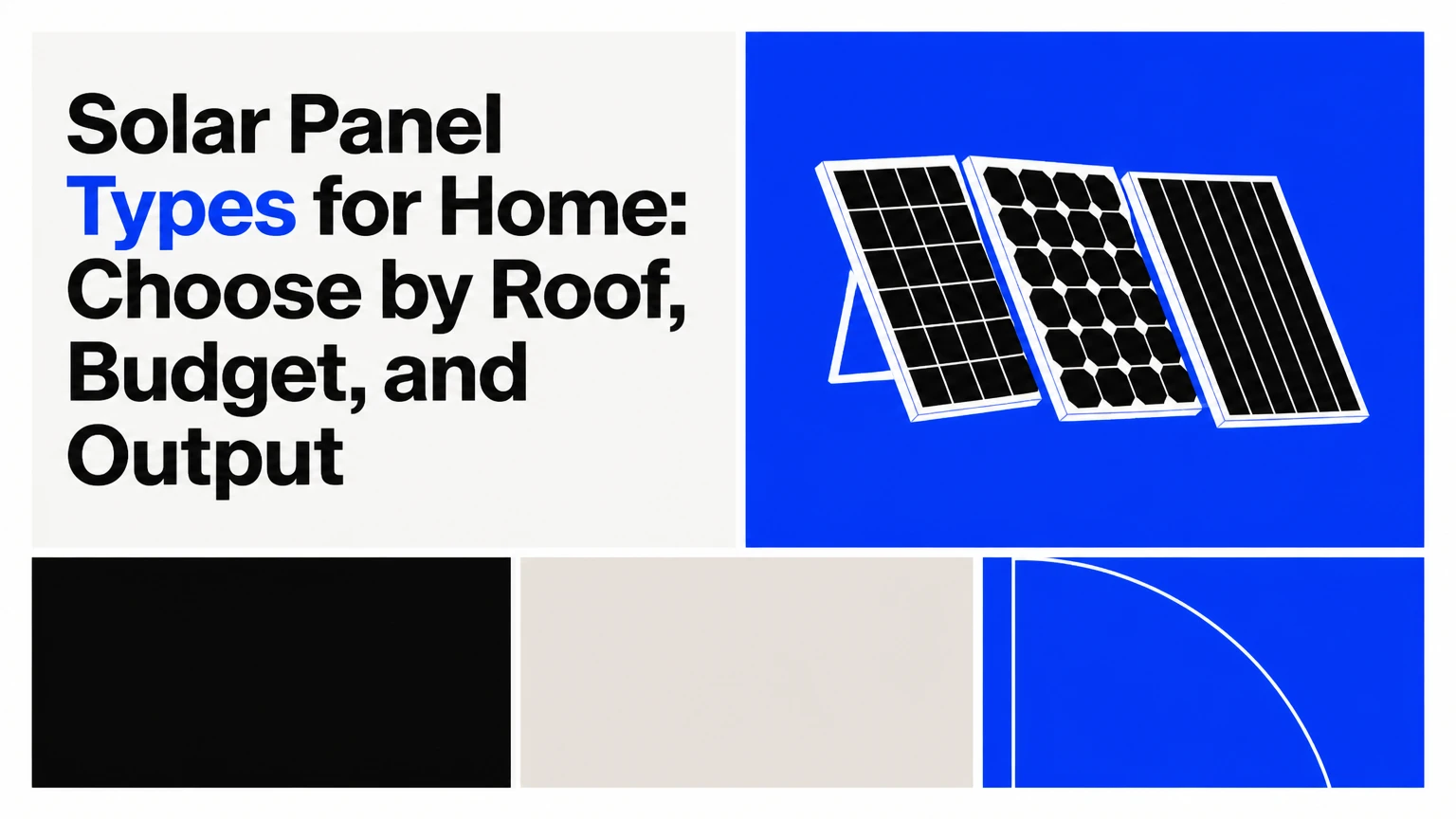
The best solar panel types for home installations are usually high-efficiency monocrystalline modules, especially n-type TOPCon or HJT panels when roof space is limited. Polycrystalline panels can suit large, unshaded roofs with strict equipment budgets, while thin-film, bifacial, and solar-shingle systems solve more specific mounting, appearance, or structural problems.
Key Facts at a Glance
- Monocrystalline residential panels typically provide about 19%-23% module efficiency and 350-450 watts under standard test conditions.
- Polycrystalline panels usually cost less per module but occupy more roof area for the same system capacity.
- Thin-film modules are lightweight and adaptable, yet commonly provide lower efficiency and shorter product lifetimes than crystalline panels.
- N-type TOPCon and HJT cells generally offer lower degradation and stronger performance than older p-type PERC designs.
- A typical grid-connected home system is 6-10 kW, costs about $15,000-$25,000 before incentives, and uses approximately 15-25 panels.
- Solar panels do not normally power a home during a grid outage unless the system includes an approved battery or other islanding-capable backup equipment.
How Do Residential Solar Panels Work?
Residential solar panels convert sunlight into direct-current electricity, and an inverter converts that electricity into alternating current for household circuits. Photovoltaic cells absorb photons, release electrons in semiconductor material, collect the resulting current through metal contacts, and send usable AC power to the service panel.
The electricity path is:
Sunlight → photovoltaic cells → DC electricity → inverter → AC electricity → home loads or grid
A grid-tied system sends excess generation through a bidirectional meter when household production exceeds demand. At night or during low production, the home draws electricity from the utility unless a battery changes that flow.
The U.S. Department of Energy explains the resource in concrete terms: “The amount of sunlight that strikes the earth’s surface in 90 minutes could power the world’s total energy use for a full year.” That statement describes resource abundance, not the output of an individual roof. Roof angle, weather, shading, module temperature, wiring losses, inverter efficiency, and utility rules determine actual household results.
What are the main solar system components?
A complete installation contains more than panels. The module generates DC power, racking fixes modules to the roof or ground structure, and an inverter manages conversion and grid interaction.
| Component | Residential specification or role | Main decision |
|---|---|---|
| PV module | 350-450 W, approximately 1.7-2.0 square meters | Efficiency, warranty, dimensions |
| Inverter | String, microinverter, or optimizer-based architecture | Shade response and serviceability |
| Racking | Aluminum rails, roof attachments, flashing, clamps | Roof type and wind or snow loads |
| Monitoring | App or web portal, panel-level or system-level data | Fault detection and production records |
| Battery | Commonly 10-20 kWh usable capacity | Backup loads, time-of-use rates, outage needs |
| Electrical protection | Disconnects, breakers, rapid shutdown equipment | Code compliance and firefighter safety |
A battery stores electricity but does not automatically make a grid-tied system operational during an outage. The inverter must isolate the home from the utility and supply a permitted backup circuit.
What Are the Solar Panel Types for Home?
The three traditional panel families are monocrystalline, polycrystalline, and thin-film. Modern homeowners must also compare cell architecture, such as p-type PERC versus n-type TOPCon or HJT, because two panels with the same appearance can have different degradation, temperature, and warranty characteristics.
Monocrystalline panels
Monocrystalline panels use wafers cut from a single silicon crystal. Their typical 19%-23% efficiency makes them the default choice when a roof has limited usable area, and current residential modules commonly deliver 350-450 W.
The cells usually appear black or very dark blue. The module may have rounded cell corners, black or silver frames, and either a white or black backsheet. Monocrystalline modules cost more than older polycrystalline products, but the relevant comparison is installed cost per kilowatt-hour, not module price alone.
Monocrystalline panels are not automatically the best purchase for every roof. A homeowner with abundant roof area may gain little from paying for the highest efficiency if the lower-priced system already meets the electricity target.
Polycrystalline panels
Polycrystalline panels use silicon formed from multiple crystals melted into ingots. Typical efficiency is about 15%-18%, so a polycrystalline array needs more surface area than a similarly rated monocrystalline array.
The blue, speckled appearance results from the crystal structure and light reflection. Polycrystalline technology was once a major residential choice because manufacturing costs were lower, but current market availability is more limited as high-volume manufacturers have shifted toward monocrystalline formats.
Polycrystalline panels can still make sense on a large, unshaded roof, a detached structure, or a price-sensitive project where additional roof area is available. The equipment must remain compatible with the installer’s design, warranty, and local permitting requirements.
Thin-film panels
Thin-film panels deposit photovoltaic material, such as amorphous silicon, cadmium telluride, or CIGS, onto glass, metal, or flexible substrates. Typical efficiency is approximately 11%-13%, although product specifications vary substantially by chemistry and manufacturer.
Thin-film modules can be lighter, flexible, and more tolerant of some high-temperature conditions. They are useful for specialized roofs, portable systems, low-load structures, and installations where module weight or shape matters more than roof area.
Thin-film is usually a poor choice for a normal house with limited roof space. Lower power density can require a much larger array, and some products have shorter warranties or greater long-term output loss than mainstream crystalline modules.
| Panel type | Typical efficiency | Typical residential wattage | Typical useful life | Best-fit situation |
|---|---|---|---|---|
| Monocrystalline | 19%-23% | 350-450 W | 25-35 years | Small or space-constrained roof |
| Polycrystalline | 15%-18% | 250-350 W | 20-30 years | Large roof with equipment budget limits |
| Thin-film | 11%-18%, product dependent | 100-450 W | 10-25 years | Lightweight, flexible, or specialty mounting |
| Solar shingles | 14%-20%, product dependent | Integrated roof format | 20-30 years | New roof with appearance priority |
Which Modern Panel Technologies Matter?
N-type TOPCon and HJT cells generally deserve attention for new residential proposals because they reduce some losses associated with older p-type designs. Bifacial panels and building-integrated photovoltaics can be useful, but their value depends more strongly on mounting conditions than their names suggest.
TOPCon and HJT cells
TOPCon, or tunnel oxide passivated contact, improves contact passivation around the silicon cell. HJT, or heterojunction technology, combines crystalline silicon with thin semiconductor layers. Both designs can provide high module efficiency and low temperature coefficients compared with older products.
The meaningful purchasing figures are not the acronym alone. Compare the module efficiency, temperature coefficient, first-year degradation, annual degradation, product warranty, power warranty, and dimensions on the manufacturer data sheet.
A newer n-type module can be worth a modest premium when roof space is scarce or the system will operate in a hot climate. It is less compelling when the installer can already fit the required capacity on an unshaded roof using a lower-cost module.
Bifacial panels
Bifacial modules produce electricity from the front and rear surfaces. Their rear-side gain depends on reflected light, module elevation, ground or roof albedo, row spacing, and the absence of an opaque backing surface.
A raised ground array over pale gravel can benefit more than a tightly packed asphalt-shingle roof. A roof-mounted bifacial panel may produce little extra energy if its rear side is close to dark roofing material.
Solar shingles and BIPV
Solar shingles integrate photovoltaic cells into roofing products. They can reduce the visual contrast of a solar array, but they often cost more, require specialized installers, and make future roof repairs more involved.
Solar shingles are most logical during new construction or a complete roof replacement. Removing a conventional module from a serviceable roof is usually simpler than repairing an integrated photovoltaic roofing field.
How Should You Compare Solar Panels?
The strongest comparison uses usable roof area, annual energy production, installed price, warranty terms, shade conditions, and serviceability. Module efficiency alone cannot identify the lowest-cost system because inverter losses, roof layout, utility compensation, and installation labor also affect financial results.
| Decision criterion | Monocrystalline | Polycrystalline | Thin-film | Practical winner |
|---|---|---|---|---|
| Module efficiency | 19%-23% | 15%-18% | 11%-18% | Monocrystalline |
| Roof area for 8 kW | About 18-23 modules | About 23-32 modules | Often 30+ modules | Monocrystalline |
| Heat coefficient | About -0.29% to -0.40% per °C | About -0.35% to -0.45% per °C | Product dependent, often favorable | Thin-film, product dependent |
| Product warranty | Commonly 12-25 years | Commonly 10-25 years | Commonly 5-20 years | Modern mono |
| Appearance | Black or dark blue | Speckled blue | Uniform or flexible surface | Preference dependent |
| Roof suitability | Asphalt, tile, metal, flat systems | Large conventional roofs | Lightweight or specialty roofs | Site dependent |
| Current availability | High | Lower than historical levels | Specialty market | Monocrystalline |
Efficiency versus annual energy yield
A panel’s efficiency measures the percentage of sunlight converted under standardized laboratory conditions. Annual yield measures electricity produced at a specific site, where orientation, shade, temperature, snow, soiling, and inverter clipping change the result.
A 23%-efficient panel on a shaded roof can produce less electricity than an 18%-efficient panel on an unobstructed roof. Treat efficiency as a space and layout metric, not as a guaranteed percentage of your annual electric bill.
String inverters, microinverters, and optimizers
Inverter architecture can matter more than a small difference in module efficiency. String inverters connect panels in groups, microinverters convert power at each panel, and power optimizers condition individual module output before a central inverter performs conversion.
| Inverter design | Shade behavior | Typical service pattern | Best application |
|---|---|---|---|
| String inverter | Weakest when one string has uneven shade | One central replacement point | Simple, unshaded roof |
| Microinverters | Strong panel-level response | More rooftop electronics | Multiple roof faces or intermittent shade |
| Power optimizers | Panel-level control with central inverter | Central inverter plus rooftop devices | Mixed orientations and monitoring needs |
| Hybrid inverter | Solar, grid, and battery management | Integrated storage system | Backup and time-of-use control |
Microinverters do not remove shade losses. They can prevent one shaded module or roof section from reducing the output of an entire string, but the shaded module still receives less sunlight.
How Many Panels Does a Home Need?
A typical U.S. home often needs a 6-10 kW solar array, which commonly equals 15-25 modern panels, but annual electricity consumption and local solar production determine the correct size. Twelve months of utility bills provide a better starting point than the home’s square footage.
Use this planning sequence:
- Add the previous 12 months of kilowatt-hours.
- Identify expected changes, such as an electric vehicle, heat pump, or electric water heater.
- Obtain the installer’s estimated annual production in kilowatt-hours.
- Divide annual consumption by expected production per installed kilowatt.
- Check usable roof area, service-panel capacity, utility limits, and export compensation.
For example, a household using 10,800 kWh annually might need approximately 7-9 kW in a moderate-sun location, but the final figure could be lower in a high-sun region or higher where winter production is weak. The proposal should show monthly production, not only an annual total.
Oversizing can reduce financial value where the utility pays little for exported electricity. Undersizing can be reasonable when the homeowner plans to conserve energy or cannot use more roof area.
How Much Do Home Solar Panels Cost?
A typical residential solar installation costs approximately $15,000-$25,000 before incentives for a 6-10 kW system, equivalent to about $2.50-$3.50 per installed watt in many standard U.S. markets. Local labor, roof complexity, electrical upgrades, battery storage, financing, and utility requirements can move the quote outside that range.
| Project element | Typical quantity or range | Cost effect |
|---|---|---|
| PV array | 6-10 kW | Approximately $12,000-$20,000 of base project value |
| Installation and balance of system | 1 project | Included in about $2.50-$3.50 per watt |
| Main-panel upgrade | 100-200 amp service | Often adds $2,000-$5,000 |
| Battery storage | 10-20 kWh usable | Often adds $8,000-$18,000 |
| Roof repairs or replacement | 1 roof project | Highly site dependent |
| Detach and reinstall later | 1 solar service event | Commonly costs several thousand dollars |
Payback periods of 6-10 years are possible in favorable markets, but no national payback figure applies to every homeowner. Retail electricity rates, net-billing credits, local incentives, system degradation, financing interest, maintenance, and export limits must enter the calculation.
Compare ownership options carefully. Cash purchase generally provides the clearest asset ownership, while a loan adds interest but preserves cash. A lease or power purchase agreement can reduce initial payment requirements, yet contract escalators, transfer rules, purchase options, and roof removal obligations can complicate a home sale.
What Is the Installation Timeline?
A standard rooftop solar project often takes 6-14 weeks from signed agreement to permission to operate, although physical installation may take only 1-3 days. Permitting, utility review, inspection scheduling, and interconnection approval usually determine the calendar time.
| Stage | Typical duration | Homeowner checkpoint |
|---|---|---|
| Site survey and engineering | 1-2 weeks | Roof, shade, structural, and electrical review complete |
| Permit submission | 1-3 weeks | Approved drawings and equipment list available |
| Utility interconnection review | 2-6 weeks | Export and meter requirements confirmed |
| Physical installation | 1-3 days | Attachments flashed and wiring labeled |
| Inspection | 1-14 days after installation | Authority approves code compliance |
| Permission to operate | 1-4 weeks after inspection | Utility authorizes grid operation |
The installation sequence is roof inspection, engineering, permitting, attachment and flashing, rail placement, module mounting, electrical wiring, inverter commissioning, inspection, and utility authorization. A homeowner should not switch on a new grid-connected system before the utility grants permission to operate.
Which Panel Fits Your Roof and Household?
The best panel type depends on the constraint that limits the project. Roof area favors high-efficiency monocrystalline modules, while a large unshaded roof can justify less expensive equipment; shade, roof faces, structural capacity, and outage requirements may change the recommendation.
| Homeowner situation | Recommended panel or system | Reason | Important limitation |
|---|---|---|---|
| Small roof, high electricity use | 400 W or higher n-type mono | Maximum output per square meter | Higher module price |
| Large unshaded roof | Value mono or available poly | More area offsets lower efficiency | Poly availability may be limited |
| Split roof with shade | Mono plus microinverters or optimizers | Better roof-section management | More rooftop electronics |
| Standing-seam metal roof | Mono on seam clamps, or specialty thin-film | Avoids unnecessary penetrations | Verify clamp and wind ratings |
| Flat roof with bright membrane | Bifacial mono on elevated racking | Rear-side reflected light can help | Row spacing and ballast matter |
| New premium roof replacement | Solar shingles or BIPV | Integrated appearance | Higher cost and repair complexity |
| Frequent outages | Mono plus hybrid inverter and battery | Provides approved backup circuits | Panels alone do not provide backup |
A roof replacement should normally happen before panel installation when shingles or membrane have only 5-10 years of expected service remaining. Detaching and reinstalling modules later adds labor, creates sealing risks, and can interrupt production.
Snow-covered modules, wildfire-prone areas, coastal corrosion, and high-wind regions need product-specific review. Ask for snow load, wind load, fire classification, salt-mist resistance, and attachment documentation rather than assuming every residential module has the same rating.
What Mistakes Reduce Solar Value?
The most expensive solar mistakes begin before installation: sizing from square footage, ignoring shade, accepting a roof that needs replacement, and comparing only the monthly payment. A technically sound module can still produce a poor investment when the array is oversized for the utility’s export rules.
Avoid these failures:
- Using one electric bill: Seasonal air-conditioning or heating can hide the annual load. Use 12 months of kWh data.
- Choosing by wattage alone: A 450 W panel may be physically larger than a 400 W panel and fail to fit between vents or roof edges.
- Ignoring winter shade: A tree that appears harmless in summer can shade the roof after the sun moves lower in winter.
- Skipping structural review: Tile roofs, old rafters, and heavy snow loads require engineering rather than visual approval.
- Assuming net metering: Utilities may use avoided-cost credits, monthly net billing, or export caps instead of one-to-one retail compensation.
- Accepting vague warranties: Separate product, power, inverter, workmanship, and roof-penetration warranties have different terms.
A practical installer rule is to request the module data sheet, inverter model, annual production model, shade analysis, roof attachment plan, and complete contract before comparing bids. If those documents are missing, the price comparison is incomplete.
How Can You Troubleshoot Low Solar Production?
Low solar production usually results from shade, dirt, snow, equipment faults, grid conditions, or incorrect expectations. Compare current output with the monitoring portal, weather conditions, and the same month in prior years before touching electrical equipment.
| Symptom | Likely cause | Safe homeowner action | Escalation point |
|---|---|---|---|
| One panel underperforms | Shade, debris, or microinverter fault | Check visual obstruction and monitoring data | Installer service request |
| Whole system reads zero | Grid outage, disconnect, inverter fault | Check utility power and displayed error | Licensed technician |
| Gradual annual decline | Normal degradation or soiling | Compare production trend and inspect safely | Warranty review if abnormal |
| Sudden midday drop | Inverter clipping, heat, or grid voltage | Record time and error code | Installer and utility |
| Snow or heavy dirt on modules | Surface obstruction | Follow manufacturer cleaning guidance | Professional cleaning if unsafe |
| Repeated isolation fault | Wiring, grounding, or grid issue | Do not repeatedly reset equipment | Qualified electrician |
Do not climb onto a roof, open energized equipment, or repeatedly reset a fault without following the manufacturer’s procedure. A clean panel cannot correct a failed inverter, damaged cable, high utility voltage, or a disconnected grid.
Modern modules commonly carry linear power warranties that promise a specified percentage of original rated output after 25-30 years. The exact degradation schedule matters: a first-year loss near 1% followed by approximately 0.3%-0.5% annually is materially different from a product with a higher stated loss.
Frequently Asked Questions
Are black solar panels better than blue panels?
Black appearance does not prove higher performance. Panel color usually reflects cell design, backsheet, frame, and anti-reflective glass, while efficiency, temperature coefficient, dimensions, and warranty determine technical value. A black monocrystalline module can be preferable for appearance or roof density, but a blue polycrystalline module may meet the same energy target at lower equipment cost.
Do solar panels work on an east-facing or west-facing roof?
East- and west-facing roofs can produce useful electricity, especially when the household consumes power in the morning or afternoon. South-facing orientation often produces strong annual output in the Northern Hemisphere, but a shade-free west roof can outperform a shaded south roof. The installer should model azimuth, tilt, shade, and hourly household demand together.
Can solar panels heat my home?
Photovoltaic panels generate electricity rather than direct household heat. That electricity can operate a heat pump, resistance heater, or electric water heater, but the conversion chain has different costs and efficiencies than a solar thermal system. A homeowner considering electrification should model the added annual kWh before sizing the array.
Should I add a battery to rooftop solar?
A battery is most useful when outages, time-of-use pricing, demand charges, or low export credits justify its cost. A battery does not necessarily improve financial payback where the utility offers strong net metering and outages are rare. Compare usable capacity, round-trip efficiency, continuous power, warranty throughput, replacement terms, and critical-load circuits.
Are solar panels recyclable?
Solar panels contain recoverable glass, aluminum, silicon, and small quantities of other materials, but recycling availability and economics vary by location. The U.S. Environmental Protection Agency identifies photovoltaic modules as a waste-management issue that may involve hazardous-material rules depending on the product. Ask the installer about manufacturer take-back programs and local recycling facilities.
How long should a solar panel system last?
A well-installed crystalline-silicon system commonly operates for 25-35 years, while inverters, batteries, and roof components may need service sooner. Output declines gradually rather than stopping at the warranty date. Review the panel’s annual degradation rate and the separate replacement warranties for the inverter, racking, workmanship, and storage system.
The Bottom Line
Solar panel types for home projects should be selected by roof area, annual electricity use, shade, utility compensation, roof condition, and backup goals. Modern monocrystalline panels are the practical default for most houses, while polycrystalline, thin-film, bifacial, and solar-shingle systems earn consideration only when their specific structural, visual, or mounting advantages outweigh lower density or higher complexity. Obtain comparable production models and contract terms before choosing equipment.