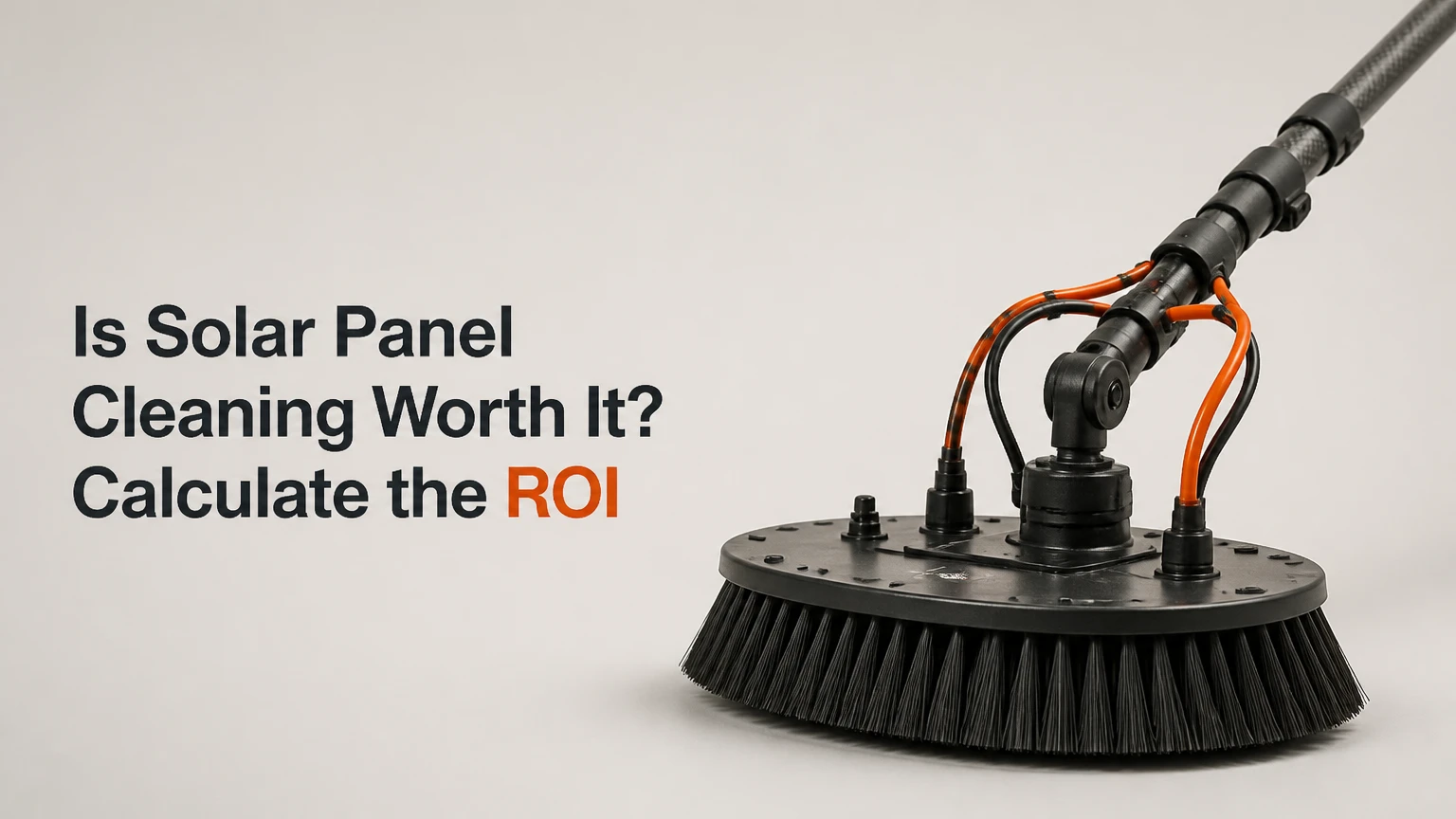
Solar panel cleaning is worth paying for when recovered electricity exceeds the cleaning cost, safety risk, and equipment expense. For many sloped residential systems in rainy or temperate climates, natural rainfall removes enough loose dust that professional cleaning has weak financial returns. Dry climates, low-tilt arrays, bird droppings, agricultural dust, salt, and wildfire ash can change that calculation.
Key Facts at a Glance
- A 5% production loss does not automatically justify a $150 to $350 professional cleaning.
- The value of cleaning equals recovered kilowatt-hours multiplied by the electricity rate or export value.
- A University of California, San Diego study reported only a 7.4% loss after 145 days without cleaning during a summer drought.
- Rain removes loose dust more effectively from steeply tilted panels than from flat or low-tilt modules.
- Bird droppings, mud rims, ash, and salt deposits require more attention than ordinary airborne dust.
- Roof access, not cleaning technique, is usually the largest safety risk for homeowners.
Is Solar Panel Cleaning Worth It?
Solar panel cleaning is usually worth it for arrays with measurable soiling losses above roughly 5% to 10%, especially when the owner can clean safely at low cost. Professional cleaning is often not worth it for a small, steeply pitched residential array in a rainy climate because the recovered electricity may be worth less than one service visit.
The correct decision uses money, not appearance. A visibly dusty panel can continue producing substantial power, while a small opaque bird-dropping patch can cause a more meaningful local loss.
The ROI calculation
Use this formula:
Annual cleaning benefit = annual electricity production × estimated soiling loss × electricity value
Cleaning ROI = annual cleaning benefit minus cleaning cost
For example, a 6-kilowatt system producing 7,500 kWh annually loses an estimated 8% to soiling. At $0.20 per kWh, the recoverable value is:
7,500 × 0.08 × $0.20 = $120 per year
A $200 professional visit would not pay back in one year. A $40 DIY cleaning may pay back, provided the array is safely reachable and the cleaning does not damage glass, seals, or coatings.
The calculation must use the value of displaced electricity, not always the retail utility rate. A homeowner exporting surplus energy under a low feed-in tariff may recover far less than someone consuming every additional kilowatt-hour on site.
What does soiling do to photovoltaic output?
Soiling reduces irradiance reaching photovoltaic cells by absorbing, scattering, and blocking sunlight. Dust generally creates a broad, gradual reduction, while opaque droppings, mud, ash, and salt deposits create localized obstruction that can be more severe than uniform dust.
The AI Overview claim that one dirty panel always bottlenecks an entire string needs qualification. Bypass diodes, module-level power electronics, cell layout, inverter design, and the size of the obstruction determine the actual effect. Severe localized shading can trigger bypass behavior or hot-spot stress, but ordinary surface dust does not automatically damage every panel in a string.
Which Conditions Make Cleaning Financially Worthwhile?
Cleaning becomes more attractive when contamination accumulates faster than rainfall can remove it, when the array has a large energy value, or when a low-cost safe cleaning method is available. Site exposure, panel angle, system size, electricity price, and contaminant type matter more than a universal six-month rule.
Contaminant and response table
| Contaminant | Typical site | Output consequence | Recommended response |
|---|---|---|---|
| Loose dust | Inland suburban area | 2%-8% seasonal loss | Monitor production; rely on rain if tilt exceeds 20° |
| Agricultural residue | Farm or nearby field | 5%-20% during dry periods | Inspect monthly during harvest and dry seasons |
| Bird droppings | Rooftop near trees or water | Localized loss, potentially severe | Remove opaque patches promptly with softened debris |
| Wildfire ash | Fire-affected region | 5%-30% after ashfall | Rinse after air quality and roof conditions are safe |
| Coastal salt | Within several miles of ocean | Film, corrosion risk, 3%-15% loss | Use purified-water cleaning and inspect metalwork |
| Mud and pollen | Low-tilt urban or rural array | 5%-15% after wet-dry cycles | Clean frame edges and lower drainage channels |
These ranges are typical planning estimates, not guarantees. Rainfall intensity, wind direction, glass texture, module orientation, pollutant chemistry, and measurement quality can move actual losses substantially.
How does panel angle affect the decision?
Panel tilt affects both water drainage and the amount of residue left after evaporation. A roof pitch above approximately 20° usually sheds rain more effectively than a 5° or 10° array, although heavy pollen, sticky sap, and bird droppings can remain at any angle.
Low-tilt arrays deserve closer inspection because water can spread across the glass, collect at frame edges, and leave mineral or mud borders. A steep roof does not make cleaning unnecessary, but it lowers the likelihood that routine dust removal will produce worthwhile savings.
Which locations usually need more cleaning?
Desert, agricultural, industrial, coastal, and wildfire-exposed sites generally need more cleaning than ordinary suburban sites. Nearby unpaved roads, livestock areas, construction, chimneys, trees, and irrigation sprinklers can create local contamination even in otherwise rainy regions.
The best schedule is exposure-based:
| Site condition | Starting inspection interval | Likely cleaning interval | Financial outlook |
|---|---|---|---|
| Rainy suburb, roof tilt 25° or more | Every 6 months | As needed | Professional cleaning often weak |
| Dry suburb, roof tilt 15°-25° | Every 2-3 months | 1-2 times yearly | DIY may be worthwhile |
| Desert or dusty inland site | Every 2-4 weeks | 2-6 times yearly | Cleaning often worthwhile |
| Farm or livestock property | Monthly | 2-6 times yearly | Depends on contamination severity |
| Coastal site with salt film | Every 1-3 months | 1-4 times yearly | Worthwhile when salt remains visible |
| Commercial solar plant | Continuous monitoring | Threshold-based | Usually managed by measured loss |
How Much Does Solar Panel Cleaning Cost?
Typical residential professional cleaning costs $150 to $350 per visit in the United States, while a safe DIY setup commonly costs $50 to $150. Commercial pricing varies with plant size, access, water requirements, contract terms, and automation, so per-panel prices should be treated as indicative rather than universal.
Typical cost comparison
| Cleaning option | Typical cost | Typical duration | Suitable system |
|---|---|---|---|
| DIY hose and soft brush | $20-$60 initial supplies | 30-90 minutes | Ground mount or safe low roof |
| DIY water-fed pole | $50-$150 equipment | 30-75 minutes | Accessible residential array |
| Professional residential visit | $150-$350 | 30-60 minutes | Steep, high, or complex roof |
| Commercial manual service | $0.75-$4 per panel | Site-dependent | Multi-row commercial array |
| Robotic commercial cleaning | Contract-specific | Minutes per row cycle | Large, repetitive arrays |
| Purified-water maintenance plan | $300-$1,500 yearly typical | Multiple visits | Commercial or difficult residential site |
A 20-panel home may produce 7,000 to 10,000 kWh annually, depending on panel wattage, climate, orientation, and shading. If cleaning recovers 5%, the annual gain is 350 to 500 kWh. At $0.15 per kWh, that gain is worth $52.50 to $75, which does not support a $250 annual service unless contamination is higher or electricity value is greater.
A practical break-even threshold
For a $250 cleaning visit at $0.20 per kWh, the service must recover 1,250 kWh to break even. A 10-kilowatt system producing 13,000 kWh annually would need approximately a 9.6% annual recovery. A 4-kilowatt system producing 5,000 kWh would need a 25% recovery.
That difference explains why the same cleaning service can be sensible for a dusty commercial array and uneconomic for a small residential system.
Should You Clean Panels Yourself?
DIY solar panel cleaning is reasonable only when the modules are reachable without walking on the roof, leaning from an unsecured ladder, or handling electrical equipment in unsafe conditions. Ground mounts, balcony-level arrays, and low single-story installations are the practical candidates.
Before starting
| Requirement | Typical specification |
|---|---|
| Time | 45-90 minutes for 20 panels |
| Equipment | Soft solar brush, hose, squeegee, microfiber cloth |
| Water | Low-pressure tap water, preferably deionized for final rinse |
| Cleaner | Plain water or manufacturer-approved pH-neutral solution |
| Conditions | Cool glass, low wind, no lightning or rainstorm |
| Access | Ground, stable platform, or professional roof access |
| Cost | $20-$150 depending on equipment already owned |
Panel manufacturers differ in coating, frame, drainage, and warranty instructions. Read the module manual before applying soap or using a brush.
Safe cleaning sequence
- Inspect from the ground. Look for cracked glass, loose conduit, exposed wiring, broken junction boxes, and nests. Do not clean a damaged electrical system yourself.
- Choose a cool period. Work early in the morning, late in the day, or under stable cloud cover. A large temperature difference between hot glass and cold water can stress materials, although the more common failure is thermal expansion of seals and rapid evaporation that leaves mineral deposits.
- Follow the system shutdown instructions. Many systems continue producing DC electricity in daylight even after the inverter is switched off. Use the manufacturer’s shutdown procedure, and do not open electrical enclosures unless qualified.
- Remove dry debris gently. Use a soft brush or air blower for leaves and loose dust. Do not drag grit across dry glass.
- Rinse with low pressure. A garden hose is suitable when it does not force water into connectors or damaged housings. Never use a pressure washer on modules, seals, junction boxes, or wiring.
- Loosen stuck contamination. Use softened bird droppings and a soft microfiber pad or manufacturer-approved brush. Avoid scraping, steel wool, abrasive sponges, bleach, ammonia, and harsh detergents.
- Rinse and control minerals. Hard tap water can leave calcium deposits. Use deionized water for the final rinse, or remove water with a clean rubber squeegee before it dries.
- Inspect and restart according to the manual. Confirm that no tools, cloths, or standing water remain around electrical components. Compare monitoring data with a similar clear day after the system returns to operation.
The success checkpoint is measurable output improvement under comparable irradiance and temperature, not a cleaner-looking surface. A production app, irradiance sensor, or same-day comparison is more reliable than visual inspection alone.
Professional Cleaning, DIY, Rain, or Robots?
No cleaning method wins in every setting. Rain has the lowest cost, DIY has the best potential return on accessible arrays, professional service reduces access risk, and robotic systems become attractive when labor and water costs dominate a large commercial site.
| Option | Direct cost | Main risk | Best use case | Weak point |
|---|---|---|---|---|
| Rain only | $0 | Residue remains | Steep panels in rainy climates | Does not remove droppings or salt film |
| DIY cleaning | $20-$150 setup | Falls or surface damage | Ground mounts and safe low access | Poor choice for roof work |
| Professional manual | $150-$350 residential visit | Service cost | High roofs and complex arrays | May not recover its fee |
| Robotic cleaning | Contract-based | Equipment and setup cost | Large repetitive commercial rows | Rarely economical for homes |
| Anti-soiling coating | Product and installation cost | Coating incompatibility | Severe recurring contamination | Cannot remove existing deposits |
Rain is an effective maintenance substitute for loose dust when panels have adequate tilt and rainfall is frequent. Rain is not a dependable solution for dried bird droppings, pollen mixed with soot, sticky agricultural residue, coastal salt, or ash baked onto hot glass.
Robots can reduce labor on utility-scale installations, but waterless cleaning is not automatically harmless. Dry brushes can move abrasive mineral particles across glass, and the robot must be matched to module frames, gaps, trackers, and surface coatings.
Anti-soiling coatings may reduce adhesion or improve water sheeting, but coating compatibility, warranty approval, ultraviolet durability, and actual local payback require verification. A coating is not a substitute for removing thick deposits.
What Are the Most Common Cleaning Mistakes?
The most expensive cleaning mistakes involve roof access, abrasive contact, pressure washing, and mineral-rich water. Preventing damage is financially more important than recovering a small amount of electricity.
- Walking on modules: Weight can stress glass, cells, and internal solder connections. Use designated walkways on commercial installations.
- Using a pressure washer: High pressure can damage seals, frames, connectors, and junction-box interfaces.
- Scrubbing dry grit: Dry dust contains mineral particles that can scratch glass and anti-reflective coatings.
- Using household chemicals: Bleach, ammonia, abrasive detergents, and solvent residues can harm coatings or leave films that attract dust.
- Cleaning hot glass with cold water: Rapid temperature change can stress glass and accelerate seal damage. Cool the work area naturally instead.
- Ignoring hard water: Tap-water droplets that dry on glass can create calcium carbonate scale and persistent spotting.
- Assuming low output means dirt: Shading, inverter faults, failed optimizers, degraded modules, and wiring problems can produce the same symptom.
A practitioner rule is to treat every visible deposit by chemistry, not color. White deposits often indicate minerals, dark films can contain soot or biological residue, and reddish material may be iron-rich dust. Water alone may spread rather than remove the wrong contaminant.
How Can You Tell Whether Cleaning Improved Production?
Measure production before and after cleaning under comparable sunlight, temperature, and shading conditions. A single day is insufficient because cloud cover, module temperature, inverter clipping, grid curtailment, and battery charging can distort the result.
Use this diagnostic sequence:
- Record daily kWh for at least seven comparable clear days.
- Note irradiance, outdoor temperature, shading, and system alarms.
- Clean one array section where possible, leaving a comparable control section.
- Compare midday power per kilowatt of installed capacity.
- Check whether output rises across the cleaned section after conditions normalize.
- Investigate the inverter and wiring if production remains low.
A broad, even reduction across the midday curve can indicate uniform soiling, but it can also indicate haze, shading, or an irradiance change. A sharp step, intermittent output, or one underperforming string points more strongly toward electrical or module-level faults.
Troubleshooting table
| Observation | Likely cause | First check | Corrective action |
|---|---|---|---|
| Uniform 5%-10% reduction | Dust or haze | Glass and weather history | Clean or compare irradiance |
| One panel visibly blocked | Dropping, leaf, nest | Visual inspection | Remove safely or call technician |
| Output remains low after washing | Shade or inverter fault | Monitoring alarms | Trim shade or arrange diagnosis |
| White chalky spots | Hard-water scale | Water source and dry marks | Purified-water wash, no dry scraping |
| Sudden string failure | Wiring, connector, inverter | String voltage and alerts | Qualified electrical inspection |
| Hot-spot warning or discoloration | Cell or bypass-diode problem | Thermal imaging, if available | Stop DIY work and service module |
Who Should Clean, and How Often?
Homeowners should choose a cleaning frequency from measured loss and exposure rather than a fixed calendar. A rainy, steeply pitched residential array may need only visual inspection, while a desert ground mount may justify several low-cost washes each year.
Temperate suburban homeowner
Professional cleaning is rarely worthwhile when a roof-mounted array has a tilt above 20°, regular rainfall, no bird concentration, and less than 5% to 7% measured output loss. Inspect annually and clean only persistent deposits or before a production investigation.
Desert or agricultural homeowner
Cleaning is more likely to pay when dust accumulates within weeks, electricity has high retail value, and panels can be reached from the ground. Inspect every 2-4 weeks during dry periods, then clean when measured loss exceeds the cost-based threshold.
Low-tilt or flat-roof owner
Low-tilt modules need more frequent inspection because evaporation concentrates residue near lower frames. Two cleanings annually may be sensible, but the production threshold should still determine whether professional labor is justified.
Commercial plant manager
Commercial operators should use soiling stations, reference modules, drone inspections, infrared imaging, or inverter analytics where appropriate. A fixed cleaning trigger, such as a measured 3% to 5% revenue loss, can outperform a universal monthly or quarterly schedule because it accounts for energy prices and weather.
What Does the Evidence Say About Cleaning Payback?
Published evidence supports a measured approach rather than a universal cleaning schedule. The University of California, San Diego reported a 7.4% efficiency loss after 145 days of summer drought exposure in a residential study, and the associated energy recovery was modest for a typical home system.
The study is useful because it separates visible dirt from financial value. A percentage loss can sound large while producing too few additional kilowatt-hours to repay a service visit.
The 2020 review in Sustainability, “Soiling Assessment and Cleaning Decision,” also treats cleaning as a site-specific optimization problem involving deposition rate, rainfall, energy price, cleaning cost, and system design. That approach is more reliable than assuming every array needs cleaning every six months.
The Energy Saving Trust’s consumer guidance summarizes the practical position as follows: “Solar panels are generally self-cleaning.” The qualification matters. Self-cleaning describes ordinary loose contamination on suitably angled modules, not heavy droppings, ash, salt, sticky residue, or low-tilt mineral scale.
FAQ
Does cleaning solar panels increase efficiency?
Cleaning can increase energy production when surface contamination blocks meaningful sunlight, but the gain varies from negligible to substantial. Ordinary dust on a rain-exposed roof may produce only a small improvement, while ash, salt, mud, or opaque droppings can create a larger localized or system-wide recovery.
Can dirty solar panels cause permanent damage?
Ordinary dust usually reduces output without causing immediate permanent damage. Persistent moisture, corrosive salt, abrasive cleaning, cracked glass, and severe localized hot spots can contribute to long-term problems, so damaged modules and discolored areas require qualified inspection rather than aggressive washing.
Is deionized water necessary for home solar panels?
Deionized water is not always necessary, but it is useful when local tap water is hard or when panels are cleaned in hot, dry conditions. A purified final rinse prevents mineral spots; a clean squeegee can provide a lower-cost alternative for safely reachable modules.
Should panels be cleaned before selling a home?
Cleaning before a sale can improve appearance and help demonstrate that the system is maintained, but it does not repair inverter faults, degraded modules, or shading. Production records, warranty documents, inspection reports, and monitoring history provide stronger evidence of system condition than clean glass alone.
Do solar panels need cleaning after rain?
Solar panels do not necessarily need cleaning after rain because rainfall often removes loose dust. Rain may leave mud rims, mineral borders, pollen, bird droppings, salt, or soot, especially on low-tilt modules, so inspect the glass after the surface dries before deciding.
Are solar panel cleaning services tax deductible?
Residential cleaning is generally a maintenance expense rather than a new energy-generating improvement, while business treatment depends on jurisdiction, accounting method, and whether the system produces taxable income. Consult a qualified tax professional before claiming a deduction.
The Bottom Line
Solar panel cleaning is worth it when measured production loss exceeds the cost of recovering that loss. For a typical rainy-climate home with a steep roof, monitoring and occasional spot cleaning usually beat recurring professional service. For desert, agricultural, coastal, ash-affected, bird-prone, or low-tilt arrays, cleaning can produce worthwhile returns, especially when safe DIY access keeps the cost low.
Use the electricity-value formula, confirm the source of underperformance, and treat roof safety as non-negotiable. The right answer to “is solar panel cleaning worth it” is a site-specific break-even decision, not a universal cleaning schedule.