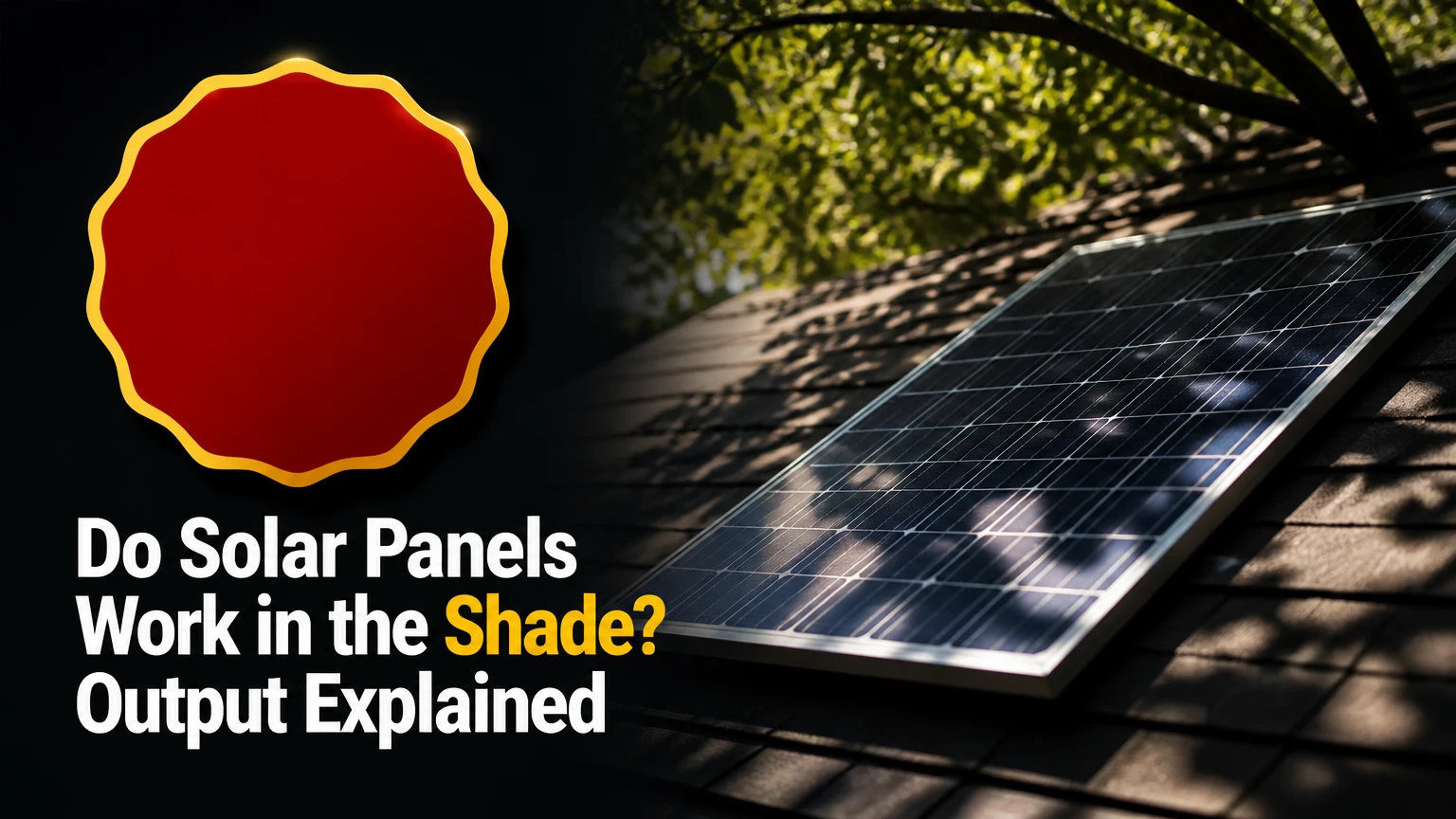
Solar panels work in the shade, but solar panel output falls as the available sunlight decreases. A shaded photovoltaic module can still convert diffuse and reflected light into electricity, yet heavy or timed shadows may reduce production enough to change the system design, payback period, inverter choice, or decision to install solar.
Key Facts at a Glance
- Solar panels generate electricity from light, not heat, so diffuse daylight can produce power without direct sun.
- Partial shade can reduce one module’s output by 20%-90%, depending on the obstruction, irradiance, panel wiring, and time of day.
- A shaded panel does not always reduce the whole array by the same percentage; the result depends mainly on string layout and inverter architecture.
- Bypass diodes protect shaded cell sections from damaging reverse-bias heating, but they do not restore the lost electricity.
- Microinverters and DC optimizers reduce mismatch between modules, but neither technology creates energy blocked by a tree, wall, or chimney.
- Shade analysis must cover the full year because a roof can be clear in June and shaded by low winter sun in December.
Do Solar Panels Work in the Shade?
Solar panels work in shade because photovoltaic cells respond to available photons in diffuse daylight, reflected light, and direct sunlight that is only partially obstructed. Output is highest under unobstructed direct irradiance, lower under thin cloud or haze, and often much lower when a solid object covers the module.
A useful distinction is between panel operation and economic usefulness. A panel can produce a measurable voltage in deep shade while delivering too little current to justify its roof space, wiring, inverter capacity, or installation cost. The rated wattage printed on a module applies to standardized test conditions, not to every daylight condition.
The U.S. Department of Energy summarizes the underlying function directly: “Solar photovoltaic (PV) cells convert sunlight into electricity.” Shade changes the quantity and distribution of sunlight reaching the cells; it does not switch the photovoltaic effect off.
How Much Power Does a Shaded Solar Panel Produce?
A lightly shaded panel may produce 50%-90% of its unshaded power, while dense hard shade can reduce the affected module or cell section to 10%-50%. Those are planning ranges, not guarantees, because cloud thickness, shadow geometry, panel temperature, orientation, and electrical configuration all change the result.
| Light condition | Typical irradiance relationship | Typical module output | Common example |
|---|---|---|---|
| Clear direct sun | 800-1,000 W/m² | 80%-100% of rated output | Open roof at solar noon |
| Thin cloud or haze | 300-800 W/m² | 25%-80% of rated output | Light overcast sky |
| Bright diffuse shade | 100-300 W/m² | 10%-35% of rated output | Shade from a distant tree canopy |
| Dense hard shade | 20-150 W/m² | 1%-20% of rated output | Wall or building covering a module |
| Night or near-total obstruction | 0-20 W/m² | 0%-2% of rated output | No usable daylight on the cells |
Module output does not track irradiance perfectly. Photovoltaic current falls strongly with irradiance, while voltage changes less dramatically, so a shaded module often loses a larger share of power than a casual visual inspection suggests. The National Renewable Energy Laboratory’s PV performance resources treat irradiance, temperature, orientation, and system losses as separate variables rather than assigning one universal shade penalty.
Why Does Shade Reduce Solar Panel Production?
Shade reduces solar panel production by lowering photocurrent in the covered cells and creating electrical mismatch between illuminated and shaded cell groups. In a conventional series-connected module or string, the lowest-current section can constrain the operating point of other sections until bypass circuitry redirects current around the affected area.
A photovoltaic cell is a current-producing device under light. When one cell receives far less irradiance than neighboring cells, it cannot pass the same current at the same operating voltage. Continued current flow can force the shaded cell into reverse bias, where it dissipates energy as heat instead of generating useful power.
That condition can create a hotspot. Bypass diodes are installed to reduce the electrical stress by allowing current to avoid a shaded substring. Sandia National Laboratories’ photovoltaic modeling work identifies bypass diodes as an important part of module behavior under partial shading, especially because diode activation changes the module’s current-voltage curve.
What Are Soft Shade and Hard Shade?
Soft shade reduces irradiance gradually across a broad area, while hard shade creates a defined boundary across selected cells or modules. Thin cloud, haze, and distant foliage usually produce soft shade; chimneys, parapets, poles, wires, and neighboring buildings usually produce hard shade.
| Shade type | Physical cause | Electrical pattern | Design concern |
|---|---|---|---|
| Soft atmospheric shade | Haze or thin cloud | Broad current reduction | Lower daily energy yield |
| Soft vegetation shade | Distant or thin tree canopy | Moving, irregular reduction | Seasonal growth and wind movement |
| Hard linear shade | Chimney, vent, cable | Narrow cell or row mismatch | Bypass-diode activation |
| Hard block shade | Wall, parapet, adjacent roof | Large module-area loss | Significant module-level loss |
| Seasonal shade | Low winter sun and leafless trees | Time-dependent production loss | Annual yield underestimation |
A shadow that crosses a single row of cells can be more damaging than a smaller shadow on an inactive frame area. Shadow geometry matters because cell strings run in defined electrical paths inside the module.
Does One Shaded Panel Affect the Whole Solar System?
One shaded panel can affect an entire series string, but it does not necessarily reduce every panel in the system to the shaded panel’s output. The outcome depends on module wiring, string length, inverter maximum-power-point tracking, bypass-diode behavior, and whether each panel has a DC optimizer or microinverter.
A simple string inverter connects multiple panels in series. The string current must remain compatible across all modules, so a heavily shaded module can reduce the string’s available operating current. Modern string inverters can find alternative operating points, and bypass diodes can isolate shaded substrings, but the whole string may still lose energy.
The common claim that one shaded panel makes an entire array produce only the shaded panel’s percentage is too simplistic. A ten-panel string with one shaded module may lose a substantial amount, but the exact loss depends on the module’s bypass state and the inverter’s ability to identify a separate maximum-power point.
What Do Bypass Diodes Do?
Bypass diodes route current around a shaded cell substring to limit reverse-bias stress and hotspot risk. A typical crystalline-silicon module contains three bypass-diode pathways, although module designs differ, so one active diode may remove roughly one-third of that module’s voltage-producing area rather than preserving its full output.
Bypass diodes are protective components, not energy-recovery devices. When a diode conducts, the shaded substring contributes little or no power, and the module’s voltage falls. The diode can prevent a more serious thermal problem while accepting a controlled production loss.
Half-cut modules divide cells into electrically separate upper and lower sections. That arrangement can improve shade behavior when a shadow covers one half, but it does not guarantee that the unshaded half produces 100% of the panel’s rated power. The unaffected half still has limited area and may operate under different current conditions.
Which Solar Hardware Handles Shade Best?
Microinverters generally provide the greatest module-level independence, DC optimizers provide module-level tracking within a string design, and standard string inverters usually cost less when shade is minimal. The best choice depends on the percentage of annual shade loss, roof complexity, service access, electrical-code requirements, and the installer’s design quality.
| System architecture | Module tracking | Typical shade behavior | Typical added cost |
|---|---|---|---|
| String inverter only | One tracker per string, commonly 1-3 MPPT inputs | Mismatch can spread through a string | Baseline |
| String inverter with optimizers | One MPPT function per module | Reduces module mismatch and adds monitoring | $40-$120 per module, typical equipment and labor |
| Microinverters | One inverter per module | Limits most module mismatch to the affected module | $100-$250 per module above basic string design |
| Separate shaded and clear strings | One tracker per roof plane or condition | Keeps unlike orientations apart | $300-$1,500 design and equipment premium |
| Module-level shade control with battery | Module tracking plus storage control | Preserves more usable energy during shade periods | $8,000-$20,000 battery system, typical installed range |
Costs vary by country, system size, roof access, labor rates, electrical upgrades, and brand. A quote that lists only the hardware premium can hide additional costs for rapid shutdown equipment, monitoring, wiring, or a larger service panel.
Are Microinverters Better for Shaded Roofs?
Microinverters are usually better for roofs with repeated partial shade, multiple orientations, or many small obstructions because each module converts electricity independently. Microinverters do not increase sunlight, so a module under a dense tree still loses its own production, but the loss is less likely to constrain neighboring modules.
Microinverters also provide module-level monitoring, which can make a failed or underperforming panel easier to locate. Their limitations include more electronic components on the roof, replacement access at module level, and a higher upfront price than a basic string inverter.
Do Power Optimizers Fix Shading?
DC power optimizers reduce electrical mismatch by allowing each module to operate closer to its own maximum-power point before the string inverter receives the combined output. Optimizers cannot recover photons blocked by shade, and they cannot guarantee that an obstructed module will perform like an unshaded module.
Optimizers can be a strong middle option when shade affects only a few modules or when a string inverter is preferred for serviceability. Installers should model the actual shadow path rather than adding optimizers automatically to every shaded roof.
How Does Roof Orientation Change Shade Loss?
Roof orientation changes the time at which shade matters, so a morning shadow on an east-facing roof and an afternoon shadow on a west-facing roof can have different annual consequences. A south-facing roof in the Northern Hemisphere often receives the most annual irradiance, while north-facing roofs may require a separate production and financial assessment.
| Roof or obstruction scenario | Highest-risk period | Likely consequence | Recommended design response |
|---|---|---|---|
| East roof shaded by a west-side tree | 8:00-11:00 a.m. | Morning production loss | Model sunrise-to-noon obstruction |
| West roof shaded by a chimney | 2:00-5:00 p.m. | Afternoon output loss | Separate MPPT or MLPE |
| South roof with nearby tall building | Winter and late afternoon | Low-sun-angle loss | Annual solar-path study |
| East and west roof planes | Different daily peaks | Mixed string voltage and timing | Separate strings or inverter inputs |
| Flat roof with parapet | Winter mornings and evenings | Low-angle shadows | Increase row spacing and set back arrays |
The correct design target is annual kilowatt-hours, not a single clear-day snapshot. A shadow that lasts one hour in December may matter more than a three-hour summer shadow because winter irradiance is already limited.
How Should You Check a Shaded Roof Before Buying Solar?
Check a roof for shade by recording obstruction height and direction, mapping shadows across all seasons, and requesting an annual production model that separates shading losses from other system losses. A professional assessment should identify each roof plane, module row, obstruction, time window, and predicted annual kilowatt-hour penalty.
Use this sequence:
- List every obstruction. Record trees, chimneys, vents, parapets, utility poles, wires, and neighboring buildings.
- Check the solar path. Compare shadows at morning, solar noon, and afternoon during winter and summer.
- Measure tree growth risk. Mature height and canopy width matter more than the tree’s current appearance.
- Request a shade report. Ask for monthly shading loss, annual kilowatt-hour production, and the modeled horizon.
- Compare layouts. A smaller unshaded array may outperform a larger array placed under recurring shade.
- Review inverter inputs. Confirm that different orientations and shade patterns do not share an unsuitable string tracker.
- Check the financial case. Compare annual savings after shade losses against installation cost and expected electricity-price changes.
A handheld observation is useful for screening but cannot replace an annual model. Tools such as Solmetric SunEye and PVsyst can represent solar paths and shading, while NREL’s PVWatts Calculator can estimate production after the system geometry and loss assumptions are entered.
Should You Remove Trees for Solar Panels?
Tree removal is not automatically the best response to solar shade because pruning, relocation, a smaller array, or module-level electronics may cost less and preserve property value. Remove or heavily reduce vegetation only after confirming ownership, local rules, arborist advice, structural risk, and the annual energy value of the shade reduction.
A useful comparison is:
| Shade response | Typical one-time cost | Recurring cost | Best use case |
|---|---|---|---|
| Professional tree pruning | $300-$2,000 | $150-$800 every 2-5 years | Limited branches near array |
| Tree removal | $800-$5,000 per tree | $0-$500 for follow-up work | Unsafe or unwanted tree |
| Module-level electronics | $40-$250 per module premium | $0-$200 monitoring service | Localized roof obstruction |
| Smaller array redesign | $500-$3,000 design change | Lower annual production | Shade affects a defined roof area |
| No installation | $0 | $0 | Shade makes projected payback unacceptable |
These are typical planning ranges for residential projects in the United States, not universal prices. Local labor, tree diameter, roof height, permits, and electrical work can change them substantially.
Is Solar Worth It on a Shaded Roof?
Solar can be worthwhile on a shaded roof when the usable unshaded area produces enough annual energy to meet the financial target after all losses. Solar is often a poor investment when dense shade covers most modules for several high-irradiance hours every day and no lower-shade roof plane is available.
Use annual production rather than panel count. For example, an eight-kilowatt array might produce 10,000 kilowatt-hours per year on an open roof but only 6,500-8,000 kilowatt-hours after persistent shade, depending on climate and geometry. The financial result depends on electricity price, export compensation, incentives, financing, maintenance, and battery use.
A battery does not solve a solar-resource problem. Storage can shift midday solar energy into the evening, but a shaded array may not generate enough surplus energy to fill the battery, and a larger battery can increase cost without increasing annual generation.
Which Inverter Is Best for Each Roof?
| Homeowner situation | Roof condition | Preferred starting design | Main reason |
|---|---|---|---|
| Unshaded budget-focused owner | One broad roof plane, less than 5% modeled shade loss | String inverter with half-cut modules | Lowest complexity and cost |
| Suburban owner | Chimney or vent shades 1-4 modules | Optimizers or separate MPPT strings | Contains localized mismatch |
| Complex-roof owner | Three or more orientations and changing shadows | Microinverters or multiple MPPT design | Independent roof-plane operation |
| Forest-edge owner | Dense seasonal canopy over many modules | Smaller array, pruning, or redesigned placement | Electronics cannot replace missing irradiance |
| Off-grid owner | Shade during battery-charging hours | Maximum clear-sky production plus backup source | Reliability matters more than peak rating |
The installer should show the modeled annual shading loss for the proposed design and for at least one alternative. A vague statement that modern panels handle shade well is not a substitute for a production estimate.
What Problems Can Shaded Solar Panels Cause?
Shaded solar panels can cause lower energy yield, repeated bypass-diode activation, module mismatch, misleading monitoring readings, and, in poorly protected equipment, hotspot stress. Shade itself does not automatically damage a panel, because certified modules include protective electrical design, but persistent mismatch and physical defects deserve inspection.
Common failure modes include:
- A new tree shadow: Annual production declines gradually as the canopy expands.
- A chimney shadow: One or two cell substrings bypass repeatedly during a predictable time window.
- Soiling mistaken for shade: Pollen, bird droppings, and leaves create small opaque obstructions.
- Failed bypass diode: A module may show a sudden step loss or abnormal voltage.
- String design mismatch: East and west modules may share a tracker despite different irradiance profiles.
- Monitoring fault: A communication failure can look like a shaded panel even when production is normal.
A bypass-diode fault should not be diagnosed solely from a percentage such as 33% or 66%. Module design, inverter tracking, irradiance, and measurement resolution can produce different readings. A qualified technician should test the module and junction box rather than opening energized rooftop equipment.
How Do You Troubleshoot Low Solar Output?
Troubleshoot low solar output by comparing the monitoring data with weather, shadow timing, whole-system voltage, and module-level production. Start with non-invasive checks, then stop and call a qualified solar electrician when the issue involves live DC wiring, rooftop connectors, inverter faults, or damaged modules.
- Compare the same day last year. Use weather-adjusted data when available.
- Check the timing. A repeatable morning or afternoon dip suggests a physical obstruction.
- Inspect from the ground. Look for leaves, droppings, new construction, and tree growth.
- Review inverter alerts. Record error codes, shutdown times, and communication gaps.
- Compare neighboring modules. One outlier suggests local shade, soiling, connector failure, or module damage.
- Request electrical testing. Ask for string voltage, insulation, current, and diode checks.
Do not climb onto the roof to wash panels or open a junction box without appropriate training. Solar modules can produce hazardous DC voltage whenever light reaches them, even when the inverter is switched off.
What Are the Main Limits of Shade-Mitigation Technology?
Shade-mitigation technology manages electrical mismatch, but it cannot make a shaded module equal to an illuminated module. Microinverters and optimizers are poor substitutes for removing a large obstruction, relocating modules, improving roof placement, or rejecting an installation with inadequate annual yield.
Three practitioner rules prevent most design mistakes:
- Model the shadow before selecting electronics. Hardware chosen without a shade map can add cost without improving annual production.
- Separate unlike conditions. Different roof orientations, steeply different tilts, and distinct shadow schedules should not share one poorly matched string.
- Price energy, not equipment. A $2,000 electronics upgrade is sensible only if its incremental energy value and maintenance profile justify that cost.
A clear roof with one orientation usually does not need microinverters solely because they are newer. Conversely, a forest-edge roof with daily moving shadows may justify the additional module-level cost even when a string inverter has a lower purchase price.
FAQ
Do Solar Panels Need Direct Sunlight?
Solar panels do not need direct sunlight to generate electricity, because photovoltaic cells respond to diffuse daylight as well as direct beam radiation. Direct sunlight produces much more energy, however, so overcast conditions, haze, and shade reduce current and total daily kilowatt-hours.
Do Solar Panels Work on Cloudy Days?
Solar panels work on cloudy days, but output can fall to roughly 10%-60% of clear-sky production depending on cloud thickness, location, panel orientation, and reflected light. Bright broken cloud can produce short increases through edge effects, while thick storm clouds can reduce production close to minimum daylight levels.
Are Half-Cut Solar Panels Better in Shade?
Half-cut solar panels can limit some mismatch losses when shade covers one half of a module, but they do not eliminate shade losses. Their benefit depends on shadow direction and the module’s internal substring layout. A half-cut module under a large opaque shadow still produces substantially less electricity.
Can Solar Panels Charge a Battery in the Shade?
Solar panels can charge a battery in shade when their output exceeds the battery system’s charging threshold and the home’s simultaneous loads. Dense shade may produce too little power for meaningful charging, so off-grid systems often need a larger clear-sky array, a generator, or another backup source.
Does Cleaning Solar Panels Remove Shade Losses?
Cleaning solar panels removes dirt, pollen, leaves, and bird droppings, but it cannot remove architectural or vegetation shade. Soiling losses vary by location; a visible opaque deposit can cause a local loss far larger than a thin uniform dust layer. Use professional cleaning where roof access is hazardous.
Should I Buy Solar if My Roof Is Partly Shaded?
Buy solar on a partly shaded roof when a shade report shows acceptable annual production and the projected payback meets your target. Compare a reduced clear-area array, tree work, optimizers, microinverters, and no installation. The best decision comes from annual kilowatt-hours and total cost, not the number of panels.
The Bottom Line
Do solar panels work in the shade? Yes, but shade reduces photovoltaic output, sometimes sharply, and the percentage cannot be predicted from the word shade alone. Diffuse daylight supports limited generation, while hard shadows can activate bypass diodes and reduce module or string performance. Evaluate the full-year shadow pattern first, then choose a string inverter, optimizers, microinverters, alternative roof layout, or no installation based on measured annual energy and cost.