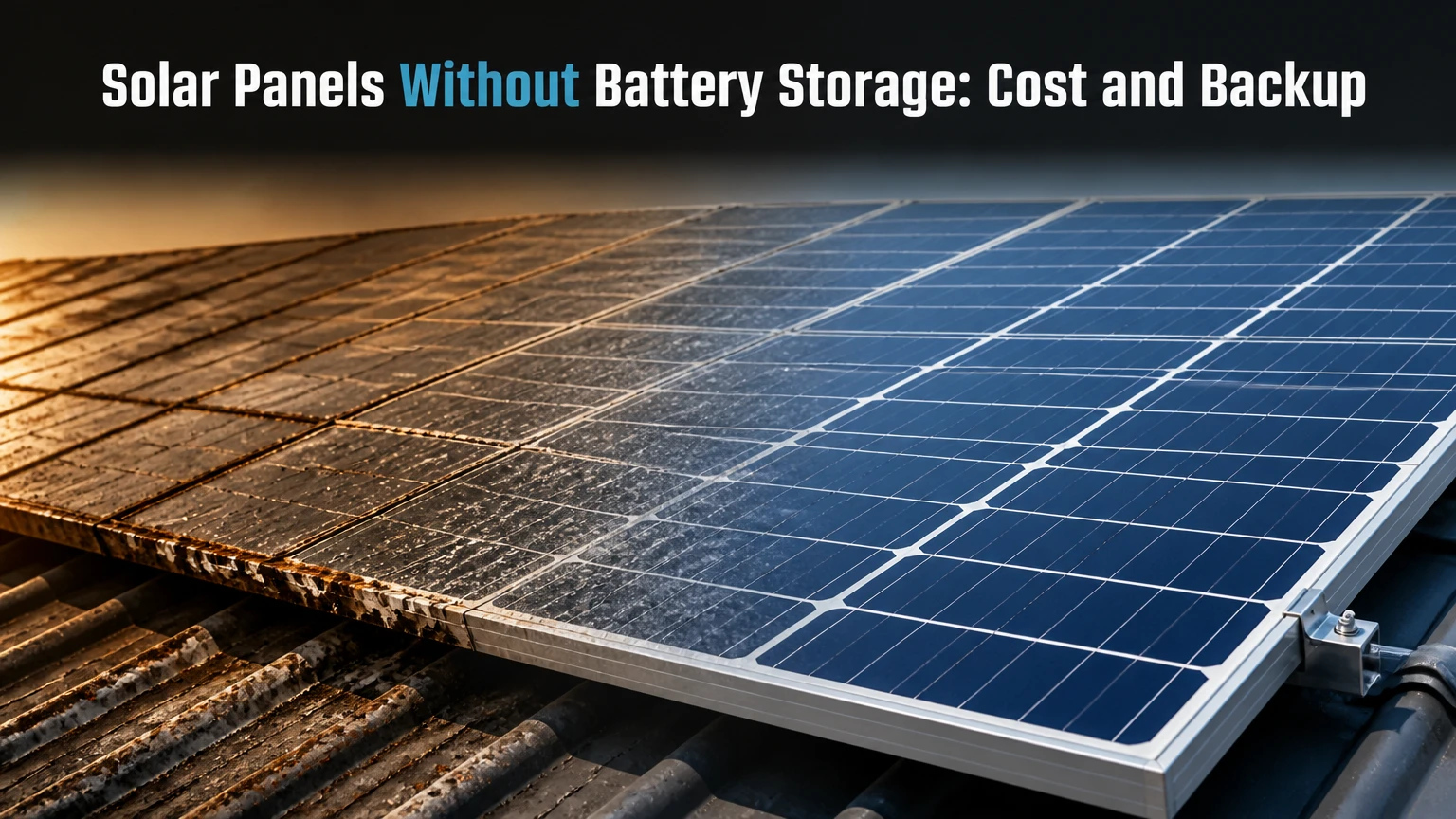
Solar panels without battery storage form a grid-tied photovoltaic system that converts sunlight into household electricity and sends unused generation to the utility grid. The home uses solar power while the array produces it, then imports electricity at night or when production is insufficient. Without specialized backup equipment, the system shuts down during a grid outage.
Key Facts at a Glance
- A batteryless solar system can reduce grid purchases without storing electricity on-site.
- Solar power normally serves operating household loads before excess electricity exports through the utility meter.
- A standard grid-tied inverter must stop producing during a utility outage because of anti-islanding protection.
- Typical residential systems range from 6-10 kilowatts and use about 15-25 panels, depending on panel wattage.
- Batteryless systems cost less and usually have fewer components than solar-plus-storage systems.
- Export credits, net metering, time-of-use rates, and daytime electricity use determine the financial result.
What Are Solar Panels Without Battery Storage?
Solar panels without battery storage are solar modules connected to a grid-tied inverter, household electrical panel, and utility service without a battery bank. The utility grid effectively balances production and demand: the home imports electricity when solar output is low and exports surplus generation when output exceeds on-site consumption.
The arrangement is also called a batteryless grid-tied, on-grid, or utility-interactive solar system. It is different from an off-grid system, which normally requires batteries or another dispatchable generator because no utility network is available to supply power after sunset.
The system does not store midday electricity for evening use. Instead, the economic value of surplus generation depends on the utility’s compensation rules. Under retail net metering, exported kilowatt-hours may offset later imports at or near the retail rate. Under net billing, avoided-cost, or wholesale export programs, exported electricity can receive substantially less value.
What Equipment Does the System Need?
A typical batteryless residential installation includes the following equipment:
| Component | Typical specification | Function | Replacement or review period |
|---|---|---|---|
| PV modules | 350-450 watts each | Converts sunlight to DC electricity | 25-35 years |
| Grid-tied inverter | 3-10 kW AC | Converts DC to synchronized AC | 10-15 years |
| Racking | Aluminum rails, roof attachments | Secures modules to roof structure | 25-30 years |
| AC and DC protection | Breakers, disconnects, rapid shutdown | Isolates and protects circuits | Inspected during service |
| Utility meter | Bidirectional digital meter | Records imports and exports | Utility-controlled |
| Monitoring gateway | Wi-Fi, cellular, or Ethernet | Reports production and faults | 5-15 years |
Solar modules alone cannot power ordinary household circuits. A properly matched inverter, disconnect equipment, wiring, grounding, and utility interconnection are required. In the United States, local electrical authorities and utilities commonly require rapid-shutdown equipment and approved inverter certifications, although exact requirements vary by jurisdiction.
How Does a Batteryless Solar System Work?
A batteryless solar system moves electricity through four operating stages: panels produce direct current, an inverter converts it to alternating current, household loads consume available power, and the utility grid absorbs surplus or supplies shortages. The inverter synchronizes with grid voltage and frequency before delivering power.
The basic flow is:
Sunlight → solar panels → DC wiring → grid-tied inverter → breaker panel → home loads or utility grid
Solar cells generate DC electricity when photons create charge carriers in the semiconductor material. The inverter tracks the array’s maximum-power point, converts DC to AC, and continuously checks grid conditions. The home does not usually receive solar power through a separate “solar outlet.” Solar generation enters the service panel, where current serves local loads according to the instantaneous electrical balance.
If a home is using 2 kilowatts and the array is producing 5 kilowatts, approximately 2 kilowatts serves the home and the remaining 3 kilowatts may export, subject to system losses and utility rules. If the home uses 6 kilowatts while the array produces 2 kilowatts, the grid supplies the approximately 4-kilowatt shortfall.
What Happens During a Typical Day?
| Time period | Solar production | Household energy flow | Grid interaction |
|---|---|---|---|
| Morning, 7-10 a.m. | 0.2-3 kW | Solar supplements early loads | Home usually imports remaining demand |
| Midday, 10 a.m.-3 p.m. | 3-8 kW for a typical home array | Solar may exceed household demand | Surplus may export |
| Late afternoon, 3-6 p.m. | 1-5 kW | Solar serves part of demand | Imports begin as output falls |
| Night, 6 p.m.-7 a.m. | 0 kW | Grid supplies household loads | All electricity is imported |
| Cloud passage | Variable, often 20-80% lower briefly | Loads remain connected | Grid fills rapid deficits |
The meter does not necessarily “spin backward.” Modern systems often use digital meters that separately register imported and exported kilowatt-hours, while some tariff programs calculate credits through interval data rather than a mechanical meter.
Will Solar Panels Work During a Power Outage?
Standard grid-tied solar panels will not keep a home powered during a utility outage, even when sunlight is available. The grid-tied inverter disconnects because anti-islanding protection prevents solar equipment from energizing utility lines that workers may believe are de-energized.
This behavior is a safety requirement, not a panel failure. IEEE 1547 establishes interconnection requirements for distributed energy resources, including abnormal-voltage and abnormal-frequency response, while UL 1741 evaluates relevant inverter equipment and functions in North American installations.
A home can operate selected circuits during an outage only when the installation includes an approved islanding and backup arrangement. That arrangement generally uses a battery, a compatible hybrid inverter, a backup gateway or transfer switch, and a critical-loads panel. Some newer systems can form a limited daytime microgrid, but the inverter must be specifically listed for that function. Ordinary solar panels connected to a conventional string inverter cannot do it.
“The purpose of anti-islanding protection is to prevent distributed resources from continuing to energize a portion of the utility system.”
Source: IEEE 1547 interconnection safety principle, summarized in the standard’s abnormal operating and unintentional-islanding requirements.
The practical rule is simple: batteryless solar lowers energy purchases, while battery-backed solar can provide outage resilience. Those are different products with different hardware.
Which Inverter Type Fits a Batteryless System?
String inverters usually provide the lowest installed cost for an unshaded roof, microinverters provide independent panel operation, and power optimizers sit between those designs. Shade, roof orientation, monitoring needs, serviceability, and future storage plans matter more than the label alone.
| Inverter architecture | Typical residential cost effect | Shade behavior | Monitoring and expansion |
|---|---|---|---|
| String inverter | Lowest, baseline cost | One string is affected, but bypass diodes and separate MPPT inputs limit the impact | Array or string monitoring; simple replacement |
| String inverter with optimizers | 5-15% above baseline | Panel-level power management reduces mismatch from partial shade | Panel monitoring; some storage compatibility |
| Microinverters | 10-25% above baseline | Each panel converts power independently | Panel monitoring; modular panel additions |
| Hybrid inverter without battery | Similar to or above string baseline | Depends on connected optimizers or module electronics | Battery connection may be possible later |
| AC-coupled retrofit system | Higher retrofit cost | Existing solar remains electrically separate | Useful when retaining an existing PV inverter |
The common claim that one shaded panel always reduces every panel in a string by the same amount is too simplistic. Panels in a series string share current, but bypass diodes, module layout, string design, multiple maximum-power-point trackers, and the duration of shade determine the actual loss.
Microinverters are often appropriate for roofs with several orientations, chimneys, dormers, or recurring partial shade. A simple south-facing roof with little shade may obtain better financial value from a string inverter because the added panel-level electronics do not automatically create more sunlight.
How Large Should the System Be?
A residential system should be sized from annual electricity consumption, usable roof area, local solar resource, utility export rules, and future loads such as an electric vehicle or heat pump. A rough first estimate is annual household consumption divided by expected annual production per installed kilowatt.
For example, a home using 10,000 kWh per year in a location producing 1,400 kWh per installed kW would need approximately 7.1 kW before roof orientation, shading, soiling, snow, inverter clipping, and degradation adjustments:
10,000 kWh ÷ 1,400 kWh/kW = 7.14 kW
NREL’s PVWatts tool estimates production from location, system size, tilt, azimuth, losses, and weather data. It is more reliable for early sizing than multiplying panel wattage by a generic number of sunny hours.
| Array size | 400-watt panels | Approximate module roof area | Typical annual production range |
|---|---|---|---|
| 4 kW | 10 panels | 175-200 sq. ft. | 4,800-6,400 kWh |
| 6 kW | 15 panels | 263-300 sq. ft. | 7,200-9,600 kWh |
| 8 kW | 20 panels | 350-400 sq. ft. | 9,600-12,800 kWh |
| 10 kW | 25 panels | 438-500 sq. ft. | 12,000-16,000 kWh |
The production range is a planning estimate, not a promise. Location, orientation, weather, shade, roof setbacks, and system losses can move actual results considerably. A 10-kW array also does not mean the home receives 10 kW continuously; 10 kW is the nameplate DC rating under laboratory conditions.
NREL’s 2016 degradation analysis found a median photovoltaic degradation rate of about 0.5% per year across a large set of systems, although individual products and climates vary. An installer should model first-year production and long-term degradation separately.
How Much Do Solar Panels Without a Battery Cost?
A typical U.S. residential batteryless solar installation costs approximately $2.60-$3.20 per watt before incentives, producing a gross price of about $15,600-$19,200 for 6 kW or $26,000-$32,000 for 10 kW. Local labor, permitting, roof access, electrical upgrades, financing, and market conditions can move the quote outside those ranges.
| System size | Panel count at 400 W | Typical gross installed cost | Typical installation duration |
|---|---|---|---|
| 4 kW | 10 | $10,400-$12,800 | 1-2 installation days |
| 6 kW | 15 | $15,600-$19,200 | 1-2 installation days |
| 8 kW | 20 | $20,800-$25,600 | 1-3 installation days |
| 10 kW | 25 | $26,000-$32,000 | 1-3 installation days |
These are typical planning figures, not a binding market quote. A main-panel replacement, trenching, structural repairs, tile-roof work, steep access, or service upgrade may add several thousand dollars. Batteryless systems avoid battery equipment, battery disconnects, backup controls, and often a larger amount of design work.
The full project commonly takes 6-12 weeks. Site assessment and design may take 1-2 weeks, permitting and utility review may take 3-6 weeks, physical installation often takes 1-3 days, and inspection or permission to operate may require another 2-4 weeks.
How Do Export Credits Affect Payback?
Export compensation can determine whether a larger array improves savings or merely increases low-value exports. Under retail net metering, a batteryless system can often offset evening imports with daytime credits; under a low export tariff, using solar directly becomes much more valuable than exporting it.
Use this simplified annual value model:
Annual bill savings = self-consumed solar × retail rate + exported solar × export rate
Suppose a system produces 9,000 kWh annually, the home directly uses 3,600 kWh of that output, the retail rate is $0.25 per kWh, and exports receive $0.08 per kWh:
- Direct-use value: 3,600 × $0.25 = $900
- Export value: 5,400 × $0.08 = $432
- Estimated annual energy value: $1,332
A $20,000 system would have a simple energy-value payback of about 15 years before financing, maintenance, tax treatment, and degradation. A tariff with full retail credits could produce a materially shorter payback. The utility’s tariff sheet matters more than a national average.
Batteryless Solar Compared With Battery Storage
Batteryless solar generally wins on initial cost and simple energy savings, while solar-plus-storage wins on outage protection and shifting solar energy into evening hours. The better choice depends on export compensation, outage frequency, critical loads, battery pricing, and whether the household can use solar during daylight.
| Decision factor | Batteryless grid-tied solar | Solar with battery storage |
|---|---|---|
| Typical 6-10 kW project cost | $15,600-$32,000 before incentives | $25,000-$50,000 or more |
| Blackout operation | No standard backup | Critical-load or whole-home backup possible |
| Nighttime solar use | Grid imports electricity | Battery can discharge stored energy |
| Round-trip storage loss | Not applicable | Typically about 10-20% system loss |
| Battery replacement exposure | None | Often planned within 10-15 years |
| System complexity | Lower | Higher, with controls and transfer equipment |
| Best financial case | Strong export credits, low outage concern | Poor export credits, high evening rates |
| Best resilience case | Not suitable alone | Suitable when backup capacity is correctly sized |
A battery does not automatically provide whole-home backup. A 10-kWh battery may supply a 500-watt refrigerator and networking equipment for many hours, but a 4-kW electric water heater or central air conditioner can consume that capacity quickly. Backup design must list circuits, starting currents, continuous loads, and expected outage duration.
Should You Install a Battery-Ready Inverter?
A battery-ready inverter can be sensible when a battery is likely within several years, but “battery-ready” does not guarantee a cheap future upgrade. Compatibility depends on inverter model, battery voltage, firmware, communication protocols, utility approval, available wall space, and whether the existing system must be rewired.
| Future storage route | Best starting equipment | Typical retrofit implication | Main limitation |
|---|---|---|---|
| DC-coupled addition | Hybrid inverter | May require replacing the original inverter | Strong integration, higher initial commitment |
| AC-coupled addition | Existing grid-tied inverter plus battery inverter | Retains much of the original PV equipment | Extra conversion losses and controls |
| New hybrid installation | Hybrid inverter with unused battery input | Battery can be added if approved later | Some models have limited backup output |
| No planned storage | Standard string or microinverter | Lowest initial cost | Later battery may require additional equipment |
Ask the installer to name the exact future battery models, maximum battery capacity, backup power rating, and required replacement parts. A vague promise that the system is “storage compatible” is not enough.
When Is a Batteryless System a Poor Fit?
Batteryless solar is a weak fit for homes with frequent long outages, very low daytime electricity use under poor export tariffs, strict zero-export requirements, or no dependable grid connection. The system also provides limited value when the roof is heavily shaded or scheduled for replacement soon.
Consider these situations:
- Frequent outages: Choose a battery or generator strategy if refrigeration, medical equipment, heating, or communications must continue.
- Low export value: Shift flexible loads into solar hours with a heat-pump water heater, EV charger, pool pump, or laundry schedule.
- Renting: A portable or community-solar arrangement may avoid roof ownership and interconnection constraints.
- Off-grid property: Use batteries, a generator, or another dispatchable source; panels alone cannot cover night and cloudy-period demand.
- Old roof: Replace the roof before installation if its remaining life is shorter than the solar project’s expected service period.
- Complex shade: Obtain shade analysis before choosing a module-level architecture.
One counterintuitive rule matters: adding panels can reduce financial returns under a low export tariff if the additional electricity is exported at a fraction of the retail purchase rate. Oversizing makes sense only when future loads, export compensation, or self-consumption justify it.
What Can Go Wrong With Batteryless Solar?
The most common batteryless solar problems are utility-grid faults, inverter shutdowns, new shade, soiling, incorrect system sizing, and export-credit misunderstandings. Troubleshooting should begin with monitoring data and inverter status, not with climbing onto the roof.
| Symptom | Likely cause | Safe first check | Professional remedy |
|---|---|---|---|
| Zero output on a sunny day | Grid outage, open breaker, inverter fault | Check utility power and monitoring alert | Installer tests AC and DC circuits |
| Production falls gradually | New shade, dirt, aging, heat | Compare current output with prior weather | Shade analysis, cleaning, or module testing |
| One module underperforms | Microinverter, optimizer, connector, or module fault | Review panel-level monitoring | Replace failed electronics or module |
| Repeated grid-voltage error | Utility voltage outside inverter range | Record fault times and code | Installer logs voltage and contacts utility |
| High exports but poor bill savings | Low export tariff or credit expiration | Review tariff and interval bill | Re-size loads, tariff, or future storage |
| Inverter clipping at midday | Array DC power exceeds inverter AC rating | Compare production curve with design | Confirm intentional clipping or redesign |
Do not open energized inverter enclosures or disconnect rooftop wiring. Solar arrays can produce dangerous DC voltage in daylight, and utility interconnection work belongs to qualified personnel.
Grid-voltage errors deserve special attention. Repeated “grid high” events may result from a long service run, a lightly loaded neighborhood circuit, or utility voltage regulation. Replacing the inverter without measuring voltage can leave the actual problem unresolved.
How Do You Get the Best Result From a Batteryless System?
Start with twelve months of interval or monthly electricity data, then model production and export value using the actual utility tariff. A reliable design connects array size, inverter architecture, roof condition, service capacity, daytime loads, and future electrification rather than treating panel count as the only decision.
Use this installation sequence:
- Audit consumption: Record annual kWh, seasonal peaks, demand charges, and planned EV or heat-pump loads.
- Inspect the site: Check roof age, structure, orientation, shade, setbacks, conduit route, and main-panel capacity.
- Model production: Use NREL PVWatts or equivalent software with location-specific assumptions.
- Model the bill: Separate direct solar use, exports, imports, fixed charges, and credit rollover rules.
- Choose inverter architecture: Match shade and roof complexity, not sales preference.
- Request comparable bids: Require module model, inverter model, annual production, degradation assumption, workmanship warranty, and exclusions.
- Confirm interconnection: Obtain written utility requirements, export limits, meter work, and permission-to-operate steps.
- Plan operations: Schedule EV charging, water heating, laundry, or pool pumping during high-production hours.
Practitioner rule of thumb: a proposal should show both annual kWh production and expected annual bill savings. Production without tariff modeling cannot establish financial value.
FAQ
Can Solar Panels Without Batteries Reduce My Electric Bill?
Yes. Solar panels without batteries reduce a bill by supplying household loads during production and earning credits or payments for eligible exports. Savings depend on the retail electricity rate, export compensation, fixed charges, system production, and the share of solar electricity consumed directly.
Can I Use Solar Power Directly Without Connecting to the Grid?
Yes, but direct solar use without a grid connection requires a properly designed off-grid system. Batteries or another dispatchable source are normally needed because solar production stops at night and falls during storms. A panel connected directly to an appliance is not a safe substitute for a complete inverter-based electrical system.
Is Solar Without a Battery Worth It?
Solar without a battery is often worthwhile when the utility offers strong export credits, the home uses substantial daytime electricity, and outages are infrequent. Battery storage becomes more attractive when export rates are low, evening rates are high, or backup power has significant practical value.
Can I Add a Battery to Existing Solar Panels Later?
Often, yes. A later battery can use AC coupling with the existing solar inverter or require a hybrid-inverter replacement for DC coupling. Confirm the inverter model, battery compatibility, backup rating, electrical capacity, warranty effects, and utility approval before assuming a future retrofit will be inexpensive.
How Much Maintenance Does Batteryless Solar Need?
Batteryless solar typically requires little scheduled maintenance. Monitor production monthly, keep nearby trees from creating new shade, inspect visible equipment after severe weather, and arrange professional electrical checks when faults recur. Module cleaning depends on pollen, dust, bird activity, rainfall, snow, and the roof’s accessibility.
Does a Larger Solar System Always Save More Money?
No. A larger system saves more only when added production offsets valuable electricity use or receives worthwhile export compensation. Under low export rates, additional panels can have a weaker return than efficiency upgrades or load shifting. Future EV, heating, and cooling loads can justify a larger design.
The Bottom Line
Solar panels without battery storage are a practical, lower-cost way to reduce grid electricity purchases, but they are not an outage-power system. A well-designed batteryless installation uses a certified grid-tied inverter, matches array size to consumption and export rules, accounts for roof and service constraints, and models direct-use savings separately from exported energy.
Choose batteryless solar when financial simplicity and daytime energy production matter most. Choose storage or a hybrid design when outage resilience, evening load shifting, or poor export compensation justify its added cost. The right answer comes from the utility tariff and household load profile, not from panel count alone.